Stick in the Fan

   / Stick in the Fan #21  
Charlie_Iliff said:
I'm riding a train to Montana, a rental car to Jackson Wyoming, and then return with a couple of days in Minneapolis. Maybe the PT will heal while I'm gone. :D

Sound like you're going from a bad ground to good ground. :p
 
   / Stick in the Fan #22  
To all you electricians out there, a good ground today is not necessarily good forever. Corrosion will eventually set in and weaken your ground. Screws/ bolts need to be re tighten, re-solder if necessary, and the same goes to the crimp connectors, replace if necessary. You may have to add extra wire to prevent the tension from weakening your circuit. Correct fuse, correct wire size, are all important. With a volt/ohm meter, most problems can be isolated and fixed. There are some electronic ghost out there that will perplex, [ to disturb mentally ] the human mind, one day it works and the next it don't Go figure. It would be hard to tell you how many black boxes we have written up as bad, only to have the electronics shop say there is nothing with it.

These are just some observations I have made over the past 68 years. Not that I cared a lot about this as a kid, but after that, working with Navy electronics, etc.
 
   / Stick in the Fan #23  
Last week I leveled some dirt for my brother with my pt 425 and noticed the oil cooler fan didn't come on when I thought it should, so I checked the fuse. The fuse was good but I noticed that when I moved the fuse holder to put the fuse back in that the wire on one side had come loose. That is the second time that has happened and again for the second time I set it in my mind that I am going to replace that fuse holder with a better fuse holder. I hope I remember to get a new fuse holder the next itme iam in the parts store, but I will probably forget again.
 
   / Stick in the Fan #24  
toy said:
Last week I leveled some dirt for my brother with my pt 425 and noticed the oil cooler fan didn't come on when I thought it should, so I checked the fuse. The fuse was good but I noticed that when I moved the fuse holder to put the fuse back in that the wire on one side had come loose. That is the second time that has happened and again for the second time I set it in my mind that I am going to replace that fuse holder with a better fuse holder. I hope I remember to get a new fuse holder the next itme iam in the parts store, but I will probably forget again.

I have replaced both of the fuse holders on my PT. Pretty poor quality.
 
   / Stick in the Fan #25  
BobRip said:
I have replaced both of the fuse holders on my PT. Pretty poor quality.
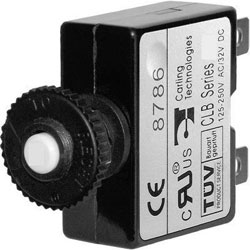
I am thinking that somewhere I saw a small 12 volt circuit breaker that if it kicked you could manually reset it instead of having to have a fuse, that is what Iam going to replace mine with if I can find one of the right volt and amp. rating. I think that would be a better setup.
 
   / Stick in the Fan #26  
maybe something like this:

200981.jpg


Thermal Trip Circuit Breaker
 
   / Stick in the Fan #28  
ponytug-
great site, bookmarked it for later. Dfeinitely better prices (50%) then West Marine for their electrical gear.

Of interest to me was the circuit breaks that plugs into a spade-type fuse holder.

At $2, they would be an easy short-term solution.

71178_71188_tab.jpg
 
   / Stick in the Fan #29  
One caution on the automatic reset breakers is that you can drive around for awhile with the breakers tripping and reseting. Some of the automatic ones trip and stay tripped as long as they are powered up. So YMMV. I prefer the manual reset versions- then you know that they have blown.

All the best,

Peter
 
   / Stick in the Fan #30  
ponytug said:
One caution on the automatic reset breakers is that you can drive around for awhile with the breakers tripping and reseting. Some of the automatic ones trip and stay tripped as long as they are powered up. So YMMV. I prefer the manual reset versions- then you know that they have blown.

All the best,

Peter
I would only want to use one that you had to be manually reset. I wouldn't want to have to shut the machine down to reset it nor would I want one that would reset itself automatically. If it kicked the circuit breaker I would want my attention on that circuit when I reset it so if there was something wrong I might catch it then.
 
   / Stick in the Fan
  • Thread Starter
#31  
I finally got around to a "permanent" fix for my alternator. After I got the bad diodes fixed, on advice of the repair shop I wired it only as a one-wire alternator. It worked two or three times, just revving it until the regulator kicked it in and the voltage went to 14+. Then, it stopped doing that. I could get it to charge fine by touching a 12V lead to the pole that was originally wired by PT with continuous 12V from the accessories circuit. Since my guru opined that straight 12V would fry the diodes if left on without the engine running, I wired in a momentary contact button, with a neon panel light across it. The post on the alternator is the idiot light post, so I could have made it automatic with a low resistance panel light between the positive and the alternator. I couldn't find such a panel light with a quick look, and the pushbutton and neon were easily available.
So, now I start the machine and the panel light turns on. I press the button and the light goes out and the voltage meter goes to 14+. Gives me a great feeling of satisfaction whenever I do it.:)
But I will never know for sure how the stick in the fan caused the fried alternator, or even if it did. Nor will I know for sure if there is anything at all wrong with putting 12V constantly to that post as PT did it originally. I do not plan any controlled tests to see if I can cost myself an alternator.:rolleyes:
 
   / Stick in the Fan #32  
Alternators either have to have some inherent residual magnetism to excite them or an external excitation voltage has to be applied.

I'm not sure what the neon is doing. Neons usually require 65+ volts to fire. However, if it works, it works, and that's what counts.

New motto: Push for satisfaction! It could have all kinds of meanings. :D
 
   / Stick in the Fan #33  
The motto we're hearing around our company a lot lately is "Not the best, but good enough." :rolleyes: Unfortunately, it makes sense when scraping for every penny. For example, you spends a hundred million dollars to make the best product and some clown spends just a million and gets something that's 90% as good and costs less than yours.... you get bragging rights but he gets the sales.:(
 
   / Stick in the Fan #34  
Snowridge is right about the excitation voltage. If an alternator is not a permanent magnet alternator, it has to have an exciting voltage to start generating volts and amps. This is normally done via the ignition switch. Manual operation is OK I guess unless you forget to hit the switch.
 

Attachments

  • chargediag.jpg
    chargediag.jpg
    17.9 KB · Views: 138
   / Stick in the Fan
  • Thread Starter
#35  
Alternators either have to have some inherent residual magnetism to excite them or an external excitation voltage has to be applied.

I'm not sure what the neon is doing. Neons usually require 65+ volts to fire. However, if it works, it works, and that's what counts.

New motto: Push for satisfaction! It could have all kinds of meanings. :D

The "neon" panel light was so designated on the package. I no nothing of its actual character except it is very high resistance, so doesn't pass through enough to excite the alternator. I put it directly across the switch, so it reminds me to push the button.
 
   / Stick in the Fan
  • Thread Starter
#36  
Snowridge is right about the excitation voltage. If an alternator is not a permanent magnet alternator, it has to have an exciting voltage to start generating volts and amps. This is normally done via the ignition switch. Manual operation is OK I guess unless you forget to hit the switch.
Correct, of course. That's why after I had excited it a few times it had enough residual magnetism to work as a one-wire, but after I left it a while there wasn't enough magnetism left to do the trick.
My alternator repair shop guy told me that it may damage the alternator to excite it with continuous 12V from the ignition circuit, if the key is left on without the engine running. With a high-watt panel light or a resistor in series, the voltage can be set to excite the alternator, but not enough current to damage anything if the key is left on with the engine stopped. I don't know any numbers, and I'm not sure if he's correct about all alternators, or if his concern is applicable to this particular Valeo, but my rig avoids the possible problem.
 
   / Stick in the Fan
  • Thread Starter
#37  
The motto we're hearing around our company a lot lately is "Not the best, but good enough." :rolleyes: Unfortunately, it makes sense when scraping for every penny. For example, you spends a hundred million dollars to make the best product and some clown spends just a million and gets something that's 90% as good and costs less than yours.... you get bragging rights but he gets the sales.:(
Corrollary: "The perfect is the enemy of the good."
 
   / Stick in the Fan #38  
With a high-watt panel light or a resistor in series, the voltage can be set to excite the alternator, but not enough current to damage anything if the key is left on with the engine stopped.
How about wiring the alternator excitation connection to the "START" position on the ignition switch? That way, excitation voltage is applied only while you are cranking the engine with the starter motor.
 
   / Stick in the Fan #39  
Charlie, Does your system have an internal regulator, or external regulator.

The IGN switch voltage goes to the regulator via the IGN terminal on the regulator, which then excites the field windings by sending the correct amount of voltage to excite the field. If the regulator doesn't have any feed back from the alternator, then I don't think it will supply any voltage to the field windings. On your setup, you need some way to vary the field voltage so as not to overcharge the battery. It seems like I had seen an old timer touch the battery voltage to the field terminal to test the alternators he was rebuilding. By doing that, he forced the alternator to put out max amps. This guy was good, he could take a bad alternator and rebuild it in about 20 min. He had a test stand with an AC motor that turned a belt to the alternator. It's hard to find those guys anymore. Most people just take it in to Autozone or Napa, and get a replacement.
 
   / Stick in the Fan #40  
How about wiring the alternator excitation connection to the "START" position on the ignition switch? That way, excitation voltage is applied only while you are cranking the engine with the starter motor.

Tim,

I believe the regulator has to have a voltage from the IGN switch at all times, meaning the on position, to energize the the regulator/alternator. The start position would only give a momentary connection, and then the alternator would lose the exciting voltage.
 

Tractor & Equipment Auctions

2006 Heil Tanker Trailer Heavy Duty 65K GVWR Tank Trailer (A56438)
2006 Heil Tanker...
Unused 2025 CFG Industrial MH12R Mini Excavator (A59228)
Unused 2025 CFG...
(INOP) 2007 VOLVO A35D OFF ROAD DUMP TRUCK (A60429)
(INOP) 2007 VOLVO...
HYDRAULIC THUMB CLAMP FOR MINI EXCAVATOR (A58214)
HYDRAULIC THUMB...
Volvo ECR235CL (A53317)
Volvo ECR235CL...
2014 Freightliner 105' Bucket Truck (A56438)
2014 Freightliner...
 
Top