Starting a Bridge

/ Starting a Bridge #1  

Kapnfriday

Bronze Member
Joined
Nov 30, 2011
Messages
50
Location
Raleigh, NC and Lansing, NC
Tractor
Kubota B7610
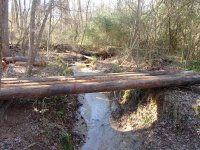
I've enjoyed reading all the posts about bridge building on TBN so thought I would share my own. We have a small creek on our property and being able to cross it will allow us access to 3/4 acre that we own but have never used. We'll also be able to walk to a city park. Initially this was just going to be a foot bridge, but then I thought it would be nice to be able to get the tractor over there to clean up/build trails.

The plan is for an 18' span that will be 6-7 feet above the creek bed.
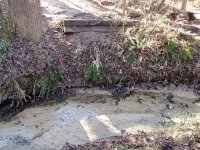
PC270330.jpg

This shot is of the creek at normal water level - not much more than a trickle.
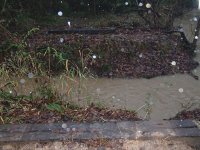
PC280381.jpg

Here's a shot from the opposite bank after we had about 2" of rain over a couple hours.

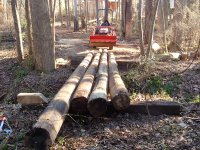
I have five utility poles that I'm planning to use as the main "beams" across the creek. Initially I was only going to use 3 but I checked with an electrical engineer friend who checked with a structural engineer coworker and they said that would be pushing up against the maximum capacity for my estimated 3,000lb load of the tractor (Kubota B7610) and FEL and any implement I might have on.

The poles are between 10 and 14" in diameter. They will rest on railroad ties pinned to the banks with rebar. Hard to tell in the pictures, but the rail road ties are about 3-4 feet back from the top of the banks. I plan to marry two poles together on both the left and right side of the bridge and strap them together with some kind of cable or other metal strapping. These will be set apart about the distance between my left and right side tractor wheels. The fifth pole will run down the center. I initially thought I'd deck it with pt 2x6's, but now I'm thinking of looking into full dimension 2x6 white oak from a local sawmill.

A couple still undecided things: how to anchor the poles to the railroad ties and the best way to attach the decking to the poles.
 
/ Starting a Bridge
  • Thread Starter
#2  
First challenge with the bridge was how to get the RR tie for the far side over to the far side. I have no way to access that side with the tractor and there was no way I could drag it over by hand. Then I thought of laying my extension ladder across the creek and pushing the tie across that.

PC270333.jpg

Keeping the tie balanced on the ladder was a bit tricky, but not bad.

PC270334.jpg

The ladder surface was slick enough that I could inch the tie the last few feet by hand.

PC270337.jpg
 
/ Starting a Bridge #3  
You might find a "come-along" useful.

Aside from any wetlands issue, did you simply consider sloping an approach, and laying down some concrete to make an all-weather ford for the tractor, and a stepping stone or two--between the wheel width--for people crossing
 
/ Starting a Bridge #4  
I decked a 16' bridge with 2" rough sawn fir 12" wide planks. Nailed them down with 8" galvanized nails to 3 RR tie stringers. I drive my 3500 Dodge dually with 5000# of aggregate in the bed over trhat bridge and it doesn't deflect or creak. If you can get that oak in 12" you would be better off if nailing it. I held the first nails back 2" from each edge with 3 in-between and never had a split. You should consider on that oak, especially the 6", to pre-drill the nails holes just a little smaller than the dia. I wish we had access to oak up here.

Ron
 
/ Starting a Bridge
  • Thread Starter
#5  
I had the come-alongs and chains ready to inch the RR tie across, but it was a lot faster and easier to push one end of the tie and then the other.

I think you mean something like this: http://www.americantrails.org/photoGalleries/cool/25images/12.jpg ? There would be wetlands issues. My friend and neighbor used to work for our state wetlands division and I checked with her about doing a culvert instead of a bridge. Again, there would be issues.

Also, the creak banks are about 4-5 feet high so doing a sloping approach would've required moving a lot of dirt. At least what I consider to be a lot to move with my tractor.

Free utility poles also swayed me toward a bridge. The decking will be the most expensive part of this project.
 
/ Starting a Bridge #6  
How far are you into using the railroad ties? Here in East Texas, where we have quite a bit of humidity and close to 4 ft of rain per year, they rot out really fast. Railroads put them on a bed of gravel so water will drain under them because when left on the ground, they ROT!!!!!!!

Eddie
 
/ Starting a Bridge #7  
I've mulled over wha kind of support would work for my (future bridge). I think the best (but not easiest) bet would be steel piles with a steel beam across in a square, inverted U configuration. A number of years ago, I supported a hefty footbridge this way and it has worked great. However, driving piles for a tractor bridge is a bigger undertaking!
I think (mostly) buried Jersey barriers would work really well for abutments, if they could be had cheaply enough.
Final is something just sitting on the ground. This is least desirable, even with a not-deteriorating substance, since it is more subject to movement (up, down, sideways and unevenly). Personally, I wouldn't worry too much about using a solid, well-treated RR tie, piling or piece of power pole as an abutment, knowing that it will eventually degrade (say in 25 to 50 years).

I'm still looking to track down an old flat deck container or flat bed truck frame for my bridge itself; the abutments will be customized to fit whatever I end up with.

Bob
 
/ Starting a Bridge #8  
Three words - OVERBUILD!!

Hehehehehee, yep, it'll rain about ten times harder than you ever thought, bugs, crits, vines, everything will try to destroy it. Overbuild.
 
/ Starting a Bridge #9  
First off - I see that you have sandy soil- and the creek appears to be undermining the bend and its going to get worse esp with sand. I would be putting the supports for bridge farther back as possible. I would also start putting some stones in that bend to slow down the erosion.

Next - how long are the poles you have? Since you mentioned a 18 ft span - if you want, you could build a file folder or commonly called A truss bridge. If you can use poles for across, and building A frame above bridge with a center pole attached to make equal right angle triangles. You could literally split the weight of the tractor in half when its in the middle of the bridge. Lets say the tractor is 4000 pounds and you drive it to the middle, the weight is distributed 2000 lbs to the each END of the bridge. Keep in mind the center pole of A bridge has BOTH 4000lbs of compression on bottom joint and tension on top so your connection needs to be super strong to handle that much weight you plan to have on your bridge.
 
/ Starting a Bridge #10  
Kapn, When I did my RR tie frame bridge I used 10' ties as sill logs each side parallel to the creek. One side was real humus laden material 2 feet deep the other side sandy gravel. I dug down a trench each side 3' wide X 12' long and 3-4' deep. Filled the trenches with 1 1/4 minus crushed gravel, well compacted, and packed gravel all around the sills up to the top. I knew from experience here in the PNW that RR ties do not like laying on dirt, hence the gravel beds down to solid substrate. In the winter I get water flow within 6" of the underside of the stringers. Your pictures indicate you are just setting the sill ties on top of the ground. Those will be easily undermined and/or rotted quickly. You indicated that there is no access to the area on the other side, that complicates things. You will need a temp solution to get the tractor (I assume you have or can get a BH) and gravel over there to work that side. I placed my stringers by getting one end under the front brush guard and strapping about 6' out to the FEL. Picked up that end and curled up the bucket to get the other end off the ground, just eased it across. You could drag across with a line if you can get a block tied off the something on the other side also.

Another thought; I tied all the framing members together by drilling holes and driving in concrete form steel stakes. On those poles you may want to consider cutting a flat spot on each end where they rest on the ties.

Ron
 
/ Starting a Bridge #11  
You could have tied to the RR tie and the wrapped the rope around a strong tree on the other side and then back to the tractor. Then as you drive away from the creek it pulls the tie to the other side...

Sent from my Motorola Moto X using TractorByNet
 
/ Starting a Bridge #12  
Also, if there's a way to anchor from the bridge center back into the bank at an angle, that might help. If you can drive some metal posts into the creek bed without them posing as an obstruction in high water situations, that would also help solidify things.

Check out these PDFs I found. They are pretty similar and very detailed.

http://www.fs.fed.us/eng/bridges/documents/multilog/index.htm


Sent from my Motorola Moto X using TractorByNet
 
Last edited:
/ Starting a Bridge
  • Thread Starter
#13  
Tractor Seabee - thanks for the tip on pre-drilling the oak decking. I'm amazed that you only have 3 RR ties as your stringers on a 16' bridge and it does deflect under the load you describe? What are the dimensions of those RR ties? Must be pretty stout ones.

kf
 
/ Starting a Bridge
  • Thread Starter
#14  
Eddie - I'm kind of far along into using the RR ties. I got four of the five utility poles across the span today and they're resting on the RR tie sills. However, all of the poles are longer than the 18' span - I didn't measure but I think they're in the neighborhood of 25 feet. So I could conceivably put another type of sill under the poles where they overhang the RR ties. This would also get my sills further back from the bank, which would be a good thing. Of course this would also increase my span.

Radioman - the erosion in that bend is made worse by a storm drain that deposits into the creek at that bend. You can't see it in the pics, but it is downstream of the bridge. Putting supports for the bridge further back on the bank is a good idea - I'm thinking about it. The A truss bridge design you describe sounds interesting but I don't quite follow you. The A frame is above the bridge with a center pole? I can't picture it.

Here are some pics from today's work.

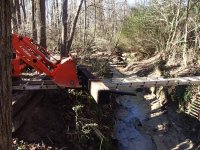
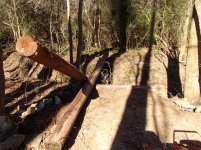
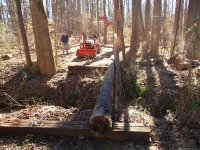
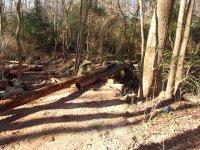
P1190001.jpgP1190003.jpgP1200008.jpgP1200010.jpgP1200011.jpg

I got the poles to the bridge site with a chain and the FEL hooks. I lifted one end of each pole a few inches off the ground and drug them backwards up my driveway, onto my front trail and down to the bridge site - slow and steady. I then unhooked the FEL chain and pushed the poles from the opposite end to get them close to the sill. Getting the first pole across was tricky. Once it was resting on the RR tie sill the sill wanted to roll when I tried pushing the pole across. I thought with the weight of one pole pushing down on the sill it might be worth trying to push a second pole over. That worked.

I thought I might push the second pole all the way across the creek without the back end of the pole tipping up, but no such luck. I got it to within a foot of the opposite bank and then it popped up. I pushed the back end down with the FEL and managed to get the bucket angle so that I could both hold the end of the pole down and push it the final distance across the creek. With the second pole across I went back to the first pole and used the same method. Got the first one across as well with no sill movement.

Once I had two poles across I used chains and come alongs to squeeze them together so that the third and fourth poles could be pushed across by riding on top of the two paired poles. Hopefully the pictures make this clearer.

With four poles across I went to get the fifth pole. I knew it would be a challenge. It is huge. 14" in diameter and probably 25+ feet. I wrestled with it out in front of the house for about a half hour before I decided it wasn't worth it. Just didn't feel safe - got up on three wheels a time or two. Felt like the pole was steering the tractor more than I was. So before I took out any mailboxes or neighbors' cars I decide to put the pole back where I found it. Maybe I'll cut it up into smaller pieces and use it for something else.

After not getting the big pole across and looking at the condition of some of the ones I did get across I'm thinking about trying to buy two more poles, which would give me a total of six. Maybe marrying two sets of three together and spacing them to match the tractor tire spacing. Three poles tied together is going to end up being 2.5 to 3 feet wide. Not sure if I mentioned it before but I'm thinking the bridge will be 8 feet wide.
 
/ Starting a Bridge
  • Thread Starter
#15  
RxRated thanks for the pdfs - I looked for something similar to this for a while and had no luck.

At this point I'm not crazy about the idea of trying to put support posts in the creek bed. My sense is that any put there wouldn't stay long.

kf
 
/ Starting a Bridge #16  
Standard 9 X 7. I buy them from a RR Salvage company. They are what is called #2, means two good sides and no visible rot. I put the stringers so the 9" side is vertical. I use them for a lot of projects, bridges, stairs, retaining walls, building sills, supports for various loads. They have them from 8' to 16" in 2' increments.

Ron
 

Marketplace Items

2012 Freightliner M2 106 Altec TA37M 37ft Insulated Material Handling Bucket Truck (A60460)
2012 Freightliner...
2008 MOTIV ALUMINUM TRAILER CO. 32 TRI AXLE GOOSENECK ENCLOSED TRAILER (A58214)
2008 MOTIV...
Caterpillar 928G Articulated Wheel Loader (A59228)
Caterpillar 928G...
2014 Freightliner Derrick Digger (A60352)
2014 Freightliner...
Kubota Snow plow with subframe
Kubota Snow plow...
16001 (A55853)
16001 (A55853)
 
Top