Stabilizing culvert over muck?

/ Stabilizing culvert over muck? #1  

Jim Timber

Veteran Member
Joined
Feb 26, 2014
Messages
1,444
Location
Metro/Brainerd, MN
Tractor
JD 5065e MFWD w/553 FEL
I'm in the process of getting final approval for a road through a wooded swamp (should have my last signature Friday). The base is about 4' of muck over 3" clay with sand under the clay. Rather than guaranteeing I need 4' of fill brought in, and risking peeling out the clay and draining the swamp, I've decided to float it with a base of riprap over the root mat, and will be putting corduroy over the riprap and then gravel over the corduroy, with a final drive surface over the gravel after a period of time to ensure there are no drainage issues or uneven settling that need to be corrected. I have pretty much free reign on the design, as it's a private road.

There's a spring seep that feeds the swamp somewhere on the property (the swamp is roughly 6 acres with me and a neighbor owning equal halves), but it doesn't flow much (maybe 2" of the bottom of a 18" culvert when there's consistent rain) - of course my road bisects it's path, so I need some culverts to manage the water.

I'm going to go with the biggest double walled poly pipe I can get locally, and multiply them as needed to get the volume I think is sufficient. The 18" culvert that drains this area into the lake isn't big enough and has over run the town's road several times in recent years with heavy rains. I'd like 24" as a minimum, 36" would be even better but I don't know that I can find it without trucking it in (which I haven't ruled out either).

With the muck and clay, how would you guys suggest building up and firming the base to place the pipes? I've got a Caterpillar outfit 6 miles from me, so I plan on renting a mini excavator to dig and tamp the holes. I can bring gravel in, or sand. I just don't have the experience with this stuff to know what the better option is.
 
/ Stabilizing culvert over muck? #2  
Dig out the culvert bed to the clay and backfill with crushed rock just as tour have planned.
 
/ Stabilizing culvert over muck? #3  
Dig out the culvert bed to the clay and backfill with crushed rock just as tour have planned.

+1 on that.
I'd do the whole road with shot rock pushed in to displace the muck full depth and dispense with the corduroy. A skill bulldozer operator will have the loads dumped on the already finished fill and push the load down and ahead pushing the mud wave in front and not trapping any muck under the rock. Bring the ledge fill to a foot above the water line and then cap with a foot of gravel.
 
/ Stabilizing culvert over muck?
  • Thread Starter
#4  
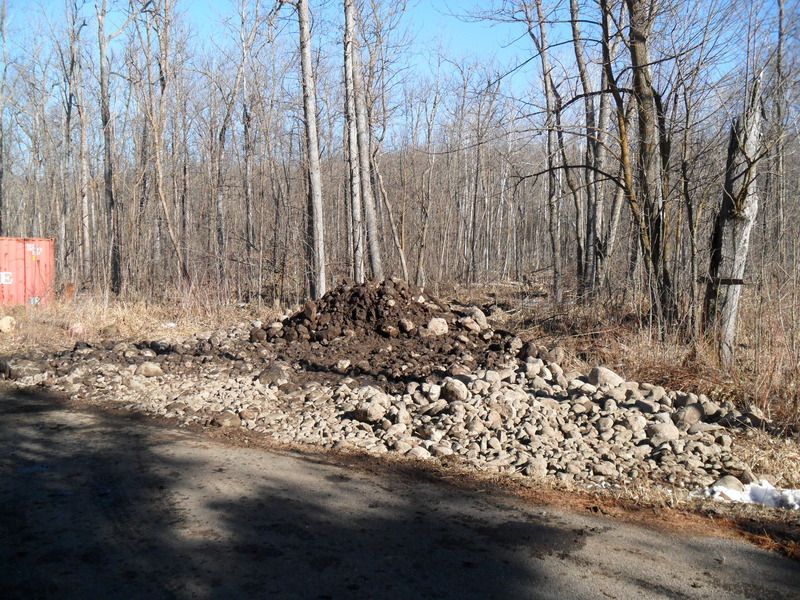
There's no dozer involved in this one though. I'm doing it with my tractor and a rental mini-ex.

The length of the swamp being filled is 250 feet, so it's not a huge project. So far the tractor's doing the job quite well.

The tree leaning hard to the left has been taken down and is just about at the high ground on the other side.

SAM_0006.jpg


I got 93 feet over frozen ground and still have a few yards that aren't spread thin enough with 5 (12yd) dump truck loads. I figure with the soggy ground I'll be looking at 10 more to get across with a fordable layer of rock down after it starts sinking in.

This was after the 5th load was dumped.

Fifth%20load%20different%20angle.jpg


The street leading in has a 7T axle limit, which prevents me from using bigger delivery trucks.
 
/ Stabilizing culvert over muck? #5  
Well a mini exc can dig a hole down to the clay and the tractor can push rock in to fill up to grade then move the mini exc ahead and repeat. It is important to not overlay some of the muck as it will pump up through what ever you lay over it and contaminate it to the point that it is just bony muck. I've used a tractor as a substitute for a bulldozer quite a bit but it is hard on them and takes a lot more time not having sufficient weight pushing the material around.
 
/ Stabilizing culvert over muck?
  • Thread Starter
#6  
Boney muck with the root mat should be sufficient to hold the weight of the tractor while laying the corduroy. I don't think I want to fill this to the extent needed for a solid base down to the clay. Semi traffic will be limited to building materials, my machinery, and steel for my manufacturing business. The primary loads this road will see are automotive traffic. Corduroy is also a the BMP for roads through this wetland type according to our DNR and the ACoE, and I have plenty of trees to use on site.

I forgot to mention I have 8' wide chain link fence to lay down before the logs go down. I'll put two strips of that over the rock instead of geotextile because the road's shoulder isn't firm enough to anchor fabric as the manufacturers suggest needs to be done for it to work right.
 
/ Stabilizing culvert over muck? #7  
Ok your doing things to please a DNR and their best management practices. Your not talking about building a durable road. Forget all my previous posts.
 
/ Stabilizing culvert over muck?
  • Thread Starter
#8  
Sorry, I don't have a governmental body to pay for 740 yards of fill for this project.
 
/ Stabilizing culvert over muck?
  • Thread Starter
#10  
Yes, because I can cut it off my property. How do you think a course of logs would cost $11,000?
 
/ Stabilizing culvert over muck? #11  
Yes, because I can cut it off my property. How do you think a course of logs would cost $11,000?
250 ft X 12 ft x 1 ft logs / 128 = 23 cord at $200 a cord =$4687 now add in your cost to install them and your tractor does use fuel and depreciate each hour it is run and your time must be worth something. ? But I'm just being pissy because it's late at night and have done more Micky Mouse projects then I care to remember. Have fun with yours and don't get the tractor stuck in the swamp unless there is a camera present to send the video to us.
 
/ Stabilizing culvert over muck?
  • Thread Starter
#12  
I have 5 acres I want cleared. I can do an acre a day cutting, then hauling is the unknown. My time is free in this case because I enjoy doing the work and it's a project I want to do myself. Sure, the wood being cut has a market value, but it's not a cash expense to the project. I would need to sell far more wood than I need to build the road to offset the expense of excavating the swamp to the clay (which would risk punching through it - something I don't want), I'd then also need to move the spoils outside the wetland at additional expense.

I was spreading 12 yard loads in 20 minutes when they were being delivered last week to do what was done. All 5 were brought in in 4.5 hours and I stopped with the last one because the tractor was just pushing the rock aside and sliding on the mud below (ground was still frozen about 3" down). I hand loaded 5 bucket loads of rock and moved them forward with the tractor rather than scooping and called it quits for the time being. The tractor had no issue at all scooping and moving fist size stone, but the basketball sized rock doesn't go into the bucket well and it's a much more labor intensive process. Sure, if I had a D6 on site it would be a non-issue - that's $2K a week rental and that doesn't cover fuel either.

With the heels, you're looking at 20x250x4' deep for a 12' wide road. By putting wood down, 1' of the 2' of base over the muck is occupied by the wood and the logs should last 50+ years anaerobic (I'll be dead when they rot out). There's 24" downed trees covered in moss and half submerged in the path of the road now that are still quite solid inside the cambium despite being only partially submerged.

You must be a lot harder on your `45 than I am on the `65e. In 9 hours meter time I've only burned about 6 gallons of fuel.
 
/ Stabilizing culvert over muck? #13  
Just curious. You have mentioned numerous times you want to avoid punching a hole in the clay - afraid to drain your swamp. May I ask why? I know wetlands are a valuable resource but would your area miss one small swamp? Is it state protected? You guys do need more mosquito breeding grounds up there!!!
 
/ Stabilizing culvert over muck?
  • Thread Starter
#14  
If I drain it, I'm screwed and will have to pay someone to engineer and oversee it's replacement for 5 years in another spot at a 2:1 ratio. So I'd become responsible for replacing 11 acres of wetland at a cost of about $5/sf!

Outside of that little adverse impact (to me), I'm actually very fond of my swamp and the wildlife who use it. The other day when I was getting some mods done on the tractor across the street from where this road is going, I saw a fisher cruising the snagged tree tops I hadn't yet tugged down and removed. Deer use this for drinking in the winter when everything else is frozen. We have frogs and fish in the deeper sections. Aside from all of that, it acts as my "moat" to keep the neighbors from wandering in.
 
/ Stabilizing culvert over muck? #15  
All wetlands are protected by federal law. Property owners need a permit to so much as clean a ditch with a couple of cat tails growing in it.
Is the sand below the clay not saturated with water and below the water table? I wouldn't think it would be like pulling a tub drain and have it all suck down into the sand.
 
/ Stabilizing culvert over muck? #16  
All wetlands are protected by federal law.

While I am not a wetlands expert, a quick search leads me to believe you may not be either. Perhaps state regulated, but not necessarily Federal regulated.

The 2001 Supreme Court "SWANCC decision" (Solid Waste Agency of Northern Cook County v. United States Army Corps of Engineers et al., 531 U.S. 159) excluded many isolated wetlands from federal regulation. The Supreme Court based this decision on a legal interpretation of jurisdiction under the federal Clean Water Act (CWA). The key factor was the language in the Act that relates to navigable waters. Under Section 404 of the CWA, federal protection extends to those wetlands located on or adjacent to navigable waters of the United States or their tributary systems. Wetlands that do not meet this requirement, such as isolated wetlands with no link to interstate commerce, are not regulated as waters of the United States and are therefore not protected under the CWA
 
/ Stabilizing culvert over muck? #17  
While I am not a wetlands expert, a quick search leads me to believe you may not be either. Perhaps state regulated, but not necessarily Federal regulated.

The 2001 Supreme Court "SWANCC decision" (Solid Waste Agency of Northern Cook County v. United States Army Corps of Engineers et al., 531 U.S. 159) excluded many isolated wetlands from federal regulation. The Supreme Court based this decision on a legal interpretation of jurisdiction under the federal Clean Water Act (CWA). The key factor was the language in the Act that relates to navigable waters. Under Section 404 of the CWA, federal protection extends to those wetlands located on or adjacent to navigable waters of the United States or their tributary systems. Wetlands that do not meet this requirement, such as isolated wetlands with no link to interstate commerce, are not regulated as waters of the United States and are therefore not protected under the CWA

No I'm not an expert but I have applied for and received a few wetlands permits and worked on numerous projects that had permits that needed to be complied with.
The Army corp of engineers has the authority but delegates it to state governments as long as they comply with Corp. standards.
404 - File or directory not found.
 
/ Stabilizing culvert over muck? #18  
No I'm not an expert but I have applied for and received a few wetlands permits and worked on numerous projects that had permits that needed to be complied with. The Army corp of engineers has the authority but delegates it to state governments as long as they comply with Corp. standards. 404 - File or directory not found.

What I took exception to was your blanket statement that said all wetlands are Federally protected, which isn't true.

Small isolated wetlands (ie a marshy area in the middle of farmer Joe's field) are not regulated at the Federal level, and only at the state level if their laws are more stringent then Federal law. These may be drained if desired.

By all means, a person should check prior to draining to make sure you aren't in violation.

Also, it should be known that some states, including my own, will help to establish and or improve existing wetlands.

Sorry for the thread derail, just wanted the correct information out there.
 
/ Stabilizing culvert over muck? #19  
What I took exception to was your blanket statement that said all wetlands are Federally protected, which isn't true.

Small isolated wetlands (ie a marshy area in the middle of farmer Joe's field) are not regulated at the Federal level, and only at the state level if their laws are more stringent then Federal law. These may be drained if desired.

By all means, a person should check prior to draining to make sure you aren't in violation.

Also, it should be known that some states, including my own, will help to establish and or improve existing wetlands.

Sorry for the thread derail, just wanted the correct information out there.

Back in the 70's when this first came in we had a presentation by a guy from A.C.E. named Leech. He was asked what was covered by the new law. He said 1. Everything that was tidal. 2. Everything that was seasonally or perennially inundated. and 3. Everything that was merely moist and supported wetland plants. When asked how big a wetland had to be to require a permit he held up his hands shoulder wide and said about this big. We all laughed but as the presentation went on we came to understand he was not joking. They do allow farmers to do some things but rest assured the authority and final decision power rests with them.
 
/ Stabilizing culvert over muck? #20  
You need a geotextile mat or you have to excavate down to the clay. I'M not sure what your intended traffic is though? That alone will determine how much support your road is going to need.
 

Marketplace Items

25' Flat Fold Cultivator (A66408)
25' Flat Fold...
2014 Chevrolet Impala Sedan (A61574)
2014 Chevrolet...
Mineral Feeder (A66408)
Mineral Feeder...
2022 Power Screen Phoenix 3300 Tri-Axle Trommel Screener (A64194)
2022 Power Screen...
2026 SDLANCH SDLMG1220F Galvanized Metal Livestock Shed (A64194)
2026 SDLANCH...
2025 BS43 44in. Hydraulic Boxbroom Sweeper Mini Skid Steer Attachment (A64553)
2025 BS43 44in...
 
Top