Slope Question

/ Slope Question #1  

davidcbaker

Bronze Member
Joined
Apr 6, 2018
Messages
52
Location
Nashville, TN
Tractor
Kubota M5-111
I'm newer and have done what I could on the search side, scouring Youtube, etc., but still have a succinct (I hope) question. Manual doesn't seem to address this.

Equipment: Kubota M5-111 pulling LP 3615 (15 batwing). Tractor has wheel weights. LA1854 loader (could take it off if I need to). Rear wheels have not been widened. I haven't planned on filing tires, though I could.

Land is full of 8-degree slopes with a few steeper ones at 12-degrees.

If I take my time and am not an idiot, would that slope scare any of you?

Thanks!
 
/ Slope Question #2  
To me, it would depend on how you traverse the slope. I mow a 14+ degree slope with my MX5800 set wide with filled tires and an FDR2584. By travelling straight up and down hill or at a 30 degree angle to the slope, I'm comfortable enough. Although I've never upended a tractor by doing so, mowing at a 90 degree angle to that slope would definitely raise the hair on the back of my neck.

Some tractor manuals give slope limits but there are many factors involved. You might ask your dealer the same question.
 
/ Slope Question #3  
I have a BX2200, which is much smaller, lighter, shorter, and narrower. If I park on the side of a modest slope, I can push on the ROPS and the tractor will lean downhill. I have a lot of respect for working on slopes!

1. The slope from the tractor seat will seem much steeper than if you measure it on the ground level.
2. A decent sized hole on the low side of the tractor that the rear wheel falls in, or a rock that your high side drives over, will have a HUGE effect on the slope. I was rototilling on a slope that was almost to my pucker factor anyway, and the uphill rear tire rolled over a clump of dirt. That was probably the closest I came to rolling over.
3. Always wear your seat belt when working on a slope.
4. You can keep your loader on, just keep it as low to the ground as you can crossing slopes.
5. Whenever I'm on a slope, like mowing parts of my yard, I put the unit in 4WD. It prevents loss of contact if one tire becomes lose. And the steepest parts of my yard, I only mow going straight downhill.
6. You can also be ready to turn the tractor downhill if you feel it getting light. Not sure it would save you, but maybe......

Ron
 
/ Slope Question #4  
Take your time and get the feel of the tractor working on slopes until your competent. Nobody can tell you what's safe for you when it comes to pushing the limits it will depend on your experience.
 
/ Slope Question #5  
<snip>
2. A decent sized hole on the low side of the tractor that the rear wheel falls in, or a rock that your high side drives over, will have a HUGE effect on the slope. I was rototilling on a slope that was almost to my pucker factor anyway, and the uphill rear tire rolled over a clump of dirt. That was probably the closest I came to rolling over.<snip>

That is a REAL danger. About the second hour I was using my B7610 I was hauling bucketfuls of sand about 40 yards or so. Loads were lifted fine, but where I was traveling through dense grass there was a hole. One wheel dropped down and I had to hike way out. The bucket wasn't very high up but I almost tipped over.
 
/ Slope Question #6  
I'm newer and have done what I could on the search side, scouring Youtube, etc., but still have a succinct (I hope) question. Manual doesn't seem to address this.

Equipment: Kubota M5-111 pulling LP 3615 (15 batwing). Tractor has wheel weights. LA1854 loader (could take it off if I need to). Rear wheels have not been widened. I haven't planned on filing tires, though I could.

Land is full of 8-degree slopes with a few steeper ones at 12-degrees.

If I take my time and am not an idiot, would that slope scare any of you?

Thanks!

I would not expect issues given your situation but, given that you are a newby, you should take time to familiarize your self with your equipment and conditions.

Heavy BW mowers can push tractors around on slopes.

Remove the FEL and keep the tractor in FWD anytime that you are on slopes.

SDT
 
/ Slope Question
  • Thread Starter
#7  
To me, it would depend on how you traverse the slope. I mow a 14+ degree slope with my MX5800 set wide with filled tires and an FDR2584. By travelling straight up and down hill or at a 30 degree angle to the slope, I'm comfortable enough. Although I've never upended a tractor by doing so, mowing at a 90 degree angle to that slope would definitely raise the hair on the back of my neck.

Some tractor manuals give slope limits but there are many factors involved. You might ask your dealer the same question.

Thank you! I did ask the dealer, but I didn't think they gave it a very thoughtful reply. :) Manual doesn't say anything that I can find. I guess I can set the rears wider and fill the tires. I also fell like that heavy batwing (15-footer) with weight that low on the hitch would help some.
 
/ Slope Question
  • Thread Starter
#8  
I have a BX2200, which is much smaller, lighter, shorter, and narrower. If I park on the side of a modest slope, I can push on the ROPS and the tractor will lean downhill. I have a lot of respect for working on slopes!

1. The slope from the tractor seat will seem much steeper than if you measure it on the ground level.
2. A decent sized hole on the low side of the tractor that the rear wheel falls in, or a rock that your high side drives over, will have a HUGE effect on the slope. I was rototilling on a slope that was almost to my pucker factor anyway, and the uphill rear tire rolled over a clump of dirt. That was probably the closest I came to rolling over.
3. Always wear your seat belt when working on a slope.
4. You can keep your loader on, just keep it as low to the ground as you can crossing slopes.
5. Whenever I'm on a slope, like mowing parts of my yard, I put the unit in 4WD. It prevents loss of contact if one tire becomes lose. And the steepest parts of my yard, I only mow going straight downhill.
6. You can also be ready to turn the tractor downhill if you feel it getting light. Not sure it would save you, but maybe......

Ron

Good feedback for me, Ron. I appreciate it. I'm an airplane and helicopter pilot and taught motorcycle racing, so I think my reactions will be swift and calm if I encounter something, but the 4WD idea is something I hadn't thought of.
 
/ Slope Question
  • Thread Starter
#9  
That is a REAL danger. About the second hour I was using my B7610 I was hauling bucketfuls of sand about 40 yards or so. Loads were lifted fine, but where I was traveling through dense grass there was a hole. One wheel dropped down and I had to hike way out. The bucket wasn't very high up but I almost tipped over.

Yes, for sure. It's a new 61-acre place, too, so I don't know where all the holes even are yet!
 
/ Slope Question
  • Thread Starter
#10  
I would not expect issues given your situation but, given that you are a newby, you should take time to familiarize your self with your equipment and conditions.

Heavy BW mowers can push tractors around on slopes.

Remove the FEL and keep the tractor in FWD anytime that you are on slopes.

SDT

You think the lesser weight from the FEL is better gone than if I'm carrying it low, just above the ground? I figured that weight, on balance, would be better on the tractor.
 
/ Slope Question #11  
You think the lesser weight from the FEL is better gone than if I'm carrying it low, just above the ground? I figured that weight, on balance, would be better on the tractor.
I would say to leave it on and low enough to be just above the ground for the first few mowings. That way you can find stumps and rocks with the bucket instead of with the front axle or the underside of the tractor.

Aaron Z
 
/ Slope Question #12  
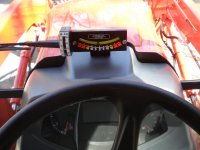
You might want to think about a 'tiltmeter' like they have in the site store. I bought one because I have a lot of hills and uneven areas on my property. P4220001.JPGP4220002.JPG
 
/ Slope Question #13  
4wd is useful in any sketchy situation because that's how you get braking on the front wheels- the rear wheel brakes slow the drivetrain. Also keep in mind that the front axle has a pivot where it attaches to the frame. So the sideways tilt of the tractor is solely determined by the terrain under the rear tires. If a rear wheel goes into a hole the tractor will tilt even if the front wheels are on level ground.

When I got my new tractor last year I got it with smaller diameter wheels & tires to lower the CG, rear axle spacers, and the rear tires loaded. Our land is steep and I wanted the tractor to be as stable as possible. When mowing steep terrain I go mostly up and down and make my turns where the slope is less. I've tried mowing with the bucket off but loader still on. There's a noticeable reduction in stability than with the bucket on and kept low.
 
/ Slope Question #15  
I'm newer and have done what I could on the search side, scouring Youtube, etc., but still have a succinct (I hope) question. Manual doesn't seem to address this.

Equipment: Kubota M5-111 pulling LP 3615 (15 batwing). has wheel weights. LA1854 loader (could take it off if I need to). Rear wheels have not been widened. I haven't planned on filing tires, though I could.

Land is full of 8-degree slopes with a few steeper ones at 12-degrees.

If I take my time and am not an idiot, would that slope scare any of you?

Thanks!

Slopes always scare me.

BTW, when looking up information about slopes, keep in mind that most slopes are given in terms of percentage or gradient rather than in degrees. For small angles, % grade is is roughly twice what the slope measured in degrees.

So your 12 degree slope is about a 22% grade. A 45 degree slope is a 100% grade, because 45 degrees is where the rise and the run are equal. (1/1=1, & times 100 is 100%)

I'd be OK with most tractors with Ag tires (but would prefer industrial tread) on an 8 degree slope (about a 15% grade) being slow & careful plus keep the bucket low & the batwing down.
At about 12 degrees, is where my personal pucker factor makes me feel more comfortable widening the stance or going up and down rather than a traverse. Side Slippage is a big worry for me. Are your rear wheels reversible for a wider stance?

If there is any doubt, or any change of side slippage, I always go up and down a slope rather than try to traverse it. Remember to always be in 4wd going down any slope.
rScotty
 
/ Slope Question
  • Thread Starter
#16  
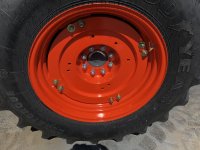
Are your rear wheels reversible for a wider stance?

Good question. My salesman is out w/ family issues and I'm not sure.

(And thank you for the other information. I have a lot to learn.)

IMG_0401.jpgIMG_0407.jpg
 
/ Slope Question #17  
David, I suspect the reason the manuals and your dealer are hesitant to name a "maximum slope you can safely traverse" is to avoid liability if you roll your tractor. So many factors over and above 'slope', such as smoothness of ground, type of soil, dampness, configuration of your tractor, speed, etc, can all effect what a safe slope is.

A general statement by a rep or the manual stating "Be extremenly cautious of driving your unit across a slope to avoid the possibility of a roll over..........." might give them protection in a lawsuit.

Tractor manufacturers destroy more than a few units in testing to make sure their units are as safe as they can be. Once, I worked for a mfger who was testing the cab structure for operator protection. We made a fixture where a huge I beam was swung into the cab to simulate the stress the cab might expect in a rollover. Engineers had calculated the weight needed and the speed it was to hit at. The beam crushed the side of the cab, and distended it, but analysis determined a seat belted operator would have survived. It passed.

A better approach for you might be to ask a nearby farmer to look at your ground and see what he thinks. Or just be safe and mow up/down until you get more experience.

Ron
 
/ Slope Question #18  
You think the lesser weight from the FEL is better gone than if I'm carrying it low, just above the ground? I figured that weight, on balance, would be better on the tractor.

Remove it, or at least the bucket.

It will be in the way, reduce visibility and is a potential hazard if low to the ground.

Do not remove the grill guard.

Yes, you may want to leave it in place the first time you mow unfamiliar property (while moving very slowly) if you expect obstacles that are difficult to see.

SDT
 
/ Slope Question #19  
/ Slope Question #20  
Remove it, or at least the bucket. It will be in the way, reduce visibility and is a potential hazard if low to the ground. Do not remove the grill guard.
Yes, you may want to leave it in place the first time you mow unfamiliar property (while moving very slowly) if you expect obstacles that are difficult to see.
SDT

There's are pros/cons to having bucket on/off. Any additional weight below the tractors center of gravity (COG), like a lowered bucket, or bucket with ballast in it, will lower the tractor's COG and make it less likely to roll over. Conversely if it's raised above the COG, more likely.
As you noted, bucket on makes it easier to run into fences, buildings, etc.., but also handy to knock down tall grass and scout hidden "surprises" when mowing.

From OP's picture, it looks like outer rim (with tire) could be mounted on the outside of the rim's inner dish (plate) to increase the width a couple more inches (by the width of the mounting tab on the outer rim that we can't see in the picture).
Widen the stance and fill the tires.
 

Marketplace Items

2020 ASV RT120 Forestry Skid Steer (A61166)
2020 ASV RT120...
2014 CASE 590 SUPER N BACKHOE (A62129)
2014 CASE 590...
UNUSED WOLVERINE TCR-12-48H 48" HYD TRENCHER (A62131)
UNUSED WOLVERINE...
Decorative Mermaid Light Post (A61569)
Decorative Mermaid...
378909 (A61166)
378909 (A61166)
500 BBL FRAC TANK (A58214)
500 BBL FRAC TANK...
 
Top