Shallow well poor recovery rate

/ Shallow well poor recovery rate #1  

chwkrx7

New member
Joined
Aug 23, 2023
Messages
3
Tractor
2012 Deere 4105
We have a 1977 built home that is supplied water from a shallow well adjacent to a large pond. The pond appears (as I've been told) to be spring-fed as the water level seems steady even when it hasn't rained for weeks. The "well" is a vertical corrugated pipe, about three feet across and 15 feet deep, with a 240V submersible pump suspended near the bottom, about 80 feet from the pond. It looks like the ground from the pond to the well was dug up many years ago, as there is a slight dip in it

We bought in summer of 2021 and first ran out of water that winter. I augered a hole in the pond ice and found lots of water, so I used a pump to fill the well back up. We had to do that three times that winter and twice last winter. We didn't have a problem those first two summers. However, this year we've had it twice now that the well ran dry, despite the pond water level still being high. Last night it ran out again, and the well only recovered 5" from midnight to 8 am this morning.

I suspect over the years that either the "channel" from the pond to the well, or the bottom of the well itself has become plugged up with sediment/leaves/debris. I'm not sure how the water "enters" the pipe either.

I could maybe try filling the well right to the top and maintaining the water level there for several days to try "backflush" it, but I'm not sure how effective that would be given that normal water level in the well is usually only about 3' from the top anyway. I'm looking for any ides to improve this situation. Thanks!
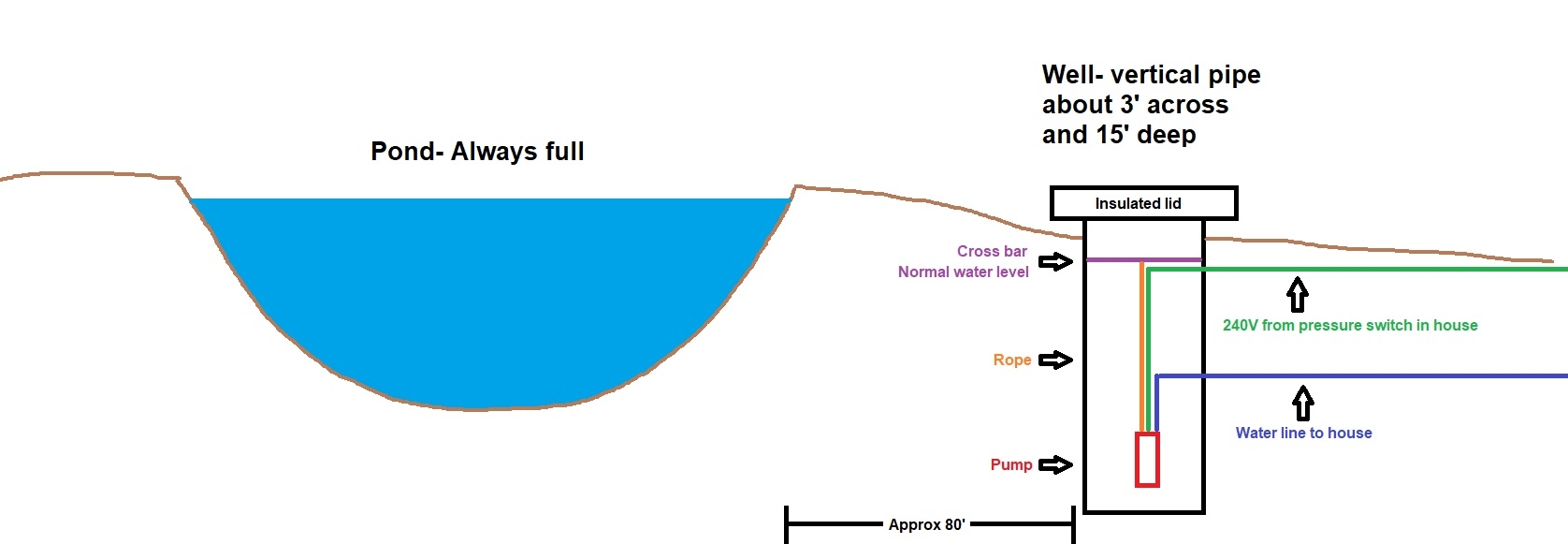
WellDiagaram.jpg
 
/ Shallow well poor recovery rate #2  
aSince you appear to be using water right out of thepond with no treatment, you might as well just install the pump in the pond. The real answer would be to call in a well driller for an opinion on a deep well.
 
/ Shallow well poor recovery rate #3  
The water table has dropped, which has a bigger impact on your well than a spring fed pond.

I see two solutions:

1. Pipe in a line from the pond to fill the well. This will require power and a trench deep enough to not freeze in the winter. Then all the plumbing to make this work.
2. Drill a well and solve the issue.


Dealing with a water table is fickle. It's always too little or too much water.
 
/ Shallow well poor recovery rate #4  
I'd never use a shallow well for drinking or house water because anything above ground like fertilizer or even animal droppings will get in your water supply and here, they are not legal anyway except for irrigation. Time to have a deep cased well drilled I'd say.
 
/ Shallow well poor recovery rate
  • Thread Starter
#5  
aSince you appear to be using water right out of thepond with no treatment, you might as well just install the pump in the pond. The real answer would be to call in a well driller for an opinion on a deep well.

The water treatment is all in the house- a pre-filter, main filter, carbon block filter, UV filter, water softener, then into house.

The water table has dropped, which has a bigger impact on your well than a spring fed pond.

I see two solutions:

1. Pipe in a line from the pond to fill the well. This will require power and a trench deep enough to not freeze in the winter. Then all the plumbing to make this work.
2. Drill a well and solve the issue.


Dealing with a water table is fickle. It's always too little or too much water.

OK. I like the idea of a pipe from the pond to the well, I'm just unsure of how to dig it all up without completely draining the pond. I don't think we'd afford drilling a well right now.

I'd never use a shallow well for drinking or house water because anything above ground like fertilizer or even animal droppings will get in your water supply and here, they are not legal anyway except for irrigation. Time to have a deep cased well drilled I'd say.

Thanks for the reply. Our water has been tested and approved as safe. I understand the concern though, and I'd love to have a drilled well. We've also considered installing a large cistern and having water trucked in
 
/ Shallow well poor recovery rate #6  
The water treatment is all in the house- a pre-filter, main filter, carbon block filter, UV filter, water softener, then into house.


OK. I like the idea of a pipe from the pond to the well, I'm just unsure of how to dig it all up without completely draining the pond. I don't think we'd afford drilling a well right now.


Thanks for the reply. Our water has been tested and approved as safe. I understand the concern though, and I'd love to have a drilled well. We've also considered installing a large cistern and having water trucked in

Get some bags of bentonite. Make a small dam around where the trench will go and drain it dry. Start trenching and laying pipe. Once it's all in, then take out the small bentonite dam.
 
/ Shallow well poor recovery rate #7  
Do you know how deep the casing goes? Is it open ended with no screen (probably)? It's possible the sand level has built up to the point that it is impeding water from entering the well. You may need to pump/dredge/dig the sand out.
 
/ Shallow well poor recovery rate #8  
It sounds like your well is just a vertical cistern being fed from the pond. There is probably a horizontal French drain with gravel from the well to the pond. Organic material will eventually clog a French drain and no water can get through. You will have the same problem with a pipe from the pond to the well. But you will be able to install a screen on the inlet of the pipe. It will need periodic or continual cleaning, but the pipe won't clog up.

Another option is to just throw the submersible well pump out in the pond. It will need a flow inducer sleeve with a screen on the bottom, but can be floated a few feet below surface or skidded in on a sled, trailer, in in a piece of PVC casing that will hold it off the bottom.

The pump will be fine laying on its side, and there is even a way to tap the line and make a permanent backflush for the screen on the pump. Will just need to bury the 80' of pipe and wire deep enough not to freeze.
 
/ Shallow well poor recovery rate #9  
Listen to this guy^^

He knows what's up.
 
/ Shallow well poor recovery rate #10  
Quick drawing of how to keep the screen on a well pump clean automatically.

shroud and screen with jet.jpg
 
/ Shallow well poor recovery rate #11  
Though I haven't used it yet I bought a submersible 115 volt well pump from VEVOR for $100.00 delivered. It came with a cord that's 60 feet long. I think. I just don't remember, but it is plenty long. I think the pump is 1/2 HP. I have not used it yet but it is slated for use in a shallow well. The pump appears to be well built though and did have good reviews. It seems like you could take Valveman's advice and set up a floating pump for pretty cheap. Since your funds are limited I think this could work out for you. I guess those VEVOR pumps are popular because at their website most are sold out or out of stock. Anyway, here is a link to a 220 volt model thrice as powerful as the one I bought, $160.00 delivered: VEVOR Deep Well Submersible Pump, 1.5 hp 220V 50 Hz, Stainless Steel w/5 FT Cable Wire, 1.25" Water Outlet, 24 GPM & 390 Ft Head for Farmland Irrigation and Factories | VEVOR US
Eric
 
/ Shallow well poor recovery rate #12  
If the water is coming from the pond, might as well put the pump in the pond.
The way we normally build sleds as valveman described is a piece of 4" PVC with a 4" T on the end laid flat, short section of 4" pipe, 4" elbow pointed straight up with some sort of screen. Be careful how fine the screen is. A fine screen will filter out more stuff, but will plug. When the screen plugs, the pump will self destruct.
 
/ Shallow well poor recovery rate #13  
I know of others who have buried perforated well casings in lake and pond beds, using a layer of sand on top to do the filtration at a slow enough rate not to plug. Given the sunken path to your well, I wonder if the original builders might have done something similar in your original design. (E.g. a trench with some gravel in it going from the pond to your well that has slowly plugged over the years.)

All the best, Peter
 
/ Shallow well poor recovery rate #14  
Vevor, made in China. I run Red Jacket submersible pumps myself or Gorman-Rupp. Made in USA. Of course they cost more but you get what you pay for and they don't pump out rice either...
 
/ Shallow well poor recovery rate
  • Thread Starter
#16  
Get some bags of bentonite. Make a small dam around where the trench will go and drain it dry. Start trenching and laying pipe. Once it's all in, then take out the small bentonite dam.
Thanks for the tip, I'll look into that

Do you know how deep the casing goes? Is it open ended with no screen (probably)? It's possible the sand level has built up to the point that it is impeding water from entering the well. You may need to pump/dredge/dig the sand out.
I'm not sure, but have thought that myself. Might have to go down in there and see

I know of others who have buried perforated well casings in lake and pond beds, using a layer of sand on top to do the filtration at a slow enough rate not to plug. Given the sunken path to your well, I wonder if the original builders might have done something similar in your original design. (E.g. a trench with some gravel in it going from the pond to your well that has slowly plugged over the years.)

All the best, Peter
Yeah, I'm thinking that was the original design as well. Might just have to be redone, it's probably 46 years old.

My final comment is, I'd be testing the water regularly for bacteria.
We get it tested every year. It's come back as safe both times so far, but we still have a separate water cooler for drinking water anyway
 
/ Shallow well poor recovery rate #17  
A buddy has a setup like that. A cistern a similar distance as yours next to a pond. He had a trench between the two filled with sand.
 
/ Shallow well poor recovery rate #18  
I'd never use a shallow well for drinking or house water because anything above ground like fertilizer or even animal droppings will get in your water supply and here, they are not legal anyway except for irrigation.
Never heard of them being illegal, I suppose it makes sense in an area where agricultural runoff would be a problem. Not a big ag area here, so not likely a problem.
My well is surrounded by forest, other than on the house side probably a half mile+ of woods on all sides.
I don't even need a pump...it sits high enough above the house so I get maybe 25 psi from gravity alone...good enough for anything I need to do...that was a big selling point when we bought the place. I'm guessing this well is better part of a century old. Best tasting water I've ever had.
 
/ Shallow well poor recovery rate #20  
We have a 1977 built home that is supplied water from a shallow well adjacent to a large pond. The pond appears (as I've been told) to be spring-fed as the water level seems steady even when it hasn't rained for weeks. The "well" is a vertical corrugated pipe, about three feet across and 15 feet deep, with a 240V submersible pump suspended near the bottom, about 80 feet from the pond. It looks like the ground from the pond to the well was dug up many years ago, as there is a slight dip in it

We bought in summer of 2021 and first ran out of water that winter. I augered a hole in the pond ice and found lots of water, so I used a pump to fill the well back up. We had to do that three times that winter and twice last winter. We didn't have a problem those first two summers. However, this year we've had it twice now that the well ran dry, despite the pond water level still being high. Last night it ran out again, and the well only recovered 5" from midnight to 8 am this morning.

I suspect over the years that either the "channel" from the pond to the well, or the bottom of the well itself has become plugged up with sediment/leaves/debris. I'm not sure how the water "enters" the pipe either.

I could maybe try filling the well right to the top and maintaining the water level there for several days to try "backflush" it, but I'm not sure how effective that would be given that normal water level in the well is usually only about 3' from the top anyway. I'm looking for any ides to improve this situation. Thanks!
View attachment 817558
I've cleaned a few dug wells in my time and I used to be a professional well driller and pump installer so I might know something .....or maybe not. Lol.

My guess would be that the holes in the corrugated pipe are simply plugged. I've seen tree roots grow into them, I've seen a simple accumulation of silt settle out on the bottom and shallowing the well.

You either need to climb down yourself or try cleaning it from above. You can use high pressure jetted water, sometimes that does the trick. Blowing a well with 300+ cfm of air at the bottom can work as well. 3 feet diameter is a tough one, too big for air I think yet too small to climb down easily. And 15 feet is a LONG way down, when you're there in the moment it can overwhelm some.

You also mention an area that looked like it had been recently dug up had a large dip in it? Is it possible that this was a transfer pipe that has subsequently collapsed, galvanized fails regularly.
 

Marketplace Items

2007 JOHN DEERE 605C CRAWLER LOADER (A60429)
2007 JOHN DEERE...
2018 VOLVO EC350EL EXCAVATOR (A60429)
2018 VOLVO EC350EL...
2021 SANY SY365C9C5K (A58214)
2021 SANY...
(APPROX. 20) 4' X 8' X 3/8" SHEETING (A52706)
(APPROX. 20) 4' X...
Husqvarna Riding mower (A56857)
Husqvarna Riding...
32in. Tilting Bucket Mini Excavator Attachment (A59228)
32in. Tilting...
 
Top