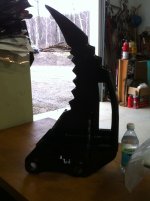
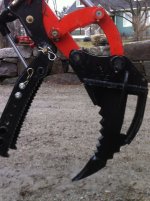
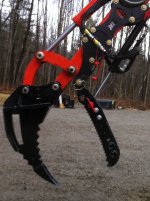
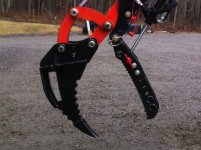
Backhoe Ripper tooth design - need your advice

   / Ripper tooth design - need your advice #21  
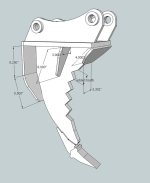
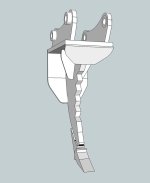
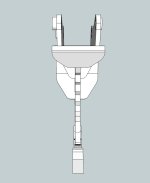
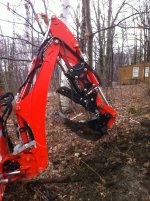
Looks good. Two comments. One is that you don't show any bevel on the cutting edge. I presume that is something you will do. The teeth will be more effective as a serrated blade than just flat faced. Second is that the backplate, which is critical for removing spoils, just looks a little smaller than mine. I have posted photos of my ripper you can compare to. I'll try to remember to measure mine next time I am at the tractor. With my ripper and backplate, I can remove roughly the equivalent of two hand shovelfuls of dirt at a time. Very useful for trenching or even digging out a big stump.

I'd also suggest that you consider getting a main bucket pin that is maybe 2" longer than standard and then taper the first 1.75" or so as that will help you line up the mount with the dipper.
 
   / Ripper tooth design - need your advice
  • Thread Starter
#22  
Looks good. Two comments. One is that you don't show any bevel on the cutting edge. I presume that is something you will do. The teeth will be more effective as a serrated blade than just flat faced. Second is that the backplate, which is critical for removing spoils, just looks a little smaller than mine. I have posted photos of my ripper you can compare to. I'll try to remember to measure mine next time I am at the tractor. With my ripper and backplate, I can remove roughly the equivalent of two hand shovelfuls of dirt at a time. Very useful for trenching or even digging out a big stump.

I'd also suggest that you consider getting a main bucket pin that is maybe 2" longer than standard and then taper the first 1.75" or so as that will help you line up the mount with the dipper.

I've seen your pics, and I must admit I was trying to copy it's features. I will look at making the back plate longer to help remove more dirt. I did not put the additional center brace/support that is shown in your pics. It looked like it would cause dirt to get clogged within the back area. Did you have any issues with that? Do you think additional support is necessary in the central section of the shank?

As for the teeth - I will put a cutting/knife edge in this area. I just couldn't figure out how to do this with the 3D modeling software (SketchUp V7.1). Every time I tried it I ended up losing surfaces and it made the teeth surfaces "see thru". This is the first thing I modeled with it... a was a bit of a challenge for me.

You had mentioned in your original thread that you had put a large chunk of tool steel round on the back of the shank... did that work out as you had hoped?

My only concern about using longer pins is that the additional tapered part of the pin extending out beyond ripper pin bore would interfere with the digging. I was trying to stay as narrow as possible and with the 9" width the bucket pins would be protected by a little bit. For installing I was going to try the 2 half length tapered pins from each side approach and see how that works out. I'll also have a couple of long tapered knock thru pins as well. Nice to work in a full access machine shop... also having an understanding boss helps a lot too!
 
   / Ripper tooth design - need your advice #23  
I've seen your pics, and I must admit I was trying to copy it's features. I will look at making the back plate longer to help remove more dirt. I did not put the additional center brace/support that is shown in your pics. It looked like it would cause dirt to get clogged within the back area. Did you have any issues with that? Do you think additional support is necessary in the central section of the shank?

As for the teeth - I will put a cutting/knife edge in this area. I just couldn't figure out how to do this with the 3D modeling software (SketchUp V7.1). Every time I tried it I ended up losing surfaces and it made the teeth surfaces "see thru". This is the first thing I modeled with it... a was a bit of a challenge for me.

You had mentioned in your original thread that you had put a large chunk of tool steel round on the back of the shank... did that work out as you had hoped?

My only concern about using longer pins is that the additional tapered part of the pin extending out beyond ripper pin bore would interfere with the digging. I was trying to stay as narrow as possible and with the 9" width the bucket pins would be protected by a little bit. For installing I was going to try the 2 half length tapered pins from each side approach and see how that works out. I'll also have a couple of long tapered knock thru pins as well. Nice to work in a full access machine shop... also having an understanding boss helps a lot too!

Understood. The center support gussets don't seem to interfere or clog but my soil is very sandy. Not sure that would be the case in moist clay. I would imagine the ripper blade is stiff enough without them but I do like the idea of the lateral bracing. Perhaps smaller braces would be a compromise. I honestly have no idea if they are necessary.

The chunk of drilling rod I welded to the back works fine. The challenge in using it is to train the operator to be as facile with his "backhand" ripper motion (push and dump motion) with down pressure as with the more standard pull and curl control. Just takes learning to smoothly control that motion which doesn't get as much practice so is harder to do with a fluid motion. It does rip a chunk of wood out when done properly but I have no idea if it is more or less efficient than serrated teeth.

If you use two short tapered starter pins, just make sure to leave flat tips on both so one can easily push the other out.

Good luck with the fabrication.
 
   / Ripper tooth design - need your advice #24  
This thread is great, I would love into find the time to fab a ripper. Please keep us posted about how you progress! Nice modeling as well; seeing your diagrams really help to understand all the choices that are being talked about.
 
   / Ripper tooth design - need your advice #25  
One more thought occurs to me on looking at the proposed design. In my experience ripping roots, the challenge is to get the ripper under the root and not allow the root to ride up the blade as I curl. If a big root rides up then it is simply dislodged rather than cut. Looking at your replaceable tooth, it occurs to me that putting a downward facing barb just above the tooth on the front of the blade would keep the root from sliding up the ripper. Although you have serrated teeth higher up, I think the primary ripping action using hydraulic power would be best accomplished nearer the tip as the distance a snagged root is pulled would be greater. Anything, like a barb, that would keep a root from sliding up during the curl movement would tend to help rip the root.
 
   / Ripper tooth design - need your advice #26  
In theory you could design the the ultimate root ripper/saw but in reality it still might not work the way you want. If there was some kind of ripper that would cut roots, it would be on the market. I guess something like a vibratory plow does but that's when the roots are packed in the ground, not like when you're digging out a stump. The only way to effectively cut all roots is to have a hyd. shear type attachment like is used on some feller/bunchers. Even when using an ax sometimes roots are almost like rubber and just don't want to cut no matter how sharp the ax is. I think a sharpened edge on the shank would cut some roots but a serrated edge, unless it was very thin and sharpened like a knife wouldn't do much more than just the sharpened edge. If you had a thumb on the hoe to use in conjunction with your sharpened edge could work to cut stubborn roots.

I've dug out some some pretty big stumps just using a 30" backhoe bucket. I think just a plain ripper would be a lot easier and not make as big of a mess. I've also seen really narrow buckets with 2 teeth on them for digging out stumps. Going from a standard bucket to a single tooth gives you a lot of concentrated force on that single tooth.
 
   / Ripper tooth design - need your advice #27  
In theory you could design the the ultimate root ripper/saw but in reality it still might not work the way you want. If there was some kind of ripper that would cut roots, it would be on the market. I guess something like a vibratory plow does but that's when the roots are packed in the ground, not like when you're digging out a stump. The only way to effectively cut all roots is to have a hyd. shear type attachment like is used on some feller/bunchers. Even when using an ax sometimes roots are almost like rubber and just don't want to cut no matter how sharp the ax is. I think a sharpened edge on the shank would cut some roots but a serrated edge, unless it was very thin and sharpened like a knife wouldn't do much more than just the sharpened edge. If you had a thumb on the hoe to use in conjunction with your sharpened edge could work to cut stubborn roots.

I've dug out some some pretty big stumps just using a 30" backhoe bucket. I think just a plain ripper would be a lot easier and not make as big of a mess. I've also seen really narrow buckets with 2 teeth on them for digging out stumps. Going from a standard bucket to a single tooth gives you a lot of concentrated force on that single tooth.

I agree with your observations. A plain Jane ripper is far better than a bucket for dealing with roots simply due to the concentration of force. The challenge is to keep the root in one spot so that force cuts rather than moves the root.
 
   / Ripper tooth design - need your advice #28  
You should take a look at Billstmaxx on youtube. Not sure how long ago it was but he was building a Ripper tooth attachement for his jd 110 tlb. You can go to youtube and do a search for " billstmaxx Ripper tooth ''
 
   / Ripper tooth design - need your advice
  • Thread Starter
#29  
Understood. The center support gussets don't seem to interfere or clog but my soil is very sandy. Not sure that would be the case in moist clay. I would imagine the ripper blade is stiff enough without them but I do like the idea of the lateral bracing. Perhaps smaller braces would be a compromise. I honestly have no idea if they are necessary.

I was thinking the same thing with slightly narrower gussets for support. See the attached images below on what I came up with. I extended the back paddle another 1.5" and widened its attachment to the shank to extend 2" on each side of the shank (more scooping volume). I shortened the front paddle 2" and widened it at the shank 2" on each side as well. Shortening this allowed me to add another beveled tooth. (I still can not figure out how to add the bevels to these teeth in this software).

ripper3-2.jpg ripper3-3.jpg ripper3-4.jpg

The chunk of drilling rod I welded to the back works fine. The challenge in using it is to train the operator to be as facile with his "backhand" ripper motion (push and dump motion) with down pressure as with the more standard pull and curl control. Just takes learning to smoothly control that motion which doesn't get as much practice so is harder to do with a fluid motion. It does rip a chunk of wood out when done properly but I have no idea if it is more or less efficient than serrated teeth.

If you use two short tapered starter pins, just make sure to leave flat tips on both so one can easily push the other out.

Good luck with the fabrication.

I certainly am a novice at the operation of the backhoe. These things are quite powerful and can certainly do some damage when the wrong lever direction is engaged.

If you use two short tapered starter pins, just make sure to leave flat tips on both so one can easily push the other out.

Good luck with the fabrication.

I will make it appoint to have good size flat tips (625"-.750") so they will have good contact with each other when driving them out the other end.

I appreciate yours and everyone's help on the design & suggestions.
 
   / Ripper tooth design - need your advice #30  
Your latest design looks pretty close to mine. Didn't get a chance to measure mine this weekend though.

I'd say even half inch flat tips would be fine to allow the pins to be pushed out. Just don't want pointy tips that might override and jamb.
 
   / Ripper tooth design - need your advice #31  
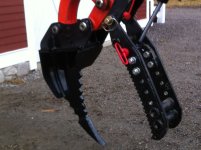
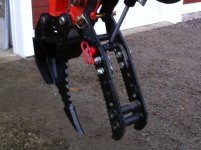
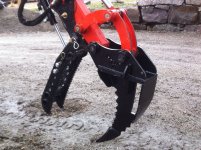
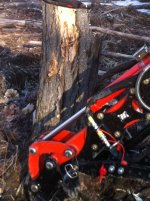
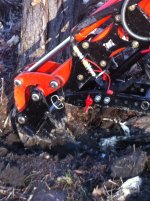
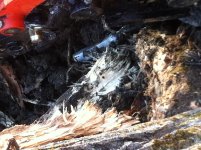
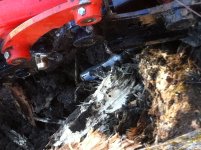
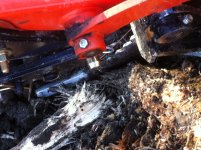
The following pics are of the second generation of what was originally made for Island Tractor. I asked the manufacturer to add teeth to both the front and backside of the ripper tooth and nicknamed it "The Claw".
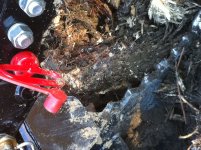
The pics are not in any particular order, however they show the claw from different angles and at work ripping out some frozen roots in the bottom group of pics in freezing temps a winter or so ago.
I'm a big fan of using the curl to tear at the roots while lifting up with the serrated edge of the claw to effectively immobilize the root from sliding off the inner curve of the claw. And though it might also be effective to push down and out, as already stated it is an odd maneuver and not easily mastered. So, I prefer to bring the root toward me and up while cutting it/breaking it as the root's natural slipperyness allows or not. Once torn some it is easier to cut further until it submits to hydraulic pressure and gives way completely.
This tooth/ripper is not perfect but it gets the job done, and well at that.
Designed and manufactured by MIE, an approved advertiser on TBN. I have NO affiliation except for having bought numerous of their products over the recent years.
Photo Feb 01, 2 40 23 PM.jpg Photo Feb 01, 1 15 44 PM.jpg
Photo Feb 01, 1 55 41 PM.jpg Photo Feb 01, 1 56 11 PM.jpgPhoto Feb 01, 1 56 23 PM.jpg Photo Feb 01, 1 56 33 PM.jpgPhoto Feb 01, 1 56 42 PM.jpg Photo Feb 01, 1 56 59 PM.jpg Photo Feb 04, 3 32 37 PM.jpgPhoto Feb 04, 3 33 17 PM.jpg Photo Feb 04, 3 33 52 PM.jpgPhoto Feb 04, 3 33 56 PM.jpg Photo Feb 04, 3 34 25 PM.jpgPhoto Feb 04, 3 34 37 PM.jpg Photo Feb 04, 3 35 16 PM.jpg
 
   / Ripper tooth design - need your advice
  • Thread Starter
#32  
~Coyote Machine~
Appreciate the pics and the description of the technique you use. I reviewed your pics and I have a couple questions:

1. You have 2 shots showing the jaw exiting the ground looking straight down on the teeth... Is there a side cutting edge on the teeth or are they full width of the shank thickness with no side angle modifications ?

2. What is the thickness of the steel used that the bucket pins go through. It looks like 1/2" with the additional round collars welded to give the pin engagement and locking bolt installation. I have contemplated/designed using 3/4" but think it might be overkill. This thing is going to be heavy and I'm second guessing some of my choices.
 
   / Ripper tooth design - need your advice #33  
~Coyote Machine~
Appreciate the pics and the description of the technique you use. I reviewed your pics and I have a couple questions:

1. You have 2 shots showing the jaw exiting the ground looking straight down on the teeth... Is there a side cutting edge on the teeth or are they full width of the shank thickness with no side angle modifications ?

2. What is the thickness of the steel used that the bucket pins go through. It looks like 1/2" with the additional round collars welded to give the pin engagement and locking bolt installation. I have contemplated/designed using 3/4" but think it might be overkill. This thing is going to be heavy and I'm second guessing some of my choices.

You're welcome- glad to be of assistance.:)
Teeth are cut from the width of the curved blade, just a mod of the CNC software to cut the tooth profile.
I believe the bushings for the pin/bolt attachment are the same or slightly wider than what Kioti uses on their buckets; I don't know exact but my guess like yours is 1/2".If you have to know exactly I can measure. Let me know.
I put things like the claw on a dolly and wheel it into position on my shop floor and then line up pins. It was a breeze to install, no work at all. I dropped 18" bucket on a dolly, moved claw into position and drove in the pins.
My latest fabrication is a 'bra' for my hoe bucket which covers all four teeth and gives me a straight edge for smoothing ditches, etc. Haven't tried it yet, but I had my local welder make it from a picture of another TBNer's similar but not as robust version.
 
   / Ripper tooth design - need your advice
  • Thread Starter
#34  
You're welcome- glad to be of assistance.:)
Teeth are cut from the width of the curved blade, just a mod of the CNC software to cut the tooth profile.
I believe the bushings for the pin/bolt attachment are the same or slightly wider than what Kioti uses on their buckets; I don't know exact but my guess like yours is 1/2".If you have to know exactly I can measure. Let me know.
I put things like the claw on a dolly and wheel it into position on my shop floor and then line up pins. It was a breeze to install, no work at all. I dropped 18" bucket on a dolly, moved claw into position and drove in the pins.
My latest fabrication is a 'bra' for my hoe bucket which covers all four teeth and gives me a straight edge for smoothing ditches, etc. Haven't tried it yet, but I had my local welder make it from a picture of another TBNer's similar but not as robust version.

Do you see any advantage to having a side angle on the teeth to help cut the roots? The straight side walls (perpendicular to curved blade) would not only be easier to produce but seems like it would hold up better to abrasion. I like the dolly idea... I'll start with that approach and adjust as needed. Sounds like you have quite a collection of attachments... I'm just getting started :D

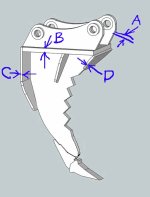
Also if you could measure for me I would greatly appreciate it as I would like to order my material this week. I have provided a sketch with 4 areas I would like input on.

My drawing has A (left & right sides)= 3/4" B= 3/4" C= 3/8" D= 3/8"

ripper3x.jpg
 
   / Ripper tooth design - need your advice #35  
The teeth work the way they are, no need to design them further. I'll get you the measurements.
What's up with the end tooth?
 
   / Ripper tooth design - need your advice #36  
The teeth work the way they are, no need to design them further. I'll get you the measurements.
What's up with the end tooth?

I would say that the teeth without "cutting" edges work simply as devices to keep the root from sliding up the ripper. They would not cut the way a sharpened edge would cut or saw. Keeping the root from sliding is great as it allows the full force of the curl to be brought to bear but if the edges were sharp they would cut better. When was the last bread knife you used that had blunt or squared off serrations? It's all about pounds of force per square inch at point of contact and a knife edge will always beat a flat wider surface when the same hydraulic force is applied. Again, I'm not arguing that there is no benefit from the "blunt" serrations because they will hold the root so it can be broken but they will not be as efficient as "sharp" edges when exerting force. Kind of the difference between having a good grip on something that you can they pull to break versus having a grip but using a knife or saw to cut through it.
 
   / Ripper tooth design - need your advice #37  
My drawing has A (left & right sides)= 3/4" B= 3/4" C= 3/8" D= 3/8"

View attachment 337236

Not sure I can get to my tractor this week. Maybe Coyote Machine can. However, I am pretty sure my A and B plate thicknesses are less than 3/4". 1/2" is my guesstimate and when I check a Woods bucket technical drawing it appears to be 1/2" for the hinge plate too. Remember there will be bushings that stand proud of the plate and that those add structural strength as well. Basically there is no need to build the mount any stronger than the mount of a standard bucket. The ripper just concentrates force but doesn't exert any greater total force on the mount than a standard bucket would. The braces front and back as well as the gussets will provide strength not just for the blade but for the mount as well. Mine weighs something over 90-100lbs and believe me you don't want it any heavier when time comes to mount it.
 
   / Ripper tooth design - need your advice #38  
I would say that the teeth without "cutting" edges work simply as devices to keep the root from sliding up the ripper. They would not cut the way a sharpened edge would cut or saw. Keeping the root from sliding is great as it allows the full force of the curl to be brought to bear but if the edges were sharp they would cut better. When was the last bread knife you used that had blunt or squared off serrations? It's all about pounds of force per square inch at point of contact and a knife edge will always beat a flat wider surface when the same hydraulic force is applied. Again, I'm not arguing that there is no benefit from the "blunt" serrations because they will hold the root so it can be broken but they will not be as efficient as "sharp" edges when exerting force. Kind of the difference between having a good grip on something that you can they pull to break versus having a grip but using a knife or saw to cut through it.

I was a little suprised when the teeth were not sharp, BUT they are safer to the OP for mounting/dismounting, and from the little use I've had time to put the claw through it does serve to grab the root so I can curl and attempt to break out sections of the side of the root facing the teeth. IMHO, once the 'squirrely' edge of an otherwise slippery round, or whatever shaped root is chinked by the teeth the root is significantly weakened and further curling attempt(s) render it into submission in fairly short order. Yes a sharper tooth edge might work faster, but for me the sawing motion that might have to be applied could be as difficult as using a down and back motion to rip with the backside teeth. More experience with the claw will provide further insight.
I do agree making the tool as light and sturdy as possible without unnecessary weight would certainly be advisable.
I can say for sure a $20 H.Depot furniture dolly made the first and only attempt to install the claw a one shot and done deal. I carefully removed the bucket for the first time and then with the claw on it's back on the dolly, moved it under the dipper and lowered it and drove in the pins. Done, easier than I thought it would be....YMMV.
I will get the measurements this afternoon.

Here are the measurements: A: 1/2", B: 3/4", C:3/8", D: 3/8" AND the hole with boss on the outside measures: 7/8" total. Ripper/claw plate is:1/2" thick. Up close the teeth have more of a point to them than may be apparent in my pics, but not a sharp knife like edge. I suspect with more use the teeth could become sharper, but that is pure conjecture on my part without more use.
 
Last edited:
   / Ripper tooth design - need your advice
  • Thread Starter
#39  
The teeth work the way they are, no need to design them further. I'll get you the measurements.
What's up with the end tooth?

The end tooth is a replaceable tip. I will be mostly dealing with trenching in clay bases soil with a large amount of volcanic rounded rock. So I figured the solid tooth that you and Island Tractor have would get worn and damaged... so a replaceable tooth seemed logical... to me at least. I know that Island Tractor is not fond of it either. I am a bit worried about the weld of that item to shank as all the force will be of those welds.

In post #19 on page 2 I showed a few pics of the adapter and the replaceable tooth
 
   / Ripper tooth design - need your advice
  • Thread Starter
#40  
~Coyote Machine & IslandTractor

Thanks to both you guys for the sizing info. I know it needs to be strong... but overkill will only hurt me trying to move it around. I will modify my plans to incorporate the bucket pin supports (item A) to be 1/2".


Tractor & Equipment Auctions

UNUSED RAYTREE RMA42 HYD AUGER (A60432)
UNUSED RAYTREE...
2017 Chevrolet Equinox SUV (A59231)
2017 Chevrolet...
2016 John Deere 35G Mini Excavator (A55973)
2016 John Deere...
iDrive TDS-2010H ProJack M2 Electric Trailer Dolly (A59228)
iDrive TDS-2010H...
2015 WESTERN STAR 4900 GLIDER TANDEM AXLE DAY CAB (A59575)
2015 WESTERN STAR...
2015 CATERPILLAR 140M3 MOTOR GRADER (A58214)
2015 CATERPILLAR...
 
Top