
DarkBlack
Super Member
Nope. My well is even deeper, and I’m using a 3/4 hp pump.
Static level, and gpm desired are big factors
Static level, and gpm desired are big factors


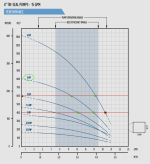
Interesting. I see lots of charts like this, courtesy of Google:Nope. My well is even deeper, and I’m using a 3/4 hp pump.
Heat, and harmonic distortion can mislead the power supply’s frequency timing.The THD issue has to do with excess heat being created in electronic parts, due to the non-sinusoidal waveform, I have read. It all feels the same to me when it bites.
That’s a 15gpm pump chart.Interesting. I see lots of charts like this, courtesy of Google:
View attachment 3744711
It seems to show the 3/4 hp pump petering out around 260 ft depth, and only delivering 5 gpm at 240 ft.
True. But given the size of today's homes, I think that's a pretty standard size to specify.That’s a 15gpm pump chart.
Maybe for people who like run lawn sprinklers everywhere.True. But given the size of today's homes, I think that's a pretty standard size to specify.
The interesting counterintuitive part, is that for a given hp, a lower gpm pump actually requires more stages and weight and size, than a higher gpm pump of the same series , using the same motorThat makes sense. I assume the big difference between nameplate pump capacities is the size and pitch of the impeller, effectively changing the mechanical advantage?
Yeah, counterintuitive at first glance. But I guess it makes sense when you stop to think about the fact that the lower GPM trade-off is greater lift. You can achieve greater velocity with changing impeller size and pitch, but the greater lift pressure at a given input HP may require more stages to reduce blow-by at a given RPM.The interesting counterintuitive part, is that for a given hp, a lower gpm pump actually requires more stages and weight and size, than a higher gpm pump of the same series , using the same motor
Watts will be calculated off of measurement volts, and amps.Tested the power meter this morning. Works fine showing W, A, F. Even catches the surges. Interesting to see how actual W are different from tables provided. One thing I can't explain... My generator is running with low load-about 60w. Turning on ceiling fan and see 2w. Tried a few times.
How can it be? Any thoughts?

They can run the two legs in opposite directions through the inductive loop, in order that they add despite being out of phase. But I agree, one ammeter on a two-leg system with split voltage leaves enormous room for ambiguity. I'm surprised there aren't two ammeters, one for each leg. Neutral current would be difference in two leg readings.Running 2 of the wrong wires through a single current donut can cause an increase in load to incorrectly read as a decrease because of cancellation. Hopefully you don’t have that going on
Problem with that setup, is the amp reading will only be correct for L1 to L2 flow. It’s totally wrong for 120v circuits.They can run the two legs in opposite directions through the inductive loop, in order that they add despite being out of phase. But I agree, one ammeter on a two-leg system with split voltage leaves enormous room for ambiguity. I'm surprised there aren't two ammeters, one for each leg. Neutral current would be difference in two leg readings.
Yep. Not a great setup, but really the only solution for a single meter on a split voltage system. It would at least show total current flow, with the overcurrent devices still being the only means of tripping an individual leg overcurrent.Problem with that setup, is the amp reading will only be correct for L1 to L2 flow. It’s totally wrong for 120v circuits.
Example:
1 amp flows L1 to L2. Meter “sees” 2 amps because of double wires through the donut.
1 amp flows through L1 to N meter only “”sees” 1 amp.
Agreed. Although unless wattmeter is actually accounting for power factor, it's mostly a useless frill feature, anyway.Second, the meter’s wattage logic doesn’t know if the amp # should be 1/2, or a portion of 100% number to use based on the neutral current flow imbalance caused by the 120v circuit’s flow, that it is unaware of.
All speculation till you post the schematic, or description of the amp/ watt screen from your owners manualNot sure what it all means. To clarify, the voltage reading on power meter is ~120 volts all the time. Does it mean wattage I see is half of actual? The generator screen shows 240 v. How can turning on a ceiling fan can reduce total watts? And this is the only one appliance that does it.

It's mostly likely just an artifact of imbalance, sign of a floating neutral. It'd be interesting to see the neutral to ground voltage under both scenarios.Not sure what it all means. To clarify, the voltage reading on power meter is ~120 volts all the time. Does it mean wattage I see is half of actual? The generator screen shows 240 v. How can turning on a ceiling fan can reduce total watts? And this is the only one appliance that does it.


