Question Concerning Loader Methods

/ Question Concerning Loader Methods #1  

MUDONTHETIRES

Gold Member
Joined
Oct 22, 2007
Messages
330
Location
Northern Louisiana
Tractor
Mahindra 6065 4WD
Hello,
I posted a couple of threads about getting a new tractor with a FEL. Having never owned or operated a FEL before, this weekend has been challenging to say the least. The manual doesn't have detailed instructions on using the FEL so I thought I would turn to the experts, You! I know common sense comes in to play here but I want to know the best way to pick up downed trees and logs longer than the bucket itself.:eek: I feel like a kid kicking around rocks. So far I can roll a log around pretty good, I just can't pick the dang thing up.:confused: I am definitely calling Markham Welding Monday and inquiring about a tooth bar. But as of now, my 6' bucket is all stock. Sorry about being long winded but hopefully I can get some advice from you seasoned folks!:)

Thanks in advance,
Perry
 
/ Question Concerning Loader Methods #2  
The toothbar is the key! The teeth will get under the log and help hold it in there. But for larger logs, you will need to chain them in so don't roll out. Having 3 grab hooks welded to the top on your bucket is invaluable for this.

There are the best 3 tips I can give you for proper FEL operation:
1. Practice...
2. Practice
3. More Practice!


/ Question Concerning Loader Methods #3  
Anything that won't fit inside the bucket will be tough. I still haven't gone for the toothbar yet but, many like them. Consider hooks on the top edge of the bucket. I had mine reinforced with angle iron, then the hooks welded on. I've used straps to sling awkward stuff using the hooks. It seems to work well.
 
/ Question Concerning Loader Methods #4  
My solution
 

Attachments

  • 104 (Large).jpg
    104 (Large).jpg
    184.6 KB · Views: 651
/ Question Concerning Loader Methods #5  
Forks are just cheating:)

He still needs the toothbar and grab hooks.... Oh yea I use forks for the same thing even though I have TB and hooks.
 
/ Question Concerning Loader Methods #6  
You might want to get with your dealer and see if he has a safety video on using your loader correctly. One came with my JD5205 when I bought it.
Common sense sometimes comes as a result of the lack of it. Been there done that myself.
Ever see anything roll off the back of a loader bucket or forks when they are raised too high?
Just my 2 pennies worth.
 
/ Question Concerning Loader Methods #7  
wushaw said:
Forks are just cheating:)


Look Again,the forks are only half the solution. The little woman is driving, I'm in the house watching the game
 
/ Question Concerning Loader Methods
  • Thread Starter
#8  
Casco1, I like your solution!:)
Thanks for the feedback and practice is definitely what I need. I will check with the dealer on a safety video. I'm also going to get a couple of hooks for the top of the bucket.

Thanks again,
Perry
 
/ Question Concerning Loader Methods #9  
A couple of things you can do:

1. A toothbar and hooks are a big step up, plus they're useful for all sorts of jobs. Beware of the toothbar in that sometimes (like backdragging to smooth soil) you won't want it attached, I think the Markham can be removed quickly so it shouldn't be a problem.

2. Bucket forks are decent for this work, but be ready in case they break. You'll probably still want hooks for chains for this.

3. A full set of pallet forks is better, not only do they tend to be stronger, but they also can used as tiedown points and they move the weight closer to the tractor so you can lift more. I also use my pallet forks to suspend weighty objects and to move around my implements, they're all-around useful toys.

4. If you'll be doing this a lot, look into a grapple - they can be loads of fun!

Also remember to make sure you've got plenty of ballast in the back, a good excuse for another rear implement :)
 
/ Question Concerning Loader Methods
  • Thread Starter
#10  
Thanks for the info Jeff! It sounds like I need a set of pallet forks. Is there a brand that you recommend? My FEL has a skid steer attachment.
 
/ Question Concerning Loader Methods #11  
I agree, if you're going to be doing this a lot you may need a grapple!!


Especially, if you're going to be lifting big limbs!;)

 
Last edited:
/ Question Concerning Loader Methods #13  
Hey Mud:

I did this for 15 years with homemade bolt on forks (two pieces of channel iron and holes through the loader bucket). It worked fine, but with my tractor upgrade I have a toothbar and a bolt on grapple for the bucket. This works great, but I wouldn't have done it if I didn't have a whole lot more logs and brush to move than before.

Steve
 
/ Question Concerning Loader Methods #15  
I am a little shocked you posted the pic "wider than the bucket." I hope those tires are loaded, but even if they are there is not enough ballast there. There is daylight under the left rear tire. Oh... and using ROPS with no seat belt on...:( That pic has the makings of a disaster. Cool attachments though. I have seen them on your website in the past.
 
/ Question Concerning Loader Methods #16  
Thank you for bringing that BAD photo to my attention - I've deleted and reposted without the "wider than bucket" photo.

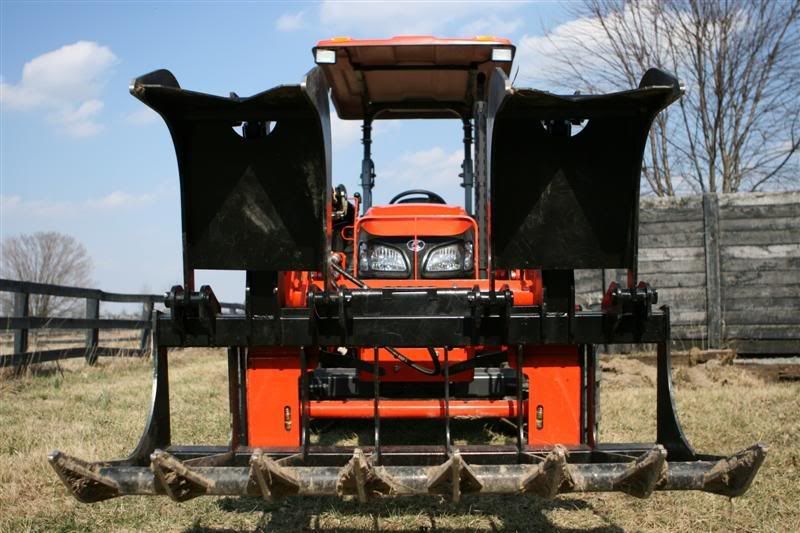
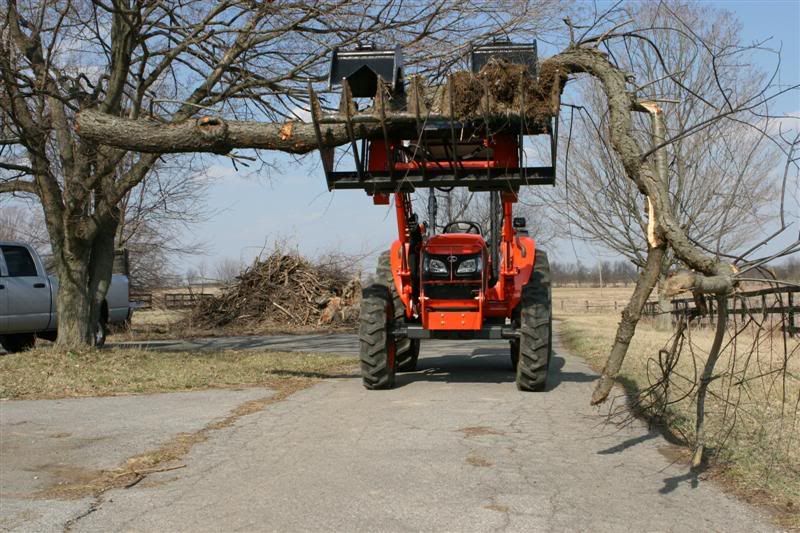
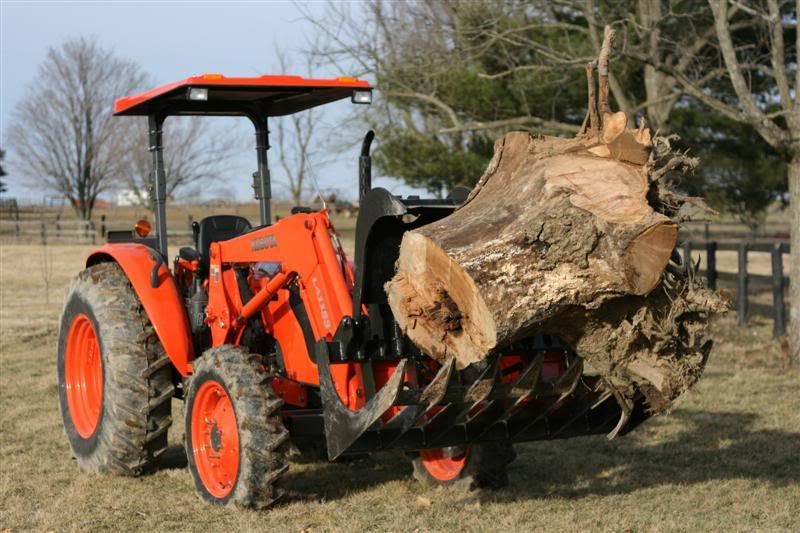
If you plan to move and clear logs, this is a unit built for just that. It attaches right to the end of the loader arms or works with your skid-steer adapter. It's just like putting fingers on the end of your loader arms. It eliminates the need for chains and hooks. It is much faster and safer way to transport logs, brush, fencing etc... and it grabs uneven loads securely. The unit on the end of the arms DOES NOT require extra hydraulics or ports on your tractor (approx. $750 to 1000). The skid-steer model will need to plug into a set of rear remotes (approx. $2100).

It is very important that you read an operators manual for your loader - contact the company you purchased it from. If you are new at operating your loader, you can get some great tips and a lot of do's and don'ts that can save you costly repairs. You can access John Deere loader/operator manuals online.
 

Attachments

  • Brush-Pile-ground.jpg
    Brush-Pile-ground.jpg
    94.9 KB · Views: 257
  • SkidSteer-wide load.jpg
    SkidSteer-wide load.jpg
    121.7 KB · Views: 277
  • skidsteer-quickattach.jpg
    skidsteer-quickattach.jpg
    112.4 KB · Views: 247
  • SKID-STEER opt finish teeth.jpg
    SKID-STEER opt finish teeth.jpg
    93.4 KB · Views: 250
/ Question Concerning Loader Methods #17  
I've moved a lot of trees, stumps, limbs, etc that were wider than the bucket without a grapple, tooth bar, forks, hooks, etc. It takes a lot of finesse and a lot of back and forth (when you drop them). But, it can be done, believe me. And if you do it enough, you get good at it.

But don't get me wrong. Its kind of like driving a nail with a screwdriver. The right tool for the right job is best and there are many times I wish I could afford a grapple. But when all you have is the screwdriver............
 
/ Question Concerning Loader Methods #18  
Was this a question about how to use a fel in general, or a question only about using the fel to pick up logs?

Are you looking for info on how to work dirt with your fel too? I'm on that same journey. And it does take practice but not a whole bunch to get the basics.

What I did was gave myself a little project of moving a pile of dirt from one spot to another. (It was actually wood chips, so real light and easy to work.)

There is a small guide on the bucket that is supposed to inform you when your bucket base is parallel to the ground. It's been hard for me to tell when that gadget is truely parallel. Anyone know how to get good at that? My bucket tends to be pointed down or up which means that it is either shoving into ground or sliding up.
 
/ Question Concerning Loader Methods #19  
Mud,

We recently purchased our first new tractor with an FEL. We decided to purchase a 66" grapple based largely on information I found on this site. I cannot believe how many uses there are for this implement. It is worth it's weight in gold in my opinion. The cost was around $1,450 installed, not including the third function valve. It is one implement that is definitely worth saving for and investing in. From a safety standpoint, it is much safer to move logs and such with also because you eliminate the opportunity for it to roll off. There are many manufacturers and there is a lot of info here, just do a search.

Here are a couple of pics for reference.
 

Attachments

  • Grapple.JPG
    Grapple.JPG
    30.2 KB · Views: 213
  • Grapple_Bucket.JPG
    Grapple_Bucket.JPG
    45.8 KB · Views: 195
  • FirewoodGrapple.JPG
    FirewoodGrapple.JPG
    28 KB · Views: 213
/ Question Concerning Loader Methods #20  
SLOBuds said:
Was this a question about how to use a fel in general, or a question only about using the fel to pick up logs?

Are you looking for info on how to work dirt with your fel too? I'm on that same journey. And it does take practice but not a whole bunch to get the basics.

What I did was gave myself a little project of moving a pile of dirt from one spot to another. (It was actually wood chips, so real light and easy to work.)

There is a small guide on the bucket that is supposed to inform you when your bucket base is parallel to the ground. It's been hard for me to tell when that gadget is truely parallel. Anyone know how to get good at that? My bucket tends to be pointed down or up which means that it is either shoving into ground or sliding up.


Quote from the OP's first post in this thread:
but I want to know the best way to pick up downed trees and logs longer than the bucket itself.

Moving the wood chips is great practice.

As far as getting the bucket level, I know on mine, and most others I have looked at, the top edge of the bucket is on the same plane as the bottom edge, so if the top is level-so is the bottom. I don't even use my level indicator anymore. I am not clear what kind of level indicator you have, but mine was a rod that slid through a tube so I cut the rod even with the tube when the bucket is parallel to the ground.


Top