Quality drill bits for metal.

   / Quality drill bits for metal. #41  
I bought some of those HF bits. I know how to sharpen bits and The HF bits just aren't worth the effort.
I invested in a good set and my life is much better.

I have purchased the small sets of B&D bits from Wal mart and found they are of descent quality.
Bought some larger bits 5/8, 3/4, etc, when I have needed them from TSC and they are of descent quality

If you waste your time sharpening a HF bit, you will continue wasting your time as you will continue to sharpen that bit and not drilling the hole LOL
 
   / Quality drill bits for metal. #42  
30 years ago my dad bought me a drill index with drill bits for Christmas. I have no idea what brand they are. I treasure that index and numerous bits are still original. When I replace I usually just go to the local NAPA store and buy individual bits as needed. They work well enough for me.

I agree that sharpening by hand is a skill easily learned and well worth learning. I don't mind sharpening any size bit. You can use fine sandpaper or a wet stone on the really small ones. For the larger ones I use the side of the grind stone. It's always dressed and a lot easier to control the bit while grinding. I don't always get a perfect point but sharpening is a lot faster than a 40 minute round trip to NAPA for a new one. The pot for cooling water behind the grinder is always wet.
 
   / Quality drill bits for metal. #43  
I have a drill bit sharpener but IMO, it isn't worth the time it takes to get right.

There are good industrial quality bits out there but they're expensive. I don't do a lot of machining anymore so for bits under a half inch, I buy in bulk and toss them when they wear out.

I've had pretty good luck with these:

Boy, the reviews aren’t consistent: people seem to either love or hate them.
 
   / Quality drill bits for metal. #44  
Boy, the reviews aren’t consistent: people seem to either love or hate them.
Isn't that the truth but same as any subject,if you weed out blowhards,strut & preeners,it start's making sense.
 
   / Quality drill bits for metal. #45  
After many years drilling holes in all sorts of materials, I have made it a rule to only buy industrial grade cobalt bits, most from McMaster-Carr.
I recently had to drill 60 3/8" holes in some 3/4" thick steel bar stock for a friend's project, and the cobalt bit I used drilled the last one just as fast as the first. Proper drill speed, plenty of coolant/lube and moderate pressure get the job done.
 
   / Quality drill bits for metal. #46  
Correct pressure and speed will preserve bit life regardless of it's quility. Curls from mild steel and chips from cast.
 
   / Quality drill bits for metal. #47  
All of my life's problems would be solved by learning to sharpen things. :cool:

The funny thing is that I've always been fanatical about sharp stuff. Cannot abide a dull knife, etc. As for drill bits its hard to say if I'm doing it right because most of the bits are junk bits. I'll get about as much drill time out of one after sharpening it as I did when it was new....which is not much. I think using the narrow belt sander is way easier than a grinder.

As mentioned, speed is critical and as shown in those videos pressure requirements vary with different metals and different bits. When hand drilling there is usually a sweet spot with both pressure and speed. I can't say if the shaving size or shape tells me much but I can usually feel the sweet spot. The issue is that keeping constant speed with a hand drill that doesn't lock at a set speed is hard. Constant even pressure is hard too when you're 58 years old, not exactly in tip top shape and lying in wet gravel.
I have an old corded black and decker variable speed hand drill that has a knob on the trigger that can be used to limit top speed. I loved that thing. The battery powered drills at my employer (Dewalt) do not have that feature. It's all by feel.

But nothing is better than lying in wet gravel. Man, that's the life! 🙃
 
   / Quality drill bits for metal. #48  
My comments. Rule of thumb, after 1/3 of the flute length is consumed from sharpening the drill should be discarded. The web becomes to thick and causes the drill force increase. Option is to grind a split point if possible. When the drill depth is over two times the diameter it is considered deep hole drilling. When drilling copper put a small flat on the face of the cutting edges to keep the drill from grabbing. Use a 90 deg spot drill when drilling with a conventional 118 deg drill. This way you do not point load the drill, causing it to walk. You can use a 120 deg spot drill when using a 135 deg drill. I have my ENCO drill press/ belt drive with shives/ set on the slowest speed. It is mainly used on steel. I cannot remember when and if I ever increases the spindle speed for all steel/ metal drilling.
 
   / Quality drill bits for metal. #49  
Correct pressure and speed will preserve bit life regardless of it's quility. Curls from mild steel and chips from cast.

Agree with your guidelines for bit life. Also agree with your examples of curl vs. chips but it can be a little more complicated than that. It's also dependent upon material being cut and the cutting edge geometry. Non-fluted carbide drills (many types) will often only produce chips due to the geometry of the cutting edge in relation to the material. Even fluted HSS drills can sometimes only produce chips, like a drill going through brass when the edges have been purposely blunted with a hand stone. Relative hardness of the material can matter as well, aluminum usually comes out in big curls but sometimes it will chatter and only produce chips. Even cast iron can produce big curls instead of just chips like in gun drilling deep holes or if it's a malleable type of iron. Each situation/cutter/material presents it's own results.

This is likely way more than anybody wanted to know but I don't know much about tractors, rural living (rather new to it), or agriculture. I've gotten a lot on this board from the collective and wanted to say thank you with the only contribution I seem to know much about, cutting metal. I'll go sit down in the back row now......
 
   / Quality drill bits for metal. #51  
I've used McMaster-Carr for other stuff. They are amazing. Stuff gets here before I knew I wanted it. ;-) I'll look at their bits.

I do use cutting oil when doing any significant drilling.

A stubb set would be very handy even for starting a hole for a jobber bit. It seems to me that any bit with any length on it can wander.

I sharpen bits on a narrow belt sander. It works okay in a pinch. Hardly precise though.

There are two Irwin sets on Amazon. The M35 set is 5% cobalt and is $122. The M42 set is presumably 8% cobalt and is $168. I don't think I need the 8% cobalt and I understand they are more brittle.

Irwin set.

Quick edit: Reviews are terrible on these bits. Pass.
The problem I have purchasing cutting tools from McMaster is most of the time you don't know what brand you're getting. I prefer MSC since they list the brand. Unfortunately when purchasing individual small drill bits from MSC they make you buy multiple bits most of the time now. If precise location is required, center drill first with a combined drill and countersink bit. Use the shortest bit that will get the job done comfortably. Chinese bits are a crapshoot, we've had some that were ground off center and drilled .010 oversize no mater what you tried. That's bad when tap drilling for small tapped holes. We always use cobalt for drilling mild steel but you can get away with HSS, it just takes longer and they don't last as long. Cutting speeds and feeds for cobalt bits are higher than HSS. You can spend a lot of money on a drill bit set, 1/16-1/2 including letter and number drills can run $1,000.
 
   / Quality drill bits for metal. #52  
But nothing is better than lying in wet gravel. Man, that's the life! 🙃
I dunno, lying in mud comes close.
I agree that sharpening by hand is a skill easily learned and well worth learning. I don't mind sharpening any size bit. You can use fine sandpaper or a wet stone on the really small ones. For the larger ones I use the side of the grind stone.
I wouldn't say "easily", it take a knack which I haven't quite mastered. Often as not I just make it dull differently.
I've had better results with a drill doctor, but it too takes "the touch". Like so many things, looks a lot easier than it is.
I won't even bother to try and sharpen a drill much smaller than 1/4", cheap enough to just replace when they get dull. Larger sizes, yeah, they can get expensive.

I've had decent luck with Irwin drills, maybe they've changed recently...mine are 10+ years old.
 
   / Quality drill bits for metal. #53  
I would guess that buying bits most anywhere is a crapshoot when it comes to the metallurgy used (and therefore the quality of the bit). Suppliers change frequently, the metallurgy could change form batch to batch, you have no idea the details of the metallurgy you are buying even if it is labeled with some cool sounding metal's name like cobalt or titanium. You have no idea of the percentage the labeled metal, or the other metals alloyed into the mix, the heat treatment (if any) or what it really it all means even if you did know. It is mostly just marketing.
With that, I will say the the more you pay for a bit the likely it will be better in quality, but that is not a sure thing.
 
   / Quality drill bits for metal. #54  
Hand sharpening drill bits is a great skill to have, but comes second to learning how to drill metal. If you don't burn up your bits to begin with, then there's a lot less sharpening (or throwing out and re-purchasing) to be done. Learning how to drill metal by hand, like hand sharpening, is an acquired skill. Most everyone doesn't do it properly, doesn't care that there's a proper way to do, and blames all their problems on "crappy bits."

I work with maintenance guys and I cringe every time I see one of them with their drill in 3rd gear, 1/2" bit screaming and squalling, belching smoke from the tip... which means I spend a lot of time cringing. I've tried to explain it to them before, demonstrate the proper technique, but they don't care. Why would they, when they have a magical self-replenishing drill bit drawer?

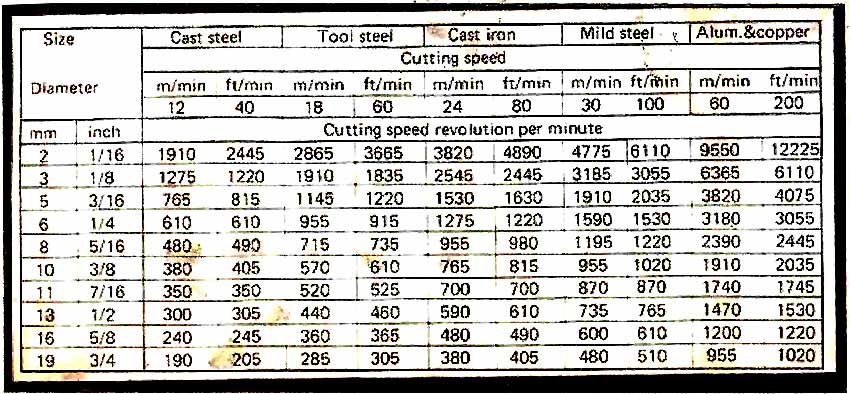
Different kinds of metals like to be cut at different speeds and different feed rates. All of them (except maybe cast iron and bearing bronze) like to be lubricated during cutting regardless of speeds and feeds (and some prefer specific lubricants, ex: aluminum = WD40). Speeds and feeds for various metals are typically given in "surface feet per minute." You take this number from the table (google "speeds and feeds for _______", fill in the blank for whatever metal you're drilling) and find out the RPM you need for the diameter of drill you're using, and the feed rate, and so forth. here's an example that gives you actual RPM so you don't have to the math:

drill-speeds_1.jpg


Say you're using a 3/8" bit in mild steel, you want to be running around 1000RPM.
This chart doesn't give you the feed rate or lubricant type, but you can find that on other charts.

If you're going to be drilling a lot of the same size hole, the best thing you can do in my opinion, is do your homework and your math for that one bit size in that material, and do a few good holes per the numbers on a drill press, take a mental video of what that looks like when done at the proper feed & speed. Then go do it by hand.

Do this each time you drill a different sized hole or in a different material, and build your mental video library. Your mind is a powerful tool, you don't need to do this for each and every size of bit; a big one, a small one, a few in the middle; It only takes a few examples and your mind will fill in the blanks.

Once you know what a properly drilled hole looks like as it's happening, you'll be able to make it happen in almost all circumstances going forward. Your bits will last, and when they don't you'll be able to say with authority that they actually are crap.

I stick to generic 135 degree HSS bits. Plain jane, no fancy metallurgy, no fancy coatings, no fancy tip geometry. They work in 99% of applications. Last set I bought was DeWalt and they work just fine. I will use split points on occasion if I'm too lazy to center punch a bunch of holes.

When drilling anything over 1/4" I'll work my way up to final diameter in a few steps, because drilling a 3/4" hole in steel with no pilot sucks.


In summary, learn how to drill before you go investing in expensive bits that you're bound to burn up only slighly slower than the cheap ones you're burning up now. Then learn how to sharpen that pile of burned bits. Odds are, there's not a single thing you need to purchase, and not a single thing that you could purchase, to get past this issue. Skill building is required.
 
   / Quality drill bits for metal. #55  
One thing for me that has made drilling easier on drill bits was when I converted my old Craftsman drill to a variable speed setup with a 3 phase motor and VFD. I mounted a magnet on the spindle pulley and have a digital tach display, and can vary the speed from ~50 rpm to ~3500 rpm. Now I can set the speed to whatever the job requires.

IMG_20210125_170028469 (Custom).jpg


IMG_20210125_171736130_HDR (Custom).jpg
 
   / Quality drill bits for metal. #57  
My Dad was a machinist and tool and die maker who I swear could sharpen a drill by looking at it. That trait did not get passed down! I got a Drill Doctor to try even though I thought it was a gimmick and was skeptical. I was wrong; it works like a champ and I can turn out perfectly sharpened bits in a couple of minutes.

I have had very good luck with the bits from Drill America sold through Amazon.
 
   / Quality drill bits for metal. #58  
I am an old chip maker also. On the drilling mild steel I would look for satin/ metalic colored chip. That would probably give you the longest cutting life although a little slow. You can increase the speed to a straw colored chip if you wish. Anything discolored / blue /dark blue is dulling the cutting edge. I don't use coolant just because it is messy and I am not setup for it. I may use and occasional shot of WD40 on a harder material but that is about it. I hand sharpen all my drills. I use my belt sander for this. Later
 
   / Quality drill bits for metal. #59  
I use RV antifreeze in a squirt bottle for coolant.
 
   / Quality drill bits for metal. #60  
I have presented this information before. When you don't have a pocket calculator and or a chart you can use this formula for calculating spindle speeds for determining spindle speeds to cut different materials. This would be for milling, drilling and turning and some other things I am forgetting about. 4 X SFM / diameter = RPM. SFM is surface feet per minute of the particular material. Lets take the 3/8 drill bit as referenced by strantor drilling mild steel/ 100 SFM. The formula would be 4 X 100 / .375 = 1066 RPM. Close enough for government work. Another example would be a 4.0 Dia. H.S. milling cutter milling mild steel. The formula would be 4 X 100 / 4.0 = 100 RPM. Lets say that milling cutter is a carbide cutter. Then the rule of thumb when using a carbide cutter is to multiply the SFM by 3. The the SFM for the mild steel is 100 X 3 = 300 SFM for mild steel using a carbide cutter. Then the formula would be 4 X 300 / 4.0 = 300 RPM for milling mild steel with a carbide cutter. Now this RPM is just a starting point. It can be adjusted up or down depending upon a lot of other factors. Later.
 

Tractor & Equipment Auctions

JLG 1255 Telehandler (A56438)
JLG 1255...
159118 (A60430)
159118 (A60430)
UNUSED FUTURE FT380 STAND ON SKID STEER (A52706)
UNUSED FUTURE...
2006 Freightliner Auger Truck (A56438)
2006 Freightliner...
2018 KOMATSU WA320-8 WHEEL LOADER (A60429)
2018 KOMATSU...
FUEL CELL (A58214)
FUEL CELL (A58214)
 
Top