You are using an out of date browser. It may not display this or other websites correctly.
You should upgrade or use an alternative browser.
You should upgrade or use an alternative browser.
PTO shaft engagement
- Thread starter jezorek
- Start date
- Views: 9154
More options
Who Replied?
/ PTO shaft engagement
#1



bjcsc
Platinum Member
- Joined
- Feb 20, 2007
- Messages
- 559
- Location
- Johns Island, SC
- Tractor
- JD 5225, JD 555B, JD 333E, JD 225DLC
jezorek said:Can anyone tell me what the minimum safe engagement is for a telescoping PTO shaft?
Assuming by "engagement" you are are referring to the overlap between the two halves, most of the shaft manufacturers spec 6"...

Jimmyp5
Silver Member
Agree, 6 inches seems to be the suggested overlap. The brushhog instructions are the best I have seen on how to cut and overlap etc...
I just rebuilt a FL850 tiller and installed it on my BX 24, my overlap is only 4 inches. The short 3 point hitch on the BX 24 draws it tiller in close. Even to get the 4 inches I had to make some adjustments. I just have to keep in mind that I will not get a 6 inch bite when tilling, just means multiable passes (good thing I am retired). No big deal, knew that with a BX 24 is a small tractor so things take longer. The FL850 was designed for a larger tractor, but the BX 24 handles it well.
I just rebuilt a FL850 tiller and installed it on my BX 24, my overlap is only 4 inches. The short 3 point hitch on the BX 24 draws it tiller in close. Even to get the 4 inches I had to make some adjustments. I just have to keep in mind that I will not get a 6 inch bite when tilling, just means multiable passes
(good thing I am retired). No big deal, knew that with a BX 24 is a small tractor so things take longer. The FL850 was designed for a larger tractor, but the BX 24 handles it well. 
greg_g
Super Member
- Joined
- Dec 18, 2003
- Messages
- 6,126
- Location
- Western Kentucky
- Tractor
- JD3720 Cab, 300X loader with 4-in-1 bucket
Ideally you want to cut your shafts so that there's at least an inch of collapsable length left at the shortest point of travel - AND - no less than 6" of overlap left at the longest point of travel.jezorek said:Can anyone tell me what the minimum safe engagement is for a telescoping PTO shaft?
//greg//
For shafts that are too short, I bought an overrun (over riding) clutch... which extends the pto shaft 6 3/4" and lets the impliment run faster than the engine. For the tiller, if you add a slip clutch, it adds 7" to the pto length and gives you added protection if you hit a big rock or root.
OVER RIDING CLUTCH - Agri Supply
SLIP CLUTCH W/1-3/8X6 MALE X 1-3/8X6 - Agri Supply
OVER RIDING CLUTCH - Agri Supply
SLIP CLUTCH W/1-3/8X6 MALE X 1-3/8X6 - Agri Supply
greg_g
Super Member
- Joined
- Dec 18, 2003
- Messages
- 6,126
- Location
- Western Kentucky
- Tractor
- JD3720 Cab, 300X loader with 4-in-1 bucket
Whereas an ORC will secondarily serve to compensate for a short PTO shaft, it's an unnecessary expense - and one extra moving part to break. More appropriate to the task is the simple PTO adapter. Same catalog, different part number(s):teg said:For shafts that are too short, I bought an overrun (over riding) clutch...
Agri Supply - Where we have Something for Everyone for your Farm Shop & Home
//greg//

Highbeam
Super Member
I just extended my PTO shaft last night that had been cut to a custom tractor and was too short. It was a very short shaft to start with and I only have about 2 inches of engagement.
Rather than use the adapter wouldn't it be wise to just order a new PTO shaft? That is, if the shaft is to be used for a long time?
My application is one of those crazy unicorn log splitters so not a lot of torque is being transmitted.
Rather than use the adapter wouldn't it be wise to just order a new PTO shaft? That is, if the shaft is to be used for a long time?
My application is one of those crazy unicorn log splitters so not a lot of torque is being transmitted.

Soundguy
Old Timer
- Joined
- Mar 11, 2002
- Messages
- 52,424
- Location
- Central florida
- Tractor
- RK 55HC,ym1700, NH7610S, Ford 8N, 2N, NAA, 660, 850 x2, 541, 950, 941D, 951, 2000, 3000, 4000, 4600, 5000, 740, IH 'C' 'H', CUB, John Deere 'B', allis 'G', case VAC
greg_g said:Whereas an ORC will secondarily serve to compensate for a short PTO shaft, it's an unnecessary expense - and one extra moving part to break. More appropriate to the task is the simple PTO adapter. Same catalog, different part number(s):
Agri Supply - Where we have Something for Everyone for your Farm Shop & Home
//greg//
Good point about more parts to wear, if the ORC properties are not needed.
I can think of one situation where the ORC may not be needed.. but might be usefull.. like in a situation with a large flywheel load on the pto, where you might want to save your pto brake.. IE.. a large mower or a chipper.. with an ORC.. it could spin down instead of havinghe pto brake grind it down to a stop.. etc..
soundguy

flusher
Super Member
- Joined
- Jun 4, 2005
- Messages
- 7,572
- Location
- Sacramento
- Tractor
- Getting old. Sold the ranch. Sold the tractors. Moved back to the city.
jezorek said:Can anyone tell me what the minimum safe engagement is for a telescoping PTO shaft?
Here is the hookup to attach my rototiller to the Kubota B7510HST

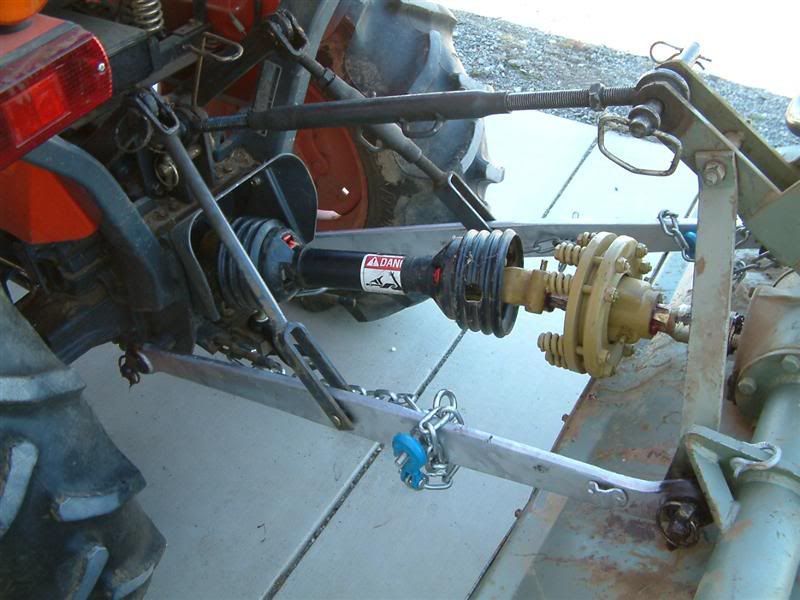
The overlap on the pto shaft sections is not more than 5 inches. It works fine.
Had to cut a shaft that I bought at TSC to get it to fit between the tractor and the slip clutch (the tiller doesn't have shear bolts, hence the slip clutch).
Don't need an overruning clutch since this is an HST tractor.
Needed to add that pto shaft extender onto the tiller to keep the slip clutch from rubbing on the tiller sheet metal.
This made the drive train too long for the 26" lower arms that are standard on the 7510. Had to use the 35" arms from my 1964 MF-135 diesel to get enough room to handle all that drive train stuff.
Jimmyp5
Silver Member
as always learning something new.... I have a very short overlap it workable but never thought about using a different set of 3 pt lower arms and top link., sure would have made life easier if I had. I converted the 18 spline FL850 Kubota tiller to the normal 6 spline 1 3/8 found a adapter on line. I had to toss the Kubota slip clutch and used one from TSC line of PTO etc...
So my overlap is only 4 inches...if I had used a different set of lowers, could have made it a full 6, oh well., next project looking for longer lower arms at farms auctions.
So my overlap is only 4 inches...if I had used a different set of lowers, could have made it a full 6, oh well., next project looking for longer lower arms at farms auctions.
greg_g
Super Member
- Joined
- Dec 18, 2003
- Messages
- 6,126
- Location
- Western Kentucky
- Tractor
- JD3720 Cab, 300X loader with 4-in-1 bucket
Yes. But in some cases that's just downright expensive. Example: I added Cat 2 PEC to my 45 horse. Doing so effectively extended the lower lift arms by nearly 4 inches. That in effect made ALL my PTO shafts too short by 4 inches. Instead of buying half a dozen new shafts, I got a 4 inch PTO adapter.Highbeam said:Rather than use the adapter wouldn't it be wise to just order a new PTO shaft?
//greg//
bjcsc
Platinum Member
- Joined
- Feb 20, 2007
- Messages
- 559
- Location
- Johns Island, SC
- Tractor
- JD 5225, JD 555B, JD 333E, JD 225DLC
flusher: you are far braver than I. No way would I have all that spinning behind me (ORC and SlipClutch) without a guard. Don't you worry about what could happen if any of it failed during use? It gives me the willies just thinking about it...
flusher
Super Member
- Joined
- Jun 4, 2005
- Messages
- 7,572
- Location
- Sacramento
- Tractor
- Getting old. Sold the ranch. Sold the tractors. Moved back to the city.
bjcsc said:flusher: you are far braver than I. No way would I have all that spinning behind me (ORC and SlipClutch) without a guard. Don't you worry about what could happen if any of it failed during use? It gives me the willies just thinking about it...
It's a rototiller, so the pto shaft rpm is pretty low (200-250 max).
And I have my backside covered with that expanded metal safety screen attached to the ROPS
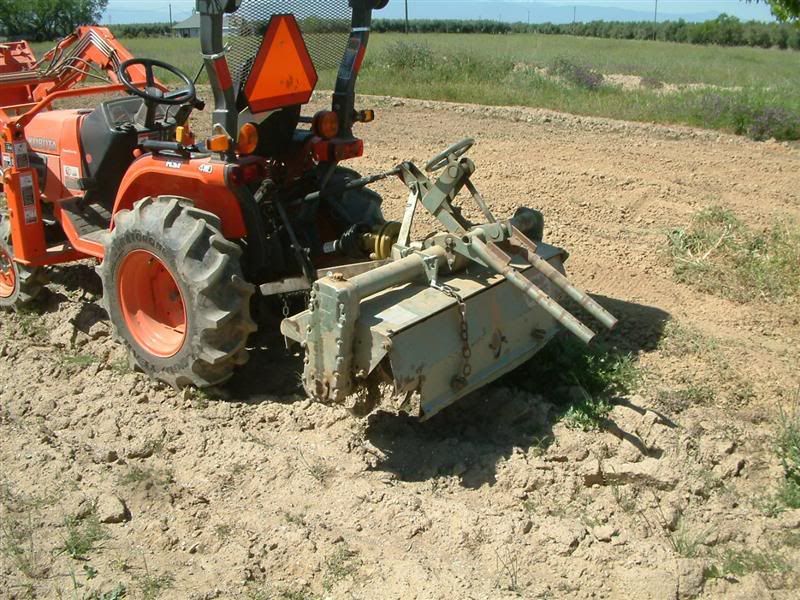
I'm more concerned about stuff flying in my direction from my brush hog. That's why the screen is there.
Soundguy
Old Timer
- Joined
- Mar 11, 2002
- Messages
- 52,424
- Location
- Central florida
- Tractor
- RK 55HC,ym1700, NH7610S, Ford 8N, 2N, NAA, 660, 850 x2, 541, 950, 941D, 951, 2000, 3000, 4000, 4600, 5000, 740, IH 'C' 'H', CUB, John Deere 'B', allis 'G', case VAC
I'm wondering if you could have reversed the hookup.. IE.. slip clutch to tractor pto stub, and then telescoping shaft to the tiller.. thus eliminating the extender and buying you a few more inches of overlap.
while the vast amjority of slip clutch setups i see are at he implement side.. I have seen some oem setups with a torque limiter on the pto stub side..
soundguy
while the vast amjority of slip clutch setups i see are at he implement side.. I have seen some oem setups with a torque limiter on the pto stub side..
soundguy
flusher said:Here is the hookup to attach my rototiller to the Kubota B7510HST
The overlap on the pto shaft sections is not more than 5 inches. It works fine.
Had to cut a shaft that I bought at TSC to get it to fit between the tractor and the slip clutch (the tiller doesn't have shear bolts, hence the slip clutch).
Don't need an overruning clutch since this is an HST tractor.
Needed to add that pto shaft extender onto the tiller to keep the slip clutch from rubbing on the tiller sheet metal.
This made the drive train too long for the 26" lower arms that are standard on the 7510. Had to use the 35" arms from my 1964 MF-135 diesel to get enough room to handle all that drive train stuff.
flusher
Super Member
- Joined
- Jun 4, 2005
- Messages
- 7,572
- Location
- Sacramento
- Tractor
- Getting old. Sold the ranch. Sold the tractors. Moved back to the city.
Soundguy said:I'm wondering if you could have reversed the hookup.. IE.. slip clutch to tractor pto stub, and then telescoping shaft to the tiller.. thus eliminating the extender and buying you a few more inches of overlap.
while the vast amjority of slip clutch setups i see are at he implement side.. I have seen some oem setups with a torque limiter on the pto stub side..
soundguy
Don't see why you couldn't do this.
Jimmyp5
Silver Member
don't think the slip clutch will clear the PTO guard on the tractor side...will not on the BX 24...just tried it...darn...was hoping it might!
Hey, I like the seat back guard...darn you all another new project!
Hey, I like the seat back guard...darn you all another new project!
bjcsc
Platinum Member
- Joined
- Feb 20, 2007
- Messages
- 559
- Location
- Johns Island, SC
- Tractor
- JD 5225, JD 555B, JD 333E, JD 225DLC
flusher said:It's a rototiller, so the pto shaft rpm is pretty low (200-250 max).
And I have my backside covered with that expanded metal safety screen attached to the ROPS
I'm more concerned about stuff flying in my direction from my brush hog. That's why the screen is there.
I missed the screen. That is a great idea, and if you made it yourself you did a great job...
SPYDERLK
Super Star Member
- Joined
- Feb 28, 2006
- Messages
- 12,605
- Location
- VA
- Tractor
- JD2010, Kubota3450,2550, Mahindra 7520 w FEL w Skid Steer QC w/Tilt Tatch, & BH, BX1500
Im not familiar with a need for PTO braking. Why are they employed on some systems?Soundguy said:Good point about more parts to wear, if the ORC properties are not needed.
I can think of one situation where the ORC may not be needed.. but might be usefull.. like in a situation with a large flywheel load on the pto, where you might want to save your pto brake.. IE.. a large mower or a chipper.. with an ORC.. it could spin down instead of havinghe pto brake grind it down to a stop.. etc..
soundguy
larry
Soundguy
Old Timer
- Joined
- Mar 11, 2002
- Messages
- 52,424
- Location
- Central florida
- Tractor
- RK 55HC,ym1700, NH7610S, Ford 8N, 2N, NAA, 660, 850 x2, 541, 950, 941D, 951, 2000, 3000, 4000, 4600, 5000, 740, IH 'C' 'H', CUB, John Deere 'B', allis 'G', case VAC
Hmm.. maybee for safey? Dunno really.
Perhaps just to arrest movement of spinning blades .. etc..
On some models.. if the pto brake is bad.. the pto will freewheel.. i see that as a bad thing as it may grab grass.. etc.. and perhaps eat the seal up..
soundguy
Perhaps just to arrest movement of spinning blades .. etc..
On some models.. if the pto brake is bad.. the pto will freewheel.. i see that as a bad thing as it may grab grass.. etc.. and perhaps eat the seal up..
soundguy


