Pole barn on plate?

/ Pole barn on plate? #41  
/ Pole barn on plate? #42  
The only advantage to floating the building on top of the gravel is to save money. Going cheap always leads to early failure and disappointment. It also leads to spending more money down the road, usually a lot more then you thought you would save by cutting corners. This is a really bad idea and grounds to look for another builder. Just because it was done before, and still might be done by some, doesn't mean it's a good idea.

With building, there are proven methods and techniques that have a proven history of working. While there might be some things new that improve what is done, usually they turn out to be a mistake. Stick with what works, and use the best materials available.

Eddie
 
/ Pole barn on plate? #43  
The only advantage to floating the building on top of the gravel is to save money. Going cheap always leads to early failure and disappointment. It also leads to spending more money down the road, usually a lot more then you thought you would save by cutting corners. This is a really bad idea and grounds to look for another builder. Just because it was done before, and still might be done by some, doesn't mean it's a good idea.

With building, there are proven methods and techniques that have a proven history of working. While there might be some things new that improve what is done, usually they turn out to be a mistake. Stick with what works, and use the best materials available.

Eddie

In general, I agree with this approach of using the best available materials and methods.

Sometimes though, depending on the intended use and expected use-life of a building, it doesn't make economic sense. In this area for example, a poured concrete footer and frost wall foundation is probably the longest lasting and most expensive common method. Putting a lowest-cost wood framed building on that foundation is like stacking a Yugo on top of a Mack truck. :laughing:

If the building is intended to be used to house animals for home meat production or a 4-H project, the cost of the building matters unless money is no object. It's better to have some chickens, pigs or goats in a building that will last 30-40 years than to have no animals because the cost of the building makes that impossible to do.

There are many examples of buildings from the past such as barns, textile mills, factories, etc., that were really very well built but now stand empty, falling into disrepair, because they are no longer viable for their intended use. They make great museums, but that's about all.

Even homes are susceptible to this. A home built to last 400-500 years will be very expensive to build, it could be a work of art, but I really doubt your ancestors will be the ones enjoying it, and the market value of the home will not be that much greater than what the location affords.

I don't mean to excuse slapping something together with no attention to quality, but it's good to keep perspective too.
 
/ Pole barn on plate? #44  
I've never understood extreme exampled when trying to make a point. This is going to be a two story building without a foundation if he goes along with the suggestion of the contractor. Bad Idea!!!! I don't know how long he wants to building to stand, and for some, a temporary building that wont last might have it's advantages, but I can't imagine that being true for too many people.

Either put the poles in the ground, or bolt the structure to concrete. Anything else is going to end up with a temporary building that is starting to decay the day the start building it.

Eddie
 
/ Pole barn on plate? #45  
Eddie, Look back at Post #21 for what I think is the best for this building:
If I were building what you describe and wanted the best combination of performance and cost, I would put in frost-depth concrete footings using sonotubes sitting on a concrete disk, and build a pole style building on top of those. That gives you the advantages of the more expensive perma columns with less cost for DIY.

The post from this morning is a general comment about building choices, not this one.
 
/ Pole barn on plate? #46  
Eddie, Look back at Post #21 for what I think is the best for this building:
If I were building what you describe and wanted the best combination of performance and cost, I would put in frost-depth concrete footings using sonotubes sitting on a concrete disk, and build a pole style building on top of those. That gives you the advantages of the more expensive perma columns with less cost for DIY.

Dave,

I concur but was too lazy to put this into words!
 
/ Pole barn on plate? #47  
Eddie, Look back at Post #21 for what I think is the best for this building:
If I were building what you describe and wanted the best combination of performance and cost, I would put in frost-depth concrete footings using sonotubes sitting on a concrete disk, and build a pole style building on top of those. That gives you the advantages of the more expensive perma columns with less cost for DIY.

Dave,

I concur but was too lazy to put this into words!

I shouldn't ramble on about general building techniques, foundations old and new. :)
 
/ Pole barn on plate? #48  
I am working with a builder to design a 26X26 two story pole barn. I live in Northern New England. The gravel pad is done. I have only ever seen other people's pole barns done with the poles set into the ground, in a concrete footer, below the frost line, which I think means something like 4ft deep here.

This builder suggested that rather than setting posts in the ground, we do a "plate" consisting of pressure treated 2X8s that sit on the gravel pad, then the barn on top of that.

I am wondering if anyone has ever heard of or used this method, and if so will it hold up and be structurally sound?

Thanks in advance!

My 2 cents,, I was given several 12' by 12' skinned panels and had them sitting in a pile when I bought my tractor.. I didn't want the tractor sitting outside and couldn't afford a pad.. So I filled in an area with inch minus and put down some 6by 6 pt.. 16' wide by 32' long ... I built on that in 07 and have had almost no problems,,

OK I said almost let me explain.. The front of the building has a 12' opening with 2 swinging doors.. This year I noticed one door was starting to sag.. The wing wall on that side was sinking so I jacked it up and blocked under it,, When I built I should have run another 6by 6 under the whole front where the opening was.

Not a 2 story building like you are doing ,, Your going to have a lot more money invested than I had plus if you are in the Belfast area you will need a permit and knowing the inspectors there,, hmmm
 
/ Pole barn on plate? #49  
I think we all agree a two-story building on dirt doesn't make any sense. Most in my neck of the woods choose pole barn type construction as the most economical for hay, equipment etc. They appreciate their decision to build that way means it will have a limited life over other more conventional methods (and is a lot less work and $$) because the poles they have built off of will start to rot the day they are placed in the ground.
 
/ Pole barn on plate? #50  
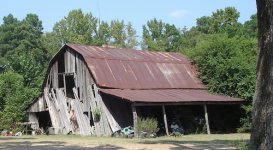
Then you would have something like this in 150 years maybe,, leaning-barn-2.jpg
 
/ Pole barn on plate? #51  
I think we all agree a two-story building on dirt doesn't make any sense. Most in my neck of the woods choose pole barn type construction as the most economical for hay, equipment etc. They appreciate their decision to build that way means it will have a limited life over other more conventional methods (and is a lot less work and $$) because the poles they have built off of will start to rot the day they are placed in the ground.

I'm not claiming to be an expert on this, but I have done quite a bit of repair work on fences and a variety of buildings. In every case, the rot is at ground level and once you get into the ground, the posts look brand new. If a pole building has the water running away from the building and the posts are protected by the walls so they don't get wet or sit in water, then there is no telling how long the posts will last. The oldest I've worked on was close to a hundred years old and the posts where pine coated in tar.

There is so much strength from a post in the ground to support the wall that it doesn't make much sense not to do it. Drilling the holes is simple enough. I've done it with a friend and a hand held post digger that we rented, and I've done it with a 3 point post hole digger. Then putting them in the ground and lining them up is just a matter of running a string and several long tapes to the corners to get it all squared up. Once this is done, the rest is a piece of cake. What contractor with any experience wouldn't do this is beyond my comprehension and a HUGE red flag.

Eddie
 
/ Pole barn on plate? #52  
There is so much strength from a post in the ground to support the wall that it doesn't make much sense not to do it. Drilling the holes is simple enough. I've done it with a friend and a hand held post digger that we rented, and I've done it with a 3 point post hole digger. Then putting them in the ground and lining them up is just a matter of running a string and several long tapes to the corners to get it all squared up. Once this is done, the rest is a piece of cake. What contractor with any experience wouldn't do this is beyond my comprehension and a HUGE red flag.

New England is rockier than most places. A lot of places the ground is mostly rock with a thin sprinkling of soil. A rock the size of a car is considered "medium-sized." Maine is rocky by New England standards. Generally, you're not going to be able to drill a row of holes with a 3-point post hole digger. For residential construction the usual practice is to dig until you hit something that doesn't move. If you must have a basement you blast it with dynamite, otherwise you leave it and pin the foundation to it with rebar.

I have three buildings on my property from the 1800's with basements. They didn't dig basements back then, only a fool would. The floor of the basement is at the original grade, a stone foundation was built on it and "dirt" (mostly rocks) was piled up around the sides so the building is on a little hill. An untreated 6x6 sill rests on top of the foundation wall and is held only by gravity and friction. There are many buildings around here that have lasted 150 years or more using this construction. The walls of the basement are desk-sized rocks they found lying around the property. I still have a few more...

I'm not saying the proposed construction is a good idea, just that a pole barn isn't always possible. I think that may be what the contractor is saying in a roundabout way.
 
/ Pole barn on plate? #53  
I'm not familiar with building in New England, and appreciate hearing about it. While I can understand the difficulty of drilling through rock, I would think that if rock is there, then bolting to it sounds like another option.

Eddie
 
/ Pole barn on plate? #54  
Regarding modern stick built residential construction on top of a concrete slab...

My wife used to work for a large residential builder in the Dallas area. One of their "better than the other guy" selling points was that they not only nailed the base plate down, but they also put anchor bolts down through the base plate every four feet. Said it was tornado proof.

I just laughed when I heard that. Okay, maybe the base plate is tornado proof. But all the vertical studs are still only nailed down to that base plate. If a tornado hits your house, you're going to be left with a slab and a base plate instead of just a slab.

xtn
 
/ Pole barn on plate? #55  
I'm not claiming to be an expert on this, but I have done quite a bit of repair work on fences and a variety of buildings. In every case, the rot is at ground level and once you get into the ground, the posts look brand new. If a pole building has the water running away from the building and the posts are protected by the walls so they don't get wet or sit in water, then there is no telling how long the posts will last. The oldest I've worked on was close to a hundred years old and the posts where pine coated in tar.

There is so much strength from a post in the ground to support the wall that it doesn't make much sense not to do it. Drilling the holes is simple enough. I've done it with a friend and a hand held post digger that we rented, and I've done it with a 3 point post hole digger. Then putting them in the ground and lining them up is just a matter of running a string and several long tapes to the corners to get it all squared up. Once this is done, the rest is a piece of cake. What contractor with any experience wouldn't do this is beyond my comprehension and a HUGE red flag.

Eddie

I'm no expert either, and I'm certainly not disputing the strength of pole type of construction. When putting up a building recently things I wanted to consider were longevity and costs. From what I learned talking to local builders, farmers and people like me who just have a few hay-burners and need some shelter and hay storage, is that a pole barn construction is considerably cheaper to build but will not last as long as a building with pressure treated sills on concrete up off the ground. The discussions then turned to which method to use; is a building on block going to last as long as a building on footings / four foot frost walls, I don't believe so but I am uncertain how much of a difference there is in longevity between the two types of construction while I do know it is considerably cheaper to build on block.

As always of course site preparation is key, you still need to clear all top soil, bring in clean dirt and properly compact and grade the site prior to laying the block. If you do the proper prep work it would be interesting to know the difference in lifespan of two identical buildings, one built on block and one on footings / concrete wall. Would make for an interesting discussion.
 
/ Pole barn on plate? #57  
The discussions then turned to which method to use; is a building on block going to last as long as a building on footings / four foot frost walls, I don't believe so but I am uncertain how much of a difference there is in longevity between the two types of construction while I do know it is considerably cheaper to build on block.

As always of course site preparation is key, you still need to clear all top soil, bring in clean dirt and properly compact and grade the site prior to laying the block. If you do the proper prep work it would be interesting to know the difference in lifespan of two identical buildings, one built on block and one on footings / concrete wall. Would make for an interesting discussion.

I have to disagree with you. Nothing is going to be cheaper then putting poles in the ground, especially if you are not planning on pouring a concrete pad. If you are pouring a pad, the cost of the concrete becomes a factor in comparing pole construction to stick built. If there isn't going to be a concrete floor in the pole barn, it's easily half the cost of any other type of construction except maybe building it on skids for a small structure kind of what the OP asked about. Of course, I would consider any building on skids, or just a heavy duty sill plate to be a temporary structure, not a building that will last.

Using block requires a concrete footing. Digging this footing to the required depth will vary in cost depending where you are located. Some places, like here, it's just a foot because we don't have any freezing concerns. If you have to do down several feet, then this becomes quite expensive. Then there is the rebar and the cost of concrete before you even get to the blocks and what they cost.

Eddie
 
/ Pole barn on plate? #58  
So let me describe a bit more one of my buildings.

I have a barn that is 36x28, 16' at the eave. It is post and beam, which is actually similar to pole barn construction, think of it as a pole barn built without metal fasteners and without digging holes. It has a dry-stacked stone foundation. On the foundation is a 6x6 untreated sill all the way around. The sill is not fastened to the foundation in any way. The frame of the barn is 6x6x16 posts on 12' centers, four on each side. There is a 6x6 top plate that rests on top of the posts, and rafters support the roof. Between the posts are 2x4's that hold the 1" board sheathing. It has a lot in common with a pole building, it might even be considered flimsy by modern standards.

According to the tax records, this building was built in 1850. The oldest building in town has essentially the same construction, with hewn beams instead of sawn. It was built in 1690.

I guess my point is it is possible to build a long-lived building on just a heavy sill. I think you really need to know what you're doing though.
 
/ Pole barn on plate? #59  
I have to disagree with you. Nothing is going to be cheaper then putting poles in the ground, especially if you are not planning on pouring a concrete pad.


Using block requires a concrete footing.

Eddie

Actually Eddie what I had said in my post was that "pole barn construction was considrably cheaper to build", no argument there. As far as using block requires using concrete footings, not necessarily the case. Remove top soil down to the hard pan, replace with sand, compact that and then lay your block, invert a course of starter shingles so your wood doesn't touch the concrete, water seal 6x6 PT sills and then stick frame on top of that. I would suggest that this construction method sits between pole barn (cheaper) and a stick frame building on concrete walls with footings (considerably more expensive) as far a longevity goes, and only because of the potential for damage caused by heaving that can occur with a building resting on block on grade.
 
/ Pole barn on plate? #60  
Whew, I thought I knew something! I don't know nary a thing! But, I'm full of questions. I'm planning to build about 36'x36' (maybe 36'x40') this summer, pole barn or post/beam type. Okay, I am planning to dig holes about 8' on center (will change this as necessary, maybe 6' or 10' on center), 3' deep by about 8" square form and pour concrete in the forms up to where all of them are level. Can y'all picture what I'm talking about? It'll be a heap of concrete square "posts" sticking up all level at least 8" above ground level at the lowest point. I'll insert those galvanized post attaching thingamabobs while concrete is still soft and attach me 6x6 ground contact treated posts to them when cured. Then I'll run treated boards around the bottom of posts, notch out for headers at top (10' at eaves) and put up me trusses. I'll put plenty of boards laterally around the barn to later attach siding when I can afford siding.

I'm in Georgia, so hard clay dirt, but don't want me posts in ground. I'll do work meself with helper. So, Eddie, what ye think about me plan? I know you're a builder, so I trust your advice.
 
 
Top