Thanks, I'd no idea as to the name of the software. I expect to pay for it but don't know what is reasonable, is $200 about right for the manual J?
Keep in mind, Wrightsoft is only one software program out there of many out there (Wrightsoft probably is one of the most expensive ones out there, and I'm thinking that becomes a racket as well).
A room to room load will proably cost more than a block load, and I'd guess the sqaure footage would determine. I looked online, and it seems my guess was right.
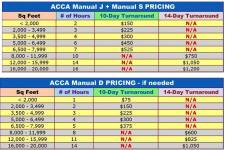
Thing is, what is just as important is ensuring that you get proper airflow to each room to hit the heating and cooling criteria for each room (where manual D comes into play). There are also a lot of variables at play with new homes being built to ensure that the garbage in is the right garbarge out. My house was built in 88, 3,500 sq ft, I did the load and ductwork (to verify it was correct, as the house sat unoccupied for at least 5 years) and it came out to what I had installed, 7 tons (lots of window square footage with windows made in '88). JK96 house is a newer (I assume) 4,600 square ft house, and he figured it only needed an actual 5 tons.
After time with experience, take size, age, windows and shade and generalize the insulation, a decent contractor can get a pretty good idea with adding or subtracting to a rule of thumb guys use if needed (technically it should always be needed but the reality of money is it isn't), but with newer, tighter homes you don't need the same cooling and heating capacity for a home built today vs a home built 20-50 years ago.
The nice thing with most good inverter mini splits where heating is required is you can oversize the cooling to meet your heating criteria.
Thing is, from the same manufacturer, one 2 ton single zone mini split system will give you 25,000 BTU/h of heat @ 5F OAT, and another model from the same manufacturer will only give you 15,000 BTU/h of heat @ 5F OAT. Lots of HVAC contractors IMO only care about the SEER rating and don't look at the actual heating capacity or take the time to explain the differences to the homeowner. People think that if they get a 2 or 3 ton multi zone mini split, they are getting 2 or 3 tons of heating, and that is generally never the case.
For straight AC, it's hard to beat even a multi zone mini split, but where it gets tricky is when the heating exceeds the cooling for the same space (and it does happen often, even in my area in NC). Think about this, on most 24,000 BTU/h AC systems used, if a gas furnace is used, the size of the furnace generally starts off is 35,000 BTU/h net output for heating.


