Need input on insulated/heated water supply hose-

   / Need input on insulated/heated water supply hose- #1  

CBW1999

Platinum Member
Joined
May 11, 2008
Messages
832
Location
Northern Vermont on the 45th parallel
Tractor
Kubota 7510, Toro Groundsmaster 217D
As always- a bit behind on getting ready for winter. This is not an urgent need as I am able to haul water daily to the animal shelter but would make life a lot easier. Winter temperature is well below freezing for the most part. All water comes off out well. The total run would be about 175 feet.

Eventually I will bury a supply line to a yard hydrant. Until then I was thinking of using a heated supply line above ground. I have looked at commercially available heated hose and the cost is too much.

I have come up with several concepts based on some things I have seen done for water lines running to an outdoor boiler.

The basic idea- 1 inch black poly water line wrapped in clear bubble wrap and placed inside 4 inch black solid drainpipe. This would be left exposed with the far end set to drip. In theory, sunlight will keep it thawed during the day and dripping will prevent freeze at night. My biggest issue is wasteing water with any type of drip system.

The "fancier" ideas is to run roof/gutter deiceing line along the black poly water line, foil tape it in place then fabricate the same as the "basic" idea. Wouldn't need to set it to drip but, now it is electricity usage to be concerned about. Secondly, over time would it degrade/melt the buble wrap? The roof/gutter type is the closest to cost effective as well as being able to run that length.

Now for the kicker- When it comes time, I just assume bury the set up as is to the yard hydrant. Once buried- probably not a need for the heating aspect (although our frost can get deep) and would hate to waste the money.

What are your thoughts and suggestions?
 
   / Need input on insulated/heated water supply hose- #2  
Get 1'' blue Pex, and a frost free hydrant, buried 6' down should eliminate any problems. Its cheaper to do it right now, and save money and not worry about freezing over the winter.

Dave
 
   / Need input on insulated/heated water supply hose-
  • Thread Starter
#3  
Get 1'' blue Pex, and a frost free hydrant, buried 6' down should eliminate any problems. Its cheaper to do it right now, and save money and not worry about freezing over the winter.

Dave

I would have to rent a mini excavator to be able to trench for this project. Financially, that won't happen till next spring at the earliest.

I suspect there is an advantage of using pex as compared to the "traditional" black water line? Can you shed some light on going that route? I'm open to suggestions..
 
   / Need input on insulated/heated water supply hose- #4  
Get 1'' blue Pex, and a frost free hydrant, buried 6' down should eliminate any problems. Its cheaper to do it right now, and save money and not worry about freezing over the winter.

Dave
PERFECT ANSWER,do it right once and be done.
 
   / Need input on insulated/heated water supply hose- #5  
Pex comes in 100' rolls or longer and very flexible. It will expand when frozen and not break. If you do your above ground solution; I guarantee you will wish you hadn't and money down the drain. If a buried line is done per plumbing code it has to be buried beneth the frost line. Never lived where it is a cold as you get. I know folks in Alaska (-40-50) and they bury 6' down. Trying to prevent freezing by flowing water gets dicey when you get below 20 degrees. Years ago i was working in a paper mill, we installed 500' of 4" steel water line out in the open. It was 10 degrees with a 40 mph wind. Turned on the line and never got water out the other end. It froze somewhere in the middle on the way at 125 psi. Takes more that a drip and then only in mildly freezing weather. I do not envy your winters, here we are lucky to see 10 days a winter below 25 degrees.

Ron
 
   / Need input on insulated/heated water supply hose- #6  
We fill our horses' water tank weekly. We use a good quality garden hose that stays flexible in the winter. Then we disconnect the hose and drain it carefully. I have toyed with putting up a poly pipe with a continuous slope to the tank. I figure then I could fill the tank and when I shut it off and disconnected it from the house- it would drain itself. Frost depth to be safe in central Maine is 5' deep. I can live without the hydrant and permanent line. The dirt is rocky and hardpan begins at 4'. -Not fun to dig.
When draining a hose- disconnect from house (remove nozzle too), leave it in a line. Hold it in a loop above your head and pull it to you- coiling the drained end. As you pull it- and hold it above your head, the water drains out the far end. Take your time to give the water a chance to flow out. If you have a deck to stand on - all the better. It is possible to do this with temps well below below 0. Use a styrofoam faucet cover. I shut mine off in the house, then that allows the outside faucet to drain before I shut that off and cover it up. I hate frozen lines! Filling the tank when it is sunny and 15 degrees is a cakewalk when you get used to it! Drain and store the hose in short sections - helps with preventing it from freezing. When you have bad luck- overnight in the bathtub thaws the hose.
Drips with VT. temps will never work- will freeze every time- the whole way.

5/8 garden hose, stock tank heater - floating or sit on bottom of tank (either keeps water from freezing), you can make your own extension cord by running UF (white, black,bare) # 12 or 14 gauge wire out to tank over the ground (don't run it over with mower or snow blower or plow) to the tank from an outlet/grounding wet outlet, etc.. Just put plug on one end and plug in on the other end.
This is not code of course- jury-rigged, but works. Voltage drop should not be a problem as the stock heater is not a high wattage. If in doubt- use #12 gauge UF wire. Use all three wires so that it is grounded. Support the tank well-- couple level pallets covered with boards or plywood, etc.. I like metal/galvanized tanks- no problem with heater, lasts forever. Ice will crack the poly tanks.
-good luck.
 
Last edited:
   / Need input on insulated/heated water supply hose- #7  
When I ran my water from the well to the building site, 25+years ago, I rented a walk behind "ditch witch". Didn't cost much, I think about 50 bucks for an afternoon, and found that it would dig about 6 feet per minute in our soil at a depth of around 2.5 feet. I ran a trench 175 feet from the well to where the house is now in no time even up a steep bank. I also ran another couple of 600 foot trenches for other hydrants around the place all in less than 4 hours. Filled the trenches with 1 inch black poly pipe that they sell at HD. I think that you should just do it right the first time, and not have to worry about it, and redo it next year.
 
   / Need input on insulated/heated water supply hose- #8  
I've seen a product used in outdoor wood boiler setups which is a pex tube surrounded by insulation and a 4-inch corrugated pipe. Might be helpful for this application.
 
   / Need input on insulated/heated water supply hose- #9  
As always- a bit behind on getting ready for winter. This is not an urgent need as I am able to haul water daily to the animal shelter but would make life a lot easier. Winter temperature is well below freezing for the most part. All water comes off out well. The total run would be about 175 feet.

Eventually I will bury a supply line to a yard hydrant. Until then I was thinking of using a heated supply line above ground. I have looked at commercially available heated hose and the cost is too much.

I have come up with several concepts based on some things I have seen done for water lines running to an outdoor boiler.

The basic idea- 1 inch black poly water line wrapped in clear bubble wrap and placed inside 4 inch black solid drainpipe. This would be left exposed with the far end set to drip. In theory, sunlight will keep it thawed during the day and dripping will prevent freeze at night. My biggest issue is wasteing water with any type of drip system.

The "fancier" ideas is to run roof/gutter deiceing line along the black poly water line, foil tape it in place then fabricate the same as the "basic" idea. Wouldn't need to set it to drip but, now it is electricity usage to be concerned about. Secondly, over time would it degrade/melt the buble wrap? The roof/gutter type is the closest to cost effective as well as being able to run that length.

Now for the kicker- When it comes time, I just assume bury the set up as is to the yard hydrant. Once buried- probably not a need for the heating aspect (although our frost can get deep) and would hate to waste the money.

What are your thoughts and suggestions?
Im not sure of your budget, but the self regulating heat tape below can just be taped straight along the pipe. There is no danger from overheating in any configuration because it automatically adjusts heat on every portion of its length and puts out no heat in any place that is warm. Scroll to the bottom of the page for the ready made which is much cheaper. ... but not cheap.

McMaster-Carr
 
   / Need input on insulated/heated water supply hose- #10  
I've seen a product used in outdoor wood boiler setups which is a pex tube surrounded by insulation and a 4-inch corrugated pipe. Might be helpful for this application.
That is good stuff but is two lines and about $12.00/ft.
 
   / Need input on insulated/heated water supply hose- #11  
I've seen a product used in outdoor wood boiler setups which is a pex tube surrounded by insulation and a 4-inch corrugated pipe. Might be helpful for this application.
thats what I was going to recommend. what about keeping the air compressor at the house so you can fill and then blow out the hose/ water line so it doesnt burst?
 
   / Need input on insulated/heated water supply hose- #12  
I used to run a lot longer waterline above ground (300'+) to a horse water trough from the house. I just used 160 psi plastic pipe. Now I have it buried with Woodford Iowa frost free hydrants. The key to an above ground line is to have the filler end raised above the ground level so that it can be drained completely. Since it can take a few minutes to fill the trough, the ground water temperature will heat the plastic pipe well above the freezing point so that no ice will form in it during the filling. Then the water will completely drain out. Use a water tank heater to keep the trough from freezing. Plumb in a shutoff valve and an air inlet valve so that the line drains quickly.

You probably don't need to do this everyday, maybe 2ce a week or so? Get a trough big enough to reduce the number of fills. Be sure to add below ground shutoff valves (Street or City type) in the lines if you have several shunts off the mainline. This is in case a future break occurs underground from a stone puncture or a clamping failure. Use all brass fittingds and stainless steel clamps. Run an electric line in the trench when you bury it because you will want tank heaters at or near every hydrant (where the troughs would be).

I recommend the Iowas because they are easy and cheap to fix later on in life. Kits are available to replace the seals and stopper all without digging them up.
 
   / Need input on insulated/heated water supply hose-
  • Thread Starter
#13  
When I ran my water from the well to the building site, 25+years ago, I rented a walk behind "ditch witch". Didn't cost much, I think about 50 bucks for an afternoon, and found that it would dig about 6 feet per minute in our soil at a depth of around 2.5 feet. I ran a trench 175 feet from the well to where the house is now in no time even up a steep bank. I also ran another couple of 600 foot trenches for other hydrants around the place all in less than 4 hours. Filled the trenches with 1 inch black poly pipe that they sell at HD. I think that you should just do it right the first time, and not have to worry about it, and redo it next year

]Didn't think of a ditch witch- have several projects for a mini excavator and thought of doing it all at once. I think one of the rental places has a larger unit that would go as deep as i need to. It seemed to have a big trenching arm on it- .

I've seen a product used in outdoor wood boiler setups which is a pex tube surrounded by insulation and a 4-inch corrugated pipe. Might be helpful for this application.

This is where I got the idea to make my own- with the addition of heat tape[/

what about keeping the air compressor at the house so you can fill and then blow out the hose/ water line so it doesnt burst?

Given some thought to this- we used to do that in the winter on the 1 inch booster line on the engine. It was a reel unit so it worked rather well. Not sure how i would set it up with the line left stretched out///at least without having to walk back and forth to open and shut valves[/I
 
   / Need input on insulated/heated water supply hose- #14  
Yes a trencher is the way to go for a waterline, I rented one 10 years ago for 175 dollars for the weekend, we trenched 800' of 1" waterline,6' deep. Rental is probly double now.

If you go with black plastic be sure to use brass barbed fittings, stainless clamps and T handle torque wrench made for hose clamps.

You can heat the pipe with a heat gun or torch just untill it starts to turn glossy, slide fitiing in, and clamp. Pex is much easier to work with.

Like said before run your wire in the trench also, this can also be a benifit if you ever have to locate the waterline, with an electronic locator.

If you have a stock tank and dont need a hydrant then use a ball valve underground with a T handle atached to turn on and off, you will need heat tape and insulation.

Dave
 
   / Need input on insulated/heated water supply hose- #15  
6 ft sounds perfect for laying water line- no fear of frost reaching it, and if in spots you can't get to the six- you'll still be below 5. What is your frost depth?

Back when we used to get 25 below with a wind- the 1.5 inch pipe coming from the well would freeze just below where it entered the house in the crawlspace- despite being foam insulated and wrapped very thickly with fiberglass batting. Cold penetrates- plan ahead.
 
   / Need input on insulated/heated water supply hose-
  • Thread Starter
#16  
6 ft sounds perfect for laying water line- no fear of frost reaching it, and if in spots you can't get to the six- you'll still be below 5. What is your frost depth?

Back when we used to get 25 below with a wind- the 1.5 inch pipe coming from the well would freeze just below where it entered the house in the crawlspace- despite being foam insulated and wrapped very thickly with fiberglass batting. Cold penetrates- plan ahead.

6 feet would be a minimum, heavy clay soil and ledge in areas although where I want to run it- I can go down far enough.

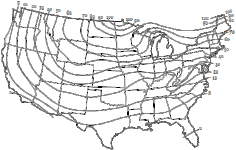
mhf_map_frostheave.gif

This chart is used for determining foundation depths based on the frost level. 70 to 80 inches down in out area is a possibility. Even with a yard hydrant that drains the stand pipe, I may still need to install componenets to drain out the line or blow air through it.

It would appear that getting a 300 gallon skid tank, floating heater and running electricity to it might be the better option. I would ony have to top it off every 10 to 14 days. Whatever method I use to refill, the less often I have to drag hose or exert myself during the winter will keep my cardiologist happy with me..
 
   / Need input on insulated/heated water supply hose- #17  
Ask for a trencher with a frost tooth digging chain, they have carbide tipped cutters, they realy dig!

Dave
 
   / Need input on insulated/heated water supply hose- #18  
I wouldn't waste my money on the pex with the insulation for the boilers. I do not think it would help in your situation. Boilers have pumps that cycle the water through a loop. If you put your line deep enough you will not need to worry. If you don't and the water sits for any time it will still freeze regardless of the amount of insulation you have on the pipe. Depending were you tap into your water, you may have to use heat tape until you get below the frost line.
 
   / Need input on insulated/heated water supply hose-
  • Thread Starter
#19  
I appreciate all of the information members provide. Certainley is worth the time to save wasted money.

For this winter, I will be getting a 275 gallon tote and using a submersible heater in it. I already have the appropriate electrical wire to run out of the way/not burried yet. The suggestion of gravity drain back is likely the method to prevent freezing- I just have to be careful where I direct runoff.

Crunching numbers really is leading me to using an excavator for the job. I have multiple other needs for the unit as opposed to a single purpose for a ditch witch. In addition, I know I will be able to dig deep enough to avoid the frost line without question.

Of course, the thought of moving to a warmer climate always seem to be suggested by my wife.....
 

Marketplace Items

iDrive TDS-2010H ProJack M2 Electric Trailer Dolly (A59228)
iDrive TDS-2010H...
Case Axial-Flow Combine Wheels NO RESERVE (A61307)
Case Axial-Flow...
2014 Ford Transit Connect XLT Passenger Van (A59230)
2014 Ford Transit...
Bigfoot Plastic Baler (A57148)
Bigfoot Plastic...
2017 FREIGHTLINER CASCADIA TANDEM AXLE SLEEPER TRUCK (A59905)
2017 FREIGHTLINER...
2013 VOLVO EC250DL EXCAVATOR (A60429)
2013 VOLVO EC250DL...
 
Top