My Solar Panel Power Project

/ My Solar Panel Power Project
  • Thread Starter
#21  
Solar Power Thoughts, Part 2:


Now lets think about a day where the temperatures are in the 95 to 105 degree range. This is when the electric utilities are at a maximum load. In fact, many utilities on these sorts of days will do two things to get more power. They will try to get power over the grid from areas where it is not so hot, and they will bring power generating units called Peaking Plants on line.
There is only so much power that you can get through the grid. There are both losses sending power over transmission lines, and limits as to how much power you can send over these lines. The power has to come from a near by part of the country where it is not so hot. That might be due to the time of day, it might be taking power from more northern (and hence cooler) areas, and it might be because some area has cloud cover. But we have also seen times when, for example, the entire U.S. east of the Mississippi had temperatures over 90 degrees from Miami to Maine. Increasing the grid capacity is very expensive. A high voltage transmission line can end up costing about $1 million per tower. It takes years to put one in since no one wants one near them (NIMBY).
Peak plants are small generating facilities that can produce between 50 and 200 Megawatts. Their electricity has the highest cost of production. A typical coal or nuclear plant produces 1200 Megawatts. These plants cost between 3 and 5 billion dollars. Often peaking plants are run by jet turbines (aka aircraft engines). A single engine on a 747 can produce 50 megawatts of power when it connects to a generator. These plants can be brought on line very quickly and their power output changed very quickly. They burn jet fuel or natural gas or diesel. They also cost $50 million to put one 50 megawatt unit in place. This is a hard number to exactly track down so if anyone has a better number let me know. There are many NIMBY problems with siting these plants as well as fuel supply logistics.

So lets look at the stage we have set with the above assumptions. We have a typical house one a very hot day. The air conditioner or heat pump is running about 65% of the time drawing one killowatt. When every gets home from work, they will bump the temperatures down and draw 1800 watts. The utility distribution grids are maxed out, and lots of jet fuel is being burned to add more power to the electric grid.

Now what happens if half of the houses have the 2 KW solar panels on them? Well, a house with solar panels that is running its air conditioning will use 1 KW and export 800 watts out for the house next to it that does not have panels. That house needs 1KW. But both are running at about a 65% duty cycle, so the net result is that all the residential cooling demand in an area is met by the solar panels with a little bit left over. Now the businesses still need power, but the demand on the electric grid is much lower. The peaking plants do not have to run, the PV systems make the peak power. The distribution grid has the ability to distribute energy and not be overloaded since the power is added all over the grid, right where it is needed.
 
/ My Solar Panel Power Project
  • Thread Starter
#22  
Solar Power Thoughts, part 3:


So what does a 2 KW solar system cost? Well, today the cost of the parts is around $10,000. Installers tend to double the cost of the hardware so it would cost $20,000 to have it installed. Now imagine a _lot_ of houses having these systems, leading to volume in the millions of systems. A lot would be come standardized. The installed cost of these systems could be about $10,000 or $5 per watt.

Here is where it gets crazy. Imagine 20 million systems installed on houses at a latitude of 40 degrees or less. This is a line at the bottom of Pennsylvania, the middle of Indiana, the border between Kansas and Nebraska and the middle of Utah. You would probably have about 50 percent between the Mississippi and the Atlantic ocean, 20 percent in the west, and 30 percent in California. Now lets look at the East Coast on a hot day. You would have 10 million houses putting out say 1500 watts each (allow for differences in the angle of the sun, panels aging, and other things that would have the system not quite at peak capacity.

Thats a total capacity of 15 gigawatts of power. That is 12 big power plants, or 300 peaking plants. The cost of those big power plants is about 45 to 60 billion. The cost of the peaking plants is about 15 billion but the fuel they burn is more expensive and most of it is imported. The cost of new transmission lines is avoided, and that might run about 40 billion to upgrade the entire east coast. So the solar panels replace between 85 to 100 billion dollars worth of costs. Those panels will cost 100 billion dollars.

Repeat this exercise on the west coast.

So $200 billion means all of our summer peak power problems go away. We do not have to substantially improve the distribution grid and can focus on smarter improvements to the grid not just raw power capacity. We stop burning imported petroleum in a fixed point of use situation, which helps on pollution and takes some of the pressure off of fuel prices. There are lots of jobs created installing and maintaining these systems.
 
/ My Solar Panel Power Project
  • Thread Starter
#23  
Solar parts, part 4 (and the last one):


There is a problem with how to finance all this. In a working world, the extra $10,000 would be part of a mortgage. You might even go to a 35 year mortgage to get the panels and improve the insulation in a house. Two problems here. Most people value granite counter tops and stainless steel appliances over energy efficiency. The second problem is that as we致e seen by recent events, the mortgage industry is somewhere between dysfunctional and run by clowns.

So why is it we can give the clowns $200 billion but not take that same money to solve energy problems and create jobs?

There are a lot of number and assumptions here. Lies, Dam Lies (we can solve our energy problem by just building more hydro plants), and statistics. Depending on what point of view you think is right, you can cook the numbers. So if anyone has better numbers than I show here, let me know and I will update this document. Note also I have not dealt with the cost of power, just kilowatt capacities and cost of plants. As the cost of power goes up, and as more parts of the U.S. go to time of day or peak billing, the economic feasibility of solar panels gets better. I have also not attempted to deal with indirect cost such as pollution, effects of more transmission lines (both real and NIMBY subjective), indirect cost of fuels both to create and then store waste products, health cost from pollution and the like. While natural gas looks good, there is a hidden cost of pollution due to the rock fracturing process. I have also not touched on global warming since that tends to stop all thinking on all sides faster than touching on religion.

Federal subsidies could encourage systems built with 65% US manufactured content. That and a commitment to this sort of volume would go a long ways to solving a lot of problems, both energy and loss of industry in the U.S.

I do think that if you deal with this in purely capitalistic cost terms, it will never happen because hidden costs don not count in capitalism. PV solar cost three to six times what coal cost. But if your peak power rate is three times the night time rate, then the peak cost of solar isn not far off the mark. I think if you view this more as a go to the moon or We must have a strong defense point of view, then the numbers are close enough that such a program could move forward with the realization that dealing with this now will be somehow better than ignoring it and waiting for a crisis. In the 70s we saw heating oil prices go up by a factor of 10. After Hurricane Katrina gas prices doubled. We are all living on the edge because it is the cheapest and we are moments away from game changing energy costs. There will hidden benefits that we can not even predict to this. Let me get off my soapbox now, and lets see where the discussion goes if we focus on the numbers - and more importantly the thoughts- I have used here today.

All I want is for people to think about if solar has a place in the U.S. If people reading this think there is no way it will ever be part of a solution, then that is OK and I thank the reader for taking time to think. It is the first step in solving any problem.

:)

Pete
 
/ My Solar Panel Power Project #24  
I like that 4 point write-up. It has merit. My view is that the more systems that are installed the lower the cost will be in the future. Everytime a system is installed I smile cuz I know eventually I might be able to afford one.
 
/ My Solar Panel Power Project #25  
Looking into it at the farm... thanks for the write-up :thumbsup:
 
/ My Solar Panel Power Project
  • Thread Starter
#26  
I've looked into it and the cost just doesn't justify doing it for me. I really do like the idea of not having to pay for power. But Vermont isn't one of the sunny states so that pushes out the ROI time. Does your state have a special price the utility must pay you for the power or do they just give you wholesale price. I don't know for sure but I've been told the new digital meters track both in coming and returning power independently so they know how much you've supplied.

Al, I have a digital meter that records both forward and reverse power. I pay for forward and get paid for reverse. North Carolina has a net metering law, so for grid tie systems you can get what you pay for power, but if you over-supply they will not cut you a check. So you pay for the net amount of KWH you use, but they won't cut you a check.

The power is being purchased by NC Green Power. They have a web site. Basically, they pay more than what the utility would under net metering. They get their power from people who wish to pay a bit more to purchase green power. If you have over 10KW (in NC) you are classified as a power generator and you get paid the burden rate for your power. So the rates are:

Burdon Rate: about 6 cents
My rate at he house for power I use: about 10 cents
What I get for my green power: about 15 cents.

I had to get a new meter and drop because the house if 400 amp service, and the meter base does not have CTs (current transformers). My power co-operative did not have a digital two way meter that would plug in. On the plus side, I've got an extra 100+ amps of service by the outbuilding garage if I need it.

Pete
 
/ My Solar Panel Power Project
  • Thread Starter
#27  
Aside from why you did this in the first place - did you look at tracking systems instead of the fixed array and if so what swayed you to the fixed system?

Once I get the data logging up and running, I'll get some idea of what the penalty is for off angle usage. Then I can figure out what kind of cost for a tracking system would pay off down the road. So fixed and simple for now, it's what a lot of houses would have. Then, figure out all the costs of a tracking system by looking at how this system performs.

Pete
 
/ My Solar Panel Power Project
  • Thread Starter
#29  
CinderSchnauzer, very interesting and good numbers for tracking vs. non tracking efficiencies. If we had that program down here, there's a good chance I would have gone tracking. If the tracking payback was 58 cents per KWH, there's no question I would have done tracking. A 46% increase in capacity is pretty impressive!

The mounting rails are about $1K in costs. The stainless steel hardware and concrete cost are about $1200 in costs, but could be used to hold other types of mounts.

It's pretty interestin to see how the various buy back programs affect what's being done. The NC Green Power set a maximum buy back amount based on my DC power rating of 7.77 KW. I'd be over that maximum with a tracking system. Maybee what's going on in Ontario will spread to other areas as the advantages of tracking catch on.

Thanks for the link :thumbsup:.

Pete
 
/ My Solar Panel Power Project #30  
Pete
I looked in to tracking for my system (off grid on roof of mt cabin).
for the expense of hardware for automatic and hazard to change it manually I decided to add an extra panel or 2 if necessary and forget about adjusting it.

But for our cabin we haven't had any problems with 600 watts (made space for 1200 watts) and 1560 ah of battery's

tom
 
/ My Solar Panel Power Project #31  
Excellent project. I'm hoping to see more of these projects so that the unit prices will decrease. I don't think that I can justify the cost of one of these systems myself at this time but perhaps in the future. I'm thinking that when we start building our new place I will probably spend a little bit extra in the beginning to make it easier to add a PV system of some sort in the future rather than spending more to replace stuff later on. Honestly I'm more of a fan of wind power and prefer the looks of a windmill to the looks of a PV array, but after doing a little research in some books and on the internet my area is not particularly suited to wind power. Actually it looks like we'd be better off with PV as far as alternative energy is concerned but at this point in time, with us being as far north as we are the costs are just too high. I applaud you for taking underaking this project and I truly wish that more people would follow suit. If a lot more people undertook this sort of project and economies of scale kicked in, I might be able to justify a PV system if it was about 25% less.
 
/ My Solar Panel Power Project
  • Thread Starter
#32  
Tom, glad your battery storage system is working for you. It is quite a task to figure out which way to go regarding mounts, tracking, number of panels, simplicity/reliability.

Lt., I hope the price comes down too. A big part of the problem is a lack of standard panel sizes between manufactures. They don't want to be generic and interchangeable, but that is what it takes to get the price down. The rail system could be a much better design, but I suspect the company in Utah that makes it can't afford a re-tool due to the volumes. The design they have takes a little more labor and thinking than I'd like. I do like that the silicon came from Japan but the mounts (aluminum and glass) are made in Tennessee and the mounts are made in Utah. Wire was all made in US, as was the DC combiner. At least the project has some US content, and maybee even an appropriate amount for a global economy.

The Fronious brand inverter I have is a top of the line, 96% efficient, unity power factor, and low harmonic distortion. But it has a common base for all the sizes from 2500 to 14000 KW. So there is a price to pay at the low end. If there was some clear high volume size (say the 2000 or 2500 watt system) the inverter could be tailored specifically to that size and it's cost would come down. I'd love to rip the skin of and look inside, but I don't want to void the warranty. That's an expensive but well thought out piece of equipment. It reminds me of what the U.S. used to be able to design.

There are some pieces missing regarding tying up the cables and the solar combiner. So anyway, with a mix of volume and smaller number of design sizes, and more standard mounts the price of the equipment and installation could come down.

We also need installers who won't just blindly double the cost of the hardware on all systems. If you've got $40K of hardware, maybee the markup could be "only" $15 for what the installer with no stock ordered. A lot of the installer base reminds me of the old home satellite days. Early installers had outrageous mark-ups. But with volume and competition, capitalism will deal with this. Many installed prices did not come down when the tax credits came along. Short term greed holds back long term progress.

One thing I found about wind systems is many are not very good with lightning. The one I looked at was made in some part of the west where there were few thunder storms. A small wind turbine design needs some sort of big post/shaft coming through it that the lightning can hit without taking out the unit.

Pete
 
/ My Solar Panel Power Project #33  
Great series of articles Pete and a really great project. Super job on the explanations and pics. I am a tad envious of your capacity versus cost.

We live totally off grid. Our system is also 36 panels at 125 watts each - 4.5 kw. These are arranged in 9, 4 panel arrays, roof mounted at fixed angle/orientation. Last year our system produced an average of 14.8kw per day, but that ranged from a low of 1.1kw to 27.5 kw. On the low days we had to supplement with our diesel generator - for a total of 310.4 hours. We have a 48 volt battery bank of Rolls Surettes (1350ah) and Outback FX3048 Inverters and MX60 charge controllers.

System ran about $60K installed, but that was 4 years ago. That cost doesn't account for my labor contribution. PV prices have come down a lot and I think tax incentives are better. We went off grid solar as there really was no cost effective alternative. I wasted almost the cost of 2 PV panels on a small wind generator on another (smaller) system on the property. We do have a small year round stream that teases my thinking about hydro, but it would be a major effort. To have hooked to the grid would have involved easements to run the poles and lines and besides not being cheap would have just bought me an ever increasing electric bill for the rest of my life.

Our house (4000sf) is "normal" electrically - standard sears appliances, plasma TV's, beer tap in addition to other refrigeration, and I run power tools. We also have a swimming pool. We do NOT have A/C or any HVAC for that matter. That said, we do live a bit differently in electrical usage than in our connected days. Example, would probably not run dishwasher, washing machine, or other high usage items at night unless generator happened to be running. In other words, more electrical intensive options are used on sunny days. Our usage was about 600kw per month last year. What that would translate into grid $$,I don't know, but grid power is very expensive here in Hawaii. I do know that we don't suffer outages in storms etc.

While it has been a learning experience, we are very happy with our system and glad we have it.

Perhaps in your future posts you'll write more about your monitoring system. As for me, every morning I walk out to my setup, record the numbers, then enter into a spreadsheet - not very high tech, but within my budget.

Thanks again for sharing.
 
/ My Solar Panel Power Project
  • Thread Starter
#34  
David, thanks for the information on your off grid battery system!

In addition to the changing prices on the panels, adding the batteries and generator definitely ups the costs, but as you point point when there is no economical alternative what can you do? Living off grid in an area where there is no need for HVAC sounds pretty nice.

I had about 2500 pounds of batteries that I got used that ran a repeater site I used to have. The life of those NiCads was about 16 years. Can't remember the amp hour rating.

I'm fired up to get something going on logging energy usage, I'll post as it happens but it might be a while.

Pete
 
/ My Solar Panel Power Project #35  
I've thought about this alot lately, my biggest hang ups, is my utility is a COOP so they offer no incentives, so I just have the Fed ones. They are still alot but its frustrating that if I was 20 miles to the north, I'd recoop alot more.

One thing I've always thought about is I like the grid tie in system idea, however we loose power a few times of the year due to heavy spring snow.
my understanding is for lineman safety they have to be wired such that if the incoming feed from the grid goes down, that your system shuts down also so you are not feeding watts back down the line. Is that correct? I think I'd be very frustrated if I had a Solar set up, its sunny outside, and I'm still without power because of a line break miles away.

I can't believe there isn't some kind of switch that would switch to a local circuit only (not feeding down the grid) if the incoming drops. that way you could still use the power you are making, and when the incoming feed came back up it would sense this and reconnect the outgoing.
 
/ My Solar Panel Power Project
  • Thread Starter
#36  
When NC got a net metering law, and a target goal for some percent of green energy, things changed. North Carolina also has a tax credit for installing lots of energy stuff, so that plus the Feds makes it possible.

With a grid tie system, the inverter shuts down if there is no commercial mains. It has to in order to get the required UL listing. That's fine, good feature, safety first.

I would love to have a way to tell the inverter that "I'm on my own". I am guessing that the problem is how to co-ordinate that with a mechanical switch (or electro-mechanical switch) so that you can not backfeed the grid.

There is also the problem of what happens when the power output of the array goes down? Do you risk damaging your compressor? How do you manage your load in a changing supply environment?

So I think what you want is doable, but suspect that the additional cost of some sort of inverter-controled electromechanical transfer switch would be a big expense in a low volume market. The low volume would come from the varying output of the cells during the day. You'd have to be a pretty savvy user to work with that.

For what it's worth, I did not connect the PV system after my transfer switch (on the same side as the generator). I'm pretty sure it wants to "push around" the grid and counts on that being an "immovable object". If the inverter was "pushing around" the generator, I think things would be unstable. The inverter has some pretty stringent requirements regarding the AC line frequency, and might also be unhappy if the frequency changed a bit on the generator as more load (like a heat pump kicking on) was added. It would be interesting to know if anyone has tried this, but I don't want to be the test case due to the cost of all the stuff I could blow up :laughing:.

Pete
 
/ My Solar Panel Power Project #37  
Pete,

That's a nice setup you have there. I have a 4.6 kW array on my roof that was installed in May of 2009. I used microinverters from Enphase that constantly report production to a control box in the house, which in turn is connected via the internets to the mother ship in California. You can see my installation here. My array faces SE and they are installed at a 26 degree pitch. I found this chart online which indicates that I'm not losing a lot compared to the optimum orientation (S) and tilt (33 deg).

The microinverters convert DC to AC at the panel, which eliminates high voltage DC runs through my attic. The system is described here. There are advantages and disadvantages to the system, and I'm not sure I would use the microinverters again if I was deciding today, but it does give you all of the instant feedback and history you could ever want - down to the individual panel.

My system had a gross cost of about $7.00/watt ($32k) and a net cost after electric company rebates and federal tax credits of about $2.50/watt ($11.5k). In the first year, the system generated about 17kWh/day and I used about 10.5 of that and pushed the other 6.5 out to the grid. I pay about .09/kWh for incoming and sell my excess for about .065/kWh.

Even with all of the incentives, if electricity prices don't rise it will take about 20 years to break even. However, I don't think it's necessary to recoup all the costs with electricity savings, since the system probably added about $10k to the value of the house. That's based on annual operating cost savings of at least $500 times 20. I don't know if that's actually backed up with empirical evidence, or if it's just a marketing ploy, but I do think it does add value to the house, like high efficiency replacement windows would.
 

Attachments

  • IMG_0773 (Small).JPG
    IMG_0773 (Small).JPG
    49.9 KB · Views: 248
Last edited:
/ My Solar Panel Power Project
  • Thread Starter
#38  
Nice setup bill :thumbsup:.

With my open field, the micro inverter approach is not as beneficial as residential with trees that might shade part of the array. I'm not smart enough to know which system (single inverter vs. micro inverters) will win or even if there will be a winner. The reliability and aging characteristics of the panels will determine if per-pannel information is worth the cost.

I found a site that did an annual output vs. tilt angle, so even though I'm at a 36 degree latitude, my array is at 30 degrees. This maxed out the annual production (for a fixed angle array).

The Enphase stuff is pretty nice. I wanted a more open system, and all the stuff I'm working on for monitoring will be open. I see a lot of the energy aspects of a house tying into the home automation parts. The ability for the user (or a systems integrator) to select what is graphed and monitored might find some interesting thing that would be missed with a more targeted (albeit nicer looking) approach.

Tnx for your cost numbers too. The "dollar a watt" dream point of pricing is a ways off, and I suspect that increases in electric costs and billing structures might push that to $2/watt as the point where things are more viable. If you're going to be an early adopter, you are also taking some risks with the economic side.

As for what value does PV add to your home, in time it will be like a heat pump or furnace. You have infrastructure in your home (wiring, meters, support structures) and it is understood that you change out the guts (panels and inverters) every 20 years or so.

Pete
 
/ My Solar Panel Power Project #39  
Pete,

I see where Enphase is now offering a thermostat that is connected wirelessly to the Envoy. You can control your thermostat by logging in to your Enlighten web page. At $350 each (I would need two) plus monthly monitoring fees, I'll pass for now.

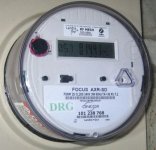
I have a "smartmeter", which measures incoming and outgoing energy and communicates with the transmission company's computers for remote monitoring and billing. I'm guessing you have a similar or identical meter? In Texas, we have a portal where you can monitor your incoming electricity in 15 minute increments. You can also add up to 5 HAN (Home Are Network) devices to your smartmeter account. I'm not sure about the capabilities of this site, i.e. whether you can control those HAN devices, or just monitor them. This sounds like the type of program that you are looking into for your installation, yes?
 

Attachments

  • DRG Meter.jpg
    DRG Meter.jpg
    44.3 KB · Views: 171
/ My Solar Panel Power Project
  • Thread Starter
#40  
That's the same Landis+Gyr meter I have. Too bad it's made in Mexico and not back in Lafayette, IN anymore :(.

It is read via RF on the power lines. No portal, that's OK. I have two CTs on the lines to the inverter, that's how I'll measure the output power. I have 8 CTs on my breaker boxes to measure power I've used.

The $350 thermostats are OK. The problem in a very general sense is that by the time a house has all these various gadgets, the time to maintain them all is high and the interoperability is low. So reduce it all to simple sensors, web based or app based displays (like a program that runs on you Apple platform), and a single machine to run it all.

The incremental pain of running all these single purpose devices can soon outweigh the individual advantages. Well, the PV array is another step to figuring all this out.

The new meters with Zigbee/2.4GHz RF interfaces will also be interesting. It will let people read how much power they have used without having to retro fit CTs into their wiring. This is how Google does it's power monitoring service. There are just too many things going on in this area at once. Something goods got to emerge from it.

Pete
 

Marketplace Items

2017 Chevrolet Tahoe SUV (A64194)
2017 Chevrolet...
MAN BASKET (A64553)
MAN BASKET (A64553)
Barrel (A64557)
Barrel (A64557)
Landhonor Livestock Chute w/ Scale (A66408)
Landhonor...
2022 EZ-GO ELITE ELECTRIC GOLF CART (A63276)
2022 EZ-GO ELITE...
2020 VOLVO EC200EL EXCAVATOR (A64279)
2020 VOLVO EC200EL...
 
Top