Land Plane - Yet another build

/ Land Plane - Yet another build #1  

Oliver1655

Gold Member
Joined
Jun 25, 2010
Messages
253
Tractor
Oliver 1655
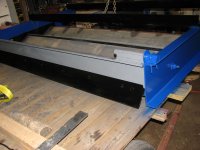
Overall Size is 8 ft 6 inches wide & just under 6 ft long. The cutting edges are 8 ft across. I wasn't sure how much lower the cutting edge should be below the skids so I decided to make the depth adjustable. Then the debate was should the blades be straight across or angled to direct material sideways. In the future I will be building a grader for cutting ditches & crowning so in the end I decided to have the blades straight across. Next decision was whether to have 2 cutting edges at the same height or to have the front one higher or lower than the second. Since the blades will be adjustable pivoting at the rear, they ended up level with the bottom of the skids in the up position. As the blades are lowered in 1/4 in increments, the front blade becomes lower than the secondary cutting edge. I decided to add a hinged drag at the back which can also be used as a back blade.

Let the pictures begin!
 

Attachments

  • Basic lay out.jpg
    Basic lay out.jpg
    265 KB · Views: 642
  • Marking Skids.jpg
    Marking Skids.jpg
    90.3 KB · Views: 421
  • Skids ready for center section.jpg
    Skids ready for center section.jpg
    289.7 KB · Views: 660
  • Homemade press - 20 ton jack.jpg
    Homemade press - 20 ton jack.jpg
    339.9 KB · Views: 611
  • Clamped to large piece of metal for heat sink.jpg
    Clamped to large piece of metal for heat sink.jpg
    259.2 KB · Views: 551
  • Installing cutting edges.jpg
    Installing cutting edges.jpg
    275 KB · Views: 859
  • Transfer punch.jpg
    Transfer punch.jpg
    310.3 KB · Views: 419
/ Land Plane - Yet another build
  • Thread Starter
#2  
I'm rust on mixing the photos with the text so please bear with me.
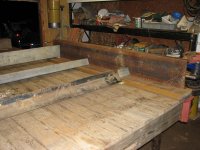
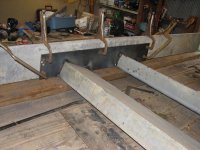
- 1st photo: Basic lay out. The side skids are 12" channel iron. The cutting edge supports are 3/4" thick 4 x 8" angle iron. I want the weight to help it cut & not bounce around.

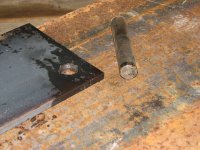
- 2nd photo: "transfer punch" They come in different diameters. My sets are in 1/64" increments. Very useful for marking the center of holes.

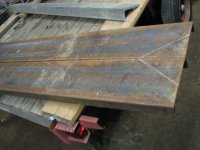
- 3rd photo: Marking the skids in a mirror image. The triangles on the right side will be cut off to taper the front of the skids.

- 4th photo: Completed skids. They have pockets welded on to cradle the center section ends. The holes are for setting the cutter depth. The open loops on the front ends are to allow for pulling it with a chain.

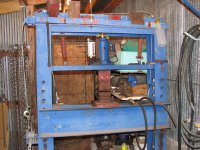
- 5th photo: My press which I built many years ago with a 20 ton air over hydraulic jack. Used to form the flats welded to the front of the skids & the sockets for the fork option you will see later.

- 6th photo: I clamped the 3/8" x 6" plate to another piece of heavy metal to be a heat sink to prevent the metal from warping as I welded the angle iron to it.

- 7th photo: Post welding, no visible warp-age. For the secondary cutting edge, I used 3/8" x 6" flat.
 
/ Land Plane - Yet another build
  • Thread Starter
#4  
Lets pause for a moment & think about the time spent just drilling the holes.
- Going through 3/4" thick angle iron: 30 holes which need 3 passes each to make the 5/8" holes needed for mounting the cutting edges.
- Then there were the other holes most of them through 3/8" thick steel, 36 of them. I am making the height of the cutting edges adjustable & the mount for the top link of the 3 point hitch mount pivots so it can follow the ground contour better.

Where is a magnetic drill when I need one?! There is definitely one in my future! I figure over 3 hours for marking & drilling holes.

It is basically together now.

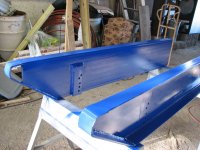
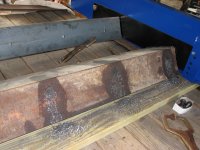
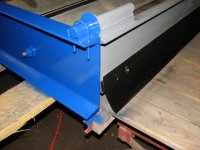
- Back view: The back is a hinged drag made from a 1/2" thick x 8" angle iron cut down to a 3 x 8" angle using my circular saw. I then bolted a cutting edge to it. Weight is around 225#. It will swing up 1/2-3/4" fairly easily then you have to work to get it to lift higher. I have to use a 15" Crescent wrench with some ump to swing it horizontal. (Photos 1 & 2 show the cut off edge & the hinged back blade installed/painted.)

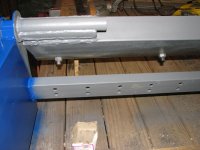
- 3rd photo: Close-up of the hinge. 1-1/4" rod cradled in 1-1/2" channel iron. I will be keeping an eye out for heavier duty "U" bolts but these will work fine for now.

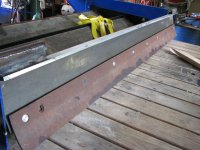
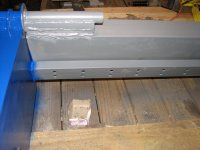
- The next 2 photos show the 3" channel iron which lock the back ends of the skids in place & serves as a stop for the hinged back blade while pushing backwards.
 

Attachments

  • 8 ft of half in thick steel cut with circular saw.jpg
    8 ft of half in thick steel cut with circular saw.jpg
    151.1 KB · Views: 438
  • View from the back.jpg
    View from the back.jpg
    126.1 KB · Views: 382
  • Hinge.jpg
    Hinge.jpg
    120.6 KB · Views: 422
  • 3 in channel iron.jpg
    3 in channel iron.jpg
    110 KB · Views: 401
  • Hinged back resting against 3 in channel iron stop.jpg
    Hinged back resting against 3 in channel iron stop.jpg
    113 KB · Views: 318
/ Land Plane - Yet another build
  • Thread Starter
#5  
To make it versatile there will be 3 ways it can be connected up:
- 3pt hitch
- A chain hooked to the bront of the skids
- Slide the forks under the 3 pt hitch locations through sockets welded to the under side.

Photos:
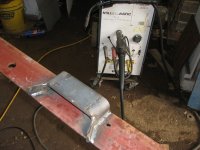
- 1st photo: Angle iron turned upside down with fork socket welded on.

- 2nd photo: Angle iron in place with sockets for forks shown on the underside.

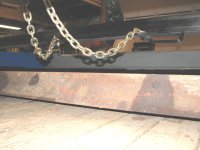
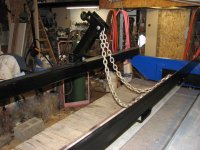
- 3rd photo: 3 point hitch center post for connecting the top link. The chains will allow the plane to follow the contour of the road/ground. Have you ever seen a 3pt hitch mounted brush hog where they have had to repair it because the hitch was solid? Chains work great!

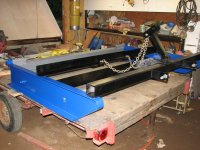
- 4th photo: Near complete. Still need to weld on the front set of fork sockets & add some bolts to the cutting edges.

Later I will get some shots of it mounted.
 

Attachments

  • socket for forks - upside down for welding.jpg
    socket for forks - upside down for welding.jpg
    129.9 KB · Views: 305
  • Rear fork sockets.jpg
    Rear fork sockets.jpg
    121.5 KB · Views: 336
  • Upper link floating mount for 3pt hitch.jpg
    Upper link floating mount for 3pt hitch.jpg
    159.5 KB · Views: 364
  • Completed except front fork sockets.jpg
    Completed except front fork sockets.jpg
    168.1 KB · Views: 550
/ Land Plane - Yet another build #7  
Great work!!!! I totally understand your frustration with hole drilling. Takes a LOT of time.

I'm confused about the front blade vertical adjustment?? What holds the pins in place?

I really like the rear push blade. I always thought if I built a plane, I'd have a setup like that. Might even create a latch on it so I could drag it full of material like a BB. With a hydraulic top link you cut material, store it, move it and spread it in whatever thickness you wanted.

Very cool Plane!!!
 
/ Land Plane - Yet another build #8  
Curious to see if the chain thing works. :confused: From my experience, it does not seem like it will. :(
 
/ Land Plane - Yet another build
  • Thread Starter
#9  
I estimate total weight to be around 1,150 lbs.
 
/ Land Plane - Yet another build #10  
Curious to see if the chain thing works. :confused: From my experience, it does not seem like it will. :(
I agree, my experience also. Started using mine with a chain as the top link so it would lift at the back if needed. Did not work like that at all. Mine is 8' long and still lifts at the back if no solid top link is used.
 
/ Land Plane - Yet another build #11  
Looks great and a nice build.:thumbsup:
Making the depth adjustable does add more work.
I did notice that you used unequal leg angle iron for the blade mounts and would suggest that 45 degrees would be the better setting since all the grader blades I have seen are ground on a 45 degree angle and mounted the same. If you set these grader blades at a steeper angle they will wear down too quickly.
 
/ Land Plane - Yet another build
  • Thread Starter
#12  
My batteries died on the camera so no photos at this time.

- Chains for 3 pt: Remember I have a pivoting center post which connect to the top link of the tractor. It lifted without any problems.

- Dragging with a chain: The height of the chain on the tractor versus the drag does make a difference. When hooked to the draw bar it wanted to pull the skids downward which with soft ground made them sink. When hooked to the trailer hitch on the 3 point to where it had a slight upward pull on the skids it pulled great.

- Using it with the forks: I haven't tried it yet but FYI, my forks are only attached at the top with an 1-1/2 in bar going through the tubes welded to the forks so it will be able to allow it to float. I don't fore see any problem. (My tractor is a 70 hp with fluid filled tires. I can pick up a 55 gallon barrel full of calcium water at the end of a 29' boom on the loader or a pallet of shingles.)

- Reference the angle of the cutting edge, I am using a curved blade which will make the point of engagement closer to what you may be use to seeing. However, the point of the cutting edge it to cut. The less surface area making contact will help it to cut in better. Take a look at a road grader & the angle of the place. Most are set almost vertical. Yes a lot of the land planes & box blades have a flatter entry. This is to help it load up with material to add weight. My plane has the weight built into the implement it's self. If you have watched the video "Everything Attachments" did on land planes, you will have noted Tim addressed this.

I haven't dropped the cutting edge below the level of the skids yet but it is still doing the job. I am very happy with the way it is working. I will drop the blade down 1/2" latter this week & go down the gravel road to see how it does filling in washouts & pot holes on harder packed/dryer ground. The road district is slow getting to it & I hate having to dodge them.
 
Last edited:
/ Land Plane - Yet another build #13  
Cutting edge angle. I run my road grader cutting edge almost straight up and down for normal road maintenance. If I am cutting dirt I lean the moldboard back to get a cutting and lifting action.

The angle on the cutting edge of a new blade is cosmetic only. After minimal use it is ground off and you are left with an edge the thickness of the blade and at whatever angle you've been running the blade. Cutting edges are priced and paid for by their size. In my case I run two 7'x7/8"x8" fastened to a 14' moldboard. They have an angle edge on both the useable edge and the bolt edge. Now why would they do that??? To save money. Has nothing to do with the use of the blade. Look how much material they save on a 7ft cutter by shaving the edges. And no one complains. I wear off the sharpened edge in the first couple days because it's thin. Pretty nifty marketing huh.... :(
 
/ Land Plane - Yet another build #14  
My batteries died on the camera so no photos at this time.

- Chains for 3 pt: Remember I have a pivoting center post which connect to the top link of the tractor. It lifted without any problems..

Our concern has nothing to do with lifting the implement. Our concern is that once you lower that front cutting edge and actually work the implement, that the force exerted from that front edge will cause the rear of the implement to raise and you will then loose any use of the second cutting edge.

We will all find out once you do this. :thumbsup:
 
/ Land Plane - Yet another build #15  
He's heavy enough that it might not be a real bad problem. But you are right, if the front blade gets a good bite into some firm material it will lift the rear of the plane.

I would tend to use a rigid 3pt. Idea being the entire weight of the plane is then applied to the area that needs shaved, rather than the plane being able to ride over those areas. But I use a hydraulic top link and can put it in float if I want the attachment to be free to drift.
 
/ Land Plane - Yet another build #16  
He's heavy enough that it might not be a real bad problem. But you are right, if the front blade gets a good bite into some firm material it will lift the rear of the plane.

I would tend to use a rigid 3pt. Idea being the entire weight of the plane is then applied to the area that needs shaved, rather than the plane being able to ride over those areas. But I use a hydraulic top link and can put it in float if I want the attachment to be free to drift.

I have the same float function, my LPGS is 1400lbs, 90" wide and 96" long. The rear will ride up. You could hold the front up in the air and it won't do it, but then not much reason to have that front cutting edge. :rolleyes:

I think a lot of things will change for the OP once he lowers that front cutting edge and starts to work the implement. Time will tell I guess. ;)
 
/ Land Plane - Yet another build #17  
Richard
I would assume you have a lot more experience with grader blades than I do. I will try to give mine a look today and see how they are wearing.

About the landplane hitch I would not bother with making it a tow type hitch the 3pt set up works great and can control how it rides over the ground much better.
 
/ Land Plane - Yet another build
  • Thread Starter
#18  
- The possibility of the plane doing a nose dive is definitely a consideration, especially as the first cutting edge is so close to the front of the skids.

- As Oversized suggested there is a lot of weight on the plane, especially with the hinged back plate which most planes do not have. It is over 300 lbs by itself. This might help offset the tendency.

- If I find it to be a problem, it would be an easy fix to weld or bolt in some tubing where the chains are attached.

- The section of dead end gravel road I maintain has several shelves of rock at the road surface level. This is why I left the blades in the up position. The plane is wide enough that the outer skid reached past the raised area between the ditch I the normal tire wear area. This allowed it to cut & fill while in the up position.

- Another thing I found was when I tried using it right after a good rain thinking it would cut easier, which it did, the road material did not fall over the angle iron very well & loaded up heavily. Once I let the road dry for a few hours then the road material fell over the angle iron just fine. This was not a problem I had when using the old horse drawn grader.

I appreciate all the feedback.
 
/ Land Plane - Yet another build #19  
A little time to let the ground dry out does make a huge difference and can sometimes be just a matter of hours. Today I am using my 8' land plane to smooth up a field I just graded. Friday it was too wet to work with, today it is powder dry.
 
/ Land Plane - Yet another build #20  
I have the same float function, my LPGS is 1400lbs, 90" wide and 96" long. The rear will ride up. You could hold the front up in the air and it won't do it, but then not much reason to have that front cutting edge. :rolleyes:

I think a lot of things will change for the OP once he lowers that front cutting edge and starts to work the implement. Time will tell I guess. ;)

I agree. If, and I say if, I ever build one I'll do a lot of question asking first to try to minimize mistakes in design.

It's only logical that the rear will ride up if allowed by a flexible top link.
 

Marketplace Items

CASE SV208 SMOOTH DRM ROLLER (A67714)
CASE SV208 SMOOTH...
2005 Acura RSX Coupe (A64557)
2005 Acura RSX...
2012 KENWORTH TRIAXLE BODY LOAD (A67714)
2012 KENWORTH...
Unused 2024 Land Pride PF1242 42. Forks and Frame Skid Steer Attachment (A66734)
Unused 2024 Land...
2017 Kenworth T880 T/A Galbreath Roll-Off Truck (A66736)
2017 Kenworth T880...
2022 CATERPILLAR 299D3 SKID STEER (A65056)
2022 CATERPILLAR...
 
Top