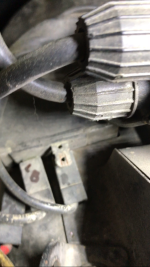
John Deere 318 voltage regulator

/ John Deere 318 voltage regulator #21  
There isn't an automotive style alternator on a mower like this. They run permanent magnets inside the flywheel and have a stator mounted stationary to the back of the engine that sits inside the flywheel. From there the rotating flywheel magnets cause the stator to output AC to the rectifier/regulator which is usually mounted on the flywheel shroud with fins inside the shroud which get cooled by air coming off the flywheel. 3 wire plug on the regulator. You could also measure voltage right there instead of getting close to the battery. From memory it's the center terminal on the plug, should be 14 ish running (red wire on your meter, black wire goes to chassis ground). The outer two terminals should be around 26 volts AC coming from the stator at full throttle. Maybe 28. It's been years since I've checked one.
 
/ John Deere 318 voltage regulator
  • Thread Starter
#22  
You're welcome.
I would go about it differently, BUT I completely understand your concerns.
So first disconnect the ground, (minus/negative) battery cable, usually black color sheathing. Set it aside.
Then positive cable, (red), without allowing the wrench to come in contact with any metal part of the mower.
Then replace your ignition switch, AFTER taking a few pics of what goes where, wires, etc. Draw yourself a diagram if necessary.
Replace the switch with the new one. Same procedure with the new voltage regulator, pics, then remove and replace.
Now install the new battery, after making sure there are no remaining frayed, broken, loose or otherwise not secure wires anywhere on the machine.
Recheck to make sure the neg and pos cables to the battery are in the right place.
You should be able to start it and verify the output voltage as detailed earlier.
Now, if it doesn't start, there can be other reasons, which get more complicated, so lets get this far before going deeper.
You should gather the year and exact model of the mower, the serial number and what EXACT engine it has in it. These items tell the tale of what parts may be needed to make it run/run properly. There are numerous issues with these mowers, especially if the engine was ever swapped out, if a different ignition switch was installed, etc. So get all the data you can so you can post it here if we determine further investigation is needed.
Take your time, check everything overe, and don't panic; it's not rocket science, yet!:eek:

So I did the test. I bought a new battery just for my own peace of mind. I tested the battery before putting it in the tractor and it was 12.55.

I fired up the tractor at a little less than half throttle and tested it while I was waiting for it to warm up. It tested at 16.23. I panicked (haha) and just shut it down. I never got it to full throttle. I'm assuming that if it is testing at 16 at half throttle it would be more than 16 ar full grottos; well beyond the 14.5 max as discussed before. Thoughts?
 
/ John Deere 318 voltage regulator #23  
Definitely too much voltage. Time to replace the regulator/rectifier.
 
/ John Deere 318 voltage regulator
  • Thread Starter
#24  
Thanks! It's on its way. Even though it wasn't at full throttle, that's an accurate assessment?
 
/ John Deere 318 voltage regulator #25  
So I did the test. I bought a new battery just for my own peace of mind. I tested the battery before putting it in the tractor and it was 12.55.

I fired up the tractor at a little less than half throttle and tested it while I was waiting for it to warm up. It tested at 16.23. I panicked (haha) and just shut it down. I never got it to full throttle. I'm assuming that if it is testing at 16 at half throttle it would be more than 16 ar full grottos; well beyond the 14.5 max as discussed before. Thoughts?

YES! Definately way too much voltage, as suspected. Do not run the machine again with out first fixing the over voltage issue. You could end up cooking your new battery too -s and same dangerous issues are still opresent for the new battery at any voltage above 14.5 MAXIMUM.

ALSO, NEVER, EVER ADD ACID to any battery if the individual cells are low on fluid. ONLY ADD WATER, nothing else. The ONLY time a battery has acid added is if it was dry from the factory and came with a container with acid to add at time of first use/delivery. Water was also added to make the cells wet and ready for their first charge to full state of charge. I haven't seen that type of battery situation in over 20 years.
 
/ John Deere 318 voltage regulator
  • Thread Starter
#26  
YES! Definately way too much voltage, as suspected. Do not run the machine again with out first fixing the over voltage issue. You could end up cooking your new battery too -s and same dangerous issues are still opresent for the new battery at any voltage above 14.5 MAXIMUM.

ALSO, NEVER, EVER ADD ACID to any battery if the individual cells are low on fluid. ONLY ADD WATER, nothing else. The ONLY time a battery has acid added is if it was dry from the factory and came with a container with acid to add at time of first use/delivery. Water was also added to make the cells wet and ready for their first charge to full state of charge. I haven't seen that type of battery situation in over 20 years.

Good to know. I'll have to figure out how to hook up the new regulator. It's got 3 prongs side by side. The current one (original I'm sure) has two side by side with one on top.
 
/ John Deere 318 voltage regulator #27  
<SNIP>

If acid boiled over, you need to take the battery out and clean anywhere acid could go, acid is highly corrosive and if left alone could eat its way threw metal.

I'm not sure of the best way to clean acid, I would thing a heavy Base type cleaner? To neutralize the acid? Idk

BAKING SODA, is what should be used to neutralize battery acid. And water, flush your eyes, hands anywhere acid gets whether it is wet or white powdered acid that has dried out.

Be very careful with liquid acid, if it contacts your eyes or mouth your most likely headed to the ER, it has the potential to burn your skin as well, a non absorbent glove is suggested until the battery is free of exterior acid, a trip to advance to have the battery checked wouldn't be a bad idea also, if it has caps you may have to top off the acid.


*NO, NEVER! DO NOT ADD ACID to an already used lead/acid/wet battery! ONLY add, preferably distilled water to the top of each split ring of individual cells

Good Luck and be careful.

Always remember to disconnect the power(battery) before wiring anything up.

* Trust me on the above; I owned and ran a foreign auto repair and sales facility for over ten years. I was an Interstate Battery dealer too. ACID does NOT get added to already in use batteries.
 
/ John Deere 318 voltage regulator #28  
Do you have a pic of the old regulator? Not sure I've seen one different than this type.
1dcdb302b5d0d93db8c4a3ea20a77ddf.jpg
 
/ John Deere 318 voltage regulator #30  
* Trust me on the above; I owned and ran a foreign auto repair and sales facility for over ten years. I was an Interstate Battery dealer too. ACID does NOT get added to already in use batteries.

When I was a kid 15+ years ago my dad bought a battery for his mower and he had to add the acid, I haven't seen one since.

Thanks for the correction, I personally have never dealt with one but have seen one or two my dad bought.
 
/ John Deere 318 voltage regulator
  • Thread Starter
#31  
Do you have a pic of the old regulator? Not sure I've seen one different than this type.
1dcdb302b5d0d93db8c4a3ea20a77ddf.jpg

I do have a picture, but I can't figure out how to add a photo from my phone. I'd have to wait until I'm at work to use the computer.
 
/ John Deere 318 voltage regulator #32  
When I was a kid 15+ years ago my dad bought a battery for his mower and he had to add the acid, I haven't seen one since.

Thanks for the correction, I personally have never dealt with one but have seen one or two my dad bought.


No Problem.
I just don't want anyone accidentally deciding to add acid when all they should be adding to low battery cells is water.
I used to do what you mentioned above, years ago; but I think they did away with that for safety issues and now all batteries are already filled with acid/water mix at the factory and are called wet batteries.
 
/ John Deere 318 voltage regulator
  • Thread Starter
#33  
IMG_7987.PNGIMG_7987.PNG
I do have a picture, but I can't figure out how to add a photo from my phone. I'd have to wait until I'm at work to use the computer.

It's a bad picture. But those are the connectors. One is undone as I took this picture when I was taking the connections off while doing a valve adjustment.
 
/ John Deere 318 voltage regulator #34  
Great, thanks. I'm getting a multimeter today. So test it before starting, then fire it up and test it at WOT? Or should it be at a different throttle range? I really don't want an explosive issue haha.

For point of info, the voltage mostly stays the same regardless of throttle position. The only time it varies greatly is when a 'load' like headlights are being used and the battery would be 'drawn' down if the voltage regulator didn't compensate for the draw down.

Batteries do best from 100% state of charge to about 80% and then back to 100%, supplied by a properly functioning charging system.
Otherwise the battery life is shortened by being allowed to undercharge, say down to 60% then back to 100.

Cold and hot temps wear harder on batteries than do relatively moderate ambient temps. That's why auto charging systems fail/ batteries die in very hot weather or extreme cold. CCA, Cold Cranking Amps is one thing used to determine the appropriate battery for a particular engine/use. Air conditioning and heater fans in winter months draw a lot of amps, which is flow of current through a circuit. Current is literally heat transfer through wires to an output/use, heater fan moving heat to warm a vehicle. Headlights draw lots of amps - heat out of the lamp = energy consumed from the battery. That energy is restored by the engine burning gas/diesel, to resupply energy lost from the battery, (discharging to say 75% state of charge), then being charged back to 100%.

This ongoing CE course is only $500/week. I take Visa and MC! :thumbsup::laughing:
 

Marketplace Items

2018 Freightliner M2 106 AWD Altec AA55 56ft. Insulated Material Handling Bucket Truck (A64194)
2018 Freightliner...
2018 John Deere 470G Hydraulic Excavator (A61572)
2018 John Deere...
KSI Conveyor (A63688)
2008 Case IH 2152 Combine Header (A63688)
2008 Case IH 2152...
2008 CATERPILLAR D4K XL CRAWLER DOZER (A64279)
2008 CATERPILLAR...
2000 INTERNATIONAL 4700 GRAIN TRUCK (A63291)
2000 INTERNATIONAL...
 
Top