How to read a Span Table???

/ How to read a Span Table??? #1  

MossflowerWoods

Super Member
Joined
Aug 12, 2011
Messages
6,024
Location
Fredericksburg, VA
Tractor
Kioti DK50SE HST w/FEL, Gravely 60" ZTR Mower. Stihl MS290 (selling), CS261, & FS190 + Echo CS400 & 2010 F-350 6.4 PSD snowplow truck
Ok, I'm trying to build a shed to hold my 4 Harley's and the gear (helmets etc.)

I'm estimating a 12' x 20' shed.

More info here http://www.tractorbynet.com/forums/projects/219690-screws-vs-nails-prepping-build.html

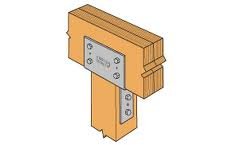
I'm going to build the base with PT lumber. I wanted to mount he base frame & joists on PT 4x4 in concrete but I have not found the correct Strong-Tie type mounting hardare to attach the frame to the 4x4's. My belief is this form of foundation is easy to level, I cam keep the structrue close to the ground, and i can support the joists directly by a row of posts through the center.

My napkin math says estimate ~3500 lbs for bikes 500 lbs for junk, and 210 lbs for me STILL gives me under 20 LBS per square foot.

A builder friend keeps upping the size and center of what I need for joists. And I'm no dummy, but I cannot figure out how to read the span tables I've found.

I need to start on by next friday and I'm not even done designing it.

HELP! Can I do this? Can I use PT 2x6 12" center or do I need 2x10, 2x8? Is there a strong-tie style I can use to mount the base to the 4x4 posts or MUST I pour concrete footers and run beams? The "ramp" into the door will be very short, I need to keep this close to the ground.

And I've not even begun the figure out the rafters...

I fear I am hosed and the Harley's will be in the carport all winter...

Thanks in advance,
David

 

Attachments

  • Bike Stable 1.jpg
    Bike Stable 1.jpg
    111.7 KB · Views: 320
/ How to read a Span Table??? #2  
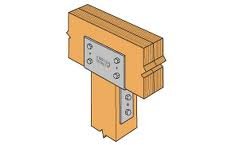
You can use the 2x6's if you like but I would recommend you use 3/4" tongue and groove plywood for the flooring if you do. Also, to mount the shed floor frame to the 4x4's in concrete, you could use simple column caps and double-up the 2x6's where-ever they land on the post.
images
 
/ How to read a Span Table???
  • Thread Starter
#4  
ustmd,

12 x 20 rectangle. 8' walls. I plan to build an off center roof with small loft space. the souther slope will be longer so I can mount 12v solar panels to run a trickle charge for the batteries and a couple 12v lights.

Dmace,

For flooring, I was planning PT plywood on the bottom as a moisture barrier, and maybe 1x6 or similat wood planking at a 45 degree angle. Partially for durability, partially for load bearing.

How do I level the dang thing if I have to cut off every post flush?

I apologize in advance for stoopid questions, I'm a computer geek...

David
 
/ How to read a Span Table??? #5  
2x6 on 12" centers will do ya, double up the outer edge and center. Set your 4x4 in concrete and let it set up, then get some bright colored concrete string to set your levels, cut the 4x4's to the desired level height and build from there...fast and easy, just make sure the string is tight and level.
Easiest way to string your grid is to go about 24' for a 20' level, pound stakes, tighten string, put level under it, pound the side that is too high, repeat for other direction and double check, remember to check level as you cut.
 
/ How to read a Span Table??? #6  
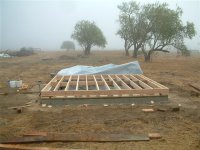
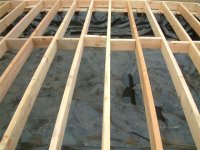
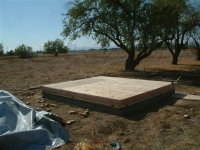
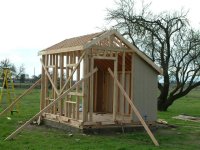
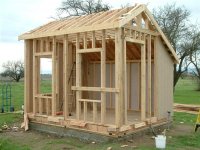
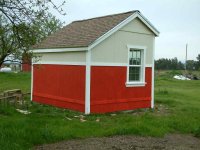
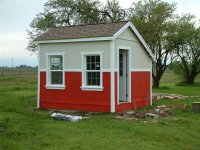
Here's some info on the 10x12 ft saltbox shed I built a few years ago. It's just a storage shed for garden tools and miscellaneous stuff--not a lot of heavy stuff. Used 2x10s on 12" centers to span 10 ft. Concrete perimeter footing 12" wide x 18" deep with about 6" exposure above ground. 2x6 PT sill plate held to the footing with embedded 1/2" dia anchor bolts. 3/4" plywood flooring. For heavy loads like you have, I'd add another footing at the middle of the joists for support.

DSCF0035 (Small).JPGDSCF0037 (Small).JPGDSCF0044 (Small).JPGDSCF0053 (Small).JPG

Here's the finished product.

DSCF0070 (Small).JPGDSCF0076 (Small).JPGDSCF0018-small.jpgDSCF0020-small.jpg

Hope this helps.
Good luck.
 
/ How to read a Span Table???
  • Thread Starter
#7  
2x6 on 12" centers will do ya, double up the outer edge and center. Set your 4x4 in concrete and let it set up, then get some bright colored concrete string to set your levels, cut the 4x4's to the desired level height and build from there...fast and easy, just make sure the string is tight and level.
Easiest way to string your grid is to go about 24' for a 20' level, pound stakes, tighten string, put level under it, pound the side that is too high, repeat for other direction and double check, remember to check level as you cut.

Fixemall,

Thank you sir! :thumbsup:

I love you guys... Saving my bacon regularly!

David
 
/ How to read a Span Table???
  • Thread Starter
#8  
Here's the finished product.

Hope this helps.
Good luck.

That is cute! Full on concrete foundation, wow! :thumbsup:

David
 
/ How to read a Span Table??? #9  
Here's some info on the 10x12 ft saltbox shed I built a few years ago.

Place like that rents for $500 a month around here.
 
/ How to read a Span Table??? #10  
For a margin of saftey, figuring 50PSF (because your bikes arent going to disrtibute their weight evenly)

A 2x6 SYP joinst on 12" spacing will span just over 10' with those specs.

IF you are building 12x20 and were figuring on running the joists in the 12' direction, WITH a row of posts also down the middle, you will only be spanning 6'. If that is the way I understand you were planning it??? The 2x6's are going to be pleanty sufficent.

More important is going to be the post spacing (how many posts) and what you plan on doing for beams to support them joists. So a little more clarification and perhaps a sketch of exactally what you are planning would be beneficial:thumbsup:
 
/ How to read a Span Table???
  • Thread Starter
#11  
So a little more clarification and perhaps a sketch of exactally what you are planning would be beneficial:thumbsup:

A SKETCH!!!! What Kind of fly-by-night operation do you think I'm running here? I ain't got no sketches!:laughing:

I'd LOVE a sketch, you got one?

Seriously, I have limited space for a ramp into the shed, so I'm trying to keep it low and close to the ground, and not 2' up in the air.

I do not think I can pour a concrete floor, I'm trying to keep it low cost and simple, yet safe (I know I might be out of my mind).

One bike is over 800 lbs, 2 are approx 450-475, the other is 750 max. There simply will not be that much weight, AND if I plank the floor with diagonal tongue & groove or similar that HAS to help the load bearing capability.

I want the top of the floor to be no more than 12" above ground if possible.

I was thinking along Fixemall's recomendation above in this thread...

More tomorrow...

David
 
/ How to read a Span Table??? #12  
Real world question. Are you getting a building permit? If not, and if you want it low to ground, assuming you are not in a swamp, what is wrong with setting it on 4" solid block piers? It will float and if you are not tying it into any utilities (solid connection like sewer) any frost heaving issue will be minimal. And if your property drains fairly well, I can't believe frost is a big issue in VA.. Here in New England we have to plan for four feet of frost but for a shed like you describe, I would have no issue setting it on dry piers

So, assuming there is loam, you could set the block right on that. Or a better job would be to remove the loam to good subsoil, backfill with some crushed stone and set your block accordingly in terms of number in the stack to give you the right floor elevation. I would space out four piers on the 20' dimensions and a 12' span with 2 x6' on 12" centers should be okay.

Easy thing about this approach, get a good straight 2 x 6 as your straitedge, (assuming you don't have a transit) and just set your first block to height that suits you and level off to the others from there. Then just mark your end rim joists at 12" and start pounding nails.

If you insist on using wood piers ( 4 x 4), you have to set them on something other than ground. Plus in any case, I would use 4 x 6 vs 4 x 4. Assuming the joists are 2 x 6, you can cut a 1-1/2" notch (5-1/2" long) and the joist will then set on the 4 x 6 while you bolt the post to the joist-you won't be just relying on a bolted connection but will have the joist actually bearing on the post.
 
/ How to read a Span Table???
  • Thread Starter
#13  
Real world question. Are you getting a building permit? If not, and if you want it low to ground, assuming you are not in a swamp, what is wrong with setting it on 4" solid block piers? It will float and if you are not tying it into any utilities (solid connection like sewer) any frost heaving issue will be minimal. And if your property drains fairly well, I can't believe frost is a big issue in VA.. Here in New England we have to plan for four feet of frost but for a shed like you describe, I would have no issue setting it on dry piers

So, assuming there is loam, you could set the block right on that. Or a better job would be to remove the loam to good subsoil, backfill with some crushed stone and set your block accordingly in terms of number in the stack to give you the right floor elevation. I would space out four piers on the 20' dimensions and a 12' span with 2 x6' on 12" centers should be okay.

Easy thing about this approach, get a good straight 2 x 6 as your straitedge, (assuming you don't have a transit) and just set your first block to height that suits you and level off to the others from there. Then just mark your end rim joists at 12" and start pounding nails.

If you insist on using wood piers ( 4 x 4), you have to set them on something other than ground. Plus in any case, I would use 4 x 6 vs 4 x 4. Assuming the joists are 2 x 6, you can cut a 1-1/2" notch (5-1/2" long) and the joist will then set on the 4 x 6 while you bolt the post to the joist-you won't be just relying on a bolted connection but will have the joist actually bearing on the post.

Red Horse,

I was not planning to permit.

I am almost a total noob. I've built decks and interior rooms etc. but I've never built anything like this from scratch without plans.

I built a 1,000 square foot deck on pt 4x4 set 2 feet deep in 8' augered holes with concrete. I was planning something similar here.

I have built a prefab shed on those floating concrete footings and it never stayed level (actually it was hard to get level). I've never felt they were solid or reliable.

I don't want to do a bunch of excavation. All I have is either a 72" FEL bucket, or a shovel and posthole digger in any event.

I'm not sure I see how 4 chunks of 4" thick concrete canbe MORE stable that a 4x4 2 feet deep in a hole filled with concrete, and the 2x6 sitting ontop of the 4x4 (doubled 2x6's on the outside and a couple more in the middle). See pic. I was thinking about all 4 corners, plus the 4 centers of each side and then maybe 3 along the centerline down the 20' direction.

I can envision how to level and cut off all the 4x4's, but I do not know how to do what you describe as "get a good straight 2 x 6 as your straitedge, (assuming you don't have a transit) and just set your first block to height that suits you and level off to the others from there. Then just mark your end rim joists at 12" and start pounding nails."

I cannot afford (at the moment) to pay for someone else to build this. So I'm jumping out there in faith that I've got solid engineering (mostly electro mechanical from the high tech and computer world) and solid basic building skills, so I should be able to do this. Maybe I'm crazy...

David
 

Attachments

  • Cap.jpg
    Cap.jpg
    3.6 KB · Views: 112
/ How to read a Span Table??? #14  
Have you thought about just using cement blocks for footings and putting the 2x6 frame right on top of it? I've had lots of luck building them like that. Just sink the cement block partly into the ground so you can keep your wood frame up off the soil by a few inches (just want it higher then any standing water). I would also use Advantech 3/4" subflooring and nothing else. I don't know about any of the other brands but the Advantech brand is 100 times better than plywood.

Advantech Flooring - Huber Engineered Woods

I have half a sheet that's been outside for about 5 years now and other than the color changed it's just as strong as the day I bought it.
 
/ How to read a Span Table???
  • Thread Starter
#15  
Have you thought about just using cement blocks for footings and putting the 2x6 frame right on top of it? I've had lots of luck building them like that. Just sink the cement block partly into the ground so you can keep your wood frame up off the soil by a few inches (just want it higher then any standing water). I would also use Advantech 3/4" subflooring and nothing else. I don't know about any of the other brands but the Advantech brand is 100 times better than plywood.

Advantech Flooring - Huber Engineered Woods

I have half a sheet that's been outside for about 5 years now and other than the color changed it's just as strong as the day I bought it.

CrazyAl,

I gotta get some sleep... BUT...

I have never built with the concrete blocks and I don't understand how to level them (or how to keep them level over time and various moisture etc levels). I can see the simplicity, especially the ones with the X to cradle the joists. I can see just laying out 15 of those and I'm DONE, but I don't know how to do it...

Is this advantech really expensive? That is quite a testamonial...

Only one place near me I can get it...

David
 
/ How to read a Span Table??? #16  
Don't forget a layer of plastic or poly tarp for a moisture barrier, pressure treated or not it is still a good practice to reduce natures migration.
 
/ How to read a Span Table???
  • Thread Starter
#17  
Don't forget a layer of plastic or poly tarp for a moisture barrier, pressure treated or not it is still a good practice to reduce natures migration.
Fixemall,

If I use concrete footers, which I am leaning towards, do I put the plastic under the concrete footers?

David
 
/ How to read a Span Table??? #18  
Well, I have a few more questions and then suggestions for you.

IF you plan on cutting off the 4x4's and setting the 2x6's on top of that, what is going to extend up past the 2x6's for your walls to be built out of??

And since I dont imagine you will be using a 4x4 for EVERY joist, what and how will the intermediate ones attach around the peremiter and how will they be supported with the row of 4x4's in the middle.

Lastly, if you have EVER poured a concrete slab, that is what I would do. I know you are building it on a budget, but you also want it dont right and be low to the ground, so lets talk some cost here...

For your floor joists, you are talking about 2x6's running the 12' direction, on 12' centers. For a 20' building, that is 21 of them @ 5.49 ea (pressure treated since they will be VERY low to the ground. So that is ~$115 there.

Now you want doubled 2x6's in the 20' direction to carry the joists. So 2 on each of the sides, and two in the middle. Total of 6, or 12 10footers.

2x6x10 are 4.59ea for a total there of ~$55.


Joist hangers. $1 ea and you are going to need 84 or so the way I am picturing this build. so another $84

Now assuming your row of posts down the middle. Lets say you space them 5' appart over 20'. You are going to need 5 of them @ about 4' long each. You could bet by with 3 8' peices and cut them. Those are 5.49ea, so another ~$16. Now you will ~ 2 bags of concrete for each of them post holes. So 10 bags @ $3/bag is $30 more dollars.

$115 + $55 + $16 + $30 + $84 = $300 and we havent even counted your time involved, screws, or misc.

Now lets talk concrete. 12 x 20 area @ 4" thick is right at about 3 yards. And in my area, it is ~$100/yd with a 3yd minimum.

So $300 for concrete, have a nice solid pad you dont have to worry about, and not any more expensive.

SO why again were you not wanting to do the concrete???
 
/ How to read a Span Table??? #19  
Just on the ground before you start adding your 2x6's and after your concrete has set up for a day, might even want to toss a few mothballs on the plastic before the floor goes down as well, as a critter deterrent. Low height buildings have been known as hangouts for mice etc...the same ones that eat electrical wires on shiny motorcycles in winter. You also want to seam seal every gap in the wood, do this by placing a work light in the structure at night before you do any siding, seal up any area you can see light coming thru, in the long run you will be glad you did this.
 
/ How to read a Span Table???
  • Thread Starter
#20  
Well, I have a few more questions and then suggestions for you.

IF you plan on cutting off the 4x4's and setting the 2x6's on top of that, what is going to extend up past the 2x6's for your walls to be built out of??

And since I dont imagine you will be using a 4x4 for EVERY joist, what and how will the intermediate ones attach around the peremiter and how will they be supported with the row of 4x4's in the middle.

Lastly, if you have EVER poured a concrete slab, that is what I would do. I know you are building it on a budget, but you also want it dont right and be low to the ground, so lets talk some cost here...

For your floor joists, you are talking about 2x6's running the 12' direction, on 12' centers. For a 20' building, that is 21 of them @ 5.49 ea (pressure treated since they will be VERY low to the ground. So that is ~$115 there.

Now you want doubled 2x6's in the 20' direction to carry the joists. So 2 on each of the sides, and two in the middle. Total of 6, or 12 10footers.

2x6x10 are 4.59ea for a total there of ~$55.


Joist hangers. $1 ea and you are going to need 84 or so the way I am picturing this build. so another $84

Now assuming your row of posts down the middle. Lets say you space them 5' appart over 20'. You are going to need 5 of them @ about 4' long each. You could bet by with 3 8' peices and cut them. Those are 5.49ea, so another ~$16. Now you will ~ 2 bags of concrete for each of them post holes. So 10 bags @ $3/bag is $30 more dollars.

$115 + $55 + $16 + $30 + $84 = $300 and we havent even counted your time involved, screws, or misc.

Now lets talk concrete. 12 x 20 area @ 4" thick is right at about 3 yards. And in my area, it is ~$100/yd with a 3yd minimum.

So $300 for concrete, have a nice solid pad you dont have to worry about, and not any more expensive.

SO why again were you not wanting to do the concrete???

LD1,

#1 I suspect my lumber costs are higher than you are quoting (that is not helping my case;))

#2 - I believe I need to excavate approx 6' to do what you suggest. Lay down 4" of gravel, build a frame for the concrete pad that is 4" tall (not 3 1/2" like a 2x4 is). Then I need some kind of rebar etc. (something wire?) inside the pad space. Then I can pour, smooth, and cure. I end up with a NICE:thumbsup: patio. How do I attach the wood for the shed?

#3 - see pic.

#4 - I currently have a non-level pad in th carport, complete with a giant crack and a low spot that becomes my 4th pond every time it rains... I do not want to repeat that on this shed.

Also keep in mind "No Permit"...

#5 - One bag of crete each post should do, but I'm giving up on that idea...

David
 

Attachments

  • Cap.jpg
    Cap.jpg
    3.6 KB · Views: 124

Marketplace Items

2019 INTERNATIONAL LT625 DAY CAB (A60736)
2019 INTERNATIONAL...
2017 Jacobsen 3551 HOURS (A56859)
2017 Jacobsen 3551...
2020 PETERBILT 567 (A58214)
2020 PETERBILT 567...
2006 JAYCO JAYFLIGHT 30' TYPE CAMPER (A58375)
2006 JAYCO...
yellow ball Trailer (A56859)
yellow ball...
TAKEUCHI TL6R SKID STEER (A59823)
TAKEUCHI TL6R SKID...
 
Top