How low does your lean to go?

/ How low does your lean to go? #1  

joeyd

Veteran Member
Joined
Jul 22, 2010
Messages
1,019
Location
North Idaho
Tractor
TYM 353HST
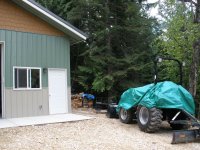
I am thinking about adding a lean to on my barn. The barn eave is 12' high and my roof is a 5/12 pitch. If I continue the pitch at 12 foot wide I would lose 5 feet of height plus the header so I would be around 6 foot at the low side. I spoke with the guys who built my barn and they said it would even be less due to the way you have to attach everything.

So, how low is too low? My ROPS folds so as long as I remember to do that I would be ok. But is 5 1/2 foot too low for function 12 feet from the pole barn? Attached is a picture of the side I want to put it on.
P6130100.JPG
 
/ How low does your lean to go? #2  
It looks like your tractor will be up next to the barn vs out on the low side anyway so I don't necessarily see that as a problem. Also, there's no reason you couldn't go a little shallower on the lean to, in fact I like that look better. You are already pretty shallow but for functionality and as long as you build it properly there's no harm in a 3 or 4 pitch. You will always find something to store down on the low side under cover vs out in the open.
 
/ How low does your lean to go? #3  
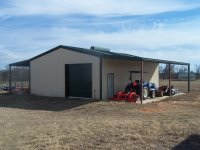
My shop is 4/12 with 1/12 on the sides. Water runs off just fine. I don't have to worry about snow load in Texas.


100_0921.JPG
 
/ How low does your lean to go? #4  
I am thinking about adding a lean to on my barn. The barn eave is 12' high and my roof is a 5/12 pitch. If I continue the pitch at 12 foot wide I would lose 5 feet of height plus the header so I would be around 6 foot at the low side. I spoke with the guys who built my barn and they said it would even be less due to the way you have to attach everything.

So, how low is too low? My ROPS folds so as long as I remember to do that I would be ok. But is 5 1/2 foot too low for function 12 feet from the pole barn? Attached is a picture of the side I want to put it on.

View attachment 497388

You could do the lean to with a 4/12 pitch, and gain about 12" height on your sidewall.
To determine roof framing lumber size required, you need to find out what the 4/12 snow load specs. are in your (Idaho?) area.
A metal roof would likely be best also.
 
/ How low does your lean to go? #5  
I would go to 3/12 on the lean to. It will look better if the slope change is greater so it will break up the line. And it will allow you to have a normal 8 foot ceiling in the lean to with horizontal ties back to the building. Also, if you want to completely enclose it you can add a normal 7 foot overhead door.
 
/ How low does your lean to go? #6  
When talking about pitch, and/or snow load, would you cheat a little if a metal roof?
 
/ How low does your lean to go? #7  
Metal roofs are better for snow loading because they are so much lighter to begin with (dead load) plus the snow will slide off easier. The calculations take the reduced dead load into consideration. For this job, I would look at 3/12 half trusses and compare that with the cost of framing it with conventional rafters and appropriate ties. I think the trusses would be really easy.
 
/ How low does your lean to go? #8  
Snow won't shed much if you go below 4:12. It'll just melt in place. That's where your could get a little daming and leakage from the seams and slope transition. I know you can go all the way down to 1:12 and have it shed water, but I wouldn't recommend going below 3:12. Even then, I'd use butyl tape on the lap seams to make sure it doesn't leak. Depending on how much drift you get in the valley, you might want to tape up the existing seams as well. I'm only saying this because I see you are in a heavy snow climate. If this was a southern climate I wouldn't be concerned.

Per the picture, I don't think there is enough eave height to use a single pitch truss. I'd stick frame it with some 2x4 purlins @ 24"o/c
 
/ How low does your lean to go? #9  
I would adjust the pitch to give no less than a 7 foot under roof clearance height at any point. Reduce head knockers as much as possible especially if the lean to will have open sides.
Also varying the pitch on the lean too from the main roof looks much better that a continuation of the 5/12 slope. Of course if you get several feet of snow load and you don't design the support structure enough to hold it, you may have to physically remove some of the snow if your pitch is too flat. Before I would put up with less than a 7 foot clearance, I would maybe look at putting a heated snow/ice removal band on the roof.
Here in Arkansas we don't worry about such little things.
 
/ How low does your lean to go?
  • Thread Starter
#10  
Thanks for the input. It already has a metal roof rated at 80# snow load. I might be able to change to a 4/12 pitch, I will have to check with the county on their specs for that snow load on a 4/12.
 
/ How low does your lean to go? #11  
You'll also have to consider "drift" because of the valley.
 
/ How low does your lean to go? #12  
'Inverted trusses' to re-pitch that whole side of the barn to 4:12? See how high your eave would be 12' out with the low chord (lean-to) horizontal ...

Trusses 4' OC and 2x4 24" across them are common under ply decking at 4:12 pitch here near the 43dr parallel, and easily makes snow load reqs. RH wall of barn can carry that, no?

Is the ground sloping away to the right as it appears to be? Put a gardrail on the right side of the entry slab and carve/grade another 6" of clearance there? :rolleyes: Concrete is wonderful. Gravel is fungible. (I now return to 'the box') t o g
 
/ How low does your lean to go? #13  
I would stand up a vertical 2x4 with braces on the barn wall and and a taller one where the new wall will be. C-clamp a "trial "rafter" and try different positions for size.

Bruce
 
/ How low does your lean to go? #14  
It's a bit more work, but you could have both, a decent width lean to (with head room) and a good roof pitch if you put your shed rafters up somewhere (about) above your window on the existing roof. You'd have to cut the metal and build a small support wall on top of your existing side wall to carry the new rafters.
 
/ How low does your lean to go? #15  
Snow won't shed much if you go below 4:12. It'll just melt in place. That's where your could get a little daming and leakage from the seams and slope transition. I know you can go all the way down to 1:12 and have it shed water, but I wouldn't recommend going below 3:12. Even then, I'd use butyl tape on the lap seams to make sure it doesn't leak. Depending on how much drift you get in the valley, you might want to tape up the existing seams as well. I'm only saying this because I see you are in a heavy snow climate. If this was a southern climate I wouldn't be concerned.


Per the picture, I don't think there is enough eave height to use a single pitch truss. I'd stick frame it with some 2x4 purlins @ 24"o/c
That is exactly why I too suggested 4/12 in my earlier response ("resident CE")
 
/ How low does your lean to go? #16  
I went 3:12 on my lean-to because it was the only way I could get decent clearance underneath to drive my RTV in (which was the whole point of the lean-to). DO whatever it takes in terms of framing and roofing materials to maximize clearance while satisfying snow load requirements. This isn't a place to cut corners -- you want that space to be as versatile and useful as possible.
 
/ How low does your lean to go? #17  
I went 3:12 on my lean-to because it was the only way I could get decent clearance underneath to drive my RTV in (which was the whole point of the lean-to). DO whatever it takes in terms of framing and roofing materials to maximize clearance while satisfying snow load requirements. This isn't a place to cut corners -- you want that space to be as versatile and useful as possible.

SNOW LOAD!
The potential snow load in Virginia is likely way less than Idaho!
3/12 may be fine in VA. ... not very satisfactory in ID.
 
/ How low does your lean to go? #18  
Snow won't shed much if you go below 4:12. It'll just melt in place. That's where your could get a little daming and leakage from the seams and slope transition. I know you can go all the way down to 1:12 and have it shed water, but I wouldn't recommend going below 3:12. Even then, I'd use butyl tape on the lap seams to make sure it doesn't leak. Depending on how much drift you get in the valley, you might want to tape up the existing seams as well. I'm only saying this because I see you are in a heavy snow climate. If this was a southern climate I wouldn't be concerned.

Per the picture, I don't think there is enough eave height to use a single pitch truss. I'd stick frame it with some 2x4 purlins @ 24"o/c
When they put up our pole barn, they used sheets long enough to go the length of the roof, then they ran a bead of silicone caulk on the down the seam between each sheet.

Aaron Z
 
/ How low does your lean to go? #19  
SNOW LOAD!
The potential snow load in Virginia is likely way less than Idaho!
3/12 may be fine in VA. ... not very satisfactory in ID.

A 3:12 should not be an issue even in Idaho. I have a friend out there -- what we call a "lean-to" they call a "shed-off" -- and his hangs off one eave wall of his shop. Can't be more than 3:12 or 4:12, and I've never heard of him having problems with it.

You can design any roof slope for any snow load if you want to, which is what I was conveying to the OP. I have been to ski lodges in Utah with completely flat roofs and 12+ feet of snow sitting on top. It will come down to how stout the rafters or trusses are, the rafter spacing, available/required clearance underneath, and cost, to decide what's feasible.

I can exceed snow load requirements here on a 3:12 over 12' span with 2x8" rafters every 24", which leaves a lot of room to handle increased snow load in other locations through bigger rafters, tighter spacing, etc. Rafter spacing scales the effect linearly, rafter width scales it linearly, but rafter height goes to the third power. As an example, if someone went to a 2x12 rafter spaced 12" on a 3:12, they'd be able to handle over 7X higher snow load than my roof, and that is a dead simple way to do it with easily obtainable building materials. Trusses could be designed to far exceed a 2x12 of one wanted to get a little more sophisticated.
 

Marketplace Items

(2) NOS-8 LUG- 7000Ib 74SC-93 HUB FACE DROP AXLES (A60432)
(2) NOS-8 LUG-...
2008 KENWORTH T300 FLATBED FUEL TRANSPORT TRUCK (A58214)
2008 KENWORTH T300...
2018 PINSA 130BBL VACUUM TRAILER (A58214)
2018 PINSA 130BBL...
iDrive TDS-2010H ProJack M2 Electric Trailer Dolly (A55851)
iDrive TDS-2010H...
UNUSED IRANCH 15" TOOTHBED MINI EXCAVATOR BUCKET (A60432)
UNUSED IRANCH 15"...
CONIBEAR EQ CO HYD SEED SPREADER (A60430)
CONIBEAR EQ CO HYD...
 
Top