How do you steer these machines?

/ How do you steer these machines? #1  

Rock knocker

Veteran Member
Joined
Jun 26, 2012
Messages
1,344
Location
Sno WA
Tractor
JD 950
How do you steer these modified tractors? I assume they lack steering clutches, so your only hope is to use the tracot brakes to death. Does anyone here have any experience with this type of machine?
FORDSURTRAC.png

Getsno Equipment サ 1995 FORD MODEL 7740 FALL PROMOTION PRICE!!

FoTra.jpg
 
/ How do you steer these machines? #2  
I don't but for the price I may need to find out. That thing is neat & not too far away from me.
 
/ How do you steer these machines? #3  
I shouldnt be any harder on brakes than using it for Ag purposes. When farming row crop, I used the brakes at every turn to slide the tractor around (dual wheels ) and never wore out the brakes on a 9000 Ford in 4 years of working it. Its not like a clutch that spins fast, you lock them and they stay locked till released so not much slippage. Not much difference in dozers where they still turn with brakes, the steering clutches just release the one side from direct drive to both tracks kinda like a positive track system so one side will stop turning while other track moves to push it around. Since tractors dont generally run in differential lock position, just hit the brakes and spin it around.
 
/ How do you steer these machines? #4  
It looks to have 5000+ hours on it which isnt a lot for that size tractor if properly maintained. The track system is worth that much if everything works on it. If I recall correctly those tractors have a torque converter (high/low shift in each gear) with a 4 gear transmission and High / Low/ Neutral / Reverse on the column with give it 16 forwards and 8 reverse speeds.
 
/ How do you steer these machines?
  • Thread Starter
#5  
But when you're using tractor brakes, the front steers are helping, oh about 90% of the work. In a crawler, the brakes are really going to get mashed on
 
/ How do you steer these machines? #6  
It says it has quad ram steering. However, I have not a clue what that means.
 
/ How do you steer these machines? #7  
You could always ask the manufacturer about it Welcome to Ebert Welding.com

But for your reading pleasure...

Steering is accomplished by means of the tractor articulating against the rear drag.

The groomer steers just as easily in forward or reverse, whether on trail, in deep snow, up snowbanks, etc...

The three point hitch “A frame” distributes steering stresses to all three 3 point hitch mounting points. The heavy lift arm stabilizer bars bear the brunt of the sideways steering action, transferring it directly to the frame assembly, and not the rear axle of the tractor. This eliminates stresses to the rear axle.

A dual pivoting steering assembly protects steering cylinders from "sideways" loads, regardless of direction of travel, relative angle of tractor and drag, or three point hitch height.


The tractor steering wheel is still used to steer the unit. The original tractor steering system has been modified for high capacity operation. Hydraulic flow of up to 20 gallons per minute on TS series, 28 gallons per minute on TM series, and a special load sensing steering orbit allow for smooth, fast steering action. Steering action responds and feels just like conventional automotive steering. Even an inexperienced operator is comfortable with the steering almost immediately. There is no need to use the tractor brakes when steering.
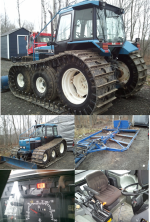
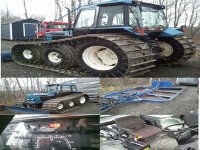
SUR TRAC Track Kit
 
/ How do you steer these machines? #8  
It looks to have 5000+ hours on it which isnt a lot for that size tractor if properly maintained. The track system is worth that much if everything works on it. If I recall correctly those tractors have a torque converter (high/low shift in each gear) with a 4 gear transmission and High / Low/ Neutral / Reverse on the column with give it 16 forwards and 8 reverse speeds.

This one is SLE (Electric powershift) .
 
/ How do you steer these machines? #9  
and have to remember the steering was designed to work with a drag.
Unit was set up for dragging sno covered sno-mo trails.
Not row crops or construction sites.

So the rear ram steer and the brakes make skid steering easy.

Seperate the two pieces and put it on dirt... well that would be probably be a problem.
 
Last edited:
/ How do you steer these machines? #10  
I shouldnt be any harder on brakes than using it for Ag purposes. When farming row crop, I used the brakes at every turn to slide the tractor around (dual wheels ) and never wore out the brakes on a 9000 Ford in 4 years of working it. Its not like a clutch that spins fast, you lock them and they stay locked till released so not much slippage. Not much difference in dozers where they still turn with brakes, the steering clutches just release the one side from direct drive to both tracks kinda like a positive track system so one side will stop turning while other track moves to push it around. Since tractors dont generally run in differential lock position, just hit the brakes and spin it around.

Tractor mechanic told me that the dual brakes on a Ag tractor are for keeping the tractor following the rows whether straight or curved. Tractors tend not to turn with heavy ground engaging equipment like planters and cultivators. Thus, 'guiding' the tractor using the brake pedal to follow the row. He also stated that locking the brake to twist the tractor around eventually will damage the brake, or worse yet, break a axle. Proper way is to stop, raise equipment and turn even if you have to backup.

I bought a JD 950 years ago that the left brake was completly worn out from the old farmer 'spinning' the tractor at the end of the garden row. Everything was worn or broken on the left side and the right side had minimum wear. The tractor was only 4 years old and he planted about a acre garden.

Just my :2cents: worth
 
/ How do you steer these machines? #11  
kneedeep said:
Tractor mechanic told me that the dual brakes on a Ag tractor are for keeping the tractor following the rows whether straight or curved. Tractors tend not to turn with heavy ground engaging equipment like planters and cultivators. Thus, 'guiding' the tractor using the brake pedal to follow the row. He also stated that locking the brake to twist the tractor around eventually will damage the brake, or worse yet, break a axle. Proper way is to stop, raise equipment and turn even if you have to backup.

I bought a JD 950 years ago that the left brake was completly worn out from the old farmer 'spinning' the tractor at the end of the garden row. Everything was worn or broken on the left side and the right side had minimum wear. The tractor was only 4 years old and he planted about a acre garden.

Just my :2cents: worth

There is a world of difference in a 950 and a Ag tractor.
 
/ How do you steer these machines?
  • Thread Starter
#13  
I bought a JD 950 years ago that the left brake was completly worn out from the old farmer 'spinning' the tractor at the end of the garden row. Everything was worn or broken on the left side and the right side had minimum wear. The tractor was only 4 years old and he planted about a acre garden

I have a 950, and not to say that the previous owner of your tractor didn't cause premature wear to the left side of the machine, but those brake drums collect dust and dirt, and you can wear out the brakes just driving.
 
/ How do you steer these machines? #14  
kneedeep said:
He was talking about AG tractors- would the principle apply for any dual brake tractor :confused:

I was saying the AG tractors are built to handle it. Show me a farmer that will stop and backup to turn instead of using the brakes.
 
/ How do you steer these machines? #15  
Tractor mechanic told me that the dual brakes on a Ag tractor are for keeping the tractor following the rows whether straight or curved. Tractors tend not to turn with heavy ground engaging equipment like planters and cultivators. Thus, 'guiding' the tractor using the brake pedal to follow the row. He also stated that locking the brake to twist the tractor around eventually will damage the brake, or worse yet, break a axle. Proper way is to stop, raise equipment and turn even if you have to backup.

I bought a JD 950 years ago that the left brake was completly worn out from the old farmer 'spinning' the tractor at the end of the garden row. Everything was worn or broken on the left side and the right side had minimum wear. The tractor was only 4 years old and he planted about a acre garden.

Just my :2cents: worth

If you need to use breaks in the row you need a bigger tractor . Turning on the end with a 2wd is fine if the implement is raised .
 
/ How do you steer these machines? #16  
I was saying the AG tractors are built to handle it. Show me a farmer that will stop and backup to turn instead of using the brakes.

With modern fwa on narrow mounted machines nearly all will stop and back up if headland is small .
 
/ How do you steer these machines? #17  
Tractor mechanic told me that the dual brakes on a Ag tractor are for keeping the tractor following the rows whether straight or curved. Tractors tend not to turn with heavy ground engaging equipment like planters and cultivators. Thus, 'guiding' the tractor using the brake pedal to follow the row. He also stated that locking the brake to twist the tractor around eventually will damage the brake, or worse yet, break a axle. Proper way is to stop, raise equipment and turn even if you have to backup.

Maybe things have changed but when I was growing up, we used full turning brakes every time we turned in the field. My brother still has some of those tractors (about 60 years old) and we never broke an axle or had unusual brake wear. We would raise the equipment if it was convenient but we'd still pivot on the brake. Backup? That would be embarrassing.
 

Marketplace Items

2022 EZ-GO ELITE ELECTRIC GOLF CART (A63276)
2022 EZ-GO ELITE...
Vegetable Sprayer (A60462)
Vegetable Sprayer...
Landhonor No Till Seed Drill (A62679)
Landhonor No Till...
2018 Kenworth T680 (A64127)
2018 Kenworth T680...
JOHN DEERE 7330 PREMIUM TRACTOR (A64280)
JOHN DEERE 7330...
2016 John Deer 5075E (A60462)
2016 John Deer...
 
Top