Homestead Communications

/ Homestead Communications #21  
The plot looks like home plate. 1005' of road frontage goes back a couple hundred feet then angles in to a point a little over 500' from the road. It is heavily wooded except where I have cleared a spot for pasture and around theThe house and barn. It slopes uphill from the road with a brook cutting it two. From the house the farthest point would be about 700' or so.
Does that help?
The Heavily wooded concerns me for the little FRS 1/2 watt radios. This could be a problem. It wouldn't cost much to try it out as these radios are very cheap, but I am thinking the GMRS or MURS radios would do better
 
/ Homestead Communications #22  
I do not think Amateur radio equipment is the answer for most people. Most people are not willing to study and take a test and pay the fees. Not unless they are interested in the hobby/emergency service aspects of it. And EVERYONE will have to be licensed, Men, women, kids, old and young. Neighbors too. AND it restricts the topics that can be discussed over the air. Unlike FRS/GMRS/MURS you CANNOT talk about subjects with a pecuniary interest to anyone involved.

So, NO, amateur is NOT the answer for most people. But there are the other alternatives that we have discussed FRS, maybe. GMRS, yes I would just about guarantee it will work even with 2.5 watt walkies with integral antennas, and for sure will work with a modest base station and very modest base station antenna on the roof or mounted on the eve.

The MURS handheld VHF radios will likely work too with just the integral antennas. The advantage of them is no licensing fees. But very few channels. Of course out in the woods, there isn't much chance you will run into other users. It is possible, but unlikely.
 
/ Homestead Communications #23  
The Heavily wooded concerns me for the little FRS 1/2 watt radios. This could be a problem. It wouldn't cost much to try it out as these radios are very cheap, but I am thinking the GMRS or MURS radios would do better
1/2W is plenty but for the 25¢ receivers in most FRS radios.

Transmitters are cheap. Good receivers are expensive.
 
/ Homestead Communications #24  
I use cheap FRS/GMRS radios on my property which is a mile long, heavily wooded, and one big hill. I keep it on an FRS 1/2 watt channel because it makes the batteries last a lot longer.

Reception is only a problem at around 3/4 of a mile. Any closer than that and reception is clear and good. For 10 acres I think FRS will be fine unless there is a mountain in the middle.
 
/ Homestead Communications #25  
I do not think Amateur radio equipment is the answer for most people.
But to make that choice one has to be aware of the differences between the options.

My observation is that a disproportionate number of newly licensed Amateur Radio Operators are recent retirees. While one could spend $10,000, there is a lot of fun to be had for $100.
 
/ Homestead Communications #26  
I have a pair of Kenwood VHF hand held transceivers. They operate under MURS. They are 16 channel and Lion powered. They easily cover my 80 acres - and beyond.

They WERE NOT cheap. But have continued to perform well for the 15 years I've owned them. Transmit power is 5 watts.

Fifteen years and I've NEVER heard another soul on any of the channels. It's either the other person( my wife ) or the continuous weather broadcast.

I'm pretty remote out here ............
 
/ Homestead Communications #27  
Kenwood makes excellent amateur radio gear and receivers. Am guessing at least half the excellent performance of your Kenwood MURS radios is due to the receiver. And how the receiver was probably 2/3rds of the cost of the unit.
 
/ Homestead Communications #28  
Kenwood makes excellent amateur radio gear and receivers. Am guessing at least half the excellent performance of your Kenwood MURS radios is due to the receiver. And how the receiver was probably 2/3rds of the cost of the unit.
Agreed, Kenwood, Icom and Yaesu all make professional quality gear, but it is NOT blister packed at Wal-Mart. I don't know what oosik paid for his Kenwoods but I would not be surprised at 300-400 dollars each. Compare that to a $25 radio. There has to be some corners cut somewhere. "Back in the day" when the Motorola handheld called the HT220 was current, it sold for around $2000 each. And that was in 1970 dollars. And yes, the receiver is the most important part of any transceiver and where most of the money goes.
 
/ Homestead Communications #29  
I do not think Amateur radio equipment is the answer for most people. Most people are not willing to study and take a test and pay the fees. Not unless they are interested in the hobby/emergency service aspects of it. And EVERYONE will have to be licensed, Men, women, kids, old and young. Neighbors too. AND it restricts the topics that can be discussed over the air. Unlike FRS/GMRS/MURS you CANNOT talk about subjects with a pecuniary interest to anyone involved.

So, NO, amateur is NOT the answer for most people. But there are the other alternatives that we have discussed FRS, maybe. GMRS, yes I would just about guarantee it will work even with 2.5 watt walkies with integral antennas, and for sure will work with a modest base station and very modest base station antenna on the roof or mounted on the eve.

The MURS handheld VHF radios will likely work too with just the integral antennas. The advantage of them is no licensing fees. But very few channels. Of course out in the woods, there isn't much chance you will run into other users. It is possible, but unlikely.
I have not gotten into amateur radio because I am in a steep, narrow canyon in basalt hills with a high iron content. There is little outside RF - no cell service, only two broadcast radio stations, no broadcast TV. I do have a CB handset that picks up skip from Australia when the sunspots cooperate.

I have considered installing a mobile unit in my pickup, but have no idea what gear would be compact enough. My state forbids handheld units while driving. The only thing you can legally grab is a mic. Taking licensing tests is not a big deal to me. I engineered a high power AM/FM commercial radio station back in the '60s.

At this point I only have vague ideas about what kind of equipment is available. I would like some flexibility, like being able to switch to a low power CB mode. Can I get by with one radio and antenna? I assume the SWR varies with frequency. The only equipment I have right now is a Wilson cell phone amplifier, which gives me a signal where I normally can't find one - sometimes.

For home reception, I have a Realistic DX-440, and don't see any reason to change. It's a good radio.
 
/ Homestead Communications #30  
I have not gotten into amateur radio because I am in a steep, narrow canyon in basalt hills with a high iron content. There is little outside RF - no cell service, only two broadcast radio stations, no broadcast TV. I do have a CB handset that picks up skip from Australia when the sunspots cooperate.

I have considered installing a mobile unit in my pickup, but have no idea what gear would be compact enough. My state forbids handheld units while driving. The only thing you can legally grab is a mic. Taking licensing tests is not a big deal to me. I engineered a high power AM/FM commercial radio station back in the '60s.

At this point I only have vague ideas about what kind of equipment is available. I would like some flexibility, like being able to switch to a low power CB mode. Can I get by with one radio and antenna? I assume the SWR varies with frequency. The only equipment I have right now is a Wilson cell phone amplifier, which gives me a signal where I normally can't find one - sometimes.

For home reception, I have a Realistic DX-440, and don't see any reason to change. It's a good radio.
If you do intend to get into Amateur Radio, especially mobile, you will need to decide if your interest is local communications with VHF/UHF gear in your vehicle or into long range communication's with HF gear in your vehicle. I have both in my truck, and VHF only in the wifes minivan. As for the size of the gear, the good news is that all types of gear has been greatly reduced in size over the years.

I can tell you what I have in the Truck if you like. For VHF/UHF I have an old Yaesu FT90r super miniature 2 meter/70 cm rig. You can't buy this one anymore but mine is still working fine so it stays. If you are only interested in the local operation (think maybe 50 to 100 miles) then the VHF/UHF rigs will only require a technician class license to operate. So a very easy written test, 35 questions, multiple choice. no Morse Code anymore for any test. The antenna is a dual band Larson 270 mounted on the front cowl area of the truck. You can go to QRZ.com and enter my callsign to see pictures. Similar current rigs could be had for around $300-$400

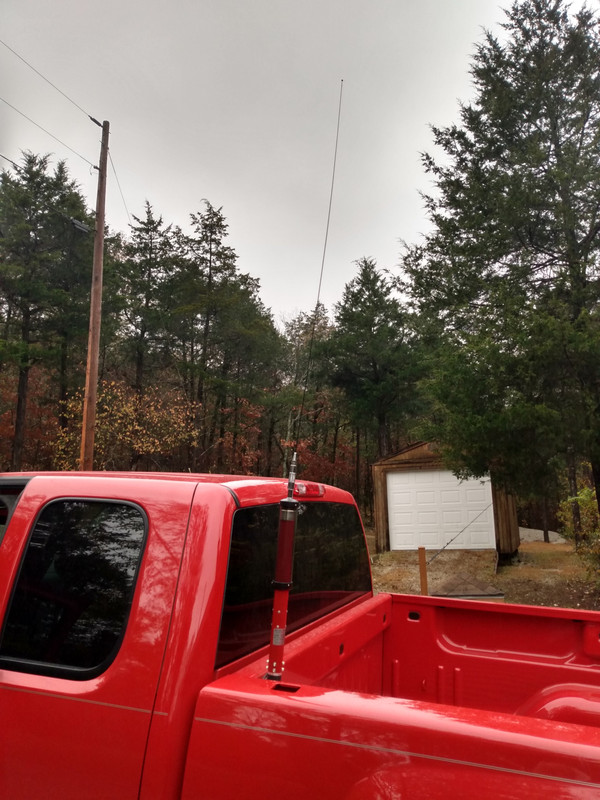
For HF worldwide communications I have the fairly new Yaesu FT891 100 watt HF rig. It is also very small considering what it is. The antenna is the Little Tarheel II mounted on a corner plate in the bed. This is a small but still fairly expensive (about $400) antenna. The Ft891 itself is about $600

The antenna is a motorized so called "screwdriver" antenna, if you are interested as to why it is called that is because the originals were "homebrewed" by a fella named Don Johnson and he used the motor out of a handheld electric screwdriver as he designed and built the originals. But the gist of it is a coil with sliding fingers moving up and down to adjust the inductance and driving the whip.

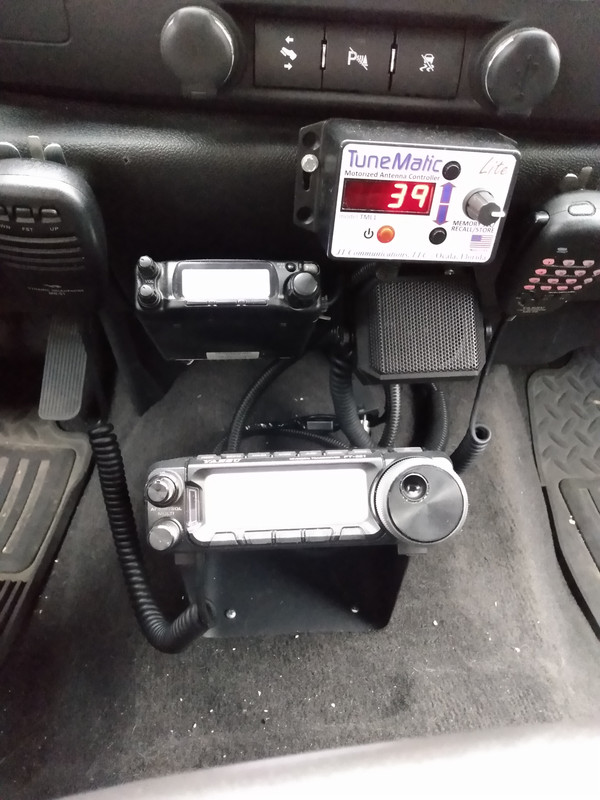
Here is a photo, you might notice that there is another device (about $139) called an antenna controller. While not strictly necessary for operation of the Little Tarheel II motorized HF antenna, it does make operation a little easier as it "remembers" the tuning settings of the antenna for each band or portion thereof. As you can tell operation of HF mobile is much more costly and much more involved than a VHF/UHF mobile install.


/ Homestead Communications #31  
You may or may not notice the "whip" of the HF antenna has a fold over device that allows it to be folded over the bed to clear 7 foot garage door openings.

Cheaper single band non motorized antennas are available for HF mobile in the $40 range, but they are not near as convenient as the motorized all HF (and 6 meters too) band antenna. I would be happy to try to answer any other questions you have about Amateur Radio, and all of its many facets.

I would not give up on operation from you home, as I too live in a valley and I can talk with voice operation to one of my friends in Stuttgart Germany with ease in the night time here and his dawn on 7 Mhz. The skywave signals are coming in at an angle of 15 to 30 degrees so may be able to clear your obstacles.
 
/ Homestead Communications
  • Thread Starter
#32  
Wow! Just WOW!
Not sure I have ever had anything to say that was important enough to have all that tech around
 
/ Homestead Communications #33  
I have not gotten into amateur radio because I am in a steep, narrow canyon in basalt hills with a high iron content. There is little outside RF - no cell service, only two broadcast radio stations, no broadcast TV. I do have a CB handset that picks up skip from Australia when the sunspots cooperate.
Remote operation is quite easy these days. With an internet connection there are services which will rent use of their HF station and antenna(s). Or you could put one up yourself. Put a remote on top of your canyon.

Just because 1.9 GHz cellphones don’t work in your canyon doesn’t mean other things will be the same. You say CB “skip” arrives on 27 MH. Amateur HF ranges from 1.8 to 30 MHz. Depending on time and sunspot cycle there is “skip” somewhere in there.

James pretty well covered the mobile end. New radios are pretty small and excellent value. A Yaesu 80W 2m for $150? Radios Amps And Repeaters GigaParts.com

Dual band and those with digital and analog cost more.
 
/ Homestead Communications #34  
If you do intend to get into Amateur Radio, especially mobile, you will need to decide if your interest is local communications with VHF/UHF gear in your vehicle or into long range communication's with HF gear in your vehicle. I have both in my truck, and VHF only in the wifes minivan. As for the size of the gear, the good news is that all types of gear has been greatly reduced in size over the years.
I don’t think one initially “needs to decide” so much as one needs to choose something of interest, or use, and have a go at it. Then expand as interest develops.

If you start out trying to replicate Jame’s truck you will be overwhelmed, frustrated, and give up.

Pretty important to find an “Elmer” to foster you into amateur Radio. Who will invite you into his shack, answer questions, and let you operate under supervision. Who will help you select good gear, know where the used bargains are to be had.

David, N4HHE
 
/ Homestead Communications #35  
If you start out trying to replicate Jame’s truck you will be overwhelmed, frustrated, and give up.

Yes, there is more I didn't cover like all the bonding and grounding you have to do to the truck parts, and the ferrite snap on chokes you have to put on things in the engine bay. Like I said, HF mobile is far most costly in money and time than VHF/UHF mobile, which can be pretty easy.
 
/ Homestead Communications #36  
K0UA - I checked - the Kenwoods were $600 for the pair. I DO like your Little Tarheal. I had an Icon HF mounted in my Chevy van. Wife drive - I work the radio. My external antennae had exchangeable top loaded tips - one for each band. I just could not figure how to reach out the side window - bend the antennae mast over and change the top tip while on the go. The Tarheal is the "cats meow".
 
/ Homestead Communications #37  
K0UA - I checked - the Kenwoods were $600 for the pair. I DO like your Little Tarheal. I had an Icon HF mounted in my Chevy van. Wife drive - I work the radio. My external antennae had exchangeable top loaded tips - one for each band. I just could not figure how to reach out the side window - bend the antennae mast over and change the top tip while on the go. The Tarheal is the "cats meow".
It truly is. I ran a single band (20 meter) MFJ, of a copy of the old "hamstick" by Lakeview, for a while, and don't get me wrong it worked (actually everything "works" it is just a matter of how well) and while I made a few DX contacts with it and of course a good number of in country contacts with the antenna, it is far from ideal. It has much lower efficiency. Here is one way to tell. Just sit and talk for about 5 minutes on it while parked so that there is no wind blowing across the coil. Then go touch the coil with you hand and you will note that it is quite hot. Now do the same test with the Tarheel and it will be as cool as a cucumber. So much more of your energy is being radiated instead of being converted to heat in a tiny low efficiency coil.

I think the MFJ was twenty something bucks, the Tarheel was $400 not counting any automatic controller. Of course the Tarheel comes with a manual up/down rocker switch for you to make adjustments manually. It works fine, just not as convenient as the controller.
 
/ Homestead Communications #38  
I don’t think one initially “needs to decide” so much as one needs to choose something of interest, or use, and have a go at it. Then expand as interest develops.

If you start out trying to replicate Jame’s truck you will be overwhelmed, frustrated, and give up.

Pretty important to find an “Elmer” to foster you into amateur Radio. Who will invite you into his shack, answer questions, and let you operate under supervision. Who will help you select good gear, know where the used bargains are to be had.

David, N4HHE
I'm still in the YouTube and reading phase of planning, but 50-100 mile range sounds pretty good. It would give me communications during natural disasters. I'm trained in the Incident Command System. I'm too old to be humping equipment, but could help with communications. I have a friend in Costa Rica who does long range stuff, but he's way over my head, using SW digital communication protocols. Thanks for the gear suggestions. I'll be back on that when I actually start shopping. Meanwhile, my first investment will be knowledge. Are there recommended web sites, YouTube channels or magazines?
 
/ Homestead Communications #39  
I suggest the ARRL web site. They have many good articles, links to Amateur Radio knowledge.
 
/ Homestead Communications #40  
This guy is from California, but he isn't too bad :) He is a fairly new ham, but he has learned a lot and most of his videos contain useful information. Start with some of his earlier and simpler videos or just skip around to what ever interests you.


Marketplace Items

2860 (A56857)
2860 (A56857)
EZ Trail 510 Grain Cart (A64047)
EZ Trail 510 Grain...
(4) Trail Quest 235/80R/16 Tires and Rims (A64047)
(4) Trail Quest...
2007 Grove RT530E-2 4x4 30 Ton Rough Terrain Crane (A61572)
2007 Grove...
6 Row Do-All (A64047)
Pallet Fork Extensions (A64047)
Pallet Fork...
 
Top