Help needed with a floor issue

   / Help needed with a floor issue #1  

EddieWalker

Epic Contributor
Joined
May 26, 2003
Messages
27,609
Location
Tyler, Texas
Tractor
Several, all used and abused.
I started a job today for a client with a three year old vinyl floor that is buckling. Under the vinyl planks is engineered wood strips that are glued to the concrete slab. The wood is ten years old. She doesn't know what was on the floor before that. The house is 20 years old.

There is no damage or staining anywhere along the walls. The concrete is noticeable lighter and drier looking along the walls. The concrete is perfect. No cracking of any kind.

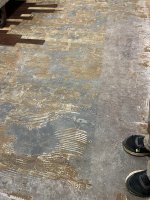
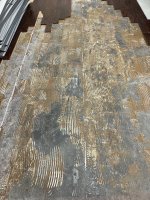
What is really weird is that the concrete is noticeably darker in a perfect square inside the room with a light area all around it, next to the walls. The damaged wood is where the dark concrete is, but no all of that area is damaged wood. The wood by the walls is perfect. Light in color, solid and no sign of mold. The damaged wood is covered in black and white mold. It's falling apart and it smells really bad of mold.

A plumber scoped the drain lines and pressure tested the water lines. He could find no sign of a leak. On the outside wall, the concrete slab is exposed for 4 to 6 inches. There is no sign of a leak or any sign of moisture. The wall with the bathroom has perfect wood flooring for about 2 feet, and for several feet before that, it was minimal coloring on the wood, but not dark and no mold.

The HVAC system is in the attic above this room. There is no sign of a leak along the walls. All sheetrock and baseboards are perfect. Not even a small crack at the seams.

The concrete is dry to the touch. The wood flooring is dry to the touch.

All ideas, thoughts and suggestions are appreciated. As of right now, nothing is too crazy!!!!

Thank you

IMG_6982.JPG IMG_6983.JPG

IMG_6988.JPG IMG_6986.JPG

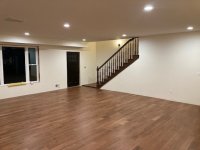
IMG_6991.JPG IMG_6992.JPG IMG_6993.JPG
 
   / Help needed with a floor issue #4  
@EddieWalker that sure looks like the damage one gets from rising water vapor, either due to a high local water table, or poor site construction (missing, or poorly installed subsoil membrane, or a poor membrane) or poor site drainage. Given the dry walls, I would be inclined to the barrier being the issue.

Personally, I have seen interior drain systems and treatments, and I am not a fan, but sometimes I think it maybe a viable choice.

A couple of questions;
how is the drainage around the house?
How are the gutters drained?
Are there gardens or lawn up against the house?

If it were my property, I would invest in some serious perimeter drain and sealing, and ensure that the gutters drain into a system that takes the water a good distance away from the house, with a gravel bed with water barrier around the house. I would also use a permeable flooring material. I was part of a renovation of an existing building once, and my prime contractor more or less said "no way, no how" to using a sealed flooring material (epoxy) as he had seen it fail in other buildings nearby. I suspect when the other issues are addressed something other than plastic flooring is warranted.

All the best,

Peter
 
   / Help needed with a floor issue #5  
Does the house have a dehumidifier along with the regular HVAC? I had a similar issue in my basement that was solved by a simple portable dehumidifier running. It worked so good I got two more. Might be worth a test before extensive reconstruction.

That looks like condensation to me. Warm moist air finding a cooler surface to produce condensation. If it was water infiltration (above, below, around or through) I think you would have figured that out with a very cursory inspection.

Could the slab have been poured over an old well/root cellar/cistern that collects water and wasn't filled in properly? I'd slap a few dehumidifiers in there long before I dug all that up.
 
   / Help needed with a floor issue #7  
I’d say it’s moisture coming up through the concrete also. I’ve seen it a garage before and it can get real wet.
 
   / Help needed with a floor issue #9  
Put a sheet of clear plastic on the concrete to see if moisture forms between it and the concrete.
Beat me to it, but will add you should tape a square of heavy plastic down, not just lay it on top. Let it sit for a day and then peel it up and check. Maybe do it in a few places in the darker and lighter areas to compare.

Edit: vinyl is notorious in this situation as a major vapor barrier. Which leads back to the earlier point t1kilo and others made: lack of vapor barrier below the slab. So the vinyl acts as that vapor barrier in this case leading to bubbling and other moisture problems.
 
Last edited:
   / Help needed with a floor issue #10  
The clean straight lines around the presumably damp area seems like a clue. I wonder if there is insulation or vapor barrier only under the perimeter? Something is different between the two areas with a very pronounced boundary.

I’d be inclined to bore two holes, one in each location to see what’s down there. Vapor barrier? Insulation? Thickness?
 
   / Help needed with a floor issue #11  
I live in a barndominium - on a concrete slab. The Amish that lived here before built the place and poured the floor - without putting visqueen down first. They put down really cheap laminate over a thin plastic barrier which when we took it up there was water pooled under it. I asked around about 6 different guys I knew and got 6 different ideas on how to fix it. I finally called the man that used to run the lumberyard where we live. Here is what he said - Get the floor dried out and cleaned off. Put down a layer of 6 mil visqueen over the entire floor. Then put down treated 2 x4 s either on the flat or on edge depending on the height youre looking for. Fasten these to the floor - either tapcons or ramset nails. Once this is done either spray foam between the "studs" or 1 1/2" poly styrene sheeting. We foamed it and wasted alotta foam scraping it back down even with the studs - so it could be sheeted. If I had to do it again I'd use the poly styrene sheeting - quicker and no waste. This worked like a charm. We didnt anticipate having to do it initially but it worked and wasnt terribly complicated. We sheeted it in 3/4 plywood - no OSB was available in it was five bucks a sheet cheaper at the time. Then put real hardwood down. So far so good.
 

Attachments

  • IMG_1605.jpg
    IMG_1605.jpg
    119.5 KB · Views: 16
   / Help needed with a floor issue
  • Thread Starter
#12  
Thank you for all the replies. I've been talking to a few friends with more experience than I have with this and they all said the same thing. It's hydrostatic pressure coming from the soil below the concrete slab.

The solution is to seal the slab with a moisture mitigation system. I'm going to remove the rest of the flooring and glue. Once the concrete is clean, I'll coat it with 2 coats of something like Redgard. I haven't decided on which one I'll use, but all of the polymer sealers are very similar.

Then glue down plywood and install the floating laminate flooring that was already there. She has 5 extra cartons so I should have enough to replace the damaged ones from the moisture.
 
   / Help needed with a floor issue #14  
What is the purpose of gluing plywood on the concrete? Why not just lay the laminate on the sealed concrete?
 
   / Help needed with a floor issue #15  
@EddieWalker if you seal the slab with Redgard, what do you think the impact will be on the walls? I.e. do you anticipate moisture will wick up the concrete, and if it does, what is the impact?

All the best,

Peter
 
   / Help needed with a floor issue
  • Thread Starter
#16  
What is the purpose of gluing plywood on the concrete? Why not just lay the laminate on the sealed concrete?
The entire house is engineered wood flooring glued to the concrete slab with vinyl plank floating over the wood flooring. She wants the floor in the master bedroom to be the same height as the flooring in the hallway and the master bathroom. I don't have a good reason not to put down the plywood and do it like she wants. It's just time and money and the entire job is time and materials.

This is the only place in the house with this issue. It started two years after the vinyl was installed, but it probably started the day it was installed and it took two years to notice it. The issue is in areas of the floor. One really bad area. Two other areas that are a lot smaller.

The coloring change in the concrete with a straight line from dark grey to light grey tells me that the footing is either so thick and wide it's stopping the issue, or they didn't put plastic down there.

Draining under the slab isn't an option.

The outside of the slab is bone dry. Zero indications of a problem. The land around the house if pretty flat, but then it dips down behind the backyard fence. The house was built in 2005.

I think the moisture in the slab was always an issue, but it wasn't noticeable because it came through the wood and evaporated in the room. Or the AC system removed the moisture. Installing the vinyl planking over the wood trapped the moisture in the wood and caused it to warp, fall apart and grow mold.

I think that sealing the concrete floor all the way to the walls will stop the moisture from coming into the room. The concrete is bone dry around the walls, so I don't think the moisture will go out past the sealed floor and under the sill plates, and into the stud framing.

Today I'm hoping to remove the rest of the flooring and get all the glue scraped off of the concrete. If that happens, I'll seal it tomorrow unless somebody suggests a better plan. I haven't tested it. I don't have a tester. I'm going in knowing there is moisture there.
 
   / Help needed with a floor issue #17  
Had similar once on a commercial project and a sealer commercially applied remedied the problem… 12 years and still good.
 
   / Help needed with a floor issue #18  
I would be more inclined to provide a pathway for the moisture to escape than try to encapsulate it. That moisture vapor has to go somewhere.

Your best bet is to create a pathway to a vent that then vents to the atmosphere. It will need an inlet lower than the condensing surface to create a vacuum to evacuate the moist air.

It's simple, passive, and works 100% of the time.

The key is using Dricore subfloor tiles to get an air gap. You will have to figure out how to vent the air gap...

 
   / Help needed with a floor issue #19  
My example was commercial slab built on an old wetlands 1960 with very high seasonal water table.

The encapsulation was professionally applied and has worked so far…
 
   / Help needed with a floor issue #20  
Yeah I can see her not wanting an offset. But even sealing the concrete surface I'd still be a little concerned putting wood on it then covering it with essentially a vapor barrier. Definitely do a few moisture tests in various places after sealing it.

Was the finished flooring (and the flooring going back) interlocking LVP (vinyl) or laminate? I see both are mentioned.
 

Tractor & Equipment Auctions

Honda EM3500S Portable Gasoline Generator (A59228)
Honda EM3500S...
1995 John Deere 7400 (A60462)
1995 John Deere...
2021 CATERPILLAR D5 LGP HIGH TRACK DOZER (A60429)
2021 CATERPILLAR...
1000 Gallon Supply Tank (A53314)
1000 Gallon Supply...
2025 MACK GRANITE GR64F DUMP TRUCK (A59823)
2025 MACK GRANITE...
2023 KRT ST900HD STAND-ON SKID STEER (A60429)
2023 KRT ST900HD...
 
Top