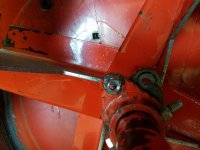
Snow Going through second stage bolts

   / Going through second stage bolts #101  
Yes, I have the updated shear bolt setup in mine:

View attachment 499062

Here is the bolt in the package from Kubota:

View attachment 499063

The total distance of the two flanges lined up is around 3/4". The thread on the bolt could be 1/4" shorter in my opinion.

View attachment 499064
View attachment 499066

And here is the head of the bolt. This is a grade 8 bolt, right? Seems like no where to step up to other than to go to a 5/16".

View attachment 499065

The last bolt I pulled out had a bit of a bend to it, even though it was only in there a short time. They seem to loosen up quickly. I assume that it is stretching the bolt.

I can get pretty good access to the two sides of the flange. It seems like a good, permanent solution would be to weld up the holes and redrill them, as they are a bit loose right now. I will try and find another grade 8 1/4" bolt with a longer flange (less threads). The JH label on bolt head indicates the Chinese manufacture. Maybe they are not really grade 8 or they have some manufacturing problem?
Are you putting this bolt in from the front or from the back? It looks almost like if you put it in from the back the shoulder may line-up into the shear area.

Aaron Z
 
   / Going through second stage bolts
  • Thread Starter
#102  
Are you putting this bolt in from the front or from the back? It looks almost like if you put it in from the back the shoulder may line-up into the shear area.

Aaron Z

I have tried putting the bolt in both directions with no difference in time between shears. Here is a picture showing that it is shearing in the threaded area. I think the two tabs are the same basic thickness, so I think it shears at the same point whether it is put in from the front or the rear.

20170215_175930.jpg
 
   / Going through second stage bolts
  • Thread Starter
#103  
Currently, the shear strength of my bolt is PI*R^2*90,000 or 4400lbs. If I was to go up to 5/16" bolt, this would move to 6900lbs. I am wondering how good the engineering was on this updated tab shear method, and possibly that it was set too tight on tolerance so that when there is any play in the hole, it fails too soon and too often. Moving down to a grade 5 bolt where the shear strength is 72000psi vs 90,000 for a grade 8 yields a shear strength of 5500lbs.

So what are thoughts on drilling it out to 5/6 so I have a tight fit again and moving to a 5/16 grade 5 bolt?
 
   / Going through second stage bolts #104  
I have tried putting the bolt in both directions with no difference in time between shears. Here is a picture showing that it is shearing in the threaded area. I think the two tabs are the same basic thickness, so I think it shears at the same point whether it is put in from the front or the rear.

View attachment 499121

Wow, newest best style flange shear bolt design and the old problem.

Looking at your photo of the fan hub/flange area, there appears to be a gap. The two flanges do not appear to be flat so they are NOT like two pieces of window glass one on top of the other. .

Is this your observation? If there is a gap it would explain two things.

The first is why you are seeing some bending in the failed bolts, the second is why the shear bolt is failing in the threads not the smooth shank.

The two flanges should be acting like a good pair of scissors cutting paper. When the scissors are new and the two halves of the scissors are tight together, they easily slice through thick heavy paper. When the scissors get old and the two halves are not tight together, it is much harder or impossible to cut heavy paper.

If your flanges are bent or something is preventing them from pulling together over the complete face of the flange, this has to be corrected.

Can you remove the bolt through the fan shaft and pull the flange back so the flange on the fan hub can be photographed with the flat edge of your caliper against it to show just how flat it is?

Do the same photo procedure on the flange you pull back.

The bolt head you are asking it it is a grade 8 is indeed a grade 8. The difference between a chinese and a north american one would not be significant in this situation.

What is interesting is the Kubota package for the shear bolt which clearly show a grade 8 bolt. Previous packages of shear bolts with newly purchased blower of your style also clearly stated grade 5 for the auger and grade 2 for the fan. Why the big change by Kubota?

At this stage I am very hesitant to have you up the bolt diameter for fear of causing damage. Thinking quickly, the rotating fan has a lot of stored energy. When it is suddenly stopped that energy is going somewhere. If there was a bigger bolt connecting it to the shaft could that energy be traveling along the fan shaft to the gear box? I have not thought thru my argument enough to say this is a genuine concern but.... Also, deviating from the Kubota design when we are jusst starting to get their attention might just give them a reason to pass you by.

Dave M7040
 
   / Going through second stage bolts
  • Thread Starter
#105  
Looking at your photo of the fan hub/flange area, there appears to be a gap. The two flanges do not appear to be flat so they are NOT like two pieces of window glass one on top of the other. .

Is this your observation? If there is a gap it would explain two things.

This may be the way the photo looks. There is no gap between the two flanges. Maybe it is the way they are rounded off at the edge, but them main material of the flanges comes together good, and when I torque the shear bolt they are pressed together tightly.

There is some extra room in the shear bolt hole. It is not a lot, but I would not say that the shear bolt is tight going into the hole. Initially this is not a problem, since there is no movement since the shear bolt is tight, but after even 15 minutes of operation the shear bolt is a bit loose, and will rock back and forth a bit when I move the fan. At this point when I move the fan there is some play between the two flanges. Since the shear bolt is held with a self locking nut, I am thinking that there is some stretch happening with the shear bolt when it is in operation.
 
   / Going through second stage bolts #106  
This may be the way the photo looks. There is no gap between the two flanges. Maybe it is the way they are rounded off at the edge, but them main material of the flanges comes together good, and when I torque the shear bolt they are pressed together tightly.

There is some extra room in the shear bolt hole. It is not a lot, but I would not say that the shear bolt is tight going into the hole. Initially this is not a problem, since there is no movement since the shear bolt is tight, but after even 15 minutes of operation the shear bolt is a bit loose, and will rock back and forth a bit when I move the fan. At this point when I move the fan there is some play between the two flanges. Since the shear bolt is held with a self locking nut, I am thinking that there is some stretch happening with the shear bolt when it is in operation.

jr

The stretching idea ..... it things are working as they should be the only stretching of the bolt is when it is torqued on installation.

Are you reusing the nyloc nuts? They dont work well the second time around.


How about this test. New bolt and two high quality NON locking nuts. Put the first nut on and torque as specified. Now tighten the second nut against the first one holding the first one from moving with a wrench. If the wrench is too wide to hold the first nut consider grinding the wrench thickness to suit. Alternatively a small washer could be put between the two nuts but this wont work as well.

Try and get a bolt where the threads are past the face of the flange so only the smooth shank is in the two flanges. Use a washer or two between the first nut and the flange to get the nut to tighten without running out of threads.

Now cut the protruding end of the bolt off leaving a few threads beyond the second nut.

At this point I want you to peen the protruding threads into a mushroom so the nuts cannot back off.

To do the peeing dont just bash the protruding threads with a hammer. Something heavy has to be held against the head of the bolt at the same time to resist your bashing of the threads.

Putting the bolt in from the back or fan side should make this test fairly easy.

Now if the bolt fails we will be certain that the nut has not moved thus loosening the bolt.

What do you think?

Dave M7040
 
   / Going through second stage bolts
  • Thread Starter
#107  
jr

The stretching idea ..... it things are working as they should be the only stretching of the bolt is when it is torqued on installation.

Are you reusing the nyloc nuts? They dont work well the second time around.


How about this test. New bolt and two high quality NON locking nuts. Put the first nut on and torque as specified. Now tighten the second nut against the first one holding the first one from moving with a wrench. If the wrench is too wide to hold the first nut consider grinding the wrench thickness to suit. Alternatively a small washer could be put between the two nuts but this wont work as well.

Now cut the protruding end of the bolt off leaving a few threads beyond the second nut.

At this point I want you to peen the protruding threads into a mushroom so the nuts cannot back off.

To do the peeing dont just bash the protruding threads with a hammer. Something heavy has to be held against the head of the bolt at the same time to resist your bashing of the threads.

Putting the bolt in from the back or fan side should make this test fairly easy.

Now if the bolt fails we will be certain that the nut has not moved thus loosening the bolt.

What do you think?

Dave M7040

The nuts I am currently using are not nylocks, but are metal friction locknuts. I am not really sure what they are called, so hopefully this make sense. I am not reusing them. A new one comes in each package from Kubota. I can double nut it like you suggest, maybe with a lock washer between the two nuts? It seems like this would be pretty secure without going to the trouble of cutting the nut and all of this. I think I should even be able to mark it with a scribe or something so I am sure that the buts are not turning relative to the bolt. This is a good idea, since there is a lot of force and vibration in this area, so it is not out of the question that they are somehow working loose.
 
   / Going through second stage bolts #108  
The nuts I am currently using are not nylocks, but are metal friction locknuts. I am not really sure what they are called, so hopefully this make sense. I am not reusing them. A new one comes in each package from Kubota. I can double nut it like you suggest, maybe with a lock washer between the two nuts? It seems like this would be pretty secure without going to the trouble of cutting the nut and all of this. I think I should even be able to mark it with a scribe or something so I am sure that the buts are not turning relative to the bolt. This is a good idea, since there is a lot of force and vibration in this area, so it is not out of the question that they are somehow working loose.
I would use a longer bolt of the same grade so that the shoulder is in the shear area and double nut it (a regular nut and the lock nut that comes with it). If its loosening, either the nut is backing off, or the bolt is stretching.
Double nutting will keep the nut from backing off. If its stretching, you need a higher grade bolt.

Aaron Z
 
   / Going through second stage bolts #109  
jr
Of course how to do this is your choice since you have to do it. :)

My fear was if the shear bolt breaks and you find just the bolt half and not the nut half or vice versa will you be able to tell if anything m.oved. If you found the double nut half with the mushroomed threads against the outer nut you would be certain. I don't know what you have to cut the bolt. Angle grinder, sawzall or hacksaw

You could cut it before you install it if you make provision to get the threads into a condition to let the nut start.

The easy way to do this is to thread a nut, cheap nut, unto the bolt past where you want to cut it. Once the cutting is done, you unthread the nut and it straightens the threads.

Then the peening is all you have to do in place and if you have two hammers, one can the the weight against the head of the bolt while you bash the threads. It is only a 1/4" bolt so it wont take much bashing.

The key part is the threads being beyond the flange and a washer there to allow the first nut to achieve a true torque squeezing the two flanges together and not an artificial torque when the nut runs out of threads as things tighten up.

Dave M7040
 
   / Going through second stage bolts #110  
I would use a longer bolt of the same grade so that the shoulder is in the shear area and double nut it (a regular nut and the lock nut that comes with it). If its loosening, either the nut is backing off, or the bolt is stretching.
Double nutting will keep the nut from backing off. If its stretching, you need a higher grade bolt.

Aaron Z

Aaron

Kubota is already providing a grade 8 bolt! First time I have seen this change. Normally the literature with a new blower say grade 2.

Dave M7040
 
   / Going through second stage bolts #111  
I am not having any shear bolt problems with my snowblower, but had them on the hay baler growing up on the farm. The very large pulley that drove the plunger had a shear bolt. It was to protect things if something solid got into the bale chamber and stopped the plunger (for those that had wire balers in the 60-70s, this happened when you baled the needles due to timing off on needles).

Two things sheared that bolt faster than you could imagine, one when I pushed too hard and overloaded input to bale chamber and the second when I sheared a few bolts, the hole got loose and then it was easier to shear and only got worse. If you have slop in bolt holes, you will start shearing bolts for no reason seemingly.

Looking at the fan enclosure, my guess is that gravel was the initial cause of shearing and now the sloppy hole is a contributor.

I suggest two things, first close up the clearance or open up the fan clearance. I am guessing the way it is right now is likely the exact wrong clearance and a single rock can get lodged briefly and pop the shear bolt.

The second thing is to take care of the hole, either by filling and drilling back to original size or drilling to next size.

We never had bolt threads in the shear area, find a different bolt that solves that. Another thought, if there is gravel behind the fan, it could be causing you ongoing issues and a piece or two comes loose...

Best wishes getting it resolved, I would not be happy at all if I was shearing bolts like that.. and final thought, it goes without saying that this is my opinion that I am sharing.
 
   / Going through second stage bolts #112  
In resume, no threads in the sheer zone is essential. Threads are like a pre determined partial cut and therefor a weak spot sure to sheer .
You want only solid bolt body in that zone.
The higher the bolt grade the cleaner the sheer or cut will be.
The holes need to be sharp (think like scissors) to be effective.

In fact when I rebuild my sheer bolt flanges this summer I will heat treat to be sure I have clean sharp cutting action and intend to add bushings on the outer faces of the flanges which will allow me to keep alignment and use longer bolts with fewer threads exposed.
Presently the 2 flange faces are a mere 1/4" total and I have to use 1 1/4 bolts resulting in lots of thread and washers.
Worst is screwing down all the thread length bare fingered in -30 degs. Fingers get so numb that I can't feel the nut to thread it on.
 
   / Going through second stage bolts
  • Thread Starter
#113  
The second thing is to take care of the hole, either by filling and drilling back to original size or drilling to next size.

Just to make sure we are talking about the same thing, are you suggesting that I weld up the hole a bit with mig or gas on each of the tabs and then redrill it to a tight fit on the 1/4" bolt? It is really starting to seem like that is the correct fix for the problem I am seeing, but I wanted to make sure I am understanding you. I just got some 1/4" bolts today that have a longer shank (before the threads start), but I still may need to tighten up the hole based on what you are saying your experience has been.
 
   / Going through second stage bolts #114  
It looks like to me that the two plates are moving when the bolt is in place (oscillating). The damage to the bolt after short use is from the one of the two sheer plates repeatedly hitting it. If you put the bolt in and use a regular nut finger tight can you move the fan while keeping the shaft from turning? I would agree with the others to try a longer bolt so the sheering happens on the shoulder of the bolt, not the threads. I think I would use a regular nut and torque it down (I think 107 inch/pounds). Then use the stover (lock) nut to keep it from loosening up.

On my Kubota snow blower the holes are very tight. With the nut in place there is virtually no movement. My L2195 uses a 1 3/4 x 5/16" grade 5 sheer bolt on both the fan and auger. Both the fan and auger are set up identical to your fan. Without running the numbers I have to believe that a 5/16" grade 5 bolt can't have much more sheer strength than a 1/4" grade 8 bolt.

If your holes are worn out I'm not sure if you would be able to drill them out. Those plates could be hardened steel. But you could potentially step up to a 5/16" grade 5 sheer bolt. A quick look on the internet shows the 1/4" grade 8 bolt has an approx sheer strength of 4500lbs while a 5/16" sheer strength would be 5750. Ideally what would be best if you can drill the hole larger would be to get a grade 8 5/16 sheer bolt that has been necked down to sheer at a specific spot for a snow blower. But that would most likely require the use of washers to try to line up the sheer spot with the two plates.
 
   / Going through second stage bolts #115  
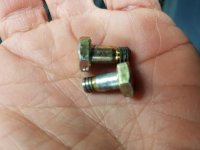
I've been tracking this thread and posted a couple times back in the beginning. My dad has a Kubota GR2100 garden tractor with the GR2707 46" front blower made by RAD. He's had the same fan shear pin failures described here. In fact many of them come under light load or just when engaging the PTO.

I have a Bercomac unit which looks nearly identical and I'm told from their tech support that the companies were somehow founded from the same owner or something to that effect. My Berco looks impeccably identical to the Kubota, however it's only 2 years old and has the upgraded shear pin design on the fan that was shown in these photos. I have never sheared a bolt on the fan.

Anyway this thread has grabbed my interest. I, like Dave M7040, emailed RAD a couple weeks back about the problem. I thought they were ignoring me but earlier this week I got an email from the same Scott Johnson from Kubota Canada asking for more information. Of course when he found out I was located in the US, he told me he was mistaken and forward my issue to Kubota USA, but promised I would be contacted again. Still interested in the issue, I called RAD today and asked to speak to their tech support department. The number is (418) 332-7384. Apparently they seem to be in some temporary facility from the rest of the company due to some building repairs or something to that effect, so I couldn't be transferred. When I called I actually requested they call me right back so I didn't have to pay international charges on my cell phone.

So they called me back and I spoke to Martin. I explained I had their front mount for about 5 years, on my Kubota, and even gave my model #. I explained the shear bolt failure and the observed shear bolt design change. The tech confirmed about 3-4 years ago they changed their fan shear bolt design specifically because they were observing many failures. Other than this and ensuring the chain tension was not slack, they couldn't provide me with any other explanation why this was occurring.

I asked him if they sold a kit to retrofit the fan for the new shear bolt design. There is no assembled "kit", but they said my local dealer would have all the parts available. However the bad news is they told me this also requires replacing the gearbox....WHAT!?!? Now we're talking some mega cash. That was all he could tell me.

I'm just catching up to the latest posts on this thread now, but had been thinking about how the holes may round out over time from repeated failures...just a guess. With my dad's tractor off, there is a small amount of slop in that shear bolt joint between the fan and shaft. On my Berco there's some slop (hard to tell if more or less without the 2 side by side), but that shear bolt is replaced with a solid 5/16" bolt, and the shear bolt is now on the collar where there is no slop. On my dad's last use, he said he torqued the shear bolt very tight and it didn't break through 1 whole usage.

Anyway I'll see where this goes when (and if) Kubota USA reaches back out to me.
 
   / Going through second stage bolts #116  
Just to make sure we are talking about the same thing, are you suggesting that I weld up the hole a bit with mig or gas on each of the tabs and then redrill it to a tight fit on the 1/4" bolt? It is really starting to seem like that is the correct fix for the problem I am seeing, but I wanted to make sure I am understanding you. I just got some 1/4" bolts today that have a longer shank (before the threads start), but I still may need to tighten up the hole based on what you are saying your experience has been.

correct, your longer shank bolts might be enough to give you some relief from shearing, but time will tell.
 
   / Going through second stage bolts #117  
Oops, one other thing I wanted to discuss. Why couldn't we just buy 2 of those collar hubs (the black piece in the photos). Remove the existing fan and bring it to a welding shop. They may have to cut down the fan hub to match the length where the solid bolt shall sit in the old shear bolt hole, but they could simply bolt the two hub sections together while they weld on one hub to the fan. If they get the finished length right, couldn't this be a solution? Seems easier than trying to weld/redrill the shaft hole.
 
   / Going through second stage bolts
  • Thread Starter
#118  
I looked at the holes closer, and the back one was definitely elongated.

20170217_151801.jpg

I filled it with my mig welder and redrilled it so that it is tight now. I also rebolted it with a new 1/4" grade 8 bolt with a longer shank so that the shear area is not where threads are. It looks like more snow this weekend, so I will try it out and see how it does. I also double bolted the shear bolt. Also the bolt that goes through the center shaft was damaged and gave it some play, so I changed this as well.
 
   / Going through second stage bolts #119  
Just what I would have done. Make it a pre-use check for a few runs to check the double nut on the sheer bolt of tightness. I think you'll have success with your solution.
 
   / Going through second stage bolts #120  
For sure you don't want any threads in the shearing area as a thread is like the start of a shear and as well threads will mangle the 'cutting edges' of the shear 'blades'.
Think like metal tin snips, a nick makes a messy cut.
 

Tractor & Equipment Auctions

2020 CATERPILLAR 242D3 SKID STEER (A60429)
2020 CATERPILLAR...
Volvo L306 (A57148)
Volvo L306 (A57148)
2019 TAKEUCHI TL10V2 SKID STEER (A60429)
2019 TAKEUCHI...
1977 Gleaner A630 Corn Head (A56436)
1977 Gleaner A630...
2000 Kenworth W900 - 3406E CAT Engine - 78,980 Miles (A55302)
2000 Kenworth W900...
2008 Dynapac CA150D (A60462)
2008 Dynapac...
 
Top