Fun with square tubing

   / Fun with square tubing
  • Thread Starter
#21  
<font color=blue>Can't see real well, but I don't see a lot of buckling on the inside of the radius. Maybe it's how you clamped it?</font color=blue>

I don't fill the tubing. It's all in the clamping.

If you ever drive by what some folks refer to as wrought or ornamental iron fencing you will see little circles about four inches or so across as decorations. The way these are made is you have a gear reduction motor attached to a drum the size of the inside diameter. In a slot in the drum you place the end of a piece of half inch square tubing. You turn on the motor. It wraps the tubing around the drum. When you've got the whole stick of tubing wrapped around the drum tight you have what appears to be a coil spring of sorts. You cut down the center length wise of the coil. You have all these circles. You tweak the ends of the circle together and you now have circles for welding in for decoration.

Small tubing bends so easy and it tries so hard to please.

Solid stock is a problem because you have the stretching on the long side and the compression of the short side working clean clear through.

If you look at a bend in solid stock where they used heat to facilitate the bend. Most folks don't stop and think for a minute. They just heat the inside of the bend causing it to fold making the bend. If they've thought a little bit they might heat the outside of the bend and let that stretch.

Neither one of those bends looks for crap. The way to do it with a torch is to heat the whole section to be bent beyond red to orange. Then you bend the piece over or around something. The bend will come out spectacular and look good too. A torch can help do a bend with pipe and or big tubing. But chances are most likely you're not going to have the area heated evenly enough not to cause more problems rather than eliminate them. Some folks bend pipe by heating it in a forge. But they fill it with dry, important, dry sand and compress it first. This supports the material from the inside as the bend is made.

On the tubing you're working against the inside not wanting to compress and the outside not wanting to stretch. So you have to give it some support. It needs your help.

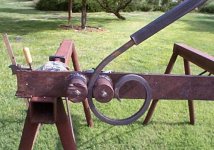
That's why we clamp it so tightly so it won't slip. What happens if we don't have it clamped tight enough and it slips is the tubing fails and it kinks. But if we have it supported, with the flange in this case, we're forcing the bend to happen over an area evenly. The evenly is really important. The tighter the bend the more deformation. The outside has to stretch more and there's more compression on the inside.

I have a friend who'd made a mini Hossfield for small craft and handyman stuff. It's called the craftbender and he's here south of Dallas. He sets up in Canton every month. I haven't seen it in action yet but a year or so ago he was telling me that he'd taken what I'd show'd him and made a die for doing half and three quarter square tubing with it. He's a character, names, Rylie. He talks almost as much as me and gets just about as excited about making things.

BTW I have two of his craftbenders. I use them to do all kinds of trick things. I guess since I use them so much I should give Rylie a call and have him get with Mohammed and the two of them find a way to get ya'll the opportunity to see and purchase one.

Maybe the best way to explain the way the bending works is to examine the emt bender you can buy for little or less at your local box home improvement store. Emt is a thin wall stiff walled round tubing. If you try to bend if over your knee it's gonna kink and break. If you try to wrap it around something like a piece of pipe. It's gonna kink and break.

But you put it into that simple little bender and with a little practice you'll lose all respect for electricians. It ain't that hard. (joke guys, joke) But the reason it works is the emt is forced around the die and the sides are supported while doing so.

I'm running late. I wish I had time to answer all the questions. I'll try to do better. Bgott, I can't thank you enough for your input on some other topics. Even though I haven't replied I do want to publicly acknowledge your input is appreciated.
 
   / Fun with square tubing #22  
Harv,

Thanks for the demonstration on bending. It looks like even I might be able to do something like that.

I would like to second John III’s suggestion of a “Welding 101” class. There are quite a few members that are interested in how to get started in basic metal work. You guys that put all these great things together have us chompen at the bit to give it a try. A list of the basic starter tools needed and a recommendation for a beginner’s welder that you would not out grow after the first project would be great.

MarkV
 
   / Fun with square tubing #23  
Great work, Harv - I enjoy reading your posts.

I needed to bend up a fair amount of 3/4" square stock (solid) last year and made the "Brick House Bar Bender" (see attached) out of a piece of old railroad rail and some 3" round stock. That, plus a big 'ole cheater bar allowed me to bend the 3/4" square stock with no heat.

The project I was working on can be found <A target="_blank" HREF=http://users.arn.net/~usnick/bed.html> here </A>

One thing I learned from that project, fellas: Make some furniture or other things for your wife and she'll open the checkbook for all of your welding supply needs!

FWIW, here's my $0.02 on buying a welder:

If you're wanting to spend as little as possible, I'd recommend a 220V Lincoln 225A arc welder, available anywhere for a little over $200. Those are very durable machines with a decent duty cycle that will do anything that you need, with one exception - they're not very good at the lightweight stuff (sheet metal).

But given that this is a tractor board, and most welding discussions center on building tractor implements/attachments, etc, I'm guessing that you guys want to buy a welder that can do "heavy" welding at the expense of the light stuff.

For the same money as a 220V buzz box, you could buy a cheap 110V MIG welder (wire feed), but those welders are for light duty stuff only. Their duty cycle is very low. They're OK for fixing a bike frame, repairing the lawn mower handle, etc, but are too light to actually BUILD much of anything, especially anything out of fairly heavy steel like you'd want to use to make a trailer hitch, 3ph whatzit, etc.

As luck would have it, I ran into a buddy of mine today that I hadn't seen in a while and he's opened a muffler shop in town. I asked if he was still using gas welding or was he using MIG. He said that he used both in his shop but did mention that he had bought a small 110V MIG for his home. He said that it wasn't fit for "anything heavier than jewelry repair". /w3tcompact/icons/laugh.gif

If you've got the money, a Millermatic 175 or 250 would be the cat's meow. They're both $1,000 or better. If you're on a budget, get the buzz box. Get a welding HOWTO book at the bookstore and have at it. I'm a self-taught welder and have really enjoyed making all kinds of stuff. I sometimes tell people that I like to go to the scrap iron lot and buy small pieces of scrap metal and weld them into much larger pieces of scrap metal. /w3tcompact/icons/laugh.gif

Best,

Mark

ps: <A target="_blank" HREF=http://users.arn.net/~usnick/welding.html> I've documented some other welding projects here </A>
 

Attachments

  • 53-156432-curlyq.jpg
    53-156432-curlyq.jpg
    40.1 KB · Views: 1,764
   / Fun with square tubing #24  
Mark,

Great project work!!! Us "welder wanna-be's" are all jealous I'm sure of both you and Harv.

Kevin
 
   / Fun with square tubing #25  
Nice welding projects, especially that bed!!! I'll second your comments about the buzzbox. I just bought one cause I couldn't justify the $1000 for a decent mig. So far I don't think I've had to go over 120 amps for most of my welding so I have plenty in reserve if I use some heavier stuff. BYTW - they don't make the AC225 anymore, it's now the AC235. Same thing but 10 more max amp capacity.
 
   / Fun with square tubing #26  
I agree Mark, the buzz box is the way to go. I've had a little Miller thunderbolt for about 20 years and I have used it for everything from sheet metal to heavy implement fabrication and repairs.

As you said these welders are not good with sheet metal but if you use the tiny rods, turn your heat down and exercise a lot of patience you can get by with them.

I enjoyed looking at your projects. They were great!

TBone
 
   / Fun with square tubing #27  
If you get into the $650 - $850 220v Mig welders will these work on the types of metal sizes you use in tractor related welding?

MarkV
 
   / Fun with square tubing #28  
Mark, I have enjoyed reading these threads from you and Harv. You mention "buzz" box, does this require gas? Or can you use wire feed without gas? I also would like to see a thread on basic welding. I have most of the suggested books, which I have enjoyed. Now its time to start looking for a welder and the thought of the 110 MIG welder really appealed to me for the fact that it does not require gas. Most of the welding I will be doing is 1/8 to 1/4 inch steel plating. I have no problem going with a 220 unit as long as I can keep away from gas. Most of my aversion to gas centers on the yearly inspection of the bottle/gage and not doing enough welding to justify keeping it filled.
I continue to read that you can make multi passes on the larger stuff with the smaller welders, is this true or should a person just figure on a 220-type unit?
Appreciate your advice.
PJ
 
   / Fun with square tubing #29  
I'll jump in here with some info on welding, though I'm not an expert I do have a Miller ac/dc stick welder and a 220 amp Century mig welder.

With Mig you can use with or without gas. It depends on the wire. Flux core wire does not need gas where solid core wire does. You can buy either. As far as the bottle gas goes...I got mine at amy local Amerigas/Propane dealer. In my case you "buy" the bottle, pay a one time fee and then you exchange the bottle for a different one each time you need a refill. They take care of the inspection issue. Your gage stays with the welder. This is not a combustible gas for those who might not know this. It is usually an argon mix which "shields" your wire from contamination. Others can explain this better.

The Century 220 Mig I bought at SamsClub about five years ago for $600 and it has served me very well. I've welded 1/4 plate down to sheet metal. I have to say it is the easiest to learn to use. A couple of hours of practice and you'll be amazed at what you can do.

The stick is harder to learn but not that much harder. I hadn't welded since high school. Take an adult ed class and you'll be well on your way to knowing the basics. Good luck

Mike
 
   / Fun with square tubing #30  
When I was a kid my dad had what he called a "Buzz Box". Actually, he still has it. It was about 12"x12"x12" and was simply a 110v arc welder. It used small diameter rods and was great for small welding jobs on small steel pieces. It was no good for sheet metal work.

At about 14 I discovered it was also no good for aluminum. I knew nothing about welding but had watched my dad and was confident that I could do it. My partner had a 305 Honda Dream. The front drum brake hub was aluminum and had a small piece cast into it that held the brake cable. That piece broke one day and we decided that we could fix it ourselves.

I set up the welder and, while he held the broken piece in place with pliers, I struck an arc. Looking back, it was really kind of neat to watch that big hole instantly appear in the brake hub. But it really wasn't very funny at the time.

Fortunately, my dad had a friend with a mig welder and he was able to fill the hole back in and weld the broken piece back on.

Lessons learned.......................
 
   / Fun with square tubing #31  
Hydrogen in the air reacts with the molten weld metal and makes it brittle. The air also makes it impossible to lay down a good bead. Thats why you need a shielding gas. The flux on a rod melts with the fill metal and floats to the top of the bead, thereby shielding the bead from the atmosphere. The use of argon or CO2 or nitrogen or other shielding gas used with a wire feed welder serves the same purpose. It saves cleanup time. It also has its problems. You can't weld with a fan blowing on you or a breeze running through your work area because it'll blow away your gas. You can tell when that happens because it gets hard to weld with all the spitting and spattering and your weld looks like birds&*t. Flux core wire solves this problem and the slag is thin and easy to chip off.
 
   / Fun with square tubing #32  
Hi PJ-

Yes, "buzz box" is a slang term for an arc welder. These do not require gas because the weld is shielded by the flux coating on the welding rods. Advantages of arc welder:

1) As I mentioned, they are relatively cheap
2) Unlike gas-shielded welders, they can be used outdoors in the wind (wind disturbs the gas shield and messes up the weld).
3) Can lay down a darn-nice looking weld. IMO, a nice arc weld bead looks better than a MIG weld bead - you can get that nice, shiny "stack of dimes" look with an arc welder.

Disadvantages of arc:

1) The flux coating forms a glass-like slag on the weld that protects it as it cools. Generally, you'll want to knock off all the slag. Certainly so if you intend to paint. This takes time, and if you want a clean shop floor, needs to be swept up.
2) Welding rods are consumed and need to be replaced often. So this takes a little time also.
3) Require a little more practice on "out of position" (vertical or overhead) welds. But if I can learn to do it, anybody can!

IMO, the main advantages of MIG over arc are that out of position welds are easier, and also the "trigger" on a MIG welder is nice - there's no chance of accidentally giving yourself "arc eye" as you can with an arc welder by accidentally touching the arc rod to the base metal before you intended to. Buying an auto-darkening helmet will make this a non-issue (they're great!). And since MIG doesn't require you to change welding rods or pound slag, you can get more welding done every hour - a good thing for a pro that welds for a living, but not too big a deal for a hobby welder.

The cheapest MIG welders frequently cannot run gas and instead must use flux-wire. Welding with flux wire produces slag on the weld like arc welding, but they can be used in the wind. Any welder that can run gas can also be used without gas by running flux core wire.

FWIW, I've never found keeping gas bottles around to be a problem. Even though I'm only a part time hobby welder, I've been at it long enough to know that it's something I'll keep at for a long time, so I went ahead and bought bottles (oxygen, acetylene, and CO2). I bought half-sized bottles that are easier to handle but still big enough to not need replacement very often at all.

The inspection on the tanks is good, I think, for five years. But that's not an issue for me. The welding supply shop where I bought my tanks takes care of that for me. I bring in an empty bottle and then pick up a full bottle that has been inspected. If I wanted, they'd let me leave my bottle and then pick it up a day or two later and always keep my original brand new bottle, but it's much more convenient for me to just continue to swap them out in one visit. Since I bought my bottles, all I pay for is the gas I use, and there's no monthly charge - all the advantages of bottle renting, but only a single up front charge.

You are right about being able to lay down multiple passes with a small welder. The smaller welders, however, will not get the penetration into the base metal that a larger unit can. So, for instance, if you're going to "butt weld" to pieces of 1/4" flat steel to each other, you can use a small welder and lay down a few passes along the seam, but the weld will mostly just sit on top of the metal and not penetrate into the core of the two pieces being joined.

You can work around this a little by tapering the ends of the two pieces of steel so that when they are butted together, there is a little valley between them that you then fill up with weld in multiple passes. This would be fine to do now and then, but I'd not want to have to do that often as it would take a fair amount of time.

IMO, in addition to the lack of penetration with small welders, an equally significant problem with them is duty cycle. This is the amount of time that they can spend working versus "resting". This resting time is critical to allow the machine to cool. The higher you crank the output voltage/amperage of a welder, the lower the duty cycle will be. In some cases, the duty cycle can drop to a horribly low 10% or so, so you need to make sure and spend LOTS of time allowing the machine to cool, or risk burning it up.

If a small welder is advertised to be able to weld "up to" a certain thickness of steel, that maximum thickness is guaranteed to be at the highest output setting and as a result will have the lowest possible duty cycle for the machine. If, however, you buy a machine that's advertised to weld steel that's quite a bit thicker than you think that you'll want to work with, this tells you that for the work you'll be doing, the machine will be set below it's maximum output setting and the duty cycle (higher to begin with on larger machines) will be increased even more.

I guess everything's a compromise. Some welders have advantages over others, but depending on how much use you plan to put a welder to, it's possible to work with what ya got and just live with the shortcomings. I do think that a cheap 220V AC arc welder gives the most power and highest duty cycle for the money. As was mentioned, with 3/32 welding rod, you can weld some fairly thin stuff. I use arc to weld 14ga steel with no problem regularly. Anything much thinner and I risk burning a hole in it. The main thing I like about the 220V arc is that it's plenty big to weld trailers, hitches and other "heavy" things at about half of it's maximum output. And since you'll have to stop now and then to change rods, etc, the duty cycle will never be an issue with a machine that size.

I'm sure that Harv has waaaaay more experience than I do. I'm really no expert. I guess my main motivation in posting is to encourage others to jump in and give welding a try. With no formal training and some reasonalby cheap equipment, anybody can be making some pretty neat stuff with just a little practice!

Best,

Mark
 
   / Fun with square tubing #33  
Re: Fun with square tubing , WELDING CAUTION!!!

CAUTION about purchasing a welder guys!!! It tends to lead to purchase of a grinder, a bandsaw, a bunch of airtools, a compressor, a huge selection of various metals, and then you'll have to have a shop for it all. Be carefull out there...
 
   / Fun with square tubing #34  
Re: Fun with square tubing , WELDING CAUTION!!!

<font color=blue>CAUTION about purchasing a welder guys!!! It tends to lead to purchase of a grinder, a bandsaw, a bunch of airtools, a compressor, a huge selection of various metals, and then you'll have to have a shop for it all. Be carefull out there... </font color=blue>

Too late for me and I don't even have a welder yet Jim /w3tcompact/icons/crazy.gif We went slightly over budget on the electrical for our house and I like to think it's the extra lights and outlets we put in (not to mention upgraded service). Our builder (jokingly) tells my wife it's all my fault for the welder circuit I demanded in the garage /w3tcompact/icons/eyes.gif
 
   / Fun with square tubing #35  
Mark, Mike, Brad, Ozarker,
Many thanks for the great advice - you guys are super.
Now what I got out of this (hope I'm right) is that a 220V arc welder is probably the best route to go. With this I can use either a welding rod (with gas) or flux core wire (without gas).
I have not welded since high school. With the move coming up and the ordering of a new tractor soon, the need for a welder for all those projects is close at hand.
I have enjoyed the many welding books by Richard Finch. I also understand that there are some good videos available.
PJ
 
   / Fun with square tubing #36  
PJ,

<font color=blue>is that a 220V arc welder is probably the best route to go. With this I can use either a welding rod (with gas) or flux core wire (without gas). </font color=blue>

Well, either you or I are confused /w3tcompact/icons/crazy.gif. I'm pretty sure the arc welder is ONLY for rods. To go with the wire (with gas) or flux wire (without gas) you have to go to a MIG welder.

Kevin
 
   / Fun with square tubing #37  
Hi PJ-

With an arc welder, your only option is flux coated welding rods. They're about 14" (something like that) long and you put them, one at a time in a "stinger"/handle and use them. You put a new one in place as they are consumed. You do not use gas with an arc welder.

A MIG welder is also called a wire-feed welder. They use *spools* of wire. The wire is fed out on demand as you pull a trigger. So the wire feed welders don't require you to stop and swap out welding rods. And the MIG welders can use either solid wire or flux wire. If you use solid wire, you must use a gas shield. All but the cheapest MIG units allow you to use gas if you want, and I'm pretty sure that they ALL can use flux wire if you don't want to use gas.

Hey, just noticed that you mentioned Richard Finch! It was one of his HOWTO books that I bought years ago that got me started! He's certainly done it all!

Best,

Mark

ps: what was said above about a welder purchase leading to other purchases is certainly true. Use the low entry price of a welder to get the tool in the door and then you can slip in "just one more thing" from now until doomsday.

One thing that you will find that you'll need soon is some way to cut steel. If you're stuck with a hacksaw, you'll get tired of welding right quick! So a sawzall, chopsaw or oxy/ace torch will need to follow PDQ. I like a chopsaw for square cuts and use the torch for most everything else.
 
   / Fun with square tubing #38  
<font color=blue>Now what I got out of this (hope I'm right) is that a 220V arc welder is probably the best route to go. With this I can use either a welding rod (with gas) or flux core wire (without gas).</font color=blue>

With the 220 arc welder, you will use welding rods, no gas required. With a wire or MIG welder, you can use flux cored wire, or solid wire with gas.

I found the MIG/wire weldor much easier to learn and use. After playing with it for about 1/2 hour, I was making usable welds. If you get a higher end 120v wire weldor, (I have a Lincoln) you don't have to worry about running it over its duty cycle, it will shut it self down until it is cooled off enough. I only had this happen a couple of times when I was welding heavy steel with long joints. As far as penetration on heavier metals, I just turn it to its highest setting and turn the wire speed to slow and weld the joint slowly.
 
   / Fun with square tubing #39  
Kevin, thanks for clearing that up. As you can tell, my preference is for MIG (wire core without gas) but will need 220v for some of the heavier stuff. If not then will go with the stick welder with gas.
If I go with the mid size MIG welders, my understanding is that they can switch to gas. Sure wish I had a work shift that allowed me to take an adult education class in welding.
PJ
 
   / Fun with square tubing #40  
So one of the 220v Lincoln arc welder’s sounds like a good place to start. If I read right, the learning curve may be a bit longer than a small Mig but it will be more versatile and will handle 3/16 and ¼ steel better than the little Mig’s.

Now that we know how to put it together, what should we look at for cutting it to size? I know about “Chop saw’s” but not what size metal they will cut. Also what is the advantage of the horizontal band saws over a chop saw? And finally, what are the other basic tools needed to get started.

Thanks,
MarkV
 

Marketplace Items

CHALLENGER MT525B TRACTOR (A59823)
CHALLENGER MT525B...
2020 BOBCAT T870 SKID STEER (A60429)
2020 BOBCAT T870...
UNKNOWN  SKIDDED FRAC TANK (A58214)
UNKNOWN SKIDDED...
2020 GMC AT4 CREW CAB TRUCK (A60430)
2020 GMC AT4 CREW...
2011 DRAGON 130BBL VAC TRAILER (A58214)
2011 DRAGON 130BBL...
2015 JOHN DEERE 35G EXCAVATOR (A52707)
2015 JOHN DEERE...
 
Top