Front Loader from a Ford Truck

/ Front Loader from a Ford Truck
  • Thread Starter
#22  
You'll also want to work out your lifting geometry over the full range of motion and bias it to have more force down low than up high since that is where you'll get the most benefit IMO.

What happened to the 530 ck in your profile? That would dig circles around what you are proposing to build.

sold the 530ck. Those things weigh 10,000 lbs, so I'd need a new trailer and a new truck to move it anywhere. I want something 5,000 lbs or less.
 
/ Front Loader from a Ford Truck
  • Thread Starter
#23  
I agree with X, you need to leave the twin I beam alone so you can keep all four wheels on the ground, most of the time.

I suppose having the front axle fixed is the major issue, so getting some movement in back might be ok. I can certainly start it that way, I looked at it closely
today and it looks like the way to fix it is just replace the spring with a solid bar, so it would be easy to go back and forth to see how it works both ways.
Thanks for the suggestion!
 
/ Front Loader from a Ford Truck
  • Thread Starter
#24  
Some people will do anything to avoid using a shovel. Me included.

I dug out the crawl space for a 400 sq ft addition to my 'flip' house, 24 inches deep, using hand shovels, I did have help from my son.
We wheelbarrowed all the dirt spread around the big backyard, I used my Jaguar as the tractor to compact the dirt with the tires. :)
I just troweled on all the stucco myself to this addition, that is tough physical work too.
 
/ Front Loader from a Ford Truck #25  
In my experience, you really cannot beat articulated machines unless they are on tracks; is there a reason you don't want to articulate this machine?

Not only would you have better maneuverability, but what I have found is, the ability to oscillate the rear axle from the front is what allows a machine to have traction. Tractors, jitterbugs, ATV's, etc all break traction when the suspensions bottom out. Forwarders for instance, can navigate the roughest terrain with ease because of their center pivot. They are easy enough to fabricate for what you would gain.

The other thing you will want to really look into is weight transfer. I don't care what it is for a machine, you want 60/40 weight transfer. That is 60% of the weight on the back prior to loading and 40% on the front, then after loading 60% on the front and 40% on the back. Skidders, bucket loaders, etc have this weight transfer figured in, other wise they would be unstable, but also unable to efficiently work.

This is the stuff you should really be figuring out rather than theoretical load calculations of hydraulic cylinders. It is going to be what nets you the most usable machine.
 
/ Front Loader from a Ford Truck #26  
This sounds like a great project. Hope you can do it. The kind of machine you are talking about building hasn't been done often, but any mechanically oriented farm kid has seen or heard of something like that. During a decade of migratory farm work I might have seen half a dozen variations on that idea....and that was half a century ago & more. I never had the opportunity to really study one or work with it, but they do exist and I've seen them in action.

Some explanation is in order......I grew up traveling with the grain and fruit harvest. It's a gypsy kind of life. We were called "Harvies" & often worked for the same farming family year after year. Sometimes we worked directly for the farmer, othertimes we worked for a custom cutter or picker. If you are country, you know what I'm talking about.

So I got to sleep in a lot of barns, see a lot of farm machinery, and marvel at farmer-designed inventions.
Even as a young kid I was known to have a knack for machinery, so earned extra money on rainy days fixing things and doing maintenance.

Using a truck backwards to make a maneuverable loader was not common, but it was something that I remember seeing every once in a while.
What struck me at the time was a couple of things. One is that the lift arms often had very long cylinders, another was that it wasn't uncommon for the entire loader frame to be made of welded and bolted metal pipe. Another thing that I wondered about was that nobody ever seemed to refine their design once it was built enough to work. It was the rare farmer who ever used even elementary physics or math; most just went with instinct and used what they had laying around. I remember the ones who did plan more completely though, because those were the ones who would often invite me up to the kitchen where we would eat pie while they explained their drawings. Wonderful times.
rScotty
 
/ Front Loader from a Ford Truck #27  
I agree with X, you need to leave the twin I beam alone so you can keep all four wheels on the ground, most of the time.

I suppose having the front axle fixed is the major issue, so getting some movement in back might be ok. I can certainly start it that way, I looked at it closely
today and it looks like the way to fix it is just replace the spring with a solid bar, so it would be easy to go back and forth to see how it works both ways.
Thanks for the suggestion!

Both of my "loaders" have a solid front axle and a pivoting rear axle:

P8181939.JPG
PA110001.JPG
 
/ Front Loader from a Ford Truck #28  
Yep, and that's the preferred design with rear steer setups.
 
/ Front Loader from a Ford Truck
  • Thread Starter
#29  
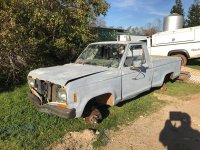
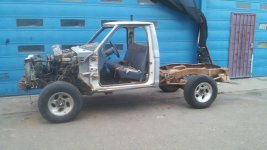
So here is the ranger I bought for $50, turns out it is a 5-speed and not an automatic, which might cause me some grief.
It was 'running when parked'. I stripped it down as much as I can before I get it running. The starter was toast, so until I get
another one, I can't do much more to it. So my plan is once it is running, I can pair the wiring down to a bare minimum,
and then remove the cab, and cut it in half and put it back on facing backwards.

I like that Bobcat with the single arm loader with the telescoping arm, what a nice design.

ranger50dollars.jpgrangerstrip1.jpg
 
/ Front Loader from a Ford Truck #30  
A $50 dollar truck is a good start for the project. I'd buy every $50 truck I could get. So far that's none. If it's a 4x4 you might have low enough gears in 4x4 low. Otherwise you're probably going to have problems. I'd probably throw a rubber chock block in the front suspension. Solid blocks would work but the block would have a little give. You could accomplish the same thing with air bags but they're more expensive.
 
/ Front Loader from a Ford Truck #31  
An interesting project, gonna be keeping an eye out for updates. I've always wanted a Toolcat, just not fond of the pricing and complexity of the machine.
 
/ Front Loader from a Ford Truck
  • Thread Starter
#34  
When looking on CL today I found a tow truck boom setup for $500, that included the electric motor to run the hydraulics.
Might not be strong enough though.
 
/ Front Loader from a Ford Truck #35  

That would be great for moving trash dumpsters. I don't think it is a good start for a loader, with the battery powered hydraulic pump.

I was lucky to find a used loader at an auction for my put-together:

P6231740.JPG
P6231742.JPG
P6231744.JPG
 
/ Front Loader from a Ford Truck #36  
Tow truck booms are pretty strong even the 1 ton truck ones. They’ll lift way more than what your ranger can support.
 
/ Front Loader from a Ford Truck #37  
Very cool project. Never occurred to me to mount the hoe facing rearward. It does make perfect sense as far as ballast goes. Darn, now I'm itching to build one on an Intl. Scout frame. I've got a complete JD40 loader and would mount simply on 2 2.5" square crossbars.
 
/ Front Loader from a Ford Truck #38  
I think you'd want more performance than an electric pump can provide, and your charging system can handle.* My tractor runs about 8 GPM at 2500 PSI.* The electric pumps I've seen are closer to 2 GPM which would be too slow, and they pull hundreds of amps.* If you found an electric pump capable of 6 or even 4 GPM, it would probably run your battery dead, so you'd have to run double or triple alternators to get a reasonable duty cycle and lift/dump cycle time.* A belt drive hydraulic gear pump would work much better IMO.**
 
/ Front Loader from a Ford Truck #39  
If you can't find a belt drive pump, you can get a couple of pillow block or flange bearings and mount a shaft with a belt pulley on one end, and a flexible coupler such as a spider coupling on the other, and use the spider to drive a shaft drive pump. (Spider couplings are also called jaw couplings or lovejoy couplings).
Shaft Couplers | Power Transmission | www.surpluscenter.com

Don't give into temptation and use a solid coupler, because your shaft bearings will fight the pump bearings, and you need the shaft bearings to take the belt side load, and a flex coupler will make sure that the pump only sees twist from the shaft and no side load.

Mount your shaft bearings on a mount attached to your engine, since it moves and shakes some in the motor mounts, if you mount it to the the truck frame it can mess with your belt tension. If your truck had an air conditioner, that might be a good place to mount your pump and shaft, and you could use the same size belt.

You will need to figure out what speed you want to run your motor, then use that with the pulley size to get the relative RPM of the pump (I suspect with an AC compressor they run close to 1:1 with engine speed, as opposed to an alternator that runs faster). Once you have the pump RPM, you can then use the needed flow rate to move your cylinders to calculate what displacement of pump you need. By going with a shaft drive pump, it can be a little easier to swap out different sizes of pump, as long as they use the same size and type of shaft--there are several (plain keyed shafts, splined shafts, and tang drive). Keyed shafts are probably easiest to work with.

I suspect your radiator is in the way to mount a flange onto your crank pulley to run a shaft out the front to a coupler and pump, avoiding the need for a belt.

For an efficient truck-size loader, a power steering pump probably does not have enough volume or pressure (but they can sometimes be made to work for a garden tractor).

You likely have the room for a good sized hydraulic reservoir, and could use the weight on the back (was front) to counteract the bucket, so I suspect you can get away without needing a hydraulic cooler, but should plan on having a filter.

If you can, pick all your hydraulic parts to use the same type of fittings. A lot of people like and prefer JIC, but if you are buying surplus pumps, valves, and cylinders they can be pipe thread taper (NPT), pipe thread straight (BSPP), O-ring boss (SAE), O-ring face seal (sometimes called block, I think?) and we haven't even gotten to the metric fittings yet.

There are adapters between most of these, but if you need to buy them for every piece you use, you can quickly eat up any savings you might have made buying the "cheap" part, AND they take up more room you may or may not have to run fittings and hoses.
 
/ Front Loader from a Ford Truck #40  
Surplus Center has a bunch of calculators and info sheets for designing hydraulic systems.

Surplus Center
 

Marketplace Items

Spartan RT-HD Zero Turn Mower (A66285)
Spartan RT-HD Zero...
Shoup John Deere 918 Poly for Platform (A65640)
Shoup John Deere...
275 Gallon Cage Tanks, Koser Safe, with 2" outlet (A62679)
275 Gallon Cage...
2022 EZ-GO ELITE ELECTRIC GOLF CART (A63276)
2022 EZ-GO ELITE...
New/Unused Landhonor 60 Gallon Sand Blasting Cabinet (A65583)
New/Unused...
2014 Ford Transit Connect Handicap Van (A61573)
2014 Ford Transit...
 
Top