Grading Finish Blade test - the blades

/ Finish Blade test - the blades
  • Thread Starter
#21  
Re: Finish Blade test - qualified success

Can't quarrel with the math. Empirically, however, the correllation between overheating and finding dust caked on the oil cooler is still 100%. With four blades per spindle, either factory or mine, I mow in a cloud, requiring a dust mask. Raising the deck helps, taking half the high lift blades off helps more. When I encountered heavy growth with the four blade setup, both factory and mine, I could not hear significantly more rpm drop than with the 2 blade system. Going uphill drops it more. Some day maybe I'll cobble up a spindle tach. That might be of interest anyway, but if I am getting pretty good results and not overheating, I'll probably lose interest.
 
/ Finish Blade test - the blades
  • Thread Starter
#22  
Re: Finish Blade test

John: I change mine with an air impact wrench, and often with an eager helper. Without the wrench, I'd never remove the blades at all. (Incidentally, when you've mowed a number of rocks, the heads of the mounting bolts start to assume different shapes. I discarded a few and replaced them with grade 8 bolts, which may last slightly longer, but all will wear. I don't even want to think about not being able to get a socket wrench to hold on the bolt heads.)
I think your observation about the rear rubber skirt may be exactly right. If you do take it off, I will be very interested to hear how it goes. I'll try to remember this weekend to look under mine to see how close the blades are to the back. Maybe a chain guard?
Yours sounds as if it is actually running hotter than mine. I haven't a clue how accurate the gauges are. Only once did mine act strangely when overheated. The last time, the needle was just about exactly on the 240. When I turned off the mower and reduced rpm, I heard the "alarm", which I had previously only associated with ignition and seat switch on, but no oil pressure. I think we need a panel strobe light, rather than an audible alarm. I'm so attuned to watching the gauge, however, that it will be well down my to do list.
This morning, I measured the slope of one of the hills I have mowed. At its steepest, it is about 30 degrees. I am able to poke the mower up into that part, but lose traction and can't keep driving up. I actually lose grip and slide sideways on slopes as little as 20 degrees when driving on fresh mowed grass. I can climb them easily straight up when dry. I looked around the place and didn't find any that I can say was as much as 27 degrees that I have climbed. With the turfs, I always lose traction before bogging the engine or stalling the wheel motors.
E-mail me your mailing address and I will send you six of my modified blades for testing. Since I had one apparently successful test, I'll want them back, but I'd like a second opinion. They are only 1/4 thick, so a little sloppy on the rough-cut bushings. If you are successful at cutting your own, you may be able to reduce the distance between the stump jumper and washer so they don't move as much. I doubt that will affect the cut, but may reduce wear.
One advantage of the modified blades is their offset downward about an inch. The deck can therefore be set higher for the same cut height.
Incidentally, last night after the pasture, I mulched some Kudzu along the road, and, of course, scalped some dirt. I haven't inspected the blades closely, but they continued to mow. The factory finish set would not have survived.
 
/ Finish Blade test - the blades #23  
Re: Finish Blade test

Charlie,

Great test and a great job posting. Couple of comments:

1) With the efficiency of the hydraulic PTO pump (80% at best) and attachment hydraulic motor (80% at best), each 1 horsepower increase at the rough mower shaft translates to a 1.56 Horsepower increase seen by the engine. You can quickly eat up any reserve engine power.
2) I thought of adding finish mower blades to my PT422 brush cutter, but when I calculated my blade tip speed, it would only have been 9,600 fpm. My Toro Wheelhouse and most other mower blade tip speeds are in the range of 16,000 fpm. I am not sure how blade tip speed translates to the lawn cut appearance.

Duane
 
/ Finish Blade test - the blades
  • Thread Starter
#24  
Re: Finish Blade test

Duane:
My understanding is that the primary reason for high tip speeds is the ability to run the machine faster over the ground. Some ZTRs are apparently mowing at 12 or 13 mph. I assume that is on very smooth stuff, or we'd hear about a lot of operators being bucked off.
From occasional research on lawnsite, and talking to people like Hans (Bubenberg) I have the impression that the primary variable in cut appearance is blade sharpness. That assumes, however, that the deck is designed for the amount of lift that the blades are developing. There is a lot of debate about double blades, high lift v. medium, etc., but I've not seen much real information about shape and placement of baffles and actual air flow under the decks.
I don't have any clue about my blade tip speed. I may do a little work to find out. Mowing uphill, I drag the engine down, much more than the mower slows when hitting really heavy growth, so I don't think I am short of power at the mower. It is a 72" three-spindle rough cut deck with stump jumpers. I have run a shaft driven 72" single spindle brush hog for years on approx 30 hp JD 950, and a 72" three spindle Jacobsen Turf Cat side discharge hydraulic finish mower with a 21 hp Kubota Diesel. Even with some inefficiency, and pretty aggressive blades, with the 45 hp Deutz, I shouldn't be running out of horsepower.
As an aside, if Sedgewood and I figure a way to get more air flow out from under the deck, I am pretty sure we will get better cut quality. The horsepower draw will probably increase, however, rather than decrease. The drag of a propeller actually able to pump - to establish air flow - is greater than one spinning in a stagnant pool, where the air can't get out. (I learned that when we gained a few horsepower by locking Corvair heating boxes shut, thus reducing flow over the engine. The cooling fan drag was greatly reduced - as was the cooling, of course.)
 
/ Finish Blade test - the blades #25  
Re: Finish Blade test

<font color=blue>The drag of a propeller actually able to pump - to establish air flow - is greater than one spinning in a stagnant pool, where the air can't get out. </font color=blue>

That's probably true. Ever plug the end of your shop vac? You'd think the motor would bog down but it actually increases in speed because there is no more air flow and the motor has less drag.
 
/ Finish Blade test - the blades #26  
Re: Finish Blade test

Charlie:

Oh my gawd the pain of internet withdrawal is severe! My ISP disappeared late last week and never came back. Just, well, GONE! So I apologize for the delayed response.

<font color=red>I think your observation about the rear rubber skirt may be exactly right. If you do take it off, I will be very interested to hear how it goes. I'll try to remember this weekend to look under mine to see how close the blades are to the back. Maybe a chain guard?</font color=red>

First off, I tried the 12 blade setup and found heating to be much more severe with no real improvement in the cut. Then I went back to 6 blades and took the skirt off. Major improvement. Much less jambing and striping right of center. It does still have a hard time with tough patches of full grown goldenrod, as I recall my Bush Hog doesn't handle all that well either. On normal mature hay & weeds a half overlap double cut leaves very few survivors, less so than the Bush Hog. On 8-10 inch grass I can now cut it to 4 inches basically at full tilt with very little jambing & striping. The grass discharges as full length stalks and is not pulverized like it was with the skirt on, which is fine with me, I ain't buildin' a pianer.

As far as the safety of removing the skirt is concerned, first let me say here that I'm not recommending anybody remove their skirt tee hee but I feel ok with mine off IF I KEEP THE DECK ON THE GROUND. The steel deck edge has a downward slant so stuff doesn't seem to fly around though the bottom 3-4 inches of the tractor frame does get plastered with grass goo. To attack Multiflora Rose etc I'll put the skirt back on. Its just a three bolt deal.

<font color=red>Yours sounds as if it is actually running hotter than mine. I haven't a clue how accurate the gauges are. Only once did mine act strangely when overheated. The last time, the needle was just about exactly on the 240. When I turned off the mower and reduced rpm, I heard the "alarm", which I had previously only associated with ignition and seat switch on, but no oil pressure.</font color=red>

I think we're about the same. I get a continuous alarm when mowing at anything over 80 degrees or so but the needle never goes more than a needles width over 240. I've had no erratic running so far, even at 95 degree ambient.

<font color=red>I think we need a panel strobe light, rather than an audible alarm]</font color=red>

I think we need a cooling system. Unless by chance the temp gage & alarm are being way too conservative. And they may not be if you got some erratic running.
 
/ Finish Blade test - the blades #27  
I wonder if another factor is at play here. A shredder has to be adjusted so that the front is about an inch lower than the rear; if this isn't done the blade in essence cuts the same material twice and increases the load on the shredder and the tractor considerably. I wonder if increasing the number of blades as you have done keeps the material at and above blade level too long and increases the load on everything. This would be great in a mulching mower but maybe not so good in a shredder.
 
/ Finish Blade test - the blades
  • Thread Starter
#28  
Glenn:
I think you're right. The last field I did was with the front of the deck lowered. This weekend, I'll try to make time to put it on a concrete floor and get an idea how the wheel settings relate to deck and blade angles. I haven't really paid attention to that. I raised the deck to its highest levels because my experimental blades were offset downward, cut with four per spindle, then two, and then canted the deck with the two. That last setting seemed dramatically better, but I've only done one field of fairly heavy ungrazed grass and weeds.
 
/ Finish Blade test - the blades
  • Thread Starter
#29  
Re: Finish Blade test

John:
As noted earlier, my most dramatic improvement has been with the offset sharp blades, with the front of the deck an inch down at the wheels. It still pulverizes pretty well, but with little or no uncut stripe. I was barely overlapping, so getting about 5 feet of new cut per pass. I have only tried it on 8-12 inch ungrazed pasture; no really tall or thick stuff. The engine slowed a bit on the thickest stuff, but held rpm OK if I reduced speed a bit. I did wade into 2-3 foot kudzu, however, and it disappeared nearly completely. Very satisfying.
I'll be doing a little more experimenting this weekend, but hope also to make a little progress on the string trimmer project, which stalled due to mowing, sick horses and hot weather.
Let me know if you want to try six of the offset blades. At some point I'd like to get in position to make some suggestions to Power Trac, but need additional understanding of what happens with different setups in varying conditions.
I listened more carefully, and occasionally turned off the mower the last field I did. The temperature never got to the 240 top line, and the alarm never went off. Ambient was in the 90 range. When I checked the bottom of the oil cooler, it had about 10% blockage after 1 1/2 hours, much better than with the additional blades.
After you got yours hot with the four rough-cut blades, did you blow out the cooler? I've started doing that as a routine after each mowing session. A cheapo tire inflator seems to work between trips to the big compressor.
 
/ Finish Blade test - the blades #30  
Re: Finish Blade test

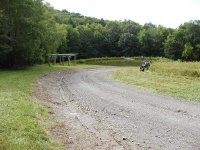
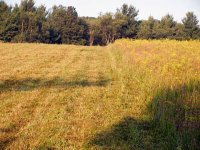
Here's a before picture I took yesterday before mowing with 6 rather dull roughcut blades, rubber skirt off, deck set at 2nd from highest in rear and 1-1/2 inches down in front. On the left the grass is about 6 inches tall with some taller weeds. Stuff on the right is uncut this year, maybe 3 feet tall, thick grass with a goldenrod patch near the edge of the drive (doesn't show in picture)
 

Attachments

  • 54-177039-before.jpg
    54-177039-before.jpg
    93.2 KB · Views: 136
/ Finish Blade test - the blades #31  
Re: Finish Blade test

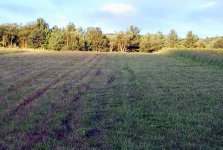
And here's an after picture. The 6 inch stuff is cut to 4 or so and the weedy bits cut well. The uncut stuff I cut with a two pass half overlap which went slowly but gave a fair cut. The goldenrod caused a lot of loading and went really slowly. I had been going back and forth but found later that a clockwise lap cut quite a bit better.

The driveway work is PT done too. And the slope behind the pond is where I'm stalling the wheel motors at 27-30 degrees.
 

Attachments

  • 54-177047-after.jpg
    54-177047-after.jpg
    92.6 KB · Views: 145
/ Finish Blade test - the blades #32  
Re: Finish Blade test

That's a beautiful place you have! Thanks for the pics.
 
/ Finish Blade test - the blades
  • Thread Starter
#33  
Re: Finish Blade test

John: As I advised by private post. I'm sending you a set of my "super custom modified finish blades" for testing. I am hopeful that they will do just a bit smoother job on the shorter grass, but I wouldn't bet on it. I think that what you are getting (and I as well) is actually pretty good for a rough-cut mower. It isn't as smooth as a real finish setup, or as tough as a brush hog, but it does both jobs reasonably well. Nothing certainly is going to make high grass and weeds transform immediately into a golf green. (At least that's what Bubenberg says, but that's no reason not to keep trying./w3tcompact/icons/laugh.gif/w3tcompact/icons/laugh.gif) We seem to be making progress on the uncut stripe problem. Maybe if we try enough configurations we'll actually understand what's happening under there.
Re the hill climbing problem, adjustment of the relief valve, as I recall, is one of the two things that voids the PT warranty. (Skipping the 50 hour service is the other.) So, you need to get their permission before you do it. Or, if you decide just to fix the wheel stall without further communication, please let me know by private e-mail if finding and adjusting the relief valve increases wheel torque or just blows oil all over eastern NY./w3tcompact/icons/crazy.gif
 
/ Finish Blade test - the blades #34  
Re: Finish Blade test

MossRoad:

<font color=red>That's a beautiful place you have!</font color=red>

Alas, it's not mine. I have a 2000 foot or so private road here that I share with 3 neighbors. That's one of them.
 
/ Finish Blade test - the blades #35  
Re: Finish Blade test

Charlie:

<font color=red>Maybe if we try enough configurations we'll actually understand what's happening under there.</font color=red>

My observations today tended to confirm my suspicion that its a jambing problem; the large volume of stuff isn't clearing fast enough. I noticed that when I stopped and backed up for some reason that the mower often dropped a clump of grass roughly right behind the front wheels. I think there's just too much stuff under there. It occurred to me while looking under the deck this afternoon that the blade cutting paths overlap maybe two inches. Could it be this is too much causing load swapping from one set to the next. Also, all three spindles turn the same way; what if the center one turned the other way? Then none would oppose any other at the blade tips.

Not to put too fine a point on it but isn't a rough cut mower for cutting rough stuff? Or is it just for cutting fine stuff roughly?
 
/ Finish Blade test - the blades
  • Thread Starter
#36  
Re: Finish Blade test

John:
I haven't had quite the same problems, but I don't think I've cut stuff with as much sheer mass as what you describe. For thick pasture grass, about a foot tall, it seemed to do fine, except for the right-side stripe. Unfortunately, after the ridiculously fast growth last May, our drought stalled the growth in June, and things have been thinner and slower since. Now that I think I've learned a little, I don't have the same stuff to cut.
The best results I've had are with kudzu and light brush, with weed and sapling stems up to about an inch. The results of those, both with the factory blades and mine, have been really good. I've had no apparent clogging, but probably the real density has been lighter than the tall thick grass I see in your pictures. Maybe it's rough stuff as opposed to super heavy stuff that the rough-cut refers to. Or maybe it is designed to leave a stripe so the result after cutting is rough./w3tcompact/icons/smile.gif
I'll think a bit about directions of rotation, and I'm going to try to look under some other decks. Unfortunately, I don't have quick access to a 3 spindle 72" rear discharge finish deck. I do have a side discharge, which has baffles partially around the blades. The blade lift is used to pass everything to the right after cutting. Somehow I doubt that we are dealing with too much blade overlap or a problem with direction of rotation. I think it more likely that air flow is pretty high speed at spots because of the reduced volume between the stump jumpers, with no baffling to prevent it locally flattening the grass below a section of blade, and none evacuating the cuttings to prevent the type of jam you've experienced. (Since I have no experience designing mowers, I can speculate about things like that as if I really have some logical basis: Ignorance with Conviction.)
My bottom line is the rough-cut mower has really done exactly what I needed most - cut my wife's pastures in all sorts of conditions, including once a driving rain, with sufficient cut quality that she has been appreciative.
Incidentally, the wet cut was of pretty thick stuff, at as high speed as I could manage without discomfort, and resulted in as good quality cut as I've done. Does that suggest anything?
 
/ Finish Blade test - the blades #37  
Re: Finish Blade test

Charlie:

<font color=red>The best results I've had are with kudzu and light brush, with weed and sapling stems up to about an inch. The results of those, both with the factory blades and mine, have been really good.</font color=red>

We're in total agreement here. This thing just pulverizes the brush & that northern kudzu, multifora rose (when you can get close enough that is - some of mine are 20 feet tall with 1-1/2 to 2 inch stems at the butt).

<font color=red>(Since I have no experience designing mowers, I can speculate about things like that as if I really have some logical basis: Ignorance with Conviction.)</font color=red>

If ignorance were bliss I'd be just a grinnin'. I suspect we're just expecting more from a 3 spindle mower than one can deliver. I must say that the results after double cutting are far supperior to what I was getting from brush hogging. So a speed penalty may be worth it (now to convince my customers...).

<font color=red>Incidentally, the wet cut was of pretty thick stuff, at as high speed as I could manage without discomfort, and resulted in as good quality cut as I've done. Does that suggest anything?</font color=red>

hmmm... I'll have to try watering the field first. Maybe I could rig a misting nozzle to squirt just ahead of the mower. Or right down through the deck..?
 
/ Finish Blade test - the blades #38  
Re: Finish Blade test

Charlie:

<font color=red>As I advised by private post. I'm sending you a set of my "super custom modified finish blades" for testing.</font color=red>

I'm running a bit short on time here so just the facts for now. Got 'em. Made some bushings for 'em. Ran some tests yesterday.

The plot. See attached. Lotsa asters & goldenrod, average 24-30 inches tall. About 1200 lineal feet around per lap. The finished results don't vary much but time to cut does.

Test 1: My roughcut blades - dull. No rubber exit deflector. Three laps in 17 minutes with overlap such that I was cutting about 30-32 inches of new stuff per lap. That works out to about .75 acres per hour. No chaff cloud.

Test 2: Charlie's nice 1/4 inch high lift blades. Sharp. No deflector. Three laps in 16 minutes with 40-42 inches new per lap = about 1.1 acre per hour. This stuff is still green but I absolutely drowned in a chaff cloud. Cooler plugged and alarm went off.

Test 3: Charlie's blades with deflector skirt on. 19 minutes for 40-42 inches per cut = about .9 acres per hour. Chaff much reduced, maybe by 3/4, quite tolerable.

Test 4: My roughcut blades, sharpened to remove secondary bevel - much like finish blades. Deflector on. Test aborted - progress too slow to bother with.

Test 5: Deflector off. 18 minutes at 30-32 inches per lap = about .7 acres per hour. No chaff cloud.
 

Attachments

  • 54-179300-Blade-TestPlot.jpg
    54-179300-Blade-TestPlot.jpg
    38.6 KB · Views: 136
/ Finish Blade test - the blades
  • Thread Starter
#39  
Re: Finish Blade test

<font color=red>The finished results don't vary much but time to cut does.</font color=red>
I think the only thing I've found variable about the finish results is the tendency to leave the dreaded right-side stripe. I've not seen it with the high-lifts and the deck canted a bit forward. Otherwise, the cut quality is typical of cutting high growth - not exactly smooth, but acceptable.
<font color=red>I absolutely drowned in a chaff cloud</font color=red>
That was with two blades per spindle and the rear rubber skirt removed. With four blades per spindle and that skirt on, the cloud blowing out the front of the mower was so bad that I sometimes had trouble seeing. The cut was pretty miserable, too.
Great test. Sounds as if we may actually be making some progress.
 
/ Finish Blade test - the blades #40  
Re: Finish Blade test

Test 6: Deflector off. 9-1/2 minutes at 24 inches per lap = about 1.1 acres per hour. Tolerable chaff cloud. Best cut and speed to date - see attached. For this test I made a set of blades from some cheap double edged reversible blades (with a wavy high lift profile). Unlike Charlie's offset blades these are not offset and seem to pretty well contain the chaff under the deck. Taking 24 inches per cut gives me a triple cut with the 72 inch deck and with the reduced loading the ground speed is roughly double what they would accept at 36 inches per lap. Also a quicky test on a previously mowed field seemed to do a good job of clipping off the stalks left behind earlier and at full tilt ground speed. I haven't had a chance yet to test cutting 6-8 inch grass but hope to soon.
 

Attachments

  • 54-181120-BladeTestPlot2.jpg
    54-181120-BladeTestPlot2.jpg
    57.1 KB · Views: 134

Marketplace Items

2015 GMC Sierra 3500 HD 4x4 Crew Cab Flatbed Truck (A64556)
2015 GMC Sierra...
2016 Ford Explorer AWD SUV (A64557)
2016 Ford Explorer...
2004 160 LC John Deere Excavator (A62613)
2004 160 LC John...
2010 Transcraft 35ft. Tri-Axle Aluminum End Dump Trailer (A64556)
2010 Transcraft...
2018 Deere 650K LGP (A64127)
2018 Deere 650K...
2019 DITCH WITCH TOWABLE VACUUM TRAILER (A63276)
2019 DITCH WITCH...
 
Top