Fence Building

/ Fence Building #1  

General Lee

Veteran Member
Joined
Oct 13, 2009
Messages
1,369
Location
Mid-Atlantic
Tractor
Kubota L4400, B2401
I am in the process of erecting a fence. First time for me. I'm going with post and plank design w/ 2x4 welded wire to keep the chickens and ducks in. I'm in the beginning stages but the problem I'm running into the post post height varies a little. The welded fence that will be attached is 60'' tall.

Any tips or tricks so that my welded wire fence won't be higher then posts in some areas as I go along? I don't mind trimming the top of a post if I need to, its when they are to short by an inch or two. The posts are round treated posts 6 1/2 foot long from TSC.

Edit to add - Also my area is not flat. Slopes, uneven terrain. When I attach the planks I should try and follow the contour of the land correct? Meaning if the area slopes my bottom plank should follow the slope to be more appealing to eye, instead making it level ?? I see it having 8'' on one end and if made level ..16'' on the other end. Sorry for the ignorance, like I said, first time doing this.
 
Last edited:
/ Fence Building #2  
Several options..

I'm putting in a horse arena and re-using posts, some are pointed and some are not, I assume they were trimmed for the last use to get the heights all the same.

My solution will be to trim them all short enough since I don't have to match a page wire fence - but my solution is put in the corner posts, you'll need to measure to be sure htey're tall enough, set them. then run a string between them a few inches off the ground, use paint to mark the holes. Drill holes.

Now you can leave that string and add one at the top and set the posts - the top string is the height. too tall? trim later or dig a big with a hand post hole digger. Too Short? Add dirt into the hole (gravel is better as it won't settle) and make the post tall enough.

the two string being on top of eachother keeps the posts in alignment, use a level to get the vertical left/right.

My ground SHOULD be level (used a laser level when grading) but I can't trust after drilling the hole and expelling the dirt that I'm 'at grade' for measuring height of posts. I plan to use the string and a level to set the boards level, well, parallel to the ground.

Last 12 posts go in today and tomorrow then the board work begins.

I also have 1000' of what you're installing to rip out...and replace with t-posts. May do that today...up to the 'female manager' what we do LOL
 
/ Fence Building
  • Thread Starter
#3  
Those are some great ideas, I appreciate that.
 
/ Fence Building #4  
I'd use woven wire rather than welded wire, it follows uneven ground better.

With the wire, you have little choice but to have the fence follow the contours of the land. I think the easiest way to deal with a post too short is to avoid it in the first place by marking how much of the post needs to be out of the ground before you put it in the hole. Failing that you can trench with a shovel to put the bottom wire an inch or two underground. At the post itself you have to clear enough dirt to swing a hammer to put a staple in to hold the bottom wire down. I wouldn't worry about posts that are an inch or two too tall, just run the wire and plank up to the top, no one's going to notice if your fence doesn't follow the ground exactly.

That said, depending on what you're trying to keep in and out you may want to bury the bottom wire of the fence anyway. With woven wire I try to put the bottom wire an inch or two underground. I use t-posts for line posts, what I do is drive the post in about a foot, then attach the bottom wire, then drive the post in until the bottom wire is underground, then attach the rest of the wires to the post. The wire will tend to bury itself over time if the ends are underground.
 
/ Fence Building #5  
The posts are round treated posts 6 1/2 foot long from TSC.

I would not use these posts. You'll never get it right by drilling each post in the ground 2 1/2 feet, so in reality, they will be 2 to 2 feet 4 inches deep. This is nowhere near deep enough for a post to remain straight over time. In most soil types, 3 feet deep is the minimum, and in areas with expansive soils, 4 feet isn't deep enough and you need to go five feet down or more.

Think of dirt like an ice cube in a tray. When it's really saturated, and then when it freezes, it expands. Some soils expand more then others, and that's where you have all the foundation issues in homes, telephone poles that are all leaning over and cracks in pavement.

Get 8 foot poles, drill your holes 3 feet down, install your wire fence, then run a row of barb wire above the post to keep animals from climbing over it to kill your chickens and ducks, and then trim off the excess if you want.
 
/ Fence Building #6  
In Maine the ground freezes and heaves out 6x6 pt posts that are in 4-5 ft. For my fencing I've gone to T posts for strength with a couple of fiberglass posts between them. I can walk around in the spring and pound them down if I need to, or use the tractor bucket to sink them. They do handle the frost well.
 
/ Fence Building
  • Thread Starter
#7  
I appreciate everyone's input. I gots some re-figuring to do I suppose. T-posts will be used in the woods portion of this fence. I like the look of post and plank fencing so that is what I'm going with in the yard as that will be visible.

Any tips on how having the planks (rails) follow the slope of the land?
 
/ Fence Building #8  
you need to find the frost line for your area, and yes, soil type can make some difference.

here in western PA i was always tol 18" to 24". Seems 13" is the 'real' frost depth.

I put posts in for a porch and hit bed rock about a foot down..no way to go deeper. Been 12 years and NOTHING has moved. Could be it's on bedrock..has a roof over it...but it's stayed put.

Put in MANY MANY posts and 2 to 3' is more than enough for them to stay put. NEver had one come up and out, ever.

HOWEVER - the depth can make them stronger, especially in loamy/sandy soils, strong as in pushing/pulling, like where a gate is or if a critter gets pushy.

t-posts and step in posts (like rebar) rarely go in more than a foot and hold up just fine, never get frost heaved.
 
/ Fence Building #9  
I would not use these posts. You'll never get it right by drilling each post in the ground 2 1/2 feet, so in reality, they will be 2 to 2 feet 4 inches deep. This is nowhere near deep enough for a post to remain straight over time. In most soil types, 3 feet deep is the minimum, and in areas with expansive soils, 4 feet isn't deep enough and you need to go five feet down or more.

Think of dirt like an ice cube in a tray. When it's really saturated, and then when it freezes, it expands. Some soils expand more then others, and that's where you have all the foundation issues in homes, telephone poles that are all leaning over and cracks in pavement.

Get 8 foot poles, drill your holes 3 feet down, install your wire fence, then run a row of barb wire above the post to keep animals from climbing over it to kill your chickens and ducks, and then trim off the excess if you want.
Good advice from Eddie.

I appreciate everyone's input. I gots some re-figuring to do I suppose. T-posts will be used in the woods portion of this fence. I like the look of post and plank fencing so that is what I'm going with in the yard as that will be visible.

Any tips on how having the planks (rails) follow the slope of the land?

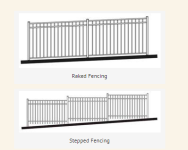
You can Rake the fence or step it - How to Install Fencing on a Slope - MMC Fencing & Railing

If your land, like mine, has ups and downs but not slopped as shown in the example below you can leave your posts out of the ground 56" or greater and follow the recommendations as posted in the RAMM FENCE installation manual.

DETERMINING POST TOP & BRACKET LOCATION • After paint is dry you need to determine the tops of your post. From this line you can determine the bracket locations. Everything, all post tops need to be over 56 inches. • Mark on the side of the post a small line at 54” from the ground. Do this on all posts. • Starting at an end post and using a thick and visible string wrap it around every post. • Make sure it is tight between each post. • Site over the string line and you will see abrupt changes in the flow. By raising and lowering the string line you can make the flow smooth from post to post. • You are looking for the average height of your fence over the entire length. • Make sure you are satisfied with your flow of the string line because this will influence the overall appearance of the fence itself. • Usually look at your string line from various angles. • More than one opinion is helpful. • Keep the corner and end posts string at the 54 inch mark, do not move the string line on them.
Take your time and do it until you like It!

Fencing.PNG
 
/ Fence Building #10  
Last edited:
/ Fence Building #11  
Really love the use of concrete under the fence panels!!!! That's the best, and only way, to stop anything from digging under it.
 
/ Fence Building #12  
/ Fence Building #13  
Really love the use of concrete under the fence panels!!!! That's the best, and only way, to stop anything from digging under it.

Around here you'd have to go down below the frost line --40" --to keep it from getting heaved in the winter. At least you'd be positive nothing could dig under it!
 
/ Fence Building #14  
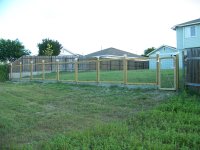
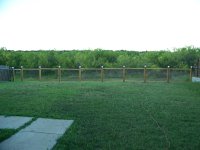
Here is how I solved the sloping problem on my daughter's welded wire back fence I put up 3 years ago..........View attachment 585359View attachment 585360
For anything wire out of square, I just trimmed the welded wire with bolt cutters.
Here is a link to the thread I have on the fence build... https://www.tractorbynet.com/forums/projects/336054-my-daughters-fence.html?highlight=
hugs, Brandi

Brandi, great looking fence!

I've always called those cattle panels or hog panels (depends on height). Is this what other people call them? Welded wire was always the cheap rolled fencing, as opposed to woven wire fencing like the horse "no climb".
 
/ Fence Building #15  
Brandi, great looking fence!

I've always called those cattle panels or hog panels (depends on height). Is this what other people call them? Welded wire was always the cheap rolled fencing, as opposed to woven wire fencing like the horse "no climb".
Your right gsganzer,
Welded wire is rolled out like chain link fencing and can be cut with dykes. I used hog panels. Thanks! I use the non climb horse fence around my place and stretch it as tight as a fiddle string!
hugs, Brandi
 
/ Fence Building #16  
Your right gsganzer,
Welded wire is rolled out like chain link fencing and can be cut with dykes. I used hog panels. Thanks! I use the non climb horse fence around my place and stretch it as tight as a fiddle string!
hugs, Brandi

Brandi,
I'm putting up 600' of no-climb as we speak. Nothing looks better than a taut fence. I made the mistake of using some of the diamond mesh no-climb about 20 years ago. It was awful! It didn't have any crimps in it, so no spring/give and you couldn't get it to ever look tight enough. Plus it wouldn't follow the ground contours worth a flip.
 
/ Fence Building #17  
i would not use those posts from TSC nor the other orscheln farm store we have aound here, they are green and supposedly treated and well, about 2 to 3 yrs here and they are rotten, no i am not exaggerating. I have had to replace them so tore them all out and put in T posts. Various options for dealing with grades/slope so research it and look at your options. I would keep the wood fence minimal as it will require a lot of maintenance if you are retired or have help thats one thing but if you are the sole fixer man, try to keep those projects and maint under control it will catch up with you when you aren't looking!!!
 
/ Fence Building #18  
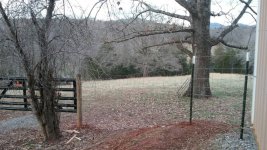
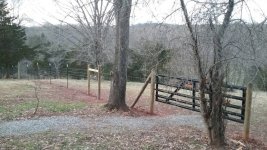
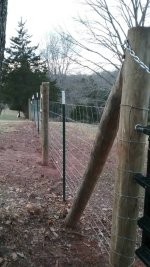
This is what I've been working on. I haven't finished with the T post clamps which is why the bungee cords. I wanted it 8" off the ground so it's easy to mow under. Eight ft. 6" treated posts, I measured and used string and level. I'll have electric on top.20190101_162935.jpeg20190101_162941.jpeg20190101_163017.jpeg20190101_163037.jpeg20190101_163146.jpeg
 
/ Fence Building #19  
you wont be mowing with that 8 inch high bottom, the horses will keep that mowed for you they will be down on their knees taking care of it
 

Marketplace Items

2013 NISSAN NV3500 CARGO VAN (A59905)
2013 NISSAN NV3500...
TPL MECHANICS BODY LUBE SKID (A60429)
TPL MECHANICS BODY...
Hyster H90XMS Forklift (A59213)
Hyster H90XMS...
2018 CATERPILLAR D6K2 XL CRAWLER DOZER (A60429)
2018 CATERPILLAR...
UNVERFERTH 330 8 AND 1/2 INCH EXTENSION STUB TUBE WELDMENT FOR FRAME (A55315)
UNVERFERTH 330 8...
2020 PETERBILT 567 (A58214)
2020 PETERBILT 567...
 
Top