Does HP matter?

/ Does HP matter? #61  
There is nothing erroneous. The problem thruout is in trying to separate torque from HP in a non rigorous fashion. Torque is nothing but a result of leverage. When it overcomes a resistance, causing movement, doing work, it immediately becomes HP. In your example, if the nut turns its HP. [I tried to describe that. ... Do you have a question?]
larry

Larry no question that I can think of. After re-reading my post I may have been grumpy this morning in the way I posted. Sorry if I was gruff. But I do think a torque is king of the 0-60. I have driven high HP autos with no low end toque and it is very disappointing. Low torque is much more fun!

What I meant by the nut and bolt is that torque is applied to the nut, sometimes by a torque wrench. The HP to apply the torque is the human. The nut then sits there static at a constant torque level. That's all I meant.
 
/ Does HP matter? #62  
Larry no question that I can think of. After re-reading my post I may have been grumpy this morning in the way I posted. Sorry if I was gruff. But I do think a torque is king of the 0-60. I have driven high HP autos with no low end toque and it is very disappointing. Low torque is much more fun!

What I meant by the nut and bolt is that torque is applied to the nut, sometimes by a torque wrench. The HP to apply the torque is the human. The nut then sits there static at a constant torque level. That's all I meant.
:)No problem. My point on the nut was that it is being tightened. Force and leverage on its pivot is causing its movement. Work per unit time [HP] is there. Motion is inherent to mechanical HP ... but not inherent to torque. That is why I view torque as a static. As soon as it moves it transforms to ForcexDistance/Time = Energy/T = HP
larry
 
/ Does HP matter? #63  
I
Using a drum and cable example, (a winch): it the engines have the same torque, the amout they can pull is going to be the same. BUT, if one of the driving engines has more HP, it can spool up the cable FASTER. But it cannot pull any more if the torque is the same.

If Engine A makes 100ft-lb and B makes 50 ft-lb, according to you -- B will not be able to spool up a cable that weighs 100 pounds with a drum that is 1ft in diameter where A can.

But you are forgetting transmissions can be used to multiply torque. If A makes 100 ft-lb at 100 rpm - then it can pull a 100 pound weight up 314 ft per minute using a 1ft drum. B makes 50ft-lb at 1000 rpm it can gear down with a transmission and pull up that same 100 pound weight 1570 ft per minute. Or gear it down further (ignoring added friction) and pull 500 pounds of weight up at the same speed A is pulling up 100 pounds.

By the way 100 ft-lb at 100 rpm is 1.9 HP. 50ft-lb at 1000 rpm is 9.5 HP.

As Larry said earlier, you really can't separate torque and HP in the real world. Question is where & how much do you want to have the torque in the rpm curve.

By the way, a horse can pull a single bottom plow with 150 pounds of drag at about 2.5 mph. Works out to one horsepower. Funny eh?
 
/ Does HP matter? #64  
If Engine A makes 100ft-lb and B makes 50 ft-lb, according to you -- B will not be able to spool up a cable that weighs 100 pounds with a drum that is 1ft in diameter where A can.

But you are forgetting transmissions can be used to multiply torque. If A makes 100 ft-lb at 100 rpm - then it can pull a 100 pound weight up 314 ft per minute using a 1ft drum. B makes 50ft-lb at 1000 rpm it can gear down with a transmission and pull up that same 100 pound weight 1570 ft per minute. Or gear it down further (ignoring added friction) and pull 500 pounds of weight up at the same speed A is pulling up 100 pounds.

By the way 100 ft-lb at 100 rpm is 1.9 HP. 50ft-lb at 1000 rpm is 9.5 HP.

As Larry said earlier, you really can't separate torque and HP in the real world. Question is where & how much do you want to have the torque in the rpm curve.

By the way, a horse can pull a single bottom plow with 150 pounds of drag at about 2.5 mph. Works out to one horsepower. Funny eh?
Hey John. Its late and I havnt perused, but looks like youve mixed radii and diameter. That could get very confusing in relating force x speed to HP.

..LD1 knows about gearing. He just doesnt put it all together in every post.
... bed
larry
 
/ Does HP matter? #65  
So far I would have to agree with LD1 on the troll thing. All you've done is call him out and then you say you posted the support of your views and then deleted it. So thus far you have added nothing but friction.

Now I happen to disagree with a couple of opinions in this thread but I try to explain why and so does the person who disagrees with me. I can respect that. You really should do the same and if you have information to help the thread, wouldn't that be something you would do. If you disagree with anything I have posted and if I am in error with my understanding, please enlighten us and share the higher intelligence you seem to be boasting of. It's only fair to offer an alternative notion.

Thanks for the support:thumbsup:

If Engine A makes 100ft-lb and B makes 50 ft-lb, according to you -- B will not be able to spool up a cable that weighs 100 pounds with a drum that is 1ft in diameter where A can.

But you are forgetting transmissions can be used to multiply torque. If A makes 100 ft-lb at 100 rpm - then it can pull a 100 pound weight up 314 ft per minute using a 1ft drum. B makes 50ft-lb at 1000 rpm it can gear down with a transmission and pull up that same 100 pound weight 1570 ft per minute. Or gear it down further (ignoring added friction) and pull 500 pounds of weight up at the same speed A is pulling up 100 pounds.

By the way 100 ft-lb at 100 rpm is 1.9 HP. 50ft-lb at 1000 rpm is 9.5 HP.

I am not forgetting about transmissions. I have mentioned gearboxes several times through out this thread. Sure, you can put a 10:1 gearbox on the 50ft-lb/1000rpm machine and make it turn 100rpm with 500ft-lbs and make if lift even more weight than engine A. All I am saying is.....you can ALSO put that gearbox on the 100ft-lb/100rpm machine and now have 1000ft-lbs @ 10rpm.

You can modify torque on ANY engine by changing gearboxes until you can do the work at hand. The point I am trying to make (and it seems I am failing), is that TORQUE is the measure you look at to see how much work "can" be done. If you cannot do the work, you can change gearing to accomodate. And HP is the number you look at to see how fast you can do that work.

In answering to OP's question, and talking about a couple of tractors for example, the RPM and gearing are both very similar. And it isnt easy to swap out transmission gearing in a tractor. So assuming they are both geared similarly, and the engines make the SAME torque, the one with more HP isnt capable of doing MORE work. It is only capable or doing the SAME amount of work. It can just do it faster is all.

I wont go into correcting you on your HP figures as larry already did. but you would need a 2' diameter drum with a circumfrence of ~6.3' to have a 1:1 relationship with torque and line-pull. IE:1' radius and NOT 1' diameter.

Hey John. Its late and I havnt perused, but looks like youve mixed radii and diameter. That could get very confusing in relating force x speed to HP.

..LD1 knows about gearing. He just doesnt put it all together in every post.
... bed
larry

Yea, I could probabally sit down and write a novel on HP and torque and gearing. But then who would read it. I try not to flood the posts with TOO much detail. I assumed (maybe wrongly) that others would understand what I was talking about with out spelling out every fine detail.:confused3:
 
/ Does HP matter? #66  
If Engine A makes 100ft-lb and B makes 50 ft-lb, according to you -- B will not be able to spool up a cable that weighs 100 pounds with a drum that is 1ft in diameter where A can.

But you are forgetting transmissions can be used to multiply torque. If A makes 100 ft-lb at 100 rpm - then it can pull a 100 pound weight up 314 ft per minute using a 1ft drum. B makes 50ft-lb at 1000 rpm it can gear down with a transmission and pull up that same 100 pound weight 1570 ft per minute. Or gear it down further (ignoring added friction) and pull 500 pounds of weight up at the same speed A is pulling up 100 pounds.

By the way 100 ft-lb at 100 rpm is 1.9 HP. 50ft-lb at 1000 rpm is 9.5 HP.

As Larry said earlier, you really can't separate torque and HP in the real world. Question is where & how much do you want to have the torque in the rpm curve.

By the way, a horse can pull a single bottom plow with 150 pounds of drag at about 2.5 mph. Works out to one horsepower. Funny eh?

Aww what the h3ll, I pursue it further since I got nothing better to do at the moment.

Engine A: 100ft-lbs @ 100rpm

Would pull a 100lb weight up 628ft in one minute using a 2' diameter drum, or would pull a 200lb weight, 314ft in one minute if you were using a 1' drum.

Engine B: 50ft-lbs @ 1000rpm

Geared with a 2:1 box to give 100ft-lbs @ 500rpm would pull the same 100lb weight 3140 ft in one minute with a 2' drum.

Or would pull 200lbs 1570' in one minute using a 1' drum.

Point being, the torque is what you look at to see how much work it "can" do. In both of these examples, engine A and engine B are geared so they can do the SAME amount of work.

HP is where you look to see how fast it can do the work. In these examples, Engine B has 5x's the HP, do it can the work 5x's faster (or pull the weight 5x's farther in the same time).

If you gear it so the higher HP machine can lift 1000lb weight, you can ALSO gear the lower HP machine to lift the SAME amount of weight. Therefore the work that they "can" do is still the same. AND, the higher HP machine will STILL be 5x's faster because it has 5x's more HP.
 
/ Does HP matter? #67  
Aww what the h3ll, I pursue it further since I got nothing better to do at the moment.

Engine A: 100ft-lbs @ 100rpm

Would pull a 100lb weight up 628ft in one minute using a 2' diameter drum, or would pull a 200lb weight, 314ft in one minute if you were using a 1' drum.

Engine B: 50ft-lbs @ 1000rpm

Geared with a 2:1 box to give 100ft-lbs @ 500rpm would pull the same 100lb weight 3140 ft in one minute with a 2' drum.

Or would pull 200lbs 1570' in one minute using a 1' drum.

Point being, the torque is what you look at to see how much work it "can" do. In both of these examples, engine A and engine B are geared so they can do the SAME amount of work.

HP is where you look to see how fast it can do the work. In these examples, Engine B has 5x's the HP, do it can the work 5x's faster (or pull the weight 5x's farther in the same time).

If you gear it so the higher HP machine can lift 1000lb weight, you can ALSO gear the lower HP machine to lift the SAME amount of weight. Therefore the work that they "can" do is still the same. AND, the higher HP machine will STILL be 5x's faster because it has 5x's more HP.

If you are trying to tell us that Work is force through a displacement, point taken.

But I see tractor pulls on TV with internal combustion engines and jet turbines. I see both of those types slugging it out and realize that the tires on both types are still throwing dirt when the tractors forward progress is arrested (neither type stalls their prime movers.)

Horsepower is king because it contains both the radian velocity and the torque, and those two can be converted one to the other at will as the equation implies. There are plenty of cases where the prime mover doesn't have the torque to do the job but has the HP and therefore does the job. There are plenty of cases where a prime mover does not have appropriate radian velocity to do the job but has the HP and therefore does the job. Designers decide how to allocate the radian velocity vs the torque to make the device work appropriately. So torque is subordinate to HP in the equation, and is also subordinate in importance so long as the designer of the entire machine is suitably talented.

Is the prime mover radian velocity sufficient? May work anyway.
It the prime mover torque sufficient? May work anyway.
If the prime mover HP sufficient? If not, it will not work.

The above is meant to motivate folks to think of it as I do, just as the comments of others are meant to motivate us to think as they do. It is not meant to call any "right" statement "wrong."
 
/ Does HP matter? #68  
If you are trying to tell us that Work is force through a displacement, point taken.

Yes, when I say work, I am meaning it as a sheer force.

The work that needs done is raising a 100lb weight x amount of feet. Does it have enough torque to do that work

If you have a 2' diameter drum, and only supplying it with 80ft-lbs of torque, it dont matter wether you have 10 or 10,000hp, it aint gonna do that work (as it is configured)
 
/ Does HP matter? #69  
Yes, when I say work, I am meaning it as a sheer force.

The work that needs done is raising a 100lb weight x amount of feet. Does it have enough torque to do that work

If you have a 2' diameter drum, and only supplying it with 80ft-lbs of torque, it dont matter wether you have 10 or 10,000hp, it aint gonna do that work (as it is configured)


LD,
I think everyone gets your point about torque needing to be sufficient to do the work as you reference. Horsepower, torque or force, distance and time are all equally important in determining the amount of work done. The amount of work done is not based solely on the sheer force it takes to do the job but includes distance and time.

Horsepower does matter, if any one takes 10 times as long to get the job done because they are underpowered they won't be in business very long. Friction losses can eat up hp, daily overhead costs can eat up profits, getting the job done fast enough is a very real consideration.
 
/ Does HP matter? #70  
I have no numbers to add to this discussion, nor do I have any new groundbreaking scientific explanation, as I am but a lowly musician and numbers make my head hurt. I will, however add a little anecdote from high school, demonstrating the effects of horsepower without sufficient torque.

A bunch of kids were hanging out after school in the student parking lot. They were all checking out each other's cars, each bragging his up over the others. One kid, who was parked on the grass, decided to show off his awesome machine. He started it up, floored the go pedal, set the brake put it in gear and proceeded to do a burn out (in the grass?). As he let off the brakes to move, the car made it's way to the pavement. As soon as the rear tires hit the pavement, the resulting friction and added load killed the engine. Seems his engine just didn't have the torque to do the work when the rubber hit the road. Poor kid never lived it down!

True story.

Joe
 
/ Does HP matter? #71  
LD,
I think everyone gets your point about torque needing to be sufficient to do the work as you reference.

I had my doubts about that a few pages ago:laughing:

Horsepower, torque or force, distance and time are all equally important in determining the amount of work done. The amount of work done is not based solely on the sheer force it takes to do the job but includes distance and time.

Horsepower does matter, if any one takes 10 times as long to get the job done because they are underpowered they won't be in business very long. Friction losses can eat up hp, daily overhead costs can eat up profits, getting the job done fast enough is a very real consideration.

Yes HP matters. As does torque. Torque needs to be sufficient enough to get the job done, and HP needs to be sufficient enough to do it in a timely manner.:thumbsup:
 
/ Does HP matter? #72  
I have no numbers to add to this discussion, nor do I have any new groundbreaking scientific explanation, as I am but a lowly musician and numbers make my head hurt. I will, however add a little anecdote from high school, demonstrating the effects of horsepower without sufficient torque.

A bunch of kids were hanging out after school in the student parking lot. They were all checking out each other's cars, each bragging his up over the others. One kid, who was parked on the grass, decided to show off his awesome machine. He started it up, floored the go pedal, set the brake put it in gear and proceeded to do a burn out (in the grass?). As he let off the brakes to move, the car made it's way to the pavement. As soon as the rear tires hit the pavement, the resulting friction and added load killed the engine. Seems his engine just didn't have the torque to do the work when the rubber hit the road. Poor kid never lived it down!

True story.

Joe

This is completely unrelated, but your story gave a visual image that is easy to see. Here is something I witnessed:

I was going down an on ramp onto Hwy 64. There was a jeep in front of me doing the same. It had snowed, and the road was very icy. In my Subaru, I am moving an appropriate speed down the ramp, but the jeep in front is "cutting up" and deliberately goosing his Jeep to make it go sideways...like when they are "drifting." I'm about the freak-out seeing all this and I immediately try to slow to a stop because I can PLAINLY see that there is a bridge crossing the highway at the bottom of the ramp and the road under the bridge is coal black and dry as a cob. That jeep hit that clear spot sideways and started rolling at the same rate had been sliding. And two lanes of oncoming traffic had to slam on brakes to make sure they could stop in time. I'm sweating bullets watching him, and the oncoming traffic, and the guys coming down the ramp towards me. Amazingly, the jeep was the only one to actually get any damage and no one else collided.
 
/ Does HP matter? #73  
This is completely unrelated, but your story gave a visual image that is easy to see. Here is something I witnessed:

I was going down an on ramp onto Hwy 64. There was a jeep in front of me doing the same. It had snowed, and the road was very icy. In my Subaru, I am moving an appropriate speed down the ramp, but the jeep in front is "cutting up" and deliberately goosing his Jeep to make it go sideways...like when they are "drifting." I'm about the freak-out seeing all this and I immediately try to slow to a stop because I can PLAINLY see that there is a bridge crossing the highway at the bottom of the ramp and the road under the bridge is coal black and dry as a cob. That jeep hit that clear spot sideways and started rolling at the same rate had been sliding. And two lanes of oncoming traffic had to slam on brakes to make sure they could stop in time. I'm sweating bullets watching him, and the oncoming traffic, and the guys coming down the ramp towards me. Amazingly, the jeep was the only one to actually get any damage and no one else collided.

Sounds like an expensive and probably very scary lesson for that Jeeper to learn. I am like you when I see someone acting a fool in snow I back way off!
 
/ Does HP matter? #74  
So can I safely say we have consensus on the OP's question that both are capable of putting the same torque to the ground, but the higher HP engine will be able to put the max torque to the ground or the PTO at a lower RPM without bogging the engine? That's probably what he is concerned with??
 
/ Does HP matter? #75  
So can I safely say we have consensus on the OP's question that both are capable of putting the same torque to the ground, but the higher HP engine will be able to put the max torque to the ground or the PTO at a lower RPM without bogging the engine? That's probably what he is concerned with??

Honestly, I can't say. I let the tractors stated PTO HP speak for the ability of the PTO. I think the two engines mentioned are close enough that my ultimate decision would likely be made based on something other than the engine differences. For example, if both tractors are hydrostatic drive, if you tip the swash plate only a tiny bit, the speed will be incredible slow, and the torque to the gears will be limited not by the engine, but by the pressure relief device in the HST.
 
/ Does HP matter? #76  
So can I safely say we have consensus on the OP's question that both are capable of putting the same torque to the ground, but the higher HP engine will be able to put the max torque to the ground or the PTO at a lower RPM without bogging the engine? That's probably what he is concerned with??

I would simply say that both tractors are able to put the same amount of torque to the ground, but the higher HP one will can do it quicker and with less lugging. That dont necessairly mean at a lower RPM.

A good example of HP would be for those of you who drive your tractors on the road and tow things. We tow wood in the trailers behind the tractors. Up some decient grades in road gear. IT only requires so much torque for the given weight to crest over the hill. But the more HP you have under the hood, the faster you can crest it. I can maintain speed with my 34hp tractor. But if I were to pull the engine and drop in a 15HP motor, I would likely have to down shift a gear of two (to increase the torque at the rear wheels that the smaller motor lacks), and this will be a slower treck up the hill, but it would still do it.
 
/ Does HP matter? #77  
Points taken. I would have to admit that the bulk of my experience with boosting HP has been in supercharging. In forced induction via roots based chargers the increased HP of the blower ALWAYs also increases torque at a lower RPM. It is a very linear torque curve and a lot of fun.
 
/ Does HP matter? #78  
Since HP is a mathametical calculation using torque AND rpm, if you boost the HP at a given RPM, the torque increases as well.

I guess it could be said that you actually increased torque (since that is what they CAN measure) and as a result, it also increased your HP.

The only way to increase "peak" HP and NOT increase the torque is to gain the HP by increasing the RPM. Since HP is a function of torque (force) and speed (rpm in this case) to gain HP, you can either increase the force (torque) OR increase the speed. But you dont necessairly have to do both.
 
/ Does HP matter? #79  
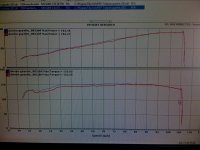
Well here is a dyno that is part of the basis of the opinions I have gathered over the years. This one is based on speed and not RMP but the car hits just under 60 mph in 2nd gear at redline.

You will see that at about that time it is making peak torque and stays linear even as HP increases. In addition there is a point where HP increases and Torque actually decreases. This is in a 1.4L Mazda engine.

Dyno.jpg
 
/ Does HP matter? #80  
Well here is a dyno that is part of the basis of the opinions I have gathered over the years. This one is based on speed and not RMP but the car hits just under 60 mph in 2nd gear at redline.

You will see that at about that time it is making peak torque and stays linear even as HP increases. In addition there is a point where HP increases and Torque actually decreases. This is in a 1.4L Mazda engine.
Torque limit or peak on an engine will always come first. Power can still increase in a small window because the torque drop off is small (as seen on your dyno chart) and not enuf to effect increasing rpm so overall hp can increase at this point. The torque eventually drops off and so much so that it countermands any gains seen with increasing rpm and that's when you see power start to drop.
 

Marketplace Items

2005 Komatsu HM-400 (A60462)
2005 Komatsu...
2015 Nissan Altima SV Sedan (A59231)
2015 Nissan Altima...
WOLVERINE TQH-26-02C, 3 PT RECEIVER HITCH (A60430)
WOLVERINE...
2020 DRAGON 150BBL ALUMINUM (A58214)
2020 DRAGON 150BBL...
2017 Kia Soul SUV (A59231)
2017 Kia Soul SUV...
ST205/75R15 Trailer Tires (A55788)
ST205/75R15...
 
Top