Diesel Engine Theory

   / Diesel Engine Theory #1  

jlgurr

Veteran Member
Joined
Oct 21, 2013
Messages
1,187
Location
Bostic, NC
Tractor
Massey Ferguson GC1705, John Deere STX46
Came across an interesting phenomenon which may simply be the norm for a diesel engine. Will try to explain it and see what the diesel experts think... This happened on a Massey-Ferguson GC1705 but I'm guessing that doesn't matter as it may occur on most if not all SCUT's with a diesel engine.

Was tilling the garden last week and it was pulling hard on the engine. Was running about 2000 RPM or so and thought I'd give her a little more so I nudged the throttle up. No response, so I nudged a little more. No response, so I let off the HST and the engine RPM increased almost immediately, as if a brake had been released.

Being an engineer and curious (sometimes a dangerous combination) I tried to repeat the scenario and get the same results. Voila, it worked. Soooo, I pondered this while puttering around and recalled reading that a diesel engine air intake is always wide open with only the delivered amount of fuel affecting the engine RPM.

With the engine loaded and nearly falling off on RPM, is it plausible that nudging the throttle up did not increase the RPM because the engine could not get any more air; until after the load was relieved by letting off the HST? I don't think what happened is a problem or of any concern, just curious.

Thanks,
Jeff
 
   / Diesel Engine Theory #2  
Nothing to do with the engine. Letting off a bit on the HST is like down-shifting a gear transmission to a lower gear. That is why your rpms increased. With HST, if engine begins to lug, ease off on the HST pedal to "lower the gear"
 
   / Diesel Engine Theory #3  
You are correct that there is no air metering. Some vehicle applications used a butterfly plate to create a vacuum, but only to draw exhaust gases through the emissions system, so that doesn't really apply here. Air/fuel ratio is not nearly as critical on a diesel engine. The more you cram in, the more power you get. To a certain point. Hence the introduction of forced induction (turbos mainly). When you ask for more throttle, your just supplying more fuel. If it's mechanical injection, it's opening up the pump. If it's electronic, the computer is holding the injectors open longer and ramping up rail pressure.

You were probably just at the limits of the engine. It was holding at the power and load that you had, but couldn't overcome the demand for more until you removed some load. If it was in fact running out of air, it would be due to restriction. Turbo not spooling, clogged filter, poor intake design, etc. If none of these are the case, and you feel you shouldn't have been at its limits, it would seem there's a problem elsewhere. Given the above info, one would first check lack of fuel next. Filter, transfer pump, injection pump, sensors if electronic...
 
   / Diesel Engine Theory #4  
A lugging engine can't increase the Rpms because it's being lugged to the max. The injection pump was already at max output.
To make more power the engine needs to move more air/fuel per minute through it. That would be raising Rpms , raising boost pressure etc.
Why were you operating the tiller at less than rated Rpms and were lugging the engine ? It's small tractor, not a steam locomotive .
Reduced Rpms also reduces coing air flow and will cause a partly loaded machine to overheat.
 
   / Diesel Engine Theory #5  
Were you running it at 2500 rpms or so before you started moving forward with the tiller or did you start at 2000 rpms and as you were moving tried to add fuel and rpms would not increase?

You need to run it up to PTO speed before you put a heavy load on it and adjust your speed with hydro pedal to keep it up to speed - ie if it starts lugging down let up on the pedal and let the tiller / engine catch up.

Don't start at low rpm doing heavy work like tilling or mowing, run it at PTO speed on your tach and adjust your speed with hst pedal to match the load.
 
   / Diesel Engine Theory
  • Thread Starter
#6  
Were you running it at 2500 rpms or so before you started moving forward with the tiller or did you start at 2000 rpms and as you were moving tried to add fuel and rpms would not increase?

You need to run it up to PTO speed before you put a heavy load on it and adjust your speed with hydro pedal to keep it up to speed - ie if it starts lugging down let up on the pedal and let the tiller / engine catch up.

Don't start at low rpm doing heavy work like tilling or mowing, run it at PTO speed on your tach and adjust your speed with hst pedal to match the load.

Started the row at proper PTO RPM but the engine slowed down because my ground speed was obviously too fast. That was a little bit intentional to "see what she could do." With my gas powered lawn mower I just pour on more throttle and it helps, to a certain extent. With the diesel it just flat lined until I let off the HST. Which relieved some of the load as Heywood mentioned.
 
   / Diesel Engine Theory #7  
Sound like you have mechanical pump, in theory if you drop or decrease the load pump should keep rpms the same, there could govenor, linkage issue going on....
 
   / Diesel Engine Theory #8  
I believe as he's described it, he was at x amount of throttle, say 50%. But loaded the tractor to 100% for that rpm range. He raised the throttle without relieving any load, now calling for 75% throttle, but can't overcome. Once he removed the load, it jumped to the 75% throttle like it was trying to do
 
   / Diesel Engine Theory
  • Thread Starter
#9  
I believe as he's described it, he was at x amount of throttle, say 50%. But loaded the tractor to 100% for that rpm range. He raised the throttle without relieving any load, now calling for 75% throttle, but can't overcome. Once he removed the load, it jumped to the 75% throttle like it was trying to do

Yeah, that's it exactly. Thank you Scott.
 
   / Diesel Engine Theory
  • Thread Starter
#10  
Sound like you have mechanical pump, in theory if you drop or decrease the load pump should keep rpms the same, there could govenor, linkage issue going on....

Not sure if I understand that correctly... Are you saying that the throttle lever position sets the RPM and a governor adjusts the fuel flow to maintain that RPM setting?

My small and simpleton knowledge of diesel engines led me to believe the throttle lever was effecting the amount of fuel supplied to the injectors.
 
   / Diesel Engine Theory #11  
Not sure if I understand that correctly... Are you saying that the throttle lever position sets the RPM and a governor adjusts the fuel flow to maintain that RPM setting?

My small and simpleton knowledge of diesel engines led me to believe the throttle lever was effecting the amount of fuel supplied to the injectors.
The throttle sets the rpm, the Governor will control the fuel amount to maintain a set rpms. As load increases the Governor will increase the fuel to the injectors/nozzles keeping the RPMs the same. At some point you can lug the engine down to when the RPS decrease, However, they should not rise past the throttle setting. Scott65 has the description correct. If the engine is lugged down to max HP for a fixed RPM then you raise the throttle to say bump it up against max governed speed, then relive the load or decrease it will go to the max governed speed. I apologize I did not realize you where increasing throttle while under load. I thought you removed load and it went past preset throttle position, which it should not do. That will teach me to answer these things on my smart phone.
 
   / Diesel Engine Theory #12  
I don't know anything about operating a HST. But for a geared tractor, I was taught by my dad that under a heavy load, the tractor should drop 100 RPM when the the clutch is released. If less or more, a different gear needs to be selected.
 
   / Diesel Engine Theory #13  
With the engine loaded and nearly falling off on RPM, is it plausible that nudging the throttle up did not increase the RPM because the engine could not get any more air; until after the load was relieved by letting off the HST? I don't think what happened is a problem or of any concern, just curious.

I think it's simpler than that - the engine governor was likely wide open, but RPMs were less than the "throttle" (not really a throttle) setting was looking for - so the engine was simply producing as much power as it can make.
 
   / Diesel Engine Theory #14  
Not sure if I understand that correctly... Are you saying that the throttle lever position sets the RPM and a governor adjusts the fuel flow to maintain that RPM setting? .

In a nutshell yes, your understanding is correct.
 
   / Diesel Engine Theory #15  
Started the row at proper PTO RPM but the engine slowed down because my ground speed was obviously too fast. That was a little bit intentional to "see what she could do." With my gas powered lawn mower I just pour on more throttle and it helps, to a certain extent. With the diesel it just flat lined until I let off the HST. Which relieved some of the load as Heywood mentioned.

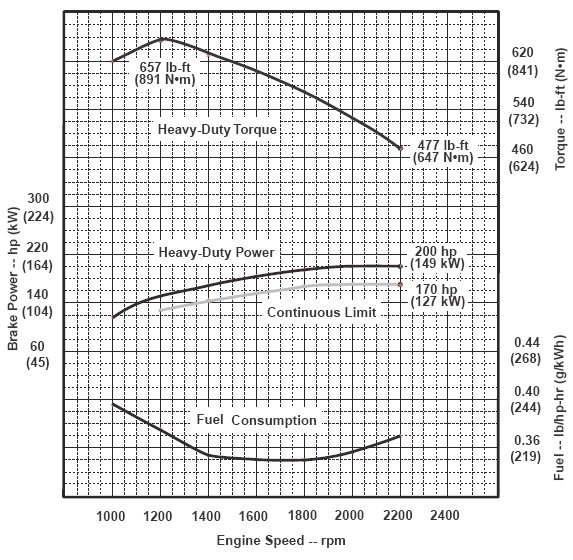
As a load increases on the engine the governor will increase the pumps fuel output in an attempt to maintain engine rpm at the level set by the throttle. The governor will keep increasing the pumps output until it is at it's maximum possible level and if more load is added then the only other possibility is dropping rpms. There is a phenomena called "torque rise" which is manifested as an increase in torque output as the rpms drop as load is applied. This is the reason your engine pulled down to 2000 and held there without falling further. The power output required to do all the work was equaled by the power available at that rpm. When you decreased ground speed the total power requirement was reduced and engine rpm increased to the equilibrium point once again.
This diagram illustrates the relationship between rpm, torque output and horsepower output.
makingsense-torquechart.jpg
 
   / Diesel Engine Theory #16  
As a load increases on the engine the governor will increase the pumps fuel output in an attempt to maintain engine rpm at the level set by the throttle. The governor will keep increasing the pumps output until it is at it's maximum possible level and if more load is added then the only other possibility is dropping rpms. There is a phenomena called "torque rise" which is manifested as an increase in torque output as the rpms drop as load is applied. This is the reason your engine pulled down to 2000 and held there without falling further. The power output required to do all the work was equaled by the power available at that rpm. When you decreased ground speed the total power requirement was reduced and engine rpm increased to the equilibrium point once again.
This diagram illustrates the relationship between rpm, torque output and horsepower output.
makingsense-torquechart.jpg
Wow. 1200 seems low for max torque point. What engine is that Mace?
Thanks,
,,,larry
 
   / Diesel Engine Theory #17  
By definition, "Lugging"* an IC engine is the condition where increasing the "throttle" does not result in an increase in engine RPMs.

*Fuel delivery in the case of a compression ignition engine, fuel and air for the otto cycle.
 
   / Diesel Engine Theory
  • Thread Starter
#18  
Gee Whiz Wally, I feel like I've stayed at the Holiday Inn Express with all this new knowledge!

Thank you everyone!

Sent from my iPhone using TractorByNet
 
   / Diesel Engine Theory #20  
I want to say one of the two quad box Macks I drove had operating RPMs at 1200 - 1800 RPM.
So 1200 would be about right for max torque on that machine.
 

Tractor & Equipment Auctions

2018 JOHN DEERE 35G EXCAVATOR (A60429)
2018 JOHN DEERE...
2022 FORD F-250 STV CREW CAB TRUCK (A59823)
2022 FORD F-250...
2016 MACK CXU613 MID-ROOF SLEEPER (A58214)
2016 MACK CXU613...
2019 FREIGHTLINER WATER TRUCK (A58214)
2019 FREIGHTLINER...
Lee Boy 250 Gal Tack Distributor (A53317)
Lee Boy 250 Gal...
2002 Allmand Night-Lite Pro Towable Light Tower (A56857)
2002 Allmand...
 
Top