You are using an out of date browser. It may not display this or other websites correctly.
You should upgrade or use an alternative browser.
You should upgrade or use an alternative browser.
Concrete Chairs
- Thread starter EddieWalker
- Start date
- Views: 18694
More options
Who Replied?
/ Concrete Chairs
#101



paulsharvey
Super Member
Search Dobie brick. Looks like Hime Depot lists them, but may not stock them; place like Whitecap should stock them.My last large pour, (40 yards, 15+ years ago), I used chairs made from concrete with a built in wire tie. Very handy. I searched and cannot find them now. It seems like plastic or wire are the only choices. I used #4 rebar, 24" on center in a grid format. I have no cracks, I did not use fiber in the small aggregate 4000 psi concrete.

I don't view rebar, chairs, or other support elements as giving better bending strain relief. And it's strain not stress that's the problem. The rerod is just there to keep the broken pies in relative position (IMHO). In order to minimize slab stress, the rebar needs to be pre-stretched as is done in bridge beam construction. Otherwise, the non-concrete pieces just provide discontinuities in the slab, which to me means pre-assigned fracture locations. Examine a bending moment diagram of any type of slab, beam, or truss. That's where the 1/3 rule comes from.
I went with a thicker slab, higher bag mix in my driveway with suitable crack 'assignment' slits, and use post-cure water proofing solutions to keep the water out. I prefer to use a rotary broom for snow removal, because it completely gets the water, snow, and ice off the surface. Plows do an ok job but leave a lot of residue for freeze thaw action. My broom even cleans out the slits.
I went with a thicker slab, higher bag mix in my driveway with suitable crack 'assignment' slits, and use post-cure water proofing solutions to keep the water out. I prefer to use a rotary broom for snow removal, because it completely gets the water, snow, and ice off the surface. Plows do an ok job but leave a lot of residue for freeze thaw action. My broom even cleans out the slits.
What I don't like is the lack of a loop on those wire ends for consumer box store dobie blocks, you can't use a twister. Imo it would get old in a hurry on a big pour bending over tying all those blocks with a lineman's or similar pliers.

lilranch2001
Super Member
- Joined
- Nov 25, 2009
- Messages
- 9,127
- Tractor
- Bobcat CT 235
This is a line I can honestly say I’ve never seen on TBN beforeMy broom even cleans out the slits.
paulsharvey
Super Member
Zzy, that's not correct about rebar, but is for WWF. Rebar, in the lower 1/3rd of the concrete is what takes the tension load. I know, your thinking what tension? A shear load, (close proximity of compression in opposite directions) creates tension. IE. down force on your exterior wall, next to static load, creates shear and tension. 3000 PSI concrete only has about 300 PSI of tension capacity. Steel is the opposite, it doesn't resist bending/reforming in compression Nearly as well as in tension, But the two together acr as one material; creating a material with the strength needed. Your rebar has 60,000 PSI of tension strength, and the concrete (with Vastly more Sq inches) resists compression and bending; creating a single structural element that meets the design loads.
paulsharvey
Super Member
For the expense question, look at a monolithic slab, by far the most common foundation. Your thick edge is going to be 16-20" thick, with 2-#5 rebar, but the rest of the floor is only 4" thick, maybe with WWF but maybe not. Imagine the cost of going to something like a 36" thick edge, vs 2-#5 parameter bars.
ericm979
Super Member
I have a dumb question: if the rebar is supposed to be in the lower 1/3 of the slab why are the chairs or dobies 2.5-3" high when most slabs for non industrial use are in the 4-5" range?
paulsharvey
Super Member
Don't know if I really explained well how it's a single structural element. The concrete can't fail in tension without breaking (causing to fail, that includes stretching) the rebar. The rebar can't bend without the concrete first failing in compression. Because the rebar has deformations, it can't move inside the concrete.
paulsharvey
Super Member
That's because you don't typically use rebar in a 4" slab for structural use; the rebar is used in 10"+ parts, ie, the thickened edges.I have a dumb question: if the rebar is supposed to be in the lower 1/3 of the slab why are the chairs or dobies 2.5-3" high when most slabs for non industrial use are in the 4-5" range?
paulsharvey
Super Member
For more engineered stuff than a single family home; they have specific bends pre-made or field bent in the rebar, to place it where the load is specifically in the correct place. Bottom 1/3 across the span, but at other places, where the load changes, being in the top 1/3.
paulsharvey
Super Member
if you cast a 1" diameter dowel of unreinforced concrete, you could literally pull it in a straight line, with some grunt needed, and pull it apart; if you add even a single 16 garage wire into that same dowel, it would take a truck to pull it apart. That 16 ga steal wire had an approx yeiled strength of 3060 lbs in tension.
paulsharvey
Super Member
I may have went in a whole rant for nothing; if we are talking a driveway slab, or something similar, 6" of 3000 psi concrete, poured on top of a well compacted subgrade, where the expansive materials and organics have been removed; does not need rebar; and the wire is there to both control curing cracks, and to hold the cracked pieces in place. A rebar grid will maybe help to distribute the point loads, but we are still looking at more than 12 sq inches of load evenly spread, and you should be fine. A building slab, bridge, inlet top, ect, are different animals, and that's why they nearly always call for rebar.
Lol meanwhile I started following this thread expecting to see elaborate and ingenious ideas for building forms for concrete furniture. Anyway I'll continue using my methods for concrete reinforcement and placement cuz they work.
OP

EddieWalker
Epic Contributor
They sell chairs in different heights. For a 3 1/2 inch slab, I buy 1 1/2 inch chairs.I have a dumb question: if the rebar is supposed to be in the lower 1/3 of the slab why are the chairs or dobies 2.5-3" high when most slabs for non industrial use are in the 4-5" range?

MossRoad
Super Moderator
- Joined
- Aug 31, 2001
- Messages
- 67,269
- Location
- South Bend, Indiana (near)
- Tractor
- Power Trac PT425 2001 Model Year
Regarding how deep... these chairs are 2.25" tall. I used 2X6 for depth, so real number is 5.5" thick slab. So they are 0.4" shy of being in the bottom 1/3 of the slab.When I did my garage addition in 2020, I used these little plastic chairs. Pretty easy addition, cheap, and I know the rebar isn't laying on the bottom or 1/4" from the top. They are currently .29 each. Not sure what they were 4 years ago.
EDIT: They were .17 each in 2020.
Nice thing about Menards... they keep your receipts on-line for quite a while.
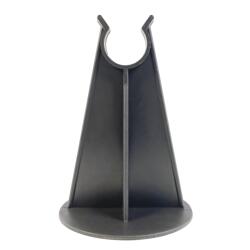
Plastic Rebar Chair
The 2-1/4in plastic rebar chair is a durable plastic rebar support system that is ideal for concrete applications. The chair is designed so that the rebar snaps securely into place allowing the rebar to sit above the ground while concrete is poured. The chairs are easy to work with and...www.menards.com
(click to enlarge).
View attachment 850529


bigtiller
Super Member
- Joined
- Feb 1, 2006
- Messages
- 7,530
- Location
- central Iowa
- Tractor
- John Deere 2720 John Deere 3039R John Deere Z545R
Is fiberglass rebar a good thing or something to avoid? I've never used it, but Menards sells it for less than steel.

ponytug
Super Member
I think that it has the big big advantage that it doesn't corrode. Just make sure you get the right size/strength.Is fiberglass rebar a good thing or something to avoid? I've never used it, but Menards sells it for less than steel.
I also think that it has the disadvantage that cutting it requires saw blades that are compatible, and good dust control.
All the best,
Peter

prairiegirl
Bronze Member
- Joined
- Sep 3, 2020
- Messages
- 71
- Tractor
- John Deere 2950, 7200, Kubota, MF
must mean 6 inch on center. So a rebar every 6 inches in a grid.What exactly do you mean?
ultrarunner
Epic Contributor
- Joined
- Apr 6, 2004
- Messages
- 29,966
- Tractor
- Cat D3, Deere 110 TLB, Kubota BX23 and L3800 and RTV900 with restored 1948 Deere M, 1949 Farmall Cub, 1953 Ford Jubliee and 1957 Ford 740 Row Crop, Craftsman Mower, Deere 350C Dozer 50 assorted vehicles from 1905 to 2006
It’s all we used for the MRI center…Is fiberglass rebar a good thing or something to avoid? I've never used it, but Menards sells it for less than steel.
It was a simple grid pattern… no bending required.


