Clearing ground for pasture

   / Clearing ground for pasture #1  

LDR812

Silver Member
Joined
Feb 14, 2022
Messages
108
Location
Central Florida
Tractor
New Holland TC33D, MF 165
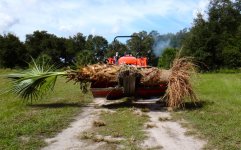
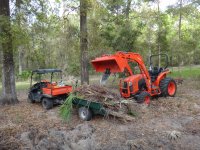
Hi, I have several small fields I need to plow and disc to prepare seed bed. About 4 years ago it was Forresty mulched. It had previously been tree farm and had 15 years or so of no maintenance so was full of overgrowth. Mostly bay trees and various scrubs. All those small stumps and roots are still in the ground. I thought they would be rotted enough by now that it could be turn plowed but my TC33D with a MF 66 2 bottom is really struggling. The plow keeps getting fowled with roots etc. I’m in central florida so also a lot of palmetto roots. Any ideas?
 
   / Clearing ground for pasture #2  
The 'right' answer is probably to root rake everything, and then disc. If the area us pretty small; maybe remove one of the plow bottoms, to reduce fowling and help it pull?
 
   / Clearing ground for pasture #3  

New Holland TC33​

New Holland TC33 Weight
2WD Shipping:2,334 lbs
1058 kg
4WD Shipping:2,474 lbs
1122 kg
SuperSteer Shipping:2,588 lbs
1173 kg
Engine Detail
Shibura
diesel
3-cylinder
liquid-cooled
Displacement:91 ci
1.5 L
Power (gross):33 hp
24.6 kW
Rated RPM:2800


Is your TC33 2-WD or 4-WD?
 
Last edited:
   / Clearing ground for pasture #4  
Palmettos I know. Often grows in layers, 1-2-3-4 plants deep.

In my opinion your tractor is just too light. Plow fouls because tractor/plow combination lacks inertia/weight/power to pull through. My 3,700 pound bare weight 4-WD Kubota L3560 would stall moldboard plowing in your conditions.

I suggest finding someone with a 5,000 pound, 6,000 pound or heavier bare weight, 4-WD tractor to contract plow, then root rake your fields (secondary tillage) with a Field Cultivator. A Field Cultivator will rake 14" deep.


A FEL bucket spade is effective digging out Palmettos but requires at least a 3,700 pound bare weight tractor, preferably with a thick, heavy duty bucket. Even teamed with my Kubota RTV500 utility vehicle + dump trailer, clearing Palmettos is a slow, one-at-a-time process. I burn excavated Palmettos.

I have never seen a heavy, primary tillage Chisel plow in Florida but that does not mean none are here. A primary tillage Chisel Plow behind a 8,000+ pound bare weight Utility category tractor might penetrate 14" in sandy-loam and pull most of that unwanted stuff mostly to the surface.


Attachments

  • DSC00418.jpg
    DSC00418.jpg
    853.4 KB · Views: 800
  • DSC00230.JPG
    DSC00230.JPG
    7.8 MB · Views: 348
  • DSC00692.JPG
    DSC00692.JPG
    4.7 MB · Views: 1,517
 
Last edited:
   / Clearing ground for pasture
  • Thread Starter
#6  
The 'right' answer is probably to root rake everything, and then disc. If the area us pretty small; maybe remove one of the plow bottoms, to reduce fowling and help it pull?
I was thinking about that. Right now I’m making multiple passes with the depth starting shallow and the getting deeper each additional pass. I’m walking the field and picking up the roots etc that are being turned up. I have 5 fields that are all 5 acres give it take each. About 30 acres total.
 
   / Clearing ground for pasture
  • Thread Starter
#7  

New Holland TC33​

New Holland TC33 Weight
2WD Shipping:2,334 lbs
1058 kg
4WD Shipping:2,474 lbs
1122 kg
SuperSteer Shipping:2,588 lbs
1173 kg
Engine Detail
Shibura
diesel
3-cylinder
liquid-cooled
Displacement:91 ci
1.5 L
Power (gross):33 hp
24.6 kW
Rated RPM:2800


Is your TC33 2-WD or 4-WD?
4 wheel No super steer. I have the 7308 FEL mounted and am loading the bucket with the debri so it might have an additional 150 lbs or so. Tires are not loaded - no other weight except the plow. It’s heavy - maybe 400lbs
 
   / Clearing ground for pasture
  • Thread Starter
#8  
Palmettos I know. Often grows in layers, 1-2-3-4 plants deep.

In my opinion your tractor is just too light. Plow fouls because tractor/plow combination lacks inertia/weight/power to pull through. My 3,700 pound bare weight 4-WD Kubota L3560 would stall moldboard plowing in your conditions.

I suggest finding someone with a 5,000 pound, 6,000 pound or heavier bare weight, 4-WD tractor to contract plow, then root rake your fields (secondary tillage) with a Field Cultivator. A Field Cultivator will rake 14" deep.


A FEL bucket spade is effective digging out Palmettos but requires at least a 3,700 pound bare weight tractor, preferably with a thick, heavy duty bucket. Even teamed with my Kubota RTV500 utility vehicle + dump trailer, clearing Palmettos is a slow, one-at-a-time process. I burn excavated Palmettos.

I have never seen a heavy, primary tillage Chisel plow in Florida but that does not mean none are here. A primary tillage Chisel Plow behind a 8,000+ pound bare weight Utility category tractor might penetrate 14" in sandy-loam and pull most of that unwanted stuff mostly to the surface.


Attachments

  • DSC00418.jpg
    DSC00418.jpg
    853.4 KB · Views: 800
  • DSC00230.JPG
    DSC00230.JPG
    7.8 MB · Views: 348
  • DSC00692.JPG
    DSC00692.JPG
    4.7 MB · Views: 1,517
Yes sir - a lot of work. I’ve used the rippers on the box blade with some success. Out in the fields there aren’t any really big palmettos. I’ve kept it mowed down regularly so far the biggest clump of root was about as big around as a gallon paint bucket but only a foot or two long
 
   / Clearing ground for pasture
  • Thread Starter
#9  
And I agree I need more tractor. Been looking for a ford 4000 or maybe a MF165
 
   / Clearing ground for pasture
  • Thread Starter
#10  
Yes sir - a lot of work. I’ve used the rippers on the box blade with some success. Out in the fields there aren’t any really big palmettos. I’ve kept it mowed down regularly so far the biggest clump of root was about as big around as a gallon paint bucket but only a foot or two long
Thanks for the link and info on the chisel plows. Really informative.
 
   / Clearing ground for pasture #11  
I was thinking about that. Right now I’m making multiple passes with the depth starting shallow and the getting deeper each additional pass. I’m walking the field and picking up the roots etc that are being turned up. I have 5 fields that are all 5 acres give it take each. About 30 acres total.
You might want to seriously think about getting a field cultivator with spring loaded tines (not a row cultivator with fixed tines). Hopefully the springs give before you break a tine or damage your tractor.
 
   / Clearing ground for pasture #12  
And I agree I need more tractor. Been looking for a ford 4000 or maybe a MF165
Both around 5,000 pounds bare tractor weight. Both 2-WD.

Depending on what tires are on the 5,000 pound tractor you acquire you will likely need a 16" wide plow to make furrows sufficiently wide to accommodate approximately 15" wide rear tires. A 16" wide plow will turn soil 7" to 9" deep in primary tillage, so a relatively light Field Cultivator will not be overstressed raking an additional 6" deep (to 14" total depth) in secondary cultivation, following the plow.

A Field Cultivator is one of several types of conservation plow. The Field Cultivator and its heavier relation, the Chisel Plow, are both used for conservation tillage.

The chisel plow is a implement used to get deep tillage (prepared land) with limited soil disruption. The main function of this plow is to loosen and aerate the soils while leaving crop residue on top of soil. This plow can be used to reduce the effects of compaction and to help break up plowpan and hardpan. Unlike many other plows the chisel will not invert or turn the soil. This characteristic has made it a useful addition to no-till and low-till farming practices that attempt to maximize the erosion-prevention benefits of keeping organic matter and farming residues present on the soil surface through the year. Because of these attributes, a chisel plow is considered to be more sustainable than other types of plow, such as the mouldboard plow.
 
Last edited:
   / Clearing ground for pasture #13  
I would not plow/disc this at all. With the history of the pines and other vegetation and Florida typically having very sandy soil. You are most likely to take your best soil and bury it and have a pile of roots to have to deal with.

If it were me. I would manage it by running a flail mower with hammers to keep the vegetative overgrowth managed. When it re-sprouts (and it certainly will) go and spray the field with a vegetative herbicide like Crossbow. After you get that under control then it comes to the task of soil building. Cover crops are your answer. Since you are in a warm location buckwheat or sun hemp in the summer and maybe oats in the winter months. Keep mowing it down and maybe VERY lightly discing it just to get it to compost and build up your organic matter. Once you get the field to your liking then go ahead and plant your pasture grasses.

This is not a fast process by any means but the only other alternative is bringing very large equipment which in turns brings a large price tag.
 
   / Clearing ground for pasture
  • Thread Starter
#14  
Both around 5,000 pounds bare tractor weight. Both 2-WD.

Depending on what tires are on the 5,000 pound tractor you acquire you will likely need a 16" wide plow to make furrows sufficiently wide to accommodate approximately 15" wide rear tires. A 16" wide plow will turn soil 7" to 9" deep in primary tillage, so a relatively light Field Cultivator will not be overstressed raking an additional 6" deep (to 14" total depth) in secondary cultivation.

A Field Cultivator is one of several types of conservation plow. The Field Cultivator and its heavier relation, the Chisel Plow, are both used for conservation tillage.

The chisel plow is a implement used to get deep tillage (prepared land) with limited soil disruption. The main function of this plow is to loosen and aerate the soils while leaving crop residue on top of soil. This plow can be used to reduce the effects of compaction and to help break up plowpan and hardpan. Unlike many other plows the chisel will not invert or turn the soil. This characteristic has made it a useful addition to no-till and low-till farming practices that attempt to maximize the erosion-prevention benefits of keeping organic matter and farming residues present on the soil surface through the year. Because of these attributes, a chisel plow is considered to be more sustainable than other types of plow, such as the mouldboard plow.
Jeff - thank you for all the information. I had never given tire size vs plow shear any thought.
 
   / Clearing ground for pasture
  • Thread Starter
#15  
I would not plow/disc this at all. With the history of the pines and other vegetation and Florida typically having very sandy soil. You are most likely to take your best soil and bury it and have a pile of roots to have to deal with.

If it were me. I would manage it by running a flail mower with hammers to keep the vegetative overgrowth managed. When it re-sprouts (and it certainly will) go and spray the field with a vegetative herbicide like Crossbow. After you get that under control then it comes to the task of soil building. Cover crops are your answer. Since you are in a warm location buckwheat or sun hemp in the summer and maybe oats in the winter months. Keep mowing it down and maybe VERY lightly discing it just to get it to compost and build up your organic matter. Once you get the field to your liking then go ahead and plant your pasture grasses.

This is not a fast process by any means but the only other alternative is bringing very large equipment which in turns brings a large price tag.
55 - I had considered what you’ve expressed. The Ag extension agent that I’m working with has suggested that it needs to be a clean seedbed. It’s full of blue stem grass now so I may have to get aggressive with herbicide and then plant a non grass crop for a season. Sun hemp is high on the list. The other option I’m considering is just putting some cracker cows on it and letting them over graze it to dirt (while supplementing with hay) and then reseeding. One reason I’m thinking I need to have a clean seedbed is some I can grain drill it and not tear up the drill. If I just broadcast seed it will take 2x times seed…
 
   / Clearing ground for pasture #16  
I may have to get aggressive with herbicide and then plant a non grass crop for a season. Sun hemp is high on the list.

I had relatively good success hand broadcasting Sunn Hemp as a green manure crop on my Gilchrist County food plots.

The professional farmers at Associated Dairy, just west of Trenton, the county seat of Gilchrist County, planted about 40 acres of Sunn Hemp after clearing jungle from overgrown, long unfarmed land. The professionals had nearly 100% coverage/germination of the Sunn Hemp seed. I know not how Associated Dairy put the seed on the soil.

North Florida grown Sunn Hemp is available from Hancock Seed in Dade City.

 
Last edited:
   / Clearing ground for pasture
  • Thread Starter
#17  
Thanks Jeff - good to know.
 
   / Clearing ground for pasture #18  
When your ag agent is referring to a clean seedbed typically they are referring to weed seeds more then they are debris or "trash" on the surface as it is commonly called. Example: You could till and have a picture perfect seedbed and it would not be "clean". Once you till you bring millions of seeds that have been on the surface or been buried too deep and now you have them in the goldilocks zone of just the right depth to germinate. Modern planters and no-till grain drills are designed to work in heavy debris with extra weight, no till coulters and trash kickers. These can often be rented at local Co-Ops or Conservation districts.

There is definitely worse plants to have sprouting then blue stem. It actually makes a great drought tolerant pasture grass so you might not want to kill it off. Your big issue is going to keep all the brush from re-sprouting but broadleaf herbicides/regular mowing should handle that and not bother the fescue.

Could you post a couple pics of the plots. Getting a visual idea of what your are dealing with give a better direction on what steps to take to get you where you want to be.
 
   / Clearing ground for pasture #19  
I dont know that burying your best soil 6" down with a disk is a bad thing. I would imagine with pines; the soil is pretty acidic also, so lime may be needed. Also, some areas have a heck of a hard pan layer, but probably deeper then will affect grasses; but will affect drainage.

On the no till; I really didn't think they did well with any woody debris, such as roots say 1" or bigger; and the ball roots from palmetto would really clog them up, I would think. Also, I would hate to hook into a 8-12" diameter pine tap root, that has started turning into lighter knot, with a drill.

I heard a description of Fla a few years ago that I had never heard before, but makes a Lot of sense; Florida is a desert where it rains a lot. That is both true figuratively and in reality. Geologically, it was basically attached to the Sahara at one point.

We do have a varied soil. West of I-75, in Alachua County, you'll find chirt rocks the size of a truck; where I am, I'm 120 ft above sea level, on a sand hill; with a 105 ft deep well, that is still in sand, and not a natural rock in 30 miles. Over by the beach, you get a really abrasive shell-sand-clay mix. Hastings, down to Bunnell, where 3 counties grow, from what I've heard, like 30% of USAs potatoes, silty sand with a lot of organics, with a Nasty hard pan layer.

Once in Ocala, open trenching gravity sewer, I think we had clay sand, gumbo, hard rock, soft rock, a false water table, and pretty mortar sand, all within about 200 ft of trench.
 
   / Clearing ground for pasture
  • Thread Starter
#20  
When your ag agent is referring to a clean seedbed typically they are referring to weed seeds more then they are debris or "trash" on the surface as it is commonly called. Example: You could till and have a picture perfect seedbed and it would not be "clean". Once you till you bring millions of seeds that have been on the surface or been buried too deep and now you have them in the goldilocks zone of just the right depth to germinate. Modern planters and no-till grain drills are designed to work in heavy debris with extra weight, no till coulters and trash kickers. These can often be rented at local Co-Ops or Conservation districts.

There is definitely worse plants to have sprouting then blue stem. It actually makes a great drought tolerant pasture grass so you might not want to kill it off. Your big issue is going to keep all the brush from re-sprouting but broadleaf herbicides/regular mowing should handle that and not bother the fescue.

Could you post a couple pics of the plots. Getting a visual idea of what your are dealing with give a better direction on what steps to take to get you where you want to be.
Interesting that the Clean seedbed is reffering to weeds/seeds. Thanks for that. It wouldn't be the first time I've talked myself into more work than necessary! When they planted the pines they "bedded" them so the pasture has what appears to be ruts in a bunch of locations. Some 2 foot or deeper. I was hoping if I got it turned / disc etc I could drag it out and level with box blade, drags etc. I did get a MF165 so have a bit more tractor than just the 33 - If I could afford it I'd like to have a dozer come work on the grade because over the years its been pushed around, ditches dug and the dirt just piled making water traps etc. I have a local company coming by to give me an estimate to root rake it. I'm gonna ask about the grading. A skid steer (tracked) might get it done. I saw the forrestry service cutting fire breaks using one a few weeks ago and was amazed at what they were able to get done.
I did take a bunch of pics this weekend. They are all 3 or 4 meg. Is there a limit?
 

Tractor & Equipment Auctions

UNUSED FUTURE FT-RT57 - 57" HYD ROTARY TILLER (A52706)
UNUSED FUTURE...
KNOW BEFORE YOU BID - DO YOUR HOMEWORK AND BE HAPPY WITH YOUR PURCHASE (A60429)
KNOW BEFORE YOU...
2021 Ford F350 XL (A57148)
2021 Ford F350 XL...
Unused 2025 CFG Industrial H15R Mini Excavator (A59228)
Unused 2025 CFG...
2018 JLG 742 TELESCOPIC FORKLIFT (A60429)
2018 JLG 742...
2020 PETERBILT 567 (A58214)
2020 PETERBILT 567...
 
Top