CHEAPEST WAY TO BUILD LOADING RAMPS

   / CHEAPEST WAY TO BUILD LOADING RAMPS #21  
Regarding the holes... both hulls look to be equally submerged.

Is it possible that you forgot to put the bungs in when you put it in the water?
That was my first guess, and if you fed a pair of quarter inch air hoses into the bungs in the back then put air in there at say 5 PSI (leaving enough room around the hoses for water to get out you might be able to displace the water in there with air) and get them to refloat with nothing more than a small air compressor.

Aaron Z
 
   / CHEAPEST WAY TO BUILD LOADING RAMPS #22  
I have helped lift a number of submerged boats and displacing water with air is by far the easiest way. The hull will not withstand being full of water and pulled by a vehicle. Something will break.

They lift ocean liners with balloons. Just takes a lot of them.

As was mentioned it will not take much air pressure. Also the auto air lift would be almost ideal. Just don't be in a hurry. Lift a little and let it drain then lift more. You can use shop vac hoses as extensions if need be.
 
   / CHEAPEST WAY TO BUILD LOADING RAMPS #23  
The attachment point on the boat for the rope may not have been designed for the additional weight of water in the hulls, so be cautious pulling it too much with the water still inside.

I would go with the idea of using some air bags, bladder etc to lift the boat as much possible to drain water and put some patches on the hulls before pulling it on to a trailer.

You didn't mention the distance from the top of the dam to the boat, but multiple trips walking back and forth on the slope can be tiring. Maybe you can find a metal cage from an IBC tote to use as a carryall for your ropes, air bag, air compressor, tools, lunch, water bottle etc. Lower the metal cage down the slope with a rope or towing strap or chain attached to a tractor or truck. When you have finished with the work, put everything back into the metal cage and pull it back up the slope.
 
   / CHEAPEST WAY TO BUILD LOADING RAMPS #24  
Did you back your trailer into the water to get the boat off? Is that the location? Do you have a picture of the trailer? A picture of the boat loaded on the trailer?

Pictures showing the slope and all approaches will help. List what you've got to work with... Tractor how big. Jib pole... hoist... winch... portable generator... air compressor... drill ...

Look at some of the video showing delivery of sheds. And roll back recovery trucks. They can go almost anywhere.

One Man Show - Delivery & Set up of 12x2 Amish Shed - YouTube

Old hickory shed delivery. Awesome Job - YouTube

Pine Hill Trailer Sales - Shed Trailer - YouTube

Rotating Flatbed Recovery part 2 - YouTube

26ft Low Loader for Phil Powers - YouTube

https://www.youtube.com/watch?v=rY9iAGjB0ME

https://www.youtube.com/watch?v=jaBD4YtY11o


I looked to see what state you were in and ... well I won't be driving down to lend you a hand. :rolleyes:
 
Last edited:
   / CHEAPEST WAY TO BUILD LOADING RAMPS #25  
Dig a couple of angled trenches for the trailer wheels so the boat can be pulled onto the back of the trailer, which would be almost on the ground. Cost: zero. You may have to do something to lighten the boat as others have said.

I loaded a tractor on a trailer that way once.
 
   / CHEAPEST WAY TO BUILD LOADING RAMPS
  • Thread Starter
#26  
All good but:

There are NO bungs so I did not forget to install them

I have a 65 Hp tractor with a jib, an 8 KVA generator, air compressor with a long airline, 3 4WD vehicles, 2 heavy chainblocks and yes, they could all be taken down to the dam in the box trailer.

Digging trenches for the trailer wheels might work using the rear scraper blade but I do not have a backhoe or FEL However, the slope is minor so it would be far easier to get some water out of the boat to raise the stern - then the loading angle will not be excessive.

The stern is too far off the bank to reach with the tractor jib and there is the added danger of losing the tractor into the dam too!

The stern sections of the hulls cannot be sealed to use airlines, but yes, inner tubes (that I do not have) could be placed inside or under each hull. An inflatable air bed under each hull might be better However, the water at the stern is around 5 feet deep and the temperature this morning was minus 5 degrees C. I might be a wimp but getting in there to place the inner tubes/airbeds then connect them to the air lines etc is not my idea of fun, even wearing a wet suit. Al up though, this is starting to look like the best option. Once the boat is moved as little as 6-8 feet forward the hulls will probably start to drain naturally, depending where the holes are located
 
   / CHEAPEST WAY TO BUILD LOADING RAMPS #27  
Guess you can tell I know nothing of boats. I'm thinking what you call a hull is a pontoon? Is it partitioned or open from end to end. I'm thinking drill a hole high up at the front insert a catheter and fill with air. Bubbles should generally locate the problem. This could displace enough water.to float your boat. Still don't know if your trailer is up to the job of backing into the water? Maybe you could rent one that could?

The 65 HP tractor should be able to move trailer and boat. 3 point could raise front of trailer making the trailer into a ramp if it is shaped for that.
 
   / CHEAPEST WAY TO BUILD LOADING RAMPS #28  
I watched Mythbusters use ping pong balls to raise a boat. Not that it's practical but if you have any old air filled balls around maybe you can stuff a few inside the hulls to help displace the water. If you look around maybe you can find other things that would displace the water.
 
   / CHEAPEST WAY TO BUILD LOADING RAMPS #29  
I agree with putting air in the pontoons and forcing/displacing the water with air.
 
   / CHEAPEST WAY TO BUILD LOADING RAMPS
  • Thread Starter
#30  
Discussion with a neighbor today pointed to an answer for my original question about cheap ramps. Small round-section treated pine logs (about 4" diameter) are cheap and readily available from landscape materials sellers. Cut into 12" lengths they can be fixed between 1" thick ply sides with washers and long coach screws so they will revolve. The sides would sit say 3" above the level of the rollers to keep the keels from slipping off. These sides will be strapped together with steel plates. Total cost around $50

Re Shade tree's question about the hull construction, they are open inside from end to end so yes, it is conceivable that air pumped in at the bow could identify where the holes are located but as stated previously I'm sure they are right at the bottom where they will be impossible to access and/or repair until clear of the water.

It looks though my wet-suit will have to get me into the literally freezing water to get tire tubes or whatever under the aft ends of the hulls. That will mean getting the generator and compressor right down the the edge of the dam but I can't think of any realistic alternative As the aft ends lift the boat can be winched up the ramps progressively and slowly to let the water drain out as the angle changes.
 
   / CHEAPEST WAY TO BUILD LOADING RAMPS #31  
How much pull can the tow points take?
How many litres of space in each hull?
1000 litres =1 tonne I would guess you have several tonne of water in that boat.
Are the hulls air tight,if so can you fit an air connection to force the water out ? By forcing the water out you will also break the suction holding the boat in place. Even a small reduction of weight can have a large effect in effort to tow the boat out.
 
   / CHEAPEST WAY TO BUILD LOADING RAMPS #32  
Somehow I think we are speaking in different languages I don't understand (this is normal for me) your use of the term "dam" for example the tractor could get in the dam. You said I think the slope is not great where the boat is. Is there a boat ramp at the pond? You never did say how you got the boat off the trailer into the water. You guys have tubeless tires? where the valve stem comes out of a hole in the rim? Get a plastic bottle with a screw on top. Fix a valve stem in the top. Punch a hole in the bottom or side of the bottle. Stick the bottle in your dam. When it fills or takes on water hold it there. Take your air line and put air in the bottle with the water. What I think will happen is you will see bubbles and some or all the water in the bottle will be forced out??? Now do the same for both your hulls. If the water is forced out and the rear of your boat floats reverse however you got your boat in the dam and don't worry about how much the ramp is going to cost. I'm having a rough day I hope yours goes well.

:confused3:

Oh yea it is 100 F here. If you are determined to use ramps - spray some water on them at 0 C 32 F and below it will turn to ice which is slick as you need.

:cool2:
 
   / CHEAPEST WAY TO BUILD LOADING RAMPS #33  
Consider that a 55 gallon drum holds about 450 lbs worth of water. So if you were to displace 55 gallons of water under the boat with an air bag or equivalent, you'd get 450 lbs of lifting minus the weight of the bag or drum. That may or may not be enough to budge the boat to start the water draining. That brings up another idea, if the holes in the hull are too big to hold pressure, sink some barrels at the rear of the boat with the hole facing down. Tie them to the boat somehow so they can't flip around. Then run a hose inside each barrel and hook it to your air compressor or the exhaust pipe of some sort of engine.

You might also try the exhaust trick in the hull of the boat...If there are holes above water line you will need more volume than pressure. Or you may blow the end off your muffler.
 
   / CHEAPEST WAY TO BUILD LOADING RAMPS #34  
DownUnder Boat.jpg

Okay had to come in to put on some dry clothes... What is that little thinggie on the back of the boat.(Click on the little picture above to get it large enough to see) Is that where you put the fuel or is that something you throw a rope around to tow a barge? Come on post some pictures. Is that the dam in front of the boat or just a bank of the pond? How did the boat get there? Did you drive it on the water or did it drift or did it come off the trailer?

I saw a boat that had hulls like that once. It was on a trailer which was narrow enough to slide in between the hulls they in turn hung down outside the trailer wheels clearing the ground by a half foot or so. Sounds like you put the hulls on a flat bed trailer. How tall does this make your load?

Do you have a local rescue squad or fire department that would like to get in a little unusual practice with their air bags???


As handirifle says below: but get a splitter on your air line and do both hulls at the same time. Your neighbor talked, now everybody knowes.
 
Last edited:
   / CHEAPEST WAY TO BUILD LOADING RAMPS #35  
If you can drill small holes in the top of each hull and pressurize with air, that will lift it. Remember bubbles from a bottom hole will not appear until at least most of the water is gone.

Do this on each side and it should lift it right up. Make the hole large enough to get an air nozzle in but small enough to plug with a screw when the water is out. Then do the same on the other side. That will probably get rid of a 1,000lbs or so. At 8lbs a gallon that's not a lot of water.

Good part is you can drill the hole in the front and stay out of the water, maybe.
 
   / CHEAPEST WAY TO BUILD LOADING RAMPS #36  
Then once it's out of the water, take plugs out to allow it to drain more, if it will.
 
   / CHEAPEST WAY TO BUILD LOADING RAMPS
  • Thread Starter
#37  
From the recent comments, it seems I have not explained the situation well enough:

"How much pull can the tow points take?" The cross beams are 100 X 50 mm marine grade aluminium bolted to the deck. A chain or ropes around one of these will take all of the weight without difficulty

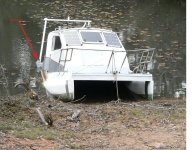
" little thinggie on the back of the boat" are the struts to carry the mast when it is lowered for trailer transport" Or maybe you refer to the winches that control the head sail when sailing and/or to recover a stern anchor.

" the term "dam" for example the tractor could get in the dam. You said I think the slope is not great where the boat is. Is there a boat ramp at the pond? You never did say how you got the boat off the trailer into the water" The picture illustrates the BOWS of the boat ON the bank of the dam which was dug into the earth and packed down with the dozer. The trailer rear wheels go right iINTO the water for normal launching and recovery, leaving the front trailer wheels (tandem axles) on the edge of the bank and the towing vehicle well clear of the water line. Once the rear end of the boat meets the water, under normal circumstances, the boat just floats off the trailer. Recovery works exactly the same way - the boat floats onto the trailer and is then winched forwards onto the supporting rollers under each hull. NO the tractor will NOT go into the dam unless it is intended to stay there!

"Are the hulls air tight?" They are normally airtight below the deck level - except for the holes that have caused the boat to sink!. The tops of the hulls have several access openings that prevent "splash" water but are not fully sealed. Given that the aft access points are now under water, sealing them would be near impossible, especially if required to withstand pressure from air pumped into the hulls.

"if the holes in the hull are too big to hold pressure, sink some barrels at the rear of the boat with the hole facing down. Tie them to the boat somehow so they can't flip around. Then run a hose inside each barrel and hook it to your air compressor" Yes, barrels, 20 litre drums or inner tubes would all work to lift the stern and they can be roped around the stern of each hull without too much difficulty.

"Consider that a 55 gallon drum holds about 450 lbs worth of water." I do not know the capacity of each hull but a rough calculation suggest the equivalent of a 55 gallon drum would be about maximum in each hull - especially since the hulls are only about half full due to the angle in the water and the bows being ON the bank. This why dragging the boat forward even a metre or so would change the angle sufficiently to start the water draining. BUT getting some lift at the stern first AND getting those ramps under the bows before starting to tow it forward seems essential.
 
   / CHEAPEST WAY TO BUILD LOADING RAMPS #38  
This is why they say a picture is worth a thousand words. Sorry I am unable to understand you but I often don't understand myself.

Why don't you just back the trailer into the water under the boat and winch it onto the trailer?

I think I now understand the Bows are like canoes not air tight as a pontoon would be. The water is cold and not inviting a swim.

If the trailer won't work as a ramp. Hook your jib pole on the tractor to the cross beam of the boat. Lift and pull. When you get the boat out of the water onto the bank or dam the water will drain out. You can pump out any that does not drain or wipe out with towels. When dry you can patch the holes from the inside and lift with the tractor to get the outside.If you looked at any of the links I posted before; you saw where wheels were attached to "things being moved (sheds) that did not normally have wheels" you could do that. Wrecker trucks often have wheels they use when what they are picking up is so damaged the extra wheels are needed. Maybe you could borrow or rent some? I was thinking the little thinggie I asked about could be used as a connection point for pulling or lifting.

Are the bows made of marine grade aluminium or fiberglass. Do you own the pond?
 
Last edited:
   / CHEAPEST WAY TO BUILD LOADING RAMPS #39  
What is the width to the outsides of the two hulls?

What is the distance from the edge of the water to perhaps a foot beyond the end of the submerged hulls and how deep is the water there?

Is building a temporary cofferdam too much of a challenge for this project?

If enough water was removed to gain access to the access points on top that are currently submerged, it might be possible to pump the water out of the hulls faster than the holes at the bottom are letting it in.
 
   / CHEAPEST WAY TO BUILD LOADING RAMPS
  • Thread Starter
#40  
NO Shadetree - it is NOT currently possible to get the trailer under the boat until it actually floats- don't you think I would have done that? Also, dragging the boat further onto the bank will only make matters worse for obvious reasons

Bard - the overall beam (width) of the boat is 2500mm (Maximum legal trailer width). The boat is 5.5 metres long (20') so the dimension you asked about is about 21-22' At that point, the dam is about 4-5' deep with a steep downward slope

The idea of a coffer dam is a very good one but not practical due to lack of appropriate machinery and rock-hard ground. It would necessary to cut sideways (across the two bows of the boat) before back-blading out the spoil. I would not be game to get my Ford 6000 that close to the edge so the only way to do it would be to get in a dozer but that would probably create more trouble than it would solve (I'm no stranger to having one working here).

Yes, getting enough water out will raise the access hatches to the waterline and if that can be achieved, it will not be necessary to pump in air because the change of angle will be sufficient to get ramps under each bow and then start winching forward. Draining will then occur naturally as stated previously. This is exactly what has to be done
 

Marketplace Items

2012 BRUMLEY MANUFACTURING DATA VAN TRAILER (A55745)
2012 BRUMLEY...
(2) UNUSED FUTURE 10' SLIP-ON FORK EXTENSIONS (A60432)
(2) UNUSED FUTURE...
2018 Freightliner M2 106 AWD Altec AA55 56ft. Insulated Material Handling Bucket Truck (A60460)
2018 Freightliner...
2007 MACK GRANITE CV713 DUMP TRUCK (A60430)
2007 MACK GRANITE...
Used Landpride GR1525 Stump Grinder
Used Landpride...
2008 GMC C7500 CREW CAB FLATBED DUMP TRUCK (A57192)
2008 GMC C7500...
 
Top