Changed motors NEED wiring HELP!

/ Changed motors NEED wiring HELP! #1  

bamaman01

Member
Joined
May 17, 2012
Messages
34
Location
Section Al
Tractor
cub LT1042
I just had my original motor replaced, a kawasaki 19 hsp, with a 21 hsp. Briggs,OHV. It worked fine for a while but I cannot figure out what is happenig, Something is pulling new batteries down and causing clutch to stall . I replaced battery twice within a month and works for a mowing or two then back to dead battery and stalling clutch.I had a part time small engine guy do the exchange for me and it seems that maybe he didn't wire it correctly I just need a simple wiring solution to go by. there ar too many loose wires from original motor. This motor is mounted on a Tank M48 mower. Can I get some help from some of you knowlegable machanic.
Thanks in avance.
 
/ Changed motors NEED wiring HELP! #2  
Do you have a VOM? (volt-ohm meter)

Why did you replace the batteries instead of simply charging them??

It could be a few things, but you really need a VOM to further troubleshoot. New fully charged battery being dean in just a few mowings makes me think that it is something more than just a no-charge situation.Something on the new motor isnt hooked up right. Because to drain a battery that fast takes more than just a few sarts. IE: you are consuming battery juice WHILE running.

And what do you mean by "stalling the clutch"??
 
/ Changed motors NEED wiring HELP!
  • Thread Starter
#3  
Yes I have a volt meter I checked silenoid and it seems to be oj. What I mean about stall is, that when you cut grass it wants to slow down. I adjusted the clutch to abt. a guage of 12 & did sonewhat better but still slows. I go to start mower & battery dead.
 
/ Changed motors NEED wiring HELP! #4  
You need to separate this into one or the other problem:

1. Is it charging while running? Check the battery voltage with engine running at full throttle for at least 10 minutes. It must be above 13.5 volts, and 13.8 or higher would better. If so the battery is charging ok. If the voltage is low the electric clutch may not have enough power to operate.

2. Is the battery being discharged while the engine is not running? With the engine off and all devices (clutch,lights, etc.) off disconnect the negative terminal of the battery and measure the current being drawn between the negative battery terminal and the lead you just disconnected.. Be careful and read your owner's meter's manual about measuring current. It is easy to damage the meter. Get help if you are in doubt. The current should be less than 10 milliamperes. Less than one is better.
 
/ Changed motors NEED wiring HELP! #5  
When you are talking about the clutch, and when you say "when mowing it slows down", do you just mean the blades slow down?? or does the whole engine slow/bog down?? If it is the whole engine, I doubt that problem is a clutch issue.

Ditto on what Bobrip said. You have a VOM. Time to use it. Check some voltages. When running?? When it appears dead?? Test the current also. Do you have a meter that will do DC amps with a clamp?? If so, you can check draw when running and with it being off without un-hooking anything.

Good advise to read your manual on the meter too. Too much current on the wrong setting will blow the internal fuse.
 
/ Changed motors NEED wiring HELP! #6  
New fully charged battery being dean in just a few mowings makes me think that it is something more than just a no-charge situation.Something on the new motor isnt hooked up right. Because to drain a battery that fast takes more than just a few sarts. IE: you are consuming battery juice WHILE running.
And what do you mean by "stalling the clutch"??

That mower has an electric clutch that runs the blades. A similar one from Surplus Center pulls over 3 amps, so I can see it draining a little lawnmower battery fairly quickly.

I agree with the other posters. Stick a voltmeter on the battery when off, when running (both at idle and 3/4 throttle) and (if possible) with the deck on. You should see at least 13 volts anytime the engine is on. If you don't see that, I would first check all fuses and then go from there.

Aaron Z
 
/ Changed motors NEED wiring HELP! #7  
That mower has an electric clutch that runs the blades. A similar one from Surplus Center pulls over 3 amps, so I can see it draining a little lawnmower battery fairly quickly.

I agree with the other posters. Stick a voltmeter on the battery when off, when running (both at idle and 3/4 throttle) and (if possible) with the deck on. You should see at least 13 volts anytime the engine is on. If you don't see that, I would first check all fuses and then go from there.

Aaron Z

Yea, thats kinda my point, even if I didnt word it too well.'

What I was trying to say was.....IF the battery was ONLY used to start, (IE bad charging connection or something) BUT the mower was STILL able to make its own power when mowing (just not charging), then it would last MUCH longer than 2-3 starts.

Thats Why I think it is something more than just a "no-charge" stuation. I could be wrong on THAT particular model, but MOST of these small engines will run WITHOUT the battery. It dont sound like thats the case with this one, somthing else is wrong
 
/ Changed motors NEED wiring HELP! #8  
Yea, thats kinda my point, even if I didnt word it too well.'
What I was trying to say was.....IF the battery was ONLY used to start, (IE bad charging connection or something) BUT the mower was STILL able to make its own power when mowing (just not charging), then it would last MUCH longer than 2-3 starts.
Thats Why I think it is something more than just a "no-charge" stuation. I could be wrong on THAT particular model, but MOST of these small engines will run WITHOUT the battery. It dont sound like thats the case with this one, somthing else is wrong

Ah, I had read it as the battery was only lasting 2-3 mowings and guessed that is is a no-charge situation. Have seen that on several zero turns (mostly on Exmarks with Kawasaki motors).
My guesses would be a mis-connected wire, a bad stator or a bad voltage regulator not allowing it to charge.
Running the voltage tests with the motor off, on and on with the deck on should tell if the charging system is doing anything.

Aaron Z
 
/ Changed motors NEED wiring HELP!
  • Thread Starter
#9  
Thanks guys, I have checked the battery with engine off and getting 12.26 volts. I have not jumped it off to test while running. I have traced wires through the harnest and find only one fuse, and that fuse has 25 amp in it, not broke, however, one wire to fuse holder is diconected and I have no idea where it would connect. where the fuse is there is nothing (no wires) going out from fuse. I touched the diconnected wire to hot post of solenoid and turned key and got clicks from battery so it appears to be hot. it did not blow the fuse. I will check the battery while running and see voltage. I think i might need to just re-wire this thing, but Im not sure of what i need to hook up to get it to work.
Thanks again guys for your help and quick responses.
 
/ Changed motors NEED wiring HELP! #10  
If there is only one fuse in the harness, that is likely the fuse protecting the charging circuit. Probabally should be a wire from the engine harness feeding that fuse, and then back to battery. Could run through the keyswitch and then to battery.
 
/ Changed motors NEED wiring HELP! #11  
Well your getting excellent advice & help from these fellas,cause you need to pinpoint what its doing &/or not doing correctly b4 you can/shld proceed! The art &/or science of good troubleshooting is to know the system, that being said, you shld at least know the basics or at least know how to use your tools & what to use,why & where! Once you know what items do what,how & why,it becomes much easier & simpler to trblsht/diagnose! Also a good wire diagram/shematic does wanders too, if you dont know where wires are supposed to be & what color,how can you possbly discern the problems? All that aside, If you have a voltmeter, all you really have to do is check for voltage here & there at the right places & at the rght times, like the guy said, about 14 volts while its running & about 12 when its off! If you check for volts,your checking for power! If there is no voltage where there is supposed to be,then your not getting power to that place/circuit/switch/relay/fuse/light etc!! It sounds a lot like a faulty or missing voltage regulator to me, a bad one will drain the batt really fast! Also check your stator & stator wires & stator field windings, check to see if any of the wires are getting hot while its running! Always check the easy,obvious stuff first, it will save you money a lot of times! I've seen car's whole elec system shut dwn & not take a jump start just from a corroded battery terminal(usually positive) ! Always disconnect the ground/negative term 1st & hook it up last! You know how the guy(s) said the mower shld run w/o the batt? Well,once your veh starts(tractor or car) , it really runs off the alternator(or generator) , the battery's most imp role is in starting/cranking power for starter & initial system voltage, from then on, the alternator takes over & also charges the batt! Newer cars have regulators built into the alternator(although still seperate inside) whereas older units had sep voltage regulators, & when you had a drastic change in charging(under or over charging) it was generally an indication of a bad voltg reg! Sometimes the batery wld be swollen/convex on one side & concave on the other! W/o the reg,the alternator is very simple, the reg is the "brain" of the charg systm & is moree sensitive & much more likely to be a culprit than the stator/alternator! With riding mowers, the vltg reg also serves as a "rectifier" which changes "DC"(direct current-ie 12-14volts) into A/C ( alternating current)(which is the opposite of an inverter,which changes "DC"currenttt into "A/C & if I'm not mistaken, the "coil" then "amplifies/multiplies" (makes voltage much higher) for ignition! It takes a lot more than 12-14 volts to fire the spark plug(s). If tou buy a gd multimeter( an electrcl meter which usually measures voltage;d/c & a/c , ohms(resistance) in diff levels(which can also be used to check for "Continuity", another way to see if power is getting thru so to speak, ie the circuit is unbroken & to check for Current/Amps in D/C mode only or amps/current in BOTH D/C & A/C! ( some will only measure in "D/C" bec it dsnt take much current/amps to "Fry" something! I was gonna say if you get a "decent" multi-meter, it shld have instructions on how to check diff values (like amps,volts, ohms etc as well as how to check relays & solonoids(& injectors etc) Good luck !!
 
/ Changed motors NEED wiring HELP! #12  
Jabel - you got a lot of questionable data in that last post - hope it doesn't screw up the OP.

BTW - wonder what the rated amperage output of that replacement briggs engine is vs. the current draw of that m48 elect PTO ?...
 
/ Changed motors NEED wiring HELP! #13  
Yea, definatally a lot of mis-information.

I neglected to even read the post (due to rambling-type run-on with lack of paragraphs that make it difficult to follow). But since you mentioned it, I tried to decipher it, and yea.....some mis-info.

I dont even go into any detail.....pointless in starting a flaming war at this point so I will leave it at that.
 
/ Changed motors NEED wiring HELP! #14  
Well sorry fellas! Didn't mean to upset anyone! I'll try to curb my enthusiasm next time though! Btw, what misinfo was there, I am just curious & only want to know for the record & not to argue w/anyone,really! I'll also try to keep in paragragh form & not "run on" & keep it very short !Didn't mean to "mislead" anyone or confuse. Thanks, Jim
 
/ Changed motors NEED wiring HELP! #15  
Well your getting excellent advice & help from these fellas,cause you need to pinpoint what its doing &/or not doing correctly b4 you can/shld proceed! The art &/or science of good troubleshooting is to know the system, that being said, you shld at least know the basics or at least know how to use your tools & what to use,why & where! Once you know what items do what,how & why,it becomes much easier & simpler to trblsht/diagnose! Also a good wire diagram/shematic does wanders too, if you dont know where wires are supposed to be & what color,how can you possbly discern the problems? All that aside, If you have a voltmeter, all you really have to do is check for voltage here & there at the right places & at the rght times, like the guy said, about 14 volts while its running & about 12 when its off! If you check for volts,your checking for power! If there is no voltage where there is supposed to be,then your not getting power to that place/circuit/switch/relay/fuse/light etc!! It sounds a lot like a faulty or missing voltage regulator to me, a bad one will drain the batt really fast! Also check your stator & stator wires & stator field windings, check to see if any of the wires are getting hot while its running! Always check the easy,obvious stuff first, it will save you money a lot of times! I've seen car's whole elec system shut dwn & not take a jump start just from a corroded battery terminal(usually positive) ! Always disconnect the ground/negative term 1st & hook it up last! You know how the guy(s) said the mower shld run w/o the batt? Well,once your veh starts(tractor or car) , it really runs off the alternator(or generator) , the battery's most imp role is in starting/cranking power for starter & initial system voltage, from then on, the alternator takes over & also charges the batt! Newer cars have regulators built into the alternator(although still seperate inside) whereas older units had sep voltage regulators, & when you had a drastic change in charging(under or over charging) it was generally an indication of a bad voltg reg! Sometimes the batery wld be swollen/convex on one side & concave on the other! W/o the reg,the alternator is very simple, the reg is the "brain" of the charg systm & is moree sensitive & much more likely to be a culprit than the stator/alternator! With riding mowers, the vltg reg also serves as a "rectifier" which changes "DC"(direct current-ie 12-14volts) into A/C ( alternating current)(which is the opposite of an inverter,which changes "DC"currenttt into "A/C & if I'm not mistaken, the "coil" then "amplifies/multiplies" (makes voltage much higher) for ignition! It takes a lot more than 12-14 volts to fire the spark plug(s). If tou buy a gd multimeter( an electrcl meter which usually measures voltage;d/c & a/c , ohms(resistance) in diff levels(which can also be used to check for "Continuity", another way to see if power is getting thru so to speak, ie the circuit is unbroken & to check for Current/Amps in D/C mode only or amps/current in BOTH D/C & A/C! ( some will only measure in "D/C" bec it dsnt take much current/amps to"Fry" something! I was gonna say if you get a "decent" multi-meter, it shld have instructions on how to check diff values (like amps,volts, ohms etc as well as how to check relays & solonoids(& injectors etc) Good luck !!

I would have worded the items in red a bit differently
 
/ Changed motors NEED wiring HELP! #16  
Yea, definatally a lot of mis-information.

I neglected to even read the post (due to rambling-type run-on with lack of paragraphs that make it difficult to follow). But since you mentioned it, I tried to decipher it, and yea.....some mis-info.

I dont even go into any detail.....pointless in starting a flaming war at this point so I will leave it at that.
Well get used to the rambling cause it seems like this is the type of posts he postingon the forums hahahah. Jabel, i know you probably mean well but people like short and sweet tips not a 3 page essay trying to come off like your teeaching a class room
 
/ Changed motors NEED wiring HELP! #17  
For the record, I dont mind long posts. AS LONG AS some proper grammar and paragraphs to separate things are used. When its a big run-on, I usually (and think most others as well) dont even bother reading.
 
/ Changed motors NEED wiring HELP! #18  
thanks for the advice shortthrow50 , I appreciate that & I like those dogs ! are they Border Collies? I have a border collie/german shepard mix that my Mom brght home, bout 10yrs old now! I'll try to keep answers short & sweet for now on! thanks again!
 
/ Changed motors NEED wiring HELP! #19  
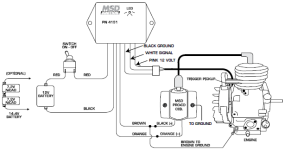
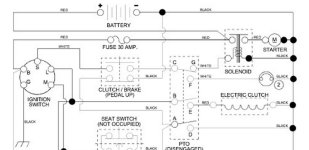
One of the first place I would look is the regulator. A Kawasaki engine uses a different regulator than the Briggs. It sounds like the person that did the engine swap tried to use the Kawasaki wiring for the Briggs. I don't think this is going to work. I have attached two wiring diagrams for the 21 horsepower Briggs engine. Check the wiring on your system and see if it is close.
 

Attachments

  • MSD-Briggs-StrattonTecumseh-Ignition-System-Wiring-Diagram.png
    MSD-Briggs-StrattonTecumseh-Ignition-System-Wiring-Diagram.png
    28.5 KB · Views: 3,973
  • unledml.jpg
    unledml.jpg
    63.5 KB · Views: 5,521
/ Changed motors NEED wiring HELP!
  • Thread Starter
#20  
Thanks LD1, I connected the loose wire to the battery and it seemed to work fine, for about an hour, then the electric clutch just quit. i checked the volts on battery and it is down to 8.20. recharged battery, reading 13.80 volts, mowed for about 30 minutes and the same thing happened, clutch quit! Would it be possible the something wrong with the clutch? If so, how could i test it. I set the air gap to .10, but not sure if thats correct. This has a 21 hsp briggs so i dont know the correct air gap. I called a shop and he could not or would not tell me without taking it to him, and I'm sure for a service charge. Can I get some help?
 
 
Top