chaining down your equipment

/ chaining down your equipment #1  

newengland mower

New member
Joined
Aug 14, 2011
Messages
1
i work for a tree co in new england we use a asv rc 100 what ways do you guys chain down your machines
 
/ chaining down your equipment #2  
If you Google DOT regulations for chaining down loads, the very first hit is Cargo Securement Rules - Federal Motor Carrier Safety Administration. Your individual States might have different requirements.

It's all well and good to ask what others do, but you have to remember, what counts in the end when you get right down to the nitty gritty is what the Regulations say.

The thread "Hoe tips on Mini van .fatal" is the perfect example of why you want to meet all the Regulations regarding restraining cargo. You can bet the Authorities will be looking at how that TLB was secured and if charges will be levied against the driver for having an unsecured load. An even more salient point is that if the TLB was not chained down properly, would the accident have been as severe and resulted in the injuries and death if it had been?
 
/ chaining down your equipment #3  
Yep, gotta do the chains correctly. Can anyone sum that up in a few sentences? I also think that a discussion of the best way to attach the chains to the machine would be interesting. I don't know if the regs tell you what kind of hooks or tie down points you use on each machine. My ASV does not have anything that looks like official tie down points but it has two holes in the underside of the rear frame on each side of the machine. So in the rear I hook the chain into the two holes. The difficulty I've always had is how to attach chains to the front of the machine when the bucket is installed. If you want to attach to the frame you have to find a way over or under the bucket to the frame. It just never seemed like a good idea to attach to the bucket or the loader arms since both of these can move around a bit if the bucket or loader cylinders leak down. I would be interesting in knowing if there are specific requirements or if anyone has any good ideas on how to properly secure the front of a skid loader.
 
Last edited:
/ chaining down your equipment #4  
Any equipment we use we chain (2) in the rear and pull the machine forward to take any slack out, then chain (2) and ratchet binder forward snug. Keep in mind if you're using chains that you feed through a metal loop or something and connect back onto itself with a grab hook you are loosing a lot of strength in the chain and creating a week spot. The best you can do is figure out where you want to tie down to and make some specific chains just for tieing the machine down, made out of a minimum of grade 70 transport chain. Sometimes sling hooks work the best if you have large loops you can hook onto instead of running the chain through and using a grab hook and hooking the chain onto itself. Keepign the chain in one straight line will retain its full load capacity. Many breaking tests for chain and 98% of the time using a grab hook you will break the chain link the grab hook is hooked onto, or it will break in the loop using the grab hook method, usually because the loop is too tight or the chain rests on a relatively sharp surface. You'll need 4 on the machine legally and usually they require a side to side chain for a backhoe if so equipped. I would prefer going over the bucket than any other way.
 
/ chaining down your equipment #5  
There are three "rules" I go by, they may, or may not be acceptable in the eyes of the law.

They ASSUME you are using proper "Transport" grade, proofed chains and not some cheap hardware/discount store crap.

Machine under 5,000#

1) One chain at each end
2) Chains secured THRU something (eyelet, frame etc)
3) One chain for each additional item (shredder, bucket etc)

Macine over 5,000#
1) Two chains each end, CROSSED
2) Chains secured TO something (frame, eyelet - loops ok)
3) One chain for each additional item (shredder, bucket etc)
 
/ chaining down your equipment #6  
Everything requires the use of a 4 pt. tie down, meaning 4 seperate chains. Its the law here and im sure its common sense anywhere else its not.
 
/ chaining down your equipment #7  
Everything requires the use of a 4 pt. tie down, meaning 4 seperate chains. Its the law here and im sure its common sense anywhere else its not.


Where is "here"

Mace posted the DOT rule link and 4 points starts at 10k

I do agree with the 4 point idea and use it myself when practical bu some smaller machines have no way to achieve that.
 
/ chaining down your equipment #8  
Not "everything", no motorcycle does ;)

The general rule (law) is that the capacity of the chains must be equal to or greater than the weight of the equipment it is securing. There are weight requirements for 4pt securement, but I don't know exactly what they are.

Obviously, 4pt securement is "best", but also total overkill for light loads.
 
/ chaining down your equipment #9  
As a former Steel Hauler(coils mainly), the thought of only 2 securements on a rolling load scares the crap out of me. If one securement breaks, or just loosens in transit...........ya now have loose load on your butt.

Overkill to use 4 securements...............I don't think so.
 
/ chaining down your equipment #10  
i work for a tree co in new england we use a asv rc 100 what ways do you guys chain down your machines

I hauled a NH TD95D with 820TL Loader from Hagerman, NM to St. Ignatius, MT through the first major snow storm of the winter in the NW. This is how I hooked it up. The tractor never moved even when I blew a tire on Raton Pass.
I used 3/8" x 14 ft chains on all four corners. I cut moving pads from HF to wrap aroud the chains so it wouldn't gouge the rims and wear the paint off. I used a couple of old tires under the bucket to elimate chaffing. I opened the rear window and placed a moving pad on the window and then closed the window on the pad trapped in the window frame to prevent glass breakage from flying stones. (The tractor was backed on to the trailer and the cg of the tractor was parked over the the point on the trailer that met the truck's rear axle load rating as best I could estimate them.) I also taped the exhaust over with duct tape to prevent the turbocompressor from windmilling without an oil supply to it's bearings.
The tractor came through with flying colors as I drove through freezing fog in Wyoming and below zero temperatures in Montana on glare ice covered highways that should have been closed. The driver (me) was sure glad to get home through all that bad weather.
 

Attachments

  • IMG_0553.jpg
    IMG_0553.jpg
    623.3 KB · Views: 4,979
  • IMG_0548.jpg
    IMG_0548.jpg
    436.4 KB · Views: 1,620
Last edited:
/ chaining down your equipment #11  
I hauled a NH TD95D with 820TL Loader from Hagerman, NM to St. Ignatius, MT through the first major snow storm of the winter in the NW. This is how I hooked it up. The tractor never moved even when I blew a tire on Raton Pass.I used 3/8" x 14 ft chains on all four corners. I cut moving pads from HF to wrap aroud the chains so it wouldn't gouge the rims and wear the paint off. I used a couple of old tires under the bucket to elimate chaffing. I opened the rear window and placed a moving pad on the window and then closed the window on the pad trapped in the window frame to prevent glass breakage from flying stones. (The tractor was backed on to the trailer and the cg of the tractor was parked over the the point on the trailer that met the truck's rear axle load rating as best I could estimate them.) I also taped the exhaust over with duct tape to prevent the turbocompressor from windmilling without an oil supply to it's bearings.
The tractor came through with flying colors as I drove threough freezing fog in Wyoming and below zero temperatures in Montana on glare ice covered highways that should have been closed. The driver (me0 was sure glad to get home through all that bad weather.
Another scenario that makes a person sure that 4 securements on a rolling load is time well spent.
 
/ chaining down your equipment #12  
According to the rules, front end loaders also need a seprate securement.


"b.Preparation of equipment being transported.
1.Accessory equipment, such as hydraulic shovels, must be completely lowered and secured to the vehicle.
2.Articulated vehicles shall be restrained in a manner that prevents articulation while in transit.
"
 
/ chaining down your equipment #13  
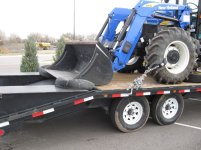
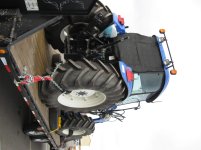
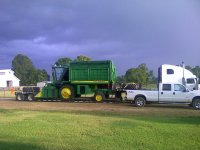
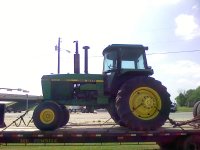
Here is a few pics of equipment i haul. I usually use the 4 point tie down after paying a $350 fine. The last is my fuel and water trailer.240.jpg

102.jpg

174.jpg
 
/ chaining down your equipment #14  
According to the rules, front end loaders also need a seprate securement.


"b.Preparation of equipment being transported.
1.Accessory equipment, such as hydraulic shovels, must be completely lowered and secured to the vehicle.
2.Articulated vehicles shall be restrained in a manner that prevents articulation while in transit.
"

I have never seen one restrianed before, regulation or not, and the Colorado State Trooper that told me my tire was blown didn't say anything about the loader not being restrained either. I think the reg is for trackhoe, backhoes, not loaders but maybe not.
 
/ chaining down your equipment #15  
I have never seen one restrianed before, regulation or not, and the Colorado State Trooper that told me my tire was blown didn't say anything about the loader not being restrained either. I think the reg is for trackhoe, backhoes, not loaders but maybe not.
According to the post above yours, the extra chain and binder may be cheaper, LOL


EDIT: I dunno, the regs say "hydraulic shovel", I just took that to mean a loader also. It is hydraulic, and used as a shovel.

Back in my logging days, we always put an extra chain on dozer blades, front buckets, backhoes, and even skidder blades.
 
/ chaining down your equipment #16  
According to the post above yours, the extra chain and binder may be cheaper, LOL


EDIT: I dunno, the regs say "hydraulic shovel", I just took that to mean a loader also. It is hydraulic, and used as a shovel.

Back in my logging days, we always put an extra chain on dozer blades, front buckets, backhoes, and even skidder blades.
let me tell you the extra chain and binder will not only save you money but alot of time. i was on the side of the road for 3 hours while the trooper did a full dot inspection. i walked away with 950 dollars worth of fines that day all because he saw i didn't have enough chains on my tractor. 350 for the chain, 200 for fire ext not properly mounted, 300 for no log book, and 100 for no gvwr sticker on trailer. he was driving 20 mph in the emergency lane letting people pass and he pulled out behind me, then passed me, then got back in emergency lane and waited till i got around him and pulled me over. so the more tie downs you have the better.
 
/ chaining down your equipment #17  
Just to throw this out there but I thought I remember reading that a binder is required in each tie down point. The exception being if the operator of the truck can move the equipment (jump on the tractor and drive it forward or reverse). I think it was written because many people tie down the front or rear and then move the tractor to tighten the chains up before tying down the other end. If the chain loosens along the way the operator must be able to tighten the load back down.

The loader needs to be tied down however I've never seen it enforced and I'm not sure what the weight limit point is where it kicks in. However, and it happens more often than people realize, I read the news a couple of years ago about a trucker who ran into a bridge because the loader he was hauling raised it's bucket up. After loading it they left the engine idling because of the cold temps and as it hit bumps it just kept lift the loader until. The news report said that the operator was cited for not tying down the bucket.

Just remember it's usually cheaper to buy a few more chains than find out that you needed one more. Also I prefer the ratcheting binders and this style.
152981_lg.jpg

The regular lever style binders can pop free if the chain gets even the slightest but of slack making things much worse.
 
/ chaining down your equipment #18  
I think you can find the federal standards here.
Electronic Code of Federal Regulations:
Down towards the bottom there's a section call "protection against falling and shifting cargo".

I did find this "(b) Preparation of equipment being transported. (1) Accessory equipment, such as hydraulic shovels, must be completely lowered and secured to the vehicle." under the 10,000lb and larger equipment. So hydraulic shovels is just an example.
 
/ chaining down your equipment #19  
Further to the recent incident On I-495 in Mass. in which a National Grid truck pulling a 580 Case lost it, I went by the scene this afternoon and the State Police were back out there I assume checking things out again. One of the news photos by the way showed a binder still attached to the 580. This will be interesting as to a final determination. You can bet national Grid has nothing but first rate equipment. As to comments on improper tongue weight, I can't see how you can have that when you are talking about a 10 ton tag trailer that is set up for a TLB. Its not like you have a long deck that lets you move the machine too far forward or too far back.n One eye witness said the driver made a "sudden lane change" but we shall see. Most obvious thing could be that it was NOT properly chained down-and again, given the fact this was National Grid, I find it hard to believe good procedure was not followed.
 
/ chaining down your equipment #20  
I haul my ASV PT100 around almost daily. I use 4 Grade 70 chains about 5 feet long. One end has a grab hook the other a slip hook. I hook 2 chains on the front head, normally the Fecon head and then the other end to the trailer and back up to tighten or ratchet binder. On the rear I use (2) 3/8 - 1/2 inch binders on the saftey rings and a chain to the trailer. 4 points of contact, the chains (and hooks) are of the correct rating...the only grey area is the front is hooked to the attachemt (the Fecon mulching head) which if 2 hydraulic cylinders broke or leaked would provide slack. I am waiting to get called on this one. There is a frame loop hook on the fron tof the ASV but it is hard to get to.
I have a mark on the trailer so I know where to allign the machine for the right weight distribution. My machine is about 12,500-13,000 pounds and I use a low boy 14k loadmaster 18 foot bumper pull or a Featherlight STL 24 foot gooseneck.
 

Marketplace Items

LMC Ag 3pt 300 Gallon 54' Boom Sprayer (A60462)
LMC Ag 3pt 300...
2014 BMW 5 SERIES 4 DOOR CAR (A59906)
2014 BMW 5 SERIES...
KJ K4020 40'x20' Carport Shed (A60463)
KJ K4020 40'x20'...
500BBL WHEELED FRAC TANK (A58214)
500BBL WHEELED...
2 new 8'' Pallet fork extensions (A61567)
2 new 8'' Pallet...
2019 John Deere Z930R (A60463)
2019 John Deere...
 
Top