California Drought

/ California Drought #181  
Didn't you know: "All the gold in California / Is in the bank in the middle of Beverly Hills / In somebody else's name. "

Just kidding, I am sure there is plenty of good color left to find
 
/ California Drought #182  
So.... I'm just sitting here reading all this and wondering what the issue was with using the emergency spillway. So here are some facts, the dam is an earthen dam, I.e. Dirt and rock filled, not solid concrete. The emergency spillway is built right on top of this earthen structure, by the same outfit that built the spillway on top of a rock base. I did a search to see about the geology of the ground the dam was built on and really found nothing. Many people are using the term bedrock. I think that is an assumption that may not be correct. In mountainous areas the term granite is used as the bedrock is usually thrust up. I don't see much granite around. I see a lot of dirt.

Now I understand why they don't want to use the emergency spillway.

If it's anything like the ones in Texas, there is no "choice" involved. When the dam pool reaches a certain level, it runs over. The only control is how much water they can run through the normal operations to keep the pool below spill over and the inflow has exceeded the outflow capabliltiy of that.
 
/ California Drought #183  
No limestone.

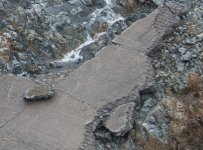
spillwayRock.jpg

Take a look at the photo above. It comes from the Metabunk web site, about half way down the cited page. It shows the bottom of the hole in the spillway after the first time DWR stopped the water flow. The stone is gray, not green, like the serpentine in this area. To me, that makes it limestone. I say this for a few reasons:

I live on the bank of the West Branch of the Feather River, upstream from the dam site, and both green serpentine and limestone can be found in abundance under my property. Bands of these limestone outcroppings can be observed in the canyon wall from the bridge that crosses the West Branch a few miles closer to the dam than my home. A marina nearby is named Lime Saddle, and back in the '20s limestone was mined and converted to cement in kilns that can still be found downslope from my property. Unfortunately, my well is drilled into that limestone, and as a result the harness of the water is very high.

When the serpentine around here gets wet, it turns dark green. Since the photo was taken shortly after the water was shut off, it is reasonable to conclude that the rock shown is wet. Another photo located closer to the top of that same Metabunk page shows water dripping off the broken spillway concrete and two workers in the hole, one of them in full raingear. The rock in both photos does not show the dark green color that is characteristic of the serpentine in this area. It's gray, same as the limestone on the canyon wall when it gets wet. It's been wet a lot this winter, and I pass over that bridge and look at it every time I head into town.

Very likely there is serpentine in the area that the dam was built, but I don't see any in the photo. It's limestone.

Somewhere is a geologic survey map of the Oroville Dam area, but I've been unable to find it online. I did find one for the Auburn Dam, and areas of serpentine are clearly marked.

But what difference does it make what the rock is for the purposes of this discussion? The original concern was that the spillway was built on earth fill, which would rapidly erode back to the reservoir once the concrete broke. That is clearly not the case, so perhaps we can come to agreement over that and move on?
 
/ California Drought #184  
... I am sure there is plenty of good color left to find
All the easy stuff is in ingots by now. The last large scale gold mining is in central Nevada (Carlin vicinity) using huge earthmoving equipment and barely recovering more than the cost of of the earthmoving. I know of a large concrete/asphalt supplier that is likely the largest gold producer in California - but the gold is a byproduct of his refining old dredger tailings into washed sand/gravel for paving material. (article)

Gold mining is a gamble that the return exceeds the cost of operation. I joke that our hobby mining was profitable if you're talking about direct daily operating cost, ie the gas used by the 5hp floating pump, but a real cost analysis would result similar to trout fishing where each trout costs $ thousands if you include the specialized gear, the 4x4 needed to get in there, abandoned road clearing, feeding the crew (family & guests) and other related costs a commercial operation has to consider for a cost analysis. We knew an old miner up there who over a lifetime likely didn't match welfare-level income from his hard work. His regular job down in Oroville (Caterpillar operator) supported his mining hobby.
 
/ California Drought #185  
View attachment 498548
The original concern was that the spillway was built on earth fill, which would rapidly erode back to the reservoir once the concrete broke. That is clearly not the case, so perhaps we can come to agreement over that and move on?
Agree.

The spillway isn't on earth fill, its on rock that didn't erode when the Feather River cut down and made its canyon.

That photo looks to me like ancient laminated something, with white (quartz?) intrusion. I too looked for geology info before posting, found nothing.
 
/ California Drought #187  
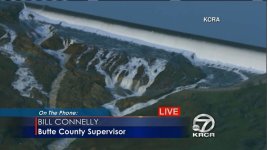
Looks like the emergency spillway is eroding and could fail (causing the top 30 feet of the emergency spillway to fail). An evacuation has been ordered for areas directly downstream.
DamErosion.jpg
Due to the rock outcropping under the emergency spillway, this cannot cause the dam itself to fail, but dropping 30' at once will not be good.
Oroville Dam Spillway Failure | Page 4 | Metabunk

Aaron Z
 
/ California Drought #191  
Evacuate and hope for the best. Texas will sell you electricity but you have to pay this time...
 
/ California Drought #194  
23 million people get water from the Oroville dam...

The area under the dam has a lot of low lying sections and 100k have been ordered to evacuate.

The aerial views show traffic backed up for miles.

Wondering if they couldn't use both sides to evacuate like they do in Hurricane areas?

More rain forecast later in the week.

Optimal fill capacity is around 70% due to seismic concerns... it is over 100% now.
 
/ California Drought #196  
Try this site. Web Soil Survey
Draw out an area of interest and use soil data explorer.
I've tried to use that twice this evening but either it doesn't have any soil data (its too steep and rocky for farmland) or I'm missing something. Did you get it to work? The address there is Oroville Dam, CA (not visitor center). It centers a satellite photo there, but there's nothing but instructions in the data box that says 'your result will appear here'. What don't I know?
 
/ California Drought #197  
I've tried to use that twice this evening but either it doesn't have any soil data (its too steep and rocky for farmland) or I'm missing something. Did you get it to work? The address there is Oroville Dam, CA (not visitor center). It centers a satellite photo there, but there's nothing but instructions in the data box that says 'your result will appear here'. What don't I know?
Try the state and county tab.
I just entered Butte county California and then zoomed in on the lake dam. Drew a AOI around the dam area I drew was about 800 acres. Went to soil map and found a 155 acres of dam area. The failed primary spillway is built on 2 soil types. 553 & 554. Both are Dunstone-Loafcreek. Just different slopes. Although it seems the failure happened close to the land classification switch. 554 shows bedrock at 15-47 inches. With a gravelly loan above it. First restrictive layer is at 10-20 inches as a paralithic bedrock and a lithic bedrock at 20-40 inches.

Now I'm not a soils engineer so some of what I wrote I can't explain. But it seems like there's not a lot to erode before bedrock. Which should mean it'll look really nasty real fast but then stabilize.

I hope they are wrong about the emergency spillway and everything is just precautionary.
 
/ California Drought #198  
Wow. I don't know anything about concrete, but retired from Caltrans (auditing contractors mostly) so I'm interested in this stuff. In my (uninformed) opinion the contractor there cheated and that looks like substandard concrete base beneath the spillway surface. The only time I've seen similar is third-world sidewalk that disintegrates after a couple of years. Do we have a civil engineer or concrete lab tech here who can support/refute this theory?

The engineers on site think the ground dried out and shrunk during the drought, leaving the concrete unsupported.
 
/ California Drought #199  
The regular spillway problems are no big deal. Yes, there will be more damage to it if they keep using it, and it is severely damaged, but they must keep using it and it's failure doesn't threaten the dam.

The bigger issue is the emergency spillway. As the water pours over the top it erodes the sloping hillside that the water pours onto. The parking lot next to the emergency spillway is also overflowing down the same hill.

The cascade of water is cutting deeply into the dirt slope and the cut is undercutting backward and upward toward the emergency spillway. It appears to be just mountain dirt. If this undercutting undermines the emergency spillway, it will fail and open up a port to the lake from underneath. Then the erosion from lake water will cut a channel that will begin to drain the lake. That will be uncontrollable and devastating.

They are currently sandbagging (with some kind of giant bags filled with rocks) the undercut to try to stop it as the regular spillway is open for business and getting the emergency overflow stopped.

No big deal how much damage occurs to the regular spillway as long as it can lower the lake level and I read they have increased the flow to about 100,000 cfs to do just that.

Early on in the regular spillway failure, there was a lot of mud being scoured out and flowing down into the river. Then the water cleared up and they announced the cut had reached "bedrock". Whatever that material is, it's not just soft dirt and it's much harder to cut. That's reassuring and will allow them to open the gates for max flow to save the emergency spillway from being undercut.

Overall, it's a poor design where an overflow can cut soft ground and lead to a catastrophic failure.

If there is a major failure it probably won't be for another week or two. By then everyone will be back in town!

This is going to be a very expensive re-design and fix. The scale of it is really impressive. That spillway looks small in pictures, but it is huge in person.
 
Last edited:
/ California Drought #200  
The engineers on site think the ground dried out and shrunk during the drought, leaving the concrete unsupported.
That makes sense. I think the photos we saw of them a year or so ago inspecting minor water coming up from beneath, indicate there might also have been erosion below, leaving it unsupported over a void.

Then - another theory that would be interesting to investigate: over on Metabunk (referenced above) one poster declared he understood standing waves in electronics and electrical transmission, said similar physics can occur in fast-moving water, and he speculated this may have caused unanticipated stresses over an unsupported portion of the spillway. So the design may have been sufficient to span a void but before considering the added uneven stress of standing waves in the water channel. Interesting theory. I'll be interested to see if we hear more about this.
 

Marketplace Items

CATERPILLAR 108" WHEEL LOADER RAKE (A52707)
CATERPILLAR 108"...
UNKNOWN  500BBL FRAC TANK (A58214)
UNKNOWN 500BBL...
2014 Vermeer Vac-Tron MC533SDT Heavy Duty Vacuum Trailer (A60352)
2014 Vermeer...
JMR mini trailer mover attachment (A61567)
JMR mini trailer...
2016 Chevrolet Tahoe SUV (A60352)
2016 Chevrolet...
2009 VOLVO VNM 300 6X4  T/A DAY CAB TRUCK TRACTOR (A59906)
2009 VOLVO VNM 300...
 
Top