Calculating Your Predicted Rollover Angle

/ Calculating Your Predicted Rollover Angle #21  
DarkBlack,

You are promoting a popular misconception.

It is not until the uphill rear wheel leaves contact with the ground that a pivoting front axle is required to move about it's pivot. Regardless of the degree of tilt. After that, the inside wheel is permitted to lift the full angular displacement provided for by the axle pivot before any resistance to further tipping will be obtained from the front wheels. I'm quite confident, that on a steep incline, that resistance will come much after a roll over is assured. On flat ground, using only cornering forces (roll) things will be much different.

It is true what you say that calculations taking into account momentum and inertia are more than complicated, but if I have read the OP correctly, this rough order of magnitude calculation is based on static conditions. Fair warning was included in the text regarding the many uncontrolled variables.

A triangle or a rectangle matters not one bit on the roll over angle based on the original assumptions.

And that is why tricycle steering gear is not more prone to tipping than a "conventional" front axle. (Assuming simple conditions)

Loaders screw up the CoG determination to no end! But a load on the back only shifts the fore and aft CoG closer to the wide rear tires. The calculation point.

Simplified, If the lateral CoG is allowed to move outside of the support plane, over it goes!

ps, I have done no work to confime the correctness of the maths, just going by the text description.

cheers

The facts I wrote are neither popular, nor are they misconceptions.

CG means nothing in calculations without factoring your roll axis, which roughly connects your front/rear roll centers. His calculation assumes the rear roll center to be a couple inches in on the rear tire ( close enough) since it's a ridged rear axle, but he didn't figure out the front roll center. His math assumed the front RC to be the same as the rear and IT IS NOT. The front roll center is at the axle pivot point. So draw a line from that point down and back to the bottom of the rear tire, and there is your roll axis- triangle shaped and rising to the front as I said before.

Still having a hard time with the tech, here's a couple of easy examples:

1) Stand a ball point pen on end on your table( table is front axle). It has a centered CG, and a pivot point in the middle like a tractor front axle. Is it stable?

2) Replace your fixed rear tractor axle with a free floating pivot axle like the front. Why did it just flop over on you?
As it flops over, is the CG moving toward the lower side wheels?

3) lift up on a side of your tractor and measure the force it took to lift the rear wheel off the ground. Now block your front axle solid with the frame, and repeat test, lifting front and rear wheels off the ground. Same? Different force?

Let me know what you figure out;)
 
/ Calculating Your Predicted Rollover Angle #22  
Hello All,

Here is the bottom line...the sideways rollover angle for my Kioti DK40 Hydro FWD, with FEL positioned with an empty bucket parallel to the ground, and Tartar 6 bush hog - and in all likelihood most similarly equipped stock utility class tractors - is above 40 degrees.
Rhino
How have you accounted for the longitudinal position of the CG? Due the front center pivot the tractor gets more tippy the more the CG is moved forward -- a real issue with a FEL. Your calculations would be realistic only if the longitudinal CG is at the rear axle.
larry
 
/ Calculating Your Predicted Rollover Angle
  • Thread Starter
#23  
The facts I wrote are neither popular, nor are they misconceptions.

CG means nothing in calculations without factoring your roll axis, which roughly connects your front/rear roll centers. His calculation assumes the rear roll center to be a couple inches in on the rear tire ( close enough) since it's a ridged rear axle, but he didn't figure out the front roll center. His math assumed the front RC to be the same as the rear and IT IS NOT. The front roll center is at the axle pivot point. So draw a line from that point down and back to the bottom of the rear tire, and there is your roll axis- triangle shaped and rising to the front as I said before.

Still having a hard time with the tech, here's a couple of easy examples:

1) Stand a ball point pen on end on your table( table is front axle). It has a centered CG, and a pivot point in the middle like a tractor front axle. Is it stable?

2) Replace your fixed rear tractor axle with a free floating pivot axle like the front. Why did it just flop over on you?
As it flops over, is the CG moving toward the lower side wheels?

3) lift up on a side of your tractor and measure the force it took to lift the rear wheel off the ground. Now block your front axle solid with the frame, and repeat test, lifting front and rear wheels off the ground. Same? Different force?

Let me know what you figure out;)

Hi DarkBlack (and other interested posters),

I think I am grasping the concept of a roll axis connecting the front and rear CG's. For purposes of discussion, let's imagine that if the front wheels are as wide as the rear, which they almost are stock, and the weight of the tractor and implements (FEL, bush hog) result in a CG that is equidistant between the front and rear axle and the same height above the ground. So this is a balanced CG.

In this balanced CG distribution, wouldn't my earlier post about the front axle hitting the stops be accurate? The static roll angle, even if the front axle pivots, would be about the same as my calculations? I say this because the pivot angle of about 20 degrees is less than the static roll over angle which I think we could at least agree is over 30 degrees. When it hits the stops the front axle behaves like the rear axle. Once those stops are hit we should be able to forget about there ever being a pivoting front axle. If we can agree on this, then we should be able to envision the effect of a lower or higher front axle CG. That imaginary "roll axis" line connecting the two CG's will go up or down, depending as you point out with the position of the FEL and the FEL load.

Spyderlk,

Your question about longitudinal position of the CG may be related to the point DarkBlack is trying to make, but I didn't attempt to calculate the forward or aft rollover (the tractor going over backwards) because I don't think the longitudinal CG in the configuration I have while bush hogging (FEL arms parallel, empty bucket two feet off the ground, bush hog and loaded rear tires) has strayed too far from about the middle of the tractor.

Best,

Rhino
 
/ Calculating Your Predicted Rollover Angle #24  
The facts I wrote are neither popular, nor are they misconceptions.

CG means nothing in calculations without factoring your roll axis, which roughly connects your front/rear roll centers. His calculation assumes the rear roll center to be a couple inches in on the rear tire ( close enough) since it's a ridged rear axle, but he didn't figure out the front roll center. His math assumed the front RC to be the same as the rear and IT IS NOT. The front roll center is at the axle pivot point. So draw a line from that point down and back to the bottom of the rear tire, and there is your roll axis- triangle shaped and rising to the front as I said before.

Still having a hard time with the tech, here's a couple of easy examples:

1) Stand a ball point pen on end on your table( table is front axle). It has a centered CG, and a pivot point in the middle like a tractor front axle. Is it stable?

2) Replace your fixed rear tractor axle with a free floating pivot axle like the front. Why did it just flop over on you?
As it flops over, is the CG moving toward the lower side wheels?

3) lift up on a side of your tractor and measure the force it took to lift the rear wheel off the ground. Now block your front axle solid with the frame, and repeat test, lifting front and rear wheels off the ground. Same? Different force?

Let me know what you figure out;)

I have no trouble with roll centers, having had several cars on the track.

An axle with zero roll stiffness is just that. Zero.


The solid rear axle is also just that, it's roll center is at the axle. and the CoG is supported by the wheels. Done

The CoG goes over the plane of support, and the system over turns.

If you are having a hard time with the tech, here is an easy example

Take the front axle off, balance the rig with rear counter weights

Let me know what you figure out!

cheers
 
/ Calculating Your Predicted Rollover Angle #25  
OK

My apology. I need not be so antagonistic. Ego is a difficult companion.

Let me give some example of the logic envolved in determination of roll over angle with consideration of a center pivot solid front axle.

Firstly, is it obvious that the front axle pivot will not be asked to do anything until one rear wheel has left the ground plane? (this is the same as rolling into a depression or a rise in terrain, but since the tractor is not moving, rolling into a bump is not considered.) The ground plane of the tractor is determined by the line drawn between the two contact patches of the rear tires. And the front axle will not deflect until something upsets the rear axle from that plane. We are not considering fore and aft tip overs IIRC.

OK with that, please visualize this example.

Place the tractor in a sturdy box and secure it solidly by straps over, around, and through the rear wheel rims that positively locate the rear tire contact patches. Place a support block under the box a point midway between the front tire contact patches.

Now, Manipulate the box in such a way as to lift one side to achieve the attitude that might be experienced on sloping ground. How much will you need to tip the box before it overturns?

If the rear end is fastened securely to the box, does it matter if the front axle is free to pivot?

Does the tractor within the box start to tip over before the box does? (Now that is an interesting consideration) Note : in this theoretical visualization, the box size is the same as the outer most dimension of the two rear tires and the mid point between the front tires, no larger.

Without knowing the content of the box, what determinations could be made that will help in understanding the roll over angle of the box? Will CoG be useful?

Will Roll center of the contents be useful?

Take this to some extreme.

What if

The front axle were pivoted at the same height as the rear tire contact patch? (front axle removed for shipping and the pivot fitting pinned to a shipping block'=_)

The front axle were the same track width as the rear and wedged ridged? (requred condition when blocking the tractor to be split)

Both front and rear wheel sets were removed and the tractor was flat on the deck?

Stand the box on end and repeat the tilting experiment.


Now In juxtaposition, release the rear wheel tie downs, but constrain the tractor from sliding within the box. Counter balance all down loading of the rear wheels., but do not raise the CoG.
The entire tractor is free to tip about the front axle pivot. What happens at the first tipping of the box? Do both rear wheels stay unloaded?

Recall, this is a static condition, not dynamic.

At what angle must the box be tipped in order to overturn?


CoG is very important in tip over calculations, and a loader can sure mess with things. rear weight is your friend

Dynamic situations are more complex than static situations.

with that, Three point determine a plane ;-)


Cheers
 
/ Calculating Your Predicted Rollover Angle #26  
Spyderlk,

Your question about longitudinal position of the CG may be related to the point DarkBlack is trying to make, but I didn't attempt to calculate the forward or aft rollover (the tractor going over backwards) because I don't think the longitudinal CG in the configuration I have while bush hogging (FEL arms parallel, empty bucket two feet off the ground, bush hog and loaded rear tires) has strayed too far from about the middle of the tractor.

Best,

Rhino
Im talking side roll. Due the center pivot, the front offers no resistance to roll until the last minute. That resistance comes into play only when the tractor is leaning ~10° more than the slope causing the roll. A CG forward of the rear axle causes the roll to start sooner, but the extra weight to the front may allow the front to arrest the roll. Very scary Id say.
larry
 
/ Calculating Your Predicted Rollover Angle #27  
Rhino, "A" for effort, but I think you and your physics major friend missed a major parameter. I posted on this subject over a year ago.

"The front axle assembly is normally mounted to the frame by a free moving pivot point. Any widening aided tip protection from, say, rolling from running crosswise on a slope, will have zero to little added benefit from widening the front wheels. That would be the case until you hit the pivot limit of the front axle, but if you lifted the machine to that point, you will probably be rolling over anyways. "

You and your friend missed this huge game changer. You/he treated the tractor calculations as a rectangle shape. What your really have is a triangle, up to tip over angles of the front axle's pivot's limit. When you physically hit that rotary stop limit and it changes to a rectangle, the momentum alone throws your pre-calculations out the window. Also, with the loader ahead of this free pivot, calculating this mass becomes much more complicated.
Sorry for the bad news. I hope this explains why you had such incredibly steep slope angle predictions.

DarkBlack

Rereading your first post, I missed your point.

There is certainly a triangle that needs be considered . My responses (abrasive though they are) acknowledge your description.

I was thrown off when you moved to "the momentum alone" statement, having understood the OPs premises of static conditions with extensive explanation of same.

That "triangular calculation" in no way changes the significance of CoG and the roll over attitude for an axle with infinite roll stiffness.
 
/ Calculating Your Predicted Rollover Angle #28  
Hi DarkBlack (and other interested posters),

I think I am grasping the concept of a roll axis connecting the front and rear CG's. For purposes of discussion, let's imagine that if the front wheels are as wide as the rear, which they almost are stock, and the weight of the tractor and implements (FEL, bush hog) result in a CG that is equidistant between the front and rear axle and the same height above the ground. So this is a balanced CG.

In this balanced CG distribution, wouldn't my earlier post about the front axle hitting the stops be accurate? The static roll angle, even if the front axle pivots, would be about the same as my calculations? I say this because the pivot angle of about 20 degrees is less than the static roll over angle which I think we could at least agree is over 30 degrees. When it hits the stops the front axle behaves like the rear axle. Once those stops are hit we should be able to forget about there ever being a pivoting front axle. If we can agree on this, then we should be able to envision the effect of a lower or higher front axle CG. That imaginary "roll axis" line connecting the two CG's will go up or down, depending as you point out with the position of the FEL and the FEL load.


Best,

Rhino

Rhino, I'll tray to answer some of your questions:
The roll axis connects the front/rear roll centers-not the CG's. CG has nothing to do with them. Where the CG happens to be, has no effect on this example because the frame is not sprung like a car( ignoring tire deflection ). So on a tractor you have a simplified model because it is not sprung. So your rear roll center is the outer edge contact of the bottom tire and the ground, and your front RC is the center axle pivot center. These are the 2 points that the rolling motion will revolve around. Your CG could be anywhere, but you will still rotate around these 2 points. Draw a line to connect these. This is your roll axis.

In a tractor the rear roll center is way below the CG. The front roll center is close to the CG- ( that's another chapter ).
In any case, The tractor rolls on this axis, until it encounters the mechanical limits of the front axle limit stops. This causes the whole tractor to become ridged, which moves the front roll center to the bottom of the front lower outside tire.- which moves the roll axis to a straight line connecting them. This change of course instantly makes the front CG higher than the new roll axes.
Hopefully I've explained it clear enough that you can see this moving roll axis, and use it to tweak your calculations.:drink:
 
/ Calculating Your Predicted Rollover Angle #29  
Rhino, I'll tray to answer some of your questions:
The roll axis connects the front/rear roll centers-not the CG's. CG has nothing to do with them. Where the CG happens to be, has no effect on this example because the frame is not sprung like a car( ignoring tire deflection ). So on a tractor you have a simplified model because it is not sprung. So your rear roll center is the outer edge contact of the bottom tire and the ground, and your front RC is the center axle pivot center. These are the 2 points that the rolling motion will revolve around. Your CG could be anywhere, but you will still rotate around these 2 points. Draw a line to connect these. This is your roll axis.

In a tractor the rear roll center is way below the CG. The front roll center is close to the CG- ( that's another chapter ).
In any case, The tractor rolls on this axis, until it encounters the mechanical limits of the front axle limit stops. This causes the whole tractor to become ridged, which moves the front roll center to the bottom of the front lower outside tire.- which moves the roll axis to a straight line connecting them. This change of course instantly makes the front CG higher than the new roll axes.
Hopefully I've explained it clear enough that you can see this moving roll axis, and use it to tweak your calculations.:drink:

This is just NOT the case.

DarkBlack, You are confused.

Consider the tractor of your description, "rolling about it's roll axis". As the front axle rolls and tilts, what happens to the rear?

NOTHING!

And if the rear can not roll, the front can not roll either! As you have pointed out, the tractor is not on springs!

Back to your "example", Remove the front axle and support the front of the tractor on a pencil tip. Now PUSH on the tractor sideways anywhere!, does the pencil topple and the tractor "tip over" , lifting the inner rear tire and toppling over the side due to the instability of the front end?

NO!

If the brakes are on, and the tractor can not swivel, NOTHING HAPPENS, until the side ways push is strong enough to lift the near side rear wheel high enough to send the CoG over the far side wheel contact point.


Think sensibly man!
 
/ Calculating Your Predicted Rollover Angle #31  
I like buttered toast.

I'm reading these posts absolutely fascinated, head spinning a bit, and then I hit this. Just about laughed my ***** off.
 
/ Calculating Your Predicted Rollover Angle #32  
What Black Dark is describing is exactly true in any case where a rear wheel lifts from the ground prior to tipping over. We have all seen the "Joey Chitwood Stunt Show" trick of driving along with the vehicle tipped up on two wheels.

However, When evaluating the maximum slope that a stationary tractor can keep it's wheels on the ground, that description does not apply.

Simply, if the ground is tipped, the uphill rear wheel leaves the surface at precisely the same angle that causes the entire tractor to tip over. Which is when the CoG crosses over the line of support, which is the down hill contact point on a solid axle.
 
/ Calculating Your Predicted Rollover Angle
  • Thread Starter
#33  
CalG (and DarkBlack),

CalG, I agree with you. I read an article by Chrysler this morning that discussed roll axis and while I admit I don't understand it all I saw nothing that directly related to the tip over angle of a static tractor (or one traveling very slow). All the roll axis depicted were very low - in most case below the axles of low sprung cars. And it was obvious that the concept of roll axis and how it relates to modern car handling is one that a lot of automotive people have trouble understanding.

DarkBlack, the line you pictured from the outside of the downhill rear tire to the center pivot point of the front axle seems fine - I agree that as long as the front axle pivots there is no force on the outside of the downhill front tire. It stays flat on the ground (if we're jacking up a tractor on level ground to find the rollover angle). So maybe the pivot - probably - the pivoting front axle is a design that assists stability - and in particular assist a four wheel drive tractor's traction on a hillside. But my point, and I think it marries up with CalG's, is that when the front axle hits the stops, just as you say, the roll axis shifts to the outside of the downhill front wheel and we're in a situation now - at whatever angle the axle hits the stops, where the front axle behaves like a fixed axle. I'm pretty sure the rollover angle based on the CG moving over the support base is greater than the pivot stop angle - so that pivoting axle won't make a difference to the eventual actual rollover angle.

I also think CalG makes a good point when he says you are talking about a tractor with an FEL loaded, or on a hill, in such a way that the front weight of the tractor lifts a rear wheel. I think I made the observation in my OP that if that happens the tractor might not only roll, but begin swapping ends in the process of the rollover.

Maybe we're talking past each other. Maybe someone has an old scrap tractor, with a pivoting front axle, and a front axle that is wide, not a triangle, who is willing to jack it up. How about we submit this to Mythbusters?

Best,

Rhino
 
/ Calculating Your Predicted Rollover Angle #34  
As a physics major many years ago, I find the discussion interesting, if a bit esoteric. Knowing the slope that a stationary tractor could endure without rolling is interesting, but of little value. After all, that stationary tractor would have had to get to that position by moving.

In any event, the real world is marked by slopes with depressions and rises in them. Effective slope angles essentially change constantly. Add to that the various weights attached to the tractor, and you get a rather vague flip factor. Most of us have endured the agony of finding ourselves on a slope where we are not sure how much more the tractor will take. I am particularly sensitive because I have one of those narrow CUTs and have lifted the rear wheel a few times in the past year. I didn't have to change my underwear, but it is not something I want to do often. To me the secret is to be cautious and slow. By going slow on any significant slope, I give myself time to react. I have found that dropping the FEL and implement seem to immediately halt the roll and pull wheels on the ground. That gives you time to decide on your next action. Usually I have been able to lift stuff a tad and back off the problem slope without difficulty. Turning downhill can be problematic. A friend actually got off and dug some dirt from behind the uphill tires and was able to back out comfortably.

But going slow and wearing your seatbelt is the key. Although I think a spring-loaded outrigger that would pop to your downhill side and lock would be helpful now and again. I just don't have time to invent it.
 
/ Calculating Your Predicted Rollover Angle #35  
As a physics major many years ago, I find the discussion interesting, if a bit esoteric. Knowing the slope that a stationary tractor could endure without rolling is interesting, but of little value. After all, that stationary tractor would have had to get to that position by moving.

In any event, the real world is marked by slopes with depressions and rises in them. Effective slope angles essentially change constantly. Add to that the various weights attached to the tractor, and you get a rather vague flip factor. Most of us have endured the agony of finding ourselves on a slope where we are not sure how much more the tractor will take. I am particularly sensitive because I have one of those narrow CUTs and have lifted the rear wheel a few times in the past year. I didn't have to change my underwear, but it is not something I want to do often. To me the secret is to be cautious and slow. By going slow on any significant slope, I give myself time to react. I have found that dropping the FEL and implement seem to immediately halt the roll and pull wheels on the ground. That gives you time to decide on your next action. Usually I have been able to lift stuff a tad and back off the problem slope without difficulty. Turning downhill can be problematic. A friend actually got off and dug some dirt from behind the uphill tires and was able to back out comfortably.

But going slow and wearing your seatbelt is the key. Although I think a spring-loaded outrigger that would pop to your downhill side and lock would be helpful now and again. I just don't have time to invent it.

I agree with your points. The practical challenge is how to work safely on slopes.

One question I have pondered is whether it makes more sense to turn the wheels uphill or downhill if you feel the tractor starting to tip when moving across a slope. I would guess downhill but wonder if any of you Newtonian physicists can shed some light on the mechanics of such a dynamic scenario.
 
/ Calculating Your Predicted Rollover Angle
  • Thread Starter
#36  
IslandTractor,

If you're moving then turn downhill (unless it is into a pond, etc.). If you turn downhill then centripetal force will offset gravity and might keep you from rolling over. If you turn uphill you'll add centripetal force to gravity and increase the likelihood of a rollover.

Rhino
 
/ Calculating Your Predicted Rollover Angle
  • Thread Starter
#37  
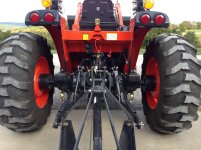
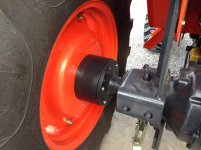
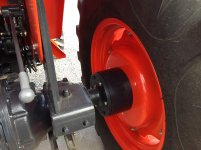
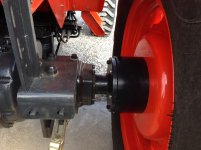
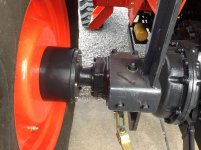
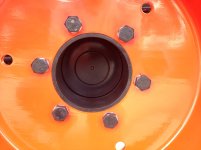
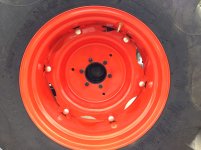
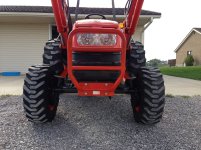
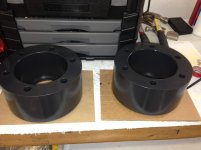
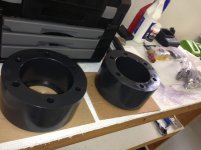
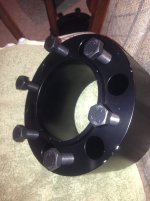
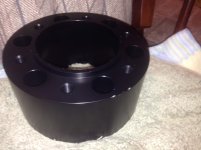
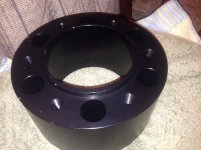
The promised photos with the 4 inch rear spacers.

IMG_0630.jpgIMG_0631.jpgIMG_0632.jpgIMG_0633.jpgIMG_0634.jpgIMG_0635.jpgIMG_0636.jpgIMG_0637.jpgIMG_0640.jpgIMG_0641.jpg
 
/ Calculating Your Predicted Rollover Angle #38  
I'd be a concerned about that 5"? thru-bolt design. You might be luck and It might last forever for you , it might not. Normally you short bolt a spacer from the back to an axle hub and then short bolt the wheel to the front of the spacer, it's a much stronger design. Hitting a jarring bump, could put heavy racking force on those long bolts. Lets us know how it holds up.
 
/ Calculating Your Predicted Rollover Angle
  • Thread Starter
#39  
I'd be a concerned about that 5"? thru-bolt design. You might be luck and It might last forever for you , it might not. Normally you short bolt a spacer from the back to an axle hub and then short bolt the wheel to the front of the spacer, it's a much stronger design. Hitting a jarring bump, could put heavy racking force on those long bolts. Lets us know how it holds up.

DarkBlack,

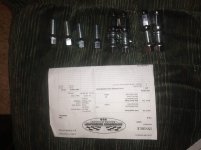
Thanks for pointing out that long bolts would not be as strong. I hadn't given it any real thought. From the beginning of my negotiations with Motorsport-Tech I was informed they would send me all the bolt hardware. When it got here I didn't have an intuitive understanding of how it would all go together. A phone call to Lenny the owner and he explained it to me.

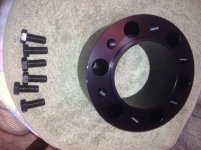
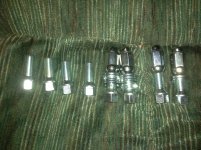
I threw the pictures up in a hurry today. I should have explained how the bolts provided by Motorsport-Tech work. They gave me six stainless steel bolts per wheel to attach the spacer to the hub through drilled out holes big enough for the bolt heads to fit, and six of the black bolts in the photo per wheel to attach the wheel to the spacer. So all the bolts are pretty much the original length of the stock set up. Here they are painted before installation.

IMG_0523.jpgIMG_0524.jpg

And here is me and some of the hardware the day the spacers arrived! The weeds on the hillside have no chance against me now! A close examination shows there are some scratches in the anodizing layer on one of the spacers - in fact there photos were sent to Lenny to show him how they were scratched. This unusual slight damage was from a few of the bolts getting loose in the box - they were in plastic bags which must have torn during shipping. When I mentioned this to Lenny he immediately offered to make me another spacer, which I declined as I was always going to paint them. I was in high obsessive compulsive mode regarding combating any future corrosion, but the small scratches were not going to make a difference to my tractor - which I'm lucky enough to keep in a detached garage. They painted perfectly. I mentioned it in my OP, but Motorsport-Tech impressed me totally with their eagerness to stand behind their workmanship.

IMG_0471.jpgIMG_0472.jpgIMG_0475.jpgIMG_0476.jpgIMG_0477.jpgIMG_0478.jpgIMG_0479.jpgIMG_0480.jpg
 
/ Calculating Your Predicted Rollover Angle
  • Thread Starter
#40  
DKCDKC (and all),

I reread the thread and I also think the comments are interesting. Esoteric knowledge is by definition difficult for most people to understand and we've had posters make valid points, but not always talking about the same situation. It is impossible to confine a discussion of tractor rollover angles to a static situation - and we really shouldn't because they are moving - but you have to start somewhere. With the static angles in mind, then it makes sense to back way off from them because of the variables. My goal here was to enhance safety awareness, not empower folks to take greater risks.

DarkBlack and CalG, methinks, kind of got into a talking past each other discussion. My point, and CalG's, was that for a FLAT hillside - in other words the front and rear tires are on a constant, flat, inclined surface, the roll axis will, by virtue of the tractor tip over angle being greater than the pivot stop angle not be an important factor. The tractor will behave irrespective of the roll axis point for a pivoting front axle.

In my example I talked about (and envisioned without thinking about the pivoting front axle) jacking the tractor up on one side on level ground to see the angle at which the CG would move outside the support base and tip over. And if we did that I now realize, thanks to DarkBlack and CalG, that the front axle would pivot and keep the front wheels flat while one rear wheel went up in the air. So DarkBlack's explanation about drawing an imaginary roll axis is correct. It would initially be the line from the "downhill" rear tire to the center of the front axle, but when the axle hits the stops that roll axis moves downward and "downhill" towards the outside of the "downhill" front wheel. That would be a dynamic effect, but I also don't see it as a catastrophic rollover inducing moment. If the tractor is stable at, say a maximum front axle pivot angle of 20 degrees, and we keep jacking it up to 21 degrees the tractor doesn't roll over. All that happens on a level floor is the "uphill" front tire moves up 1 degree. Now with the front axle is behaving like a rigid rear axle so if we keep jacking up the same side the only variable (ignoring tire deformation, if any, and lack of friction so the tractor slides) affecting rollover is where is the CG? The instant vertical CG exceeds the lateral boundary of the support wheel base the tractor will roll over. And as the math shows, even with a wide variety of vertical CG's, it's pretty high.

I'll even make an additional point about the pivoting front axle now that I've given it more thought. The practical effect of the pivoting action is to lower the tractor's CG by lowering the front of the tractor with respect to where it would remain with a fixed axle. This shouldn't be too hard to imagine - picture two identical tractors except that one has the pivoting front axle. Put them side by side and observe them from the front while one side is jacked up. The fixed axle tractor's front end goes up evenly with the rear end. But the pivoting axle tractor's front end remains level side to side, and lower to the ground, until the pivot stops are reached. At that point front end movement to the side keeps pace with the rear end's upward motion as the jacking up continues. If we kept jacking I think the fixed front axle tractor would tip over before the pivoting front axle tractor would tip over - simply because the pivot has allowed the overall tractor's vertical CG to remain below the fixed axle's CG. If this is a practical effect of a pivoting front axle, which my tractor is probably equipped with because it is four wheel drive and a pivoting front axle allows the front tires to grip better across uneven terrain, then it is an aid to preventing side rollovers.

Anyway, my reply to you is a reply to all - and I'll close by mentioning that while I was in the process of lifting mounded FEL buckets of gravel on level ground my wife thought she saw my rear tire lift a tiny bit. I didn't notice. But I shook some of the gravel out so it wouldn't fall out on the way to the dump site and that lightened the load a bit. And then I carefully drove almost straight down a 10-15 degree grassy hill - FEL first - about 25 times. Slow and steady, and feeling like the loaded rear tires and bush hog back there were going to keep me from tipping forward. And keeping the bucket as low as I could without spilling gravel.

And ready to drop the FEL to the ground immediately if I felt the rear end lifting! The nightmare scenario!

Best,

Rhino
 
Last edited:

Marketplace Items

2016 Dodge Journey SUV (A59231)
2016 Dodge Journey...
excavator trenching bucket- one bucket per lot (A61306)
excavator...
Schulte XH1500 Series 4 15ft Pull-Behind Batwing Rotary Brush Cutter Tractor Attachment (A59228)
Schulte XH1500...
XCMG CV83PD (A53317)
2019 MACK PINNACLE (A55745)
2019 MACK PINNACLE...
RIPPER ATTACHMENT FOR MINI EXCAVATOR (A58214)
RIPPER ATTACHMENT...
 
Top