Not a snowball's chance in hell that loader would have lifted the end of that tree off that building. That looks like a pig hickory. If it is, at that size, we're looking at a tree that could easily weigh as much as that tractor does, or more.Since it's dead, Once it was trimmed down to this I would have seen if the loader would lift the end off the shop just a little and trim more off until maybe it cleared the barn.
Maybe even cut sections out of it to reduce weight more.
You are using an out of date browser. It may not display this or other websites correctly.
You should upgrade or use an alternative browser.
You should upgrade or use an alternative browser.
Bad Day for Pole Barn
- Thread starter KennyG
- Start date
- Views: 39042
More options
Who Replied?
/ Bad Day for Pole Barn
#41
OP

KennyG
Super Member
Not a snowball's chance in hell that loader would have lifted the end of that tree off that building. That looks like a pig hickory. If it is, at that size, we're looking at a tree that could easily weigh as much as that tractor does, or more.
It's an oak and, yes, my tractor couldn't have lifted 1/4 of it. I cut it at about shoulder height, hoping it would drop to the ground and the top wouldn't hit the barn too hard. If I could have safely cut it up by the gutter, as someone suggested, the full weight would have dropped into the wall and probably gone right through it.

tradosaurus
Super Member
- Joined
- May 8, 2017
- Messages
- 6,146
- Location
- Texarkana, TX
- Tractor
- Kubota MX5400 HST, heavy duty bucket, 3rd function, R1 tires (rears filled), 2 remotes
I certainly wouldn't go over to a neighbor and start threatening bodily harm because if a neighbor did that to me I would tell him never to step foot on my property again.That's how you would handle it, "friendly chat about rats"? For some reason I doubt that.
Rats are colony critters. There aren't individual rats just roaming around the countryside looking for a place to live.
They only spread because of over population within the colony. My Brother was the only neighbor close. And my Brother's property was rat infested. Pretty simple.
Of course I have 3 outdoor cats with a few visiting cats that help hunt around my property.
Yup. I did this stuff for a long time. As a tree guy, if I'd have shown up to look at that job, my goal of course is to do it with zero further property damage, which is why I would have brought in a bigger machine. I knew that tree would more than likely hit the side of the building if you tried to do it as you did. As the property owner though, you've got the option to accept further property damage that ultimately will be cheaper than the bigger machine would have been, particularly if you're able to do the repairs yourself. Glad you got it down safely.It's an oak and, yes, my tractor couldn't have lifted 1/4 of it. I cut it at about shoulder height, hoping it would drop to the ground and the top wouldn't hit the barn too hard. If I could have safely cut it up by the gutter, as someone suggested, the full weight would have dropped into the wall and probably gone right through it.


IH3444
Elite Member
- Joined
- Jan 10, 2004
- Messages
- 2,648
Have had huge success with using this. When I got mine it was only 2 bills. ($200) All you have to do is get a line high up into the tree, then you have a lot of leverage. Notch tree, put strain on it with a rope, and pull it into the direction you want.

 www.treestuff.com
Rope puller was $125 with 200 ft rope when I got mine. Paid for itself first time I use it.
www.treestuff.com
Rope puller was $125 with 200 ft rope when I got mine. Paid for itself first time I use it.
 www.treestuff.com
APTA: Air Powered Tree Access
Trusted retailer of gear and supplies for professional arborists at the lowest prices. High quality products from industry leading brands. Free shipping over $100.
www.treestuff.com
Maasdam Rope Puller Kit
The Maasdam Rope Puller Kit is great for pulling trees, logs, vehicles, and other heavy items. Made in the USA.
www.treestuff.com

stevem5215
Platinum Member
- Joined
- Jul 9, 2006
- Messages
- 972
- Location
- Pittsburgh, Pa
- Tractor
- Steiner 420 - Black Craftsman Pro 24hp - Simplicity 48 ZT-2500 - Simplicity Citation XT 61" - Chainsaw CS-5720 - FarmerTec G660 90cc's
In the court of Judge Judy, she would side with you on the neighbor owing for damages. And the reason is because it was dead for a while and the neighbor knows it and is liable. It's not an "act of God" in that case. Which is what the insurance company is looking at. I just had two dead pines removed of which one was right next to the neighbors house. It had been dead for 2 years and was at the point of needing removal due to getting weak. $1500 for two trees over 100ft tall and ground up and hauled away along with a brush pile from Decembers tree that I did that was 100ft and 20" at the base (all my EFCO 20" could handle). The one they did was about 24" and the other about 20". Two truck loads of ground up trees and branches. Nice looking job they did too. I can't complain at all. Even raked the yard afterward and fixed all "divits" of grass. Pros do that kind of thing. Me, I just left it all lol. I am chainsaw certified though by the Pa DCNR state group. A plus IMO.
How did he take care of the problem? I had traps set by his hole all last summer. I don't want to use poison... I have too many animals around. They seemed to have moved by fall.No. My Brother ignored a rat problem. So bad they migrated 1/4 mile to the neighbor's farm. My Brother got adjusted by the neighbor and took care of the problem....

ovrszd
Epic Contributor
- Joined
- May 27, 2006
- Messages
- 33,727
- Location
- Missouri
- Tractor
- Kubota M9540, Ford 3910FWD, Ford 555A, JD2210
Poison. Contained so nothing bigger than a rat could get to it.How did he take care of the problem? I had traps set by his hole all last summer. I don't want to use poison... I have too many animals around. They seemed to have moved by fall.
JONNY BOYYY
Member
- Joined
- May 22, 2022
- Messages
- 40
- Tractor
- KUBOTA 4330
MORE THAN LIKELY YOUR HOME OWNERS INSURANCE HAS TO PAY IT BUT IT WILL THEN BE A CLAIM AGAINST YOU...BETTER TO TRY TO ASK YOUR NEIGHBOR TO PAY FOR IT---SHE DOESNT HAVE TO ,BUT ITS WORTH A TRY
dzldanz
New member
You noticed the tree was dead earlier?
I personally wouldn’t expect any help from the insurance company .
I personally wouldn’t expect any help from the insurance company .
In the USA, which I'm guessing this is, the process may well be different.Yesterday I found a tree on my pole barn. It was actually on my neighbors property. I noticed it was dead last year and thought about suggesting we take it down. It would have been tight to get it between our barns, but I wish we had tried now. I have to call the insurance company but I think I will probably take it off myself since it's hard to get tree services on short notice. It doesn't look likely to roll or twist on me. Since I have a ceiling and insulation, I can't tell if there is structural damage but it looks like one or two purlins might be broken.
View attachment 783725
View attachment 783724
In the UK, it would be an initial friendly chat (hopefully, but maybe not friendly) with your neighbour, and s/he would say that as it was his tree on his/her property s/he would get his/her insurance company on the case, and give you the necessary details to pass onto your insurance company. Then either with or without your neighbour's details and insurance company's details, you would call your insurance company to get them started on the case. It would then be the insurance company's job to sort it out for you. But if friendly neighbour relations existed, it would also be possible to sort it out between you without involving the insurance company. Personally I would still cover my back by ensuring the insurance company was informed but also notified that there may be no need for a claim.
oneal hicks
New member
You insurance co. may be your best bet. I say this because from the picture the roof is bent below the bottom Purlin which means if you do have structural damage it will be the eve strut ( and possibly the Purlin) The Eve Strut is much more detailed than a purlin the eve strut ties the two bays together supports the roof sheet as well as being the component that the top of the wall sheets are secured too. To change the Eve Struy all the wall and roof sheets must be unscrewed if you have the typical vinyl backed insulation it will need to be detached from the eve strut and replaced but on the other hand from the picture you may not have enough damage to go to the expense to replace all this. Oh well just an obersrvation from an old building erector. After all it is you call I hope all goes well for you.
Yesterday I found a tree on my pole barn. It was actually on my neighbors property. I noticed it was dead last year and thought about suggesting we take it down. It would have been tight to get it between our barns, but I wish we had tried now. I have to call the insurance company but I think I will probably take it off myself since it's hard to get tree services on short notice. It doesn't look likely to roll or twist on me. Since I have a ceiling and insulation, I can't tell if there is structural damage but it looks like one or two purlins might be broken.
View attachment 783725
View attachment 783724
when you get ready to clean it up I highly recommend a boom. If you have a Home Depot rental near by you can rent a tow behind one pretty reasonable and take it down in small sections. Just take your time and think before you cut.Yesterday I found a tree on my pole barn. It was actually on my neighbors property. I noticed it was dead last year and thought about suggesting we take it down. It would have been tight to get it between our barns, but I wish we had tried now. I have to call the insurance company but I think I will probably take it off myself since it's hard to get tree services on short notice. It doesn't look likely to roll or twist on me. Since I have a ceiling and insulation, I can't tell if there is structural damage but it looks like one or two purlins might be broken.
View attachment 783725
View attachment 783724
OP
KennyG
Super Member
A quick update. All the wood is cleaned up and I've ordered the replacement metal. Should be here next week. I haven't taken the damaged roofing off yet, so I don't know if the eave purlin is damaged, but if it is I think I should be able to scab in a replacement. Fortunately I have trusses on 4 foot centers, which takes away a lot of the structural concerns with the purlins.
More to come. Silver lining in all this is that, combined with another tree I took down last month, I'm about set to restock the firewood storage.
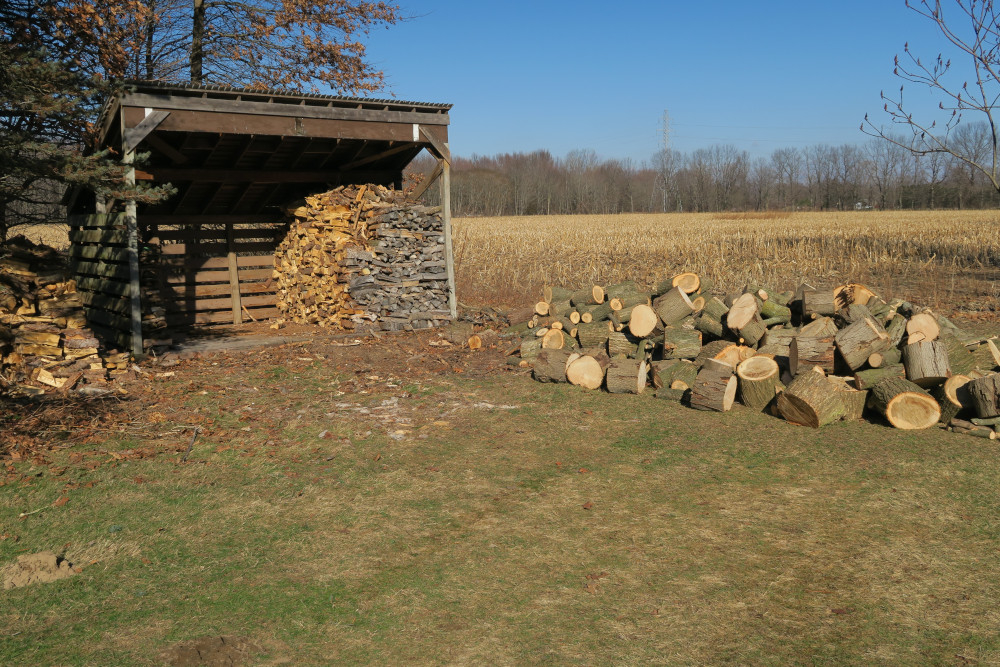
More to come. Silver lining in all this is that, combined with another tree I took down last month, I'm about set to restock the firewood storage.
John Joseph McVeigh
Gold Member
if it's your neighbors' tree then it's his insurance that will pay you or your insurance company will go after his insurance company hope you and your neighbor get along good luck
It depends upon in which State the O.P. and his neighbor live. In Maryland at least, and probably in many other jurisdictions, it also depends upon whether you put your neighbor on notice that the tree was dead or diseased or, for some other reason, a threat to your property.
Link.From the several theories that have been developed on this subject, the three Maryland courts involved in the Melnick decision adopted the “Massachusetts Rule,” which limits the remedy of the landowner who is harmed to self-help in almost all circumstances.
The Massachusetts Rule has not been universally accepted. In contrast, § 840 of the Restatement (Second) of Torts (1977) imposes a duty on a landowner to abate the condition when the encroaching vegetation is “artificial” — that is, when it is a result of human activity — but not when it is “natural.” The Maryland Court of Appeals noted that only a minority of other courts have applied the Restatement rule because of the difficulty in determining whether a tree or its growth may be as a result of human activity. Under the “Virginia Rule” liability would exist if a tree or plant is “noxious,” but liability would be limited to self-help if the tree or plant is not noxious. The “Hawaiian Rule,” for which Melnick argued, would impose liability for damages caused “other than by casting shade or dropping leaves, flowers or fruit.” In Melnick, the Maryland Court of Appeals rejected these other rules.
The Court of Appeals in Melnick held that the Massachusetts Rule should be followed because any other rule “might spawn innumerable and vexatious lawsuits.” Judge John Eldridge wrote for the Court, “We have gotten along very well in Maryland, for over 350 years, without authorizing legal actions of this type by neighbor against neighbor.” Furthermore, the Court declined to categorize living trees, plants, roots, or vines as a nuisance, which must be abated.
In the final footnote of the Melnick case, the Court of Appeals acknowledged that there may be a limit to the Massachusetts Rule for dangerous dead trees and that under certain circumstances a landowner on whose property a dead tree stands may need to take reasonable steps to prevent injury to others.
Last edited:
Robert walker
Bronze Member
- Joined
- Jul 16, 2020
- Messages
- 73
- Tractor
- Kubota L3400
Build a 4x4 a-frame and put under it about 4 or 5 feet from the side. You should then be able to cut limbs off the building side. Then hook a chain to it up to it close to the a-frame and pull it over, cut up, split and enjoy a fireYesterday I found a tree on my pole barn. It was actually on my neighbors property. I noticed it was dead last year and thought about suggesting we take it down. It would have been tight to get it between our barns, but I wish we had tried now. I have to call the insurance company but I think I will probably take it off myself since it's hard to get tree services on short notice. It doesn't look likely to roll or twist on me. Since I have a ceiling and insulation, I can't tell if there is structural damage but it looks like one or two purlins might be broken.
View attachment 783725
View attachment 783724
From my experience if the tree came from the neighbors property then their insurance pays for damages.Yesterday I found a tree on my pole barn. It was actually on my neighbors property. I noticed it was dead last year and thought about suggesting we take it down. It would have been tight to get it between our barns, but I wish we had tried now. I have to call the insurance company but I think I will probably take it off myself since it's hard to get tree services on short notice. It doesn't look likely to roll or twist on me. Since I have a ceiling and insulation, I can't tell if there is structural damage but it looks like one or two purlins might be broken.
View attachment 783725
View attachment 783724

kbt kubota
New member
- Joined
- Sep 3, 2020
- Messages
- 13
- Location
- Chepelare, Bulgaria
- Tractor
- IMT 539.2, Kubota B1502 M, BCS 740, BCS 730
That was my first thought too.. .particularly, to avoid the ding-in-the-wall problem. Was it too heavy for the loader?Since it's dead, Once it was trimmed down to this I would have seen if the loader would lift the end off the shop just a little and trim more off until maybe it cleared the barn.
Maybe even cut sections out of it to reduce weight more.


