paulsharvey
Super Member
97% passing the 3-1/2"; max 10 plasticity, min LBR100. I dont know if that meets your terminology, but thats the spec for "limerock" road base.Which is a size call out.
97% passing the 3-1/2"; max 10 plasticity, min LBR100. I dont know if that meets your terminology, but thats the spec for "limerock" road base.Which is a size call out.


Most roadbase textbooks all the way back to McAdam's original patents agree that the fines, dust, moisture content, and compaction are keys to locking the crushed rock into place.Never used asphalt millings. But if they are similar to 411's with alot of dust and fines I dont see any issue.
The reason for putting 411's on top of the base of 1-2's.....is that alot of the fines from the 411's filter down and fill the voids of the 1-2's and lock them together to stabilize the base.
IF the millings are mostly uniform in size and dont have a range of fines ranging from dust up to 1/2" or 3/4" chunks....I dont think it will lock the base in very well

Ummmmm,,,,, the Romans did it.Most roadbase textbooks all the way back to McAdam's original patents agree that the fines, dust, moisture content, and compaction are keys to locking the crushed rock into place.
It's researchable online.
Amazing how long it took mankind to figure out how to make a durable road surface.
Learning how to build roads that stay in place took until he early 1800s. Up until then, everything from farm carts to cannons used a wheel base measured to fit the ruts.
rScotty
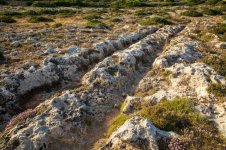
They sure did. Roadbuilding has a fascinating history. The Romans used fitted flat blocks of stone - but didn't do any compaction. Maybe the should have used cubical blocks, but still their lighetweight system worked OK as long as they were around to maintain it. The Romans were nuts for good roads & spent a lot on them. After the Romans left, the local people tended to find other uses for those paving blocks - they make dandy castles - and so the Roman roads turned into mud tracks.Ummmmm,,,,, the Romans did it.

 interestingengineering.com
asphalt milling would be closer to a 304 mixture with some larger chunksNever used asphalt millings. But if they are similar to 411's with alot of dust and fines I dont see any issue.
The reason for putting 411's on top of the base of 1-2's.....is that alot of the fines from the 411's filter down and fill the voids of the 1-2's and lock them together to stabilize the base.
IF the millings are mostly uniform in size and dont have a range of fines ranging from dust up to 1/2" or 3/4" chunks....I dont think it will lock the base in very well
Not sure where you live. Come to rural Missouri and I'll show you examples of what you described that the Romans did.They sure did. Roadbuilding has a fascinating history. The Romans used fitted flat blocks of stone - but didn't do any compaction. Maybe the should have used cubical blocks, but still their lighetweight system worked OK as long as they were around to maintain it. The Romans were nuts for good roads & spent a lot on them. After the Romans left, the local people tended to find other uses for those paving blocks - they make dandy castles - and so the Roman roads turned into mud tracks.
The British and French gov'ts posted a reward for a solution, and along about 1800 a Scottish civil engineer named John McAdam figured out how to make a strong weatherproof road surface using compacted crushed stone & fines. In fact, his patent application talks about using broken up paving blocks. He got the patent and was offered a knighthood. Later on the same technique was used with the addition of asphalt, and so here we are today.
The Americanized spelling is "macadam".
You can download his patent and read it if interested.
John Loudon McAdam: The Father of the Modern Road
John Loudon McAdam changed the world of road-building forever.
rScotty

Yep. And let's not forget they didn't have a Dozer, Grader, Scraper and Sheeps Foot Roller.Let's not forget that the heaviest thing expected to be going over a Roman roadway was an elephant, and that very rarely. Otherwise, wagons full of grain were probably the expected limit.

Very well stated.So, I think maybe we are missing something about the Roman roads, and buildings. They screwed up. Why? They built something that lasted 2000 years. They wasted man power, resources, ect for vanity; when a function system that would last for their need would have better served them. Even in Eastern Rome, which lasted until almost Columbus, most of their infrastructure wasn't really used past 900 AD.
Also, keep mind, we see the 1-2% that did survive; not the 98-99% that failed.
There is a reason we don't build houses that last forever. We certainly are able to build cast in place, 12" thick reinforced concrete houses; with Stainless steel roofs. We don't, because we don't think on a 3+ generation time line. When we die, maybe 1 generation will sue what you left behind, but thats even the minority. Most kids are gonna auction of the folks place yo the highest bidder. Farms maybe the exception, but even still; I would guess a significant % either sell; land lease it out.
Damn; I'm getting philosophical on the crapper...