Another Bridge Thread

   / Another Bridge Thread #21  
Luke, I have pulled a couple trailers back there behind my quad, and I did take my truck back there a few times early on, but may need to clear a little on the path to get it back there again. I would plan on pulling the lumber on a trailer, either behind the tractor or my truck, even if I had to make a few runs. Is that what you are talking about, or do you have another idea?

Ya, you mentioned it would be difficult to get a trailer back there but thought maybe you were taking about and 18 wheeler size.
Seems like a cheap used equipment trailer (16-25 feet) set on concrete footings would be easy and cheap.
 
   / Another Bridge Thread #22  
Egon, I don't know what section modulus figures are, but will go google them. I'm by no means an engineer of any sorts, which is part of the reason I'm here. I can generally teach myself things through research, but when faced with the alternative of having to pull my friends tractor out of a creek, I'll take as much advise as I can get. Design breaker seems important, so I'm off to google.

Thanks ag

I'm not an Engineer either. Also can't really give advice either.

Usually the deeper the beam the greater the section modulus the greater the load carrying ability. The object is to balance the beam design with the decking required to get an economical solution. This would also incorporated the use of lateral bracing between the beams.

One can also add flanges to a wooden beam. The other way is to make up a deeper beam from narrower flat pieces that are glued and do not have to be full length. This would be the desirable method and cover with fiberglass to slow rotting. Gluelam beam. (Buy them and the design might come with )

The point loads would refer to the tire contact spots where it might be a good place to place the beams.

Note: the beam formulas look nice but they have to be applied properly situation wise.
 
   / Another Bridge Thread #23  
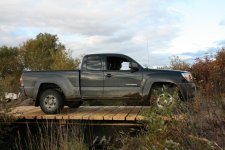
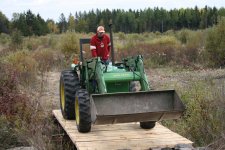
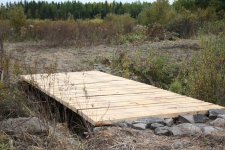
This is mine.... 20' X 8'......3 beams across creek- 8" X 8"X 20 ft (white spruce covered with tar paper to prevent moisture build-up and rot)).... supported by railway ties recessed into the creek-bank at each end.....3" decking ( white pine and jack pine treated with sealer)...underneath vertical support in the middle resting on bedrock on the creek-bed ( pressure-treated 8" X 8")...no problem supporting tractors and other vehicles...in the springtime the vertical support-beams sometimes wash away but we cross anyway....some deflection however not enough to worry about until they are replaced. Still going strong after 3 years.
282230_10151042178961091_1121664032_n.jpg420504_10151042178471091_889713576_n.jpg551954_10151042178046091_145837421_n.jpg
 
   / Another Bridge Thread
  • Thread Starter
#24  
Thanks to everyone for your feedback. I will check into culvert before I making any final decisions. I agree it's the "easiest" and probably the "safest" solution, but what I want to avoid is having two or more smaller culverts and essentially have spots in the creek where debris will back up and the force of the creek after a good rain will possibly wash the culvert. If I was going that route, I'd want a full piece of culvert that fills the 8-10 foot creek opening. I'll check.

I can't get any commercial companies to come back there, but is possible to get (drag or roll) a trailer back there, I just haven't found one that felt big enough for the job for less than what I could build a wood bridge. I also like the idea of a wood bridge from an aesthetics perspective, but again, it's an option worth looking into further before locking in. What I didn't know about trailers is that often the ones pulling tractors have axles in the middle to support the load. In my case, the middle would not be supported. So I'd want to get one (like a semi flatbed or something?) that I know can hold the weights we are talking about. Could someone who is suggesting a trailer post a link to one that could give me an idea of the type of trailer we are talking about... just so I don't hear one thing and think something different than was was intended.

mrtwister that is essentially what I'm thinking except my span is only 10-ish feet and I don't want to put the support in the middle. That being said, given my span is half your's, it seems I would essentially be doing the same thing from a structural perspective. Seems that is much in line with the design kennyg has suggested. Did you just lay tar paper across the top of the beams before attaching the decking? and fold it over some to protect from rain? Or did you do something more to "wrap" them? Are the beams attached to the railroad ties? Or just sitting on top? Railroad ties instead of concrete seems like a good option as well. Fairly easy to replace later if needed. Did you choose 3" decking for a structural reason? Seems most have used 2x (really 1.5), but I haven seen more commercial bridges that used 2x6 (or 2x8) on it's short side to deck all the way across. Overkill for my application I think, but it did look nice. Seems it would be a pain to replace a few boards in that scenario though.

Thanks again to everyone.
 
   / Another Bridge Thread #28  
Couple of suggestions.

1. Trailer is quickest, easiest, and pretty cheap if you are patient and wait on the right deal. Do some serious CL shopping before you rule this out.
2. Look for steal beams. Some 12-15' steel beams in the 10"-12" depth range I usually see on CL all the time for next to nothing. Worst case scenerio you have to buy new beams. Around here that is ~50 cents a pound. Even something as small as a W8x21 beam has the ability to carry ~4500# point load right at mid span and still have a 5:1 safety factor. A 40' stick would be ~820# and with a few cut fees to whatever size you need would probably run under $500. Then all you need is decking. Probably a good bit cheaper than you $1000+ budget.

3: Contact your local electric companies and inquire about used poles. I did a bridge spanning only about 4' this way (but drove 18k backkhoe over it). Basically use the electric poles the same way you are wanting to laminate the 2x8's. Only alternate every other one, cause the poles are tapered, So have big end on near side, then next one have it on the far side, then back to near side, etc etc. Think like making a raft.

Electric poles are usually 8-10" diameters, and treated really well. The electric companies usually give away used and broken poles. Most times still in pretty good shape. But sometimes not, avoid the ones taken out of service for rot. But lots are just where they have moved a line for one reason or another, (they dont re-use poles no matter the shape), or some are broken from stormes or accidents. The broken ones are fine cause poles are 40' or so long, lots of times you can still get two good 15' lengths.

After you have all the poles laid out spanning the creek, lay down decking with some polebarn spikes. Decking over it ties everything together and keeps the tires from just "displacing" and rolling the poles out from underneath you.

My absolute last resort would be the all wood beam as you describe or a all wood bridge with wood beams and wood decking. Lots better (and cheaper) solutions out there. I dont like to mess around with heavy things crossing bridges, do it right.
 
   / Another Bridge Thread #29  
mrtwister that is essentially what I'm thinking except my span is only 10-ish feet and I don't want to put the support in the middle. That being said, given my span is half your's, it seems I would essentially be doing the same thing from a structural perspective. Seems that is much in line with the design kennyg has suggested. Did you just lay tar paper across the top of the beams before attaching the decking? and fold it over some to protect from rain? Or did you do something more to "wrap" them? Are the beams attached to the railroad ties? Or just sitting on top? Railroad ties instead of concrete seems like a good option as well. Fairly easy to replace later if needed. Did you choose 3" decking for a structural reason? Seems most have used 2x (really 1.5), but I haven seen more commercial bridges that used 2x6 (or 2x8) on it's short side to deck all the way across. Overkill for my application I think, but it did look nice. Seems it would be a pain to replace a few boards in that scenario though.

Thanks again to everyone.

In reply to your question, yes I laid a long strip of tar paper maybe 14" wide, the length of the beam then folded it over along the sides then nailed it along those sides with roofing nails...you can kinda see it in the picture with the truck crossing.....then the decking was attached to the beams with 6" galvanized lag screws. I drilled a couple of 3/8" holes clear through the end of each beam then drove 12" spikes right through those holes to attach them to the ties. I milled the beams and decking myself with an Alaskan Sawmill so I could chose my own dimensions....I had the wood for free so I chose 3" thick to make sure there was little to no deflection when driving over it. Hope this helps...Twister
 
   / Another Bridge Thread #30  
A 24' 24" steel culvert costs about $400 around here. You could get a bunch of fill dumped where there's good access and build it up for well under your 1K budget. Class 5 is about $200 a 12yd truck delivered in my area, but we have taconite tailings which are better road base and won't wash out if crested, and those are $185 a load.

20150513_131057.jpg
 
   / Another Bridge Thread #31  
A 24' 24" steel culvert costs about $400 around here. You could get a bunch of fill dumped where there's good access and build it up for well under your 1K budget. Class 5 is about $200 a 12yd truck delivered in my area, but we have taconite tailings which are better road base and won't wash out if crested, and those are $185 a load.

20150513_131057.jpg
 
   / Another Bridge Thread #32  
Any pictures of the area?

Lots suggesting culverts. I would want to see the area first before offering that suggestion. You are wanting a 10' long bridge. Even 3 culverts @ 24" diameter may not be enough.

And how deep is the crossing. A 24" culvert with 12" of dirt on top is gonna make the crossing 3' high. If the crossing is shallower and wide, you may never use the top half of the culverts as the water may just go around, and they dont flow near the water an open bridge will
 
   / Another Bridge Thread
  • Thread Starter
#33  
I will be down there this weekend and will take some pictures of the actual area I want to cross. The banks themselves are about 4' deep and about 10 feet across (probably closer to 8 at the water taking into account some slope). Water is normally about 12-16" deep. I'll measure it more precisely when I'm back down there. But that's why I'm concerned about using multiple culverts because it creates one or more points where junk in the creek can get trapped and back up... making a little **** over time. So there is a maintenance component that I'm not excited about.

The trailer is functionally (and probably effort wise) a good option, except when I run revised numbers based on KennyG's data, I get a lower $ figure than I original had, and trailers seem to be quite a bit more than that.

Here's what I have on paper currently:

(12) 2x12x16 PT boards (~$30/ea or $360 total): 10 to use as beams, and 2 to use as cross bracing between beams
(35) 2x6x8 PT boards (~$5.50/ea or $192.50): for decking ... will probably be a couple less since I'll leave some space between the boards.
(8) 8' railroad ties ($14/ea or $112 total): to set the bridge on and to use as end caps... I would taper the 2x12 down to the rr tie at each end and then backfill to the RR tie so my 2x12 is not buried.

Total this comes to $664 for lumber, which admittedly does not include any railing or hardware, but we are still quite a bit less than the original guestimate.

It may be that a killer deal comes up for a trailer, which I would strongly consider . And I have found steel i-beams periodically... just never been ready to pull the trigger when they came up... but that would probably be a great option as well. Thanks for everyone's willingness to share. I'm pretty exited to figure out a plan and get something going.

JB
 
   / Another Bridge Thread #34  
Any pictures of the area?

Lots suggesting culverts. I would want to see the area first before offering that suggestion. You are wanting a 10' long bridge. Even 3 culverts @ 24" diameter may not be enough.

And how deep is the crossing. A 24" culvert with 12" of dirt on top is gonna make the crossing 3' high. If the crossing is shallower and wide, you may never use the top half of the culverts as the water may just go around, and they dont flow near the water an open bridge will

I spanned 250' with mine. It's not that big of deal. Make sure any of it's legal though. You might need a permit.

He's already saying the road in is soft, so maybe building it up into a proper road would be the best possible outcome.
 
   / Another Bridge Thread #35  
Oh I'd definitely assume it's illegal. Be careful what you ask about.
 
   / Another Bridge Thread #36  
You're allowed all kinds of exemptions. It's not always illegal when permission is sought.

My road crosses 100% type 7 wooded swamp. Cost me a $100 permit for silvicultural exemption. With that exemption granted, I can turn it into a personal use access road for a $300 permit and the wetland bank credits for replacement (because it's in the riparian impact zone of a lake) with a 100% chance of that application being approved - since using the road for personal ingress to the land-locked parcel becomes the least impact option to the wetland.

It's all in how you use the rules of the game to your advantage. ;)

I approached the TEP members prior to going the exemption route to make sure they didn't think poorly on my approach of doing this route vs the personal use permit first. Better to have everyone in your corner before you start than going in blind to find you have an obstacle that now doesn't want to favor your desired outcome.
 
   / Another Bridge Thread #37  
I spanned a similar distance on my property - think it's 12-14', can't remember exactly now. I used pressure treated 2 by 8's for the deck boards and for the beams I used what was local! I cut down a couple trees, not exactly the best kind for the job (Poplar!) but I went large with them (12" diameter minimum) and with my chainsaw made them flat on the top end, laid a couple perpendicular for the main 2 beams to sit on that crossed the creek. My little tractor with a 45 gallon drum of maple sap and over 800lbs of counter weight hanging off the back weighs in around 3500lbs and when I park it on the bridge I've measured zero deflection.
Yes the bridge won't last for ever (I did paint on the pressure treat stuff to help the logs from rotting too quickly.) but when the time does come one day I'll replace the beams with a couple more. It's now 3 years old and doesn't show any signs of wear yet. I made sure the logs are not in dirt so that helps them from rotting too quickly.

If you're only looking to have a bridge last 12 years as you mentioned I'd definitely look for a simple/cheap solution and save up for a more permanent option that you'll be happy with down the road.

Also how long have you been on the property - are you 100% sure it won't flood and wash away what you build? My father and I built 3 different bridges on the property I grew up on the last one is still standing today and that's 30+ years ago now that we built it. The first 2 weren't built high enough to deal with the flooding.

E.
 
   / Another Bridge Thread
  • Thread Starter
#38  
Thanks Everhard,

It would save a good bit of money to do it with local logs. I even scoped out a few near the bridge site, but I've gone back and forth on using them. The main logs on the property are cedar and shag bark hickory. I've read that while the hickory is hard, it's not ideal for long lasting in that condition. Cedar seemed/seems ideal, but I get conflicting stories about whether the log as a whole is good for this sort of use, or if I have to mill the outer of wood and get to the red stuff in order for it to last. Then comes the question of how thick they need to be. Are there the equivalent of span tables for live logs? Would cedar be the best choice?

You are right though... this is not meant to be the permanent bridge.

We've had the land for about 1.5 years now... To be fair, I couldn't say that there wouldn't be a storm large enough to cause the creek to climb over the banks, but what I've seen so far is that it get's out up stream and then again downstream. If we had rain like we did in 2010, then all bets are off and I expect I'd be looking downstream for bridge parts.

Merry Christmas all!!
 
   / Another Bridge Thread #39  
My local metal recycler resells metals at a markup, but scrap steel beams are dirt cheap right now. Might be worth checking to see if they have anything and will resell.
 
   / Another Bridge Thread #40  
Cedar seemed/seems ideal, but I get conflicting stories about whether the log as a whole is good for this sort of use, or if I have to mill the outer of wood and get to the red stuff in order for it to last. Then comes the question of how thick they need to be. Are there the equivalent of span tables for live logs? Would cedar be the best choice?

Not sure about using cedar as a structural member. It's durable (as long as it can dry out after getting wet) but my impression is that it's strength isn't great. I found some reference info that would indicate it's close to but a little lower than pine and fir.

Beam capability is related to the area moment of inertia. For a rectangular, that's calculated as (width x height cubed) divided by 12 or I=(w x h x h x h)/12. (Sorry, I'm not sure how to do superscripts here. For circular section it would be pi x diameter to the fourth power divided by 64 or I = pi x (d x d x d x d)/64. Two beams with the same I would have the same strength.

Let's say we have three 2 x 12s. The actual dimensions are 4.5 x 11.25. Then I = 534. We can solve for a circular beam and get d = 10.2 inches. Therefore, a 10" diameter log would replace three 2x12s if the wood strength is equal.
 

Tractor & Equipment Auctions

2017 FORD F-150 XL CREW CAB TRUCK (A59823)
2017 FORD F-150 XL...
WOOD GRABBER FOR MINI EXCAVATOR (A58214)
WOOD GRABBER FOR...
(2) UNUSED 320/85R24 TRACTOR TIRES / WHEELS (A57192)
(2) UNUSED...
2011 NORAM POWER SYSTEMS 100KW GENERATOR (A58216)
2011 NORAM POWER...
1979 Ford H-48 Excavator (A56438)
1979 Ford H-48...
Deere 333E (A60462)
Deere 333E (A60462)
 
Top