Amusing Circuit Breaker Failure

/ Amusing Circuit Breaker Failure #1  

s219

Super Member
Joined
Dec 7, 2011
Messages
8,607
Location
Virginia USA
Tractor
Kubota L3200, Deere X380, Kubota RTV-X
The 240V 20A circuit breaker down on my pier, for my boat lift, has been getting flakey when switched on during the last couple weeks, periodically failing to connect one leg. I figured corrosion or moisture. Finally on Friday, it made some sizzling noises and would not connect after 3-4 tries. So I bought a new breaker and replaced it.

Tonight I took the old breaker apart to see what the problem was. Breakers aren't really meant to serve as switches (unless using a specially designed breaker made to function as a switch), but it should take thousands of switching cycles before they wear out, and at best this breaker might have had 100 cycles since installed. So I was suspecting some premature wear or some moisture or corrosion on the contacts. Instead I found this:
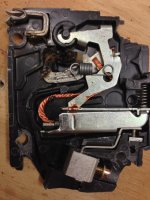
IMG_4689.jpg

That's what's left of a caterpillar that managed to get inside one side the breaker, between switch contacts, and eventually got cooked. I am at a loss to explain how a caterpillar got in the circuit panel, never mind inside an actual breaker! There are very few openings in the breaker, so I wonder if the thing got inside when small and just grew in there, getting stuck.

I plan to look over my circuit panel closely tomorrow, and plug any holes that could let insects in. It's an outdoor rated GE panel, but clearly must have some holes a caterpillar could get through.

Just when I think I have seen it all with electricity, I learn of something new and bizarre!
 
/ Amusing Circuit Breaker Failure #2  
I found this critter in a timer that was used to control part of a waste treatment plant.
He had been there quite a while. The timer still worked OK.
 

Attachments

  • Timer.JPG
    Timer.JPG
    166.6 KB · Views: 486
/ Amusing Circuit Breaker Failure #3  
I serviced consumer products for 30 years and I can't count the times I found insect and/or rodent damage that caused the failure. Never forget one rabbit that was job security for me as he bit the power cord off my customers TV on a weekly basis!
 
/ Amusing Circuit Breaker Failure #4  
Ants are usually the culprit around here. They seem to be attracted to an electrical circuit. AS for GFCI breakers, spider webs will cause them to fail to hold when reset. Even one strand of web will carry enough current to trip a GFCI breaker.
 
/ Amusing Circuit Breaker Failure #5  
Ants are usually the culprit around here. They seem to be attracted to an electrical circuit. AS for GFCI breakers, spider webs will cause them to fail to hold when reset. Even one strand of web will carry enough current to trip a GFCI breaker.

We have had issues with both spiders and ants taking down GFCIs.

When we were in Irving, a squirrel chewed through wires in a dentist's office outside our neighborhood. Burned the place to the ground.
 
/ Amusing Circuit Breaker Failure #6  
"bugs" in a computer program originated from an actual bug in one of the first computers. a moth I think...
 
/ Amusing Circuit Breaker Failure #7  
Ants were constantly getting between the contacts on my well pressure switch until I wrapped in in electrical tape.
 
/ Amusing Circuit Breaker Failure #8  
I found a cooked mouse in the High Voltage cage of a Motorola 100 watt vhf base station transmitter once. There did not seem to be enough space for him to get to the tubes in the final metallic shielding cage, but he did some how. I guess he wanted the warmth of the tubes. But that old transmitter ran about 800 volts on the plates. Ouch. When I showed the dead mouse to the owners, they were pretty grossed out. I though it kinda funny, Of course I wasn't paying the bill either.:)
 
/ Amusing Circuit Breaker Failure #9  
I found this critter in a timer that was used to control part of a waste treatment plant.
He had been there quite a while. The timer still worked OK.

That one doesn't look too bad. I found one in the fuse box (the old round screw type) at the well house. He was fried. that was fun cleaning him out.

Worst was in my irrigation line when I was watering out of a creek, Winter time drill was to drain the pump and disconnect the 'out' pipe. Spring time I fired it up and plugged up about 3 sprinkler heads with bits and parts of a chewed up mouse.

Harry K
 
/ Amusing Circuit Breaker Failure #10  
Too bad you couldn't just debug it.

I don't know how a caterpillar could grow larger inside with nothing to eat but air and electrons. Maybe an alien teleported him there. Heck, maybe he is an alien.
 
/ Amusing Circuit Breaker Failure #11  
One of the ones I found was Rat SKULL (inside a garage wall) where a outlet quit working in past. It was my sisters place no less. The odd part was JUST the SKULL no other bones inside the wall and I didn't see any holes where it got in. It was full sized skull and was hanging from a chewed thru wire... He managed to remove the insulation and was working on the copper. The copper wires were burnt thru about 6" away and no insulation with burn marks inside the wall. Was close to taking out the house/attached garage though it was an outside wall...

Found cooked & mummified mice in boxes and switch gear panels too, still nothing like the rat skull... It HAD to burn off wires right when rat chewed thru it as skull was bleached white no burn marks on it...


Mark
 
/ Amusing Circuit Breaker Failure #12  
We get tons of A/C calls where ants (yes ants) for some reason cover the contactors and screw up the contacts. If the contacts can't make contact... No A/C I can't figure why ants seem to be drawn to electricity
 
/ Amusing Circuit Breaker Failure #13  
We get tons of A/C calls where ants (yes ants) for some reason cover the contactors and screw up the contacts. If the contacts can't make contact... No A/C I can't figure why ants seem to be drawn to electricity

This does not exactly answer you question, but people are working on it.

"Ants have been a major factor in air conditioner failures. Service personnel in Texas have reported that fully one third of all summer repairs stem from ants shorting out terminal blocks. They also have been found to have set up housekeeping in televisions, well pump controls, telephone junction pedestals, airport runway lights, utility watthour meters, electrical plugs and lamp sockets, computers, and transformers-where they prefer to nest on the high-voltage side. Why are imported red fire ants attracted to electric fields? No one is yet ready to offer a theory. But biologist Dr. William P. MacKay of the University of Texas at El Paso and entomologist Professor S. Bradleigh Vinson of Texas A&M have succeeded in eliminating a number of possible factors.
They have found fire ant behavior does not correlate with a-c frequencies, or with the presence of ozone, electromagnetic or magnetic fields. Nor is the type of insulation used on wiring a factor. In tests up to 140V a-c and 350V d-c, both attracted almost the same number of ants at the same voltage and distance. However, they did find that when electricity was turned off, ants attracted to d-c power dispersed more rapidly than those who had been experiencing the nirvana of an a-c source. While the Texas researchers still don't understand the reasons why the ants have a fatal attraction to electric fields, they have been able to devise successful control techniques. Based on their studies, they recommend using terminal cap protectors to prevent bridging, and denying entrance to the insects by enclosing mechanical relays in metal or plastic cases and sealing them, as well as all entrances to padmounted equipment, with epoxy cement. In laboratory tests, silicone rubber sealants and roofing cement proved ineffective."
 
/ Amusing Circuit Breaker Failure #14  
Ants have buggered up my heat pumps in both SC (about 20 years ago) and NC (just last month).

Steve
 
 
Top