58 MPG by 2032

   / 58 MPG by 2032 #361  
I find the same thing here with gas powered vehicles. Speed limit
in town is 40 and you usually get some slow poke joker will be doing
20 to 25 in the other lane and when they see you coming jump in front
of you trying to slow you down. This only happens when I have the car I purchased chains for my old 1973 3/4 ton Dodge 975x16.5 won't fit my tractor but can add some chain to; make them work. Our VW bug I had chains for it and when you get them on snug you have a T handled wrench and in the middle of the chains a metal disk insert T handle and chains are snug never come loose.

willy
 
   / 58 MPG by 2032 #362  
Has anyone heard anything about using JP5 instead o;f diesel?

Diesel Fuel​


Diesel fuel is any fuel designed to be used in a diesel engine. Most diesel fuel is refined from crude oil, but increasingly, diesel made from biomass or natural gas is becoming available.

JP5​


JP5 fuel is a jet-propulsion fuel made to strict military specifications. Based on kerosene, the most significant difference between JP5 and other jet fuels is it has a higher flash point and is required for use on carrier-based aircraft.

willy
 
   / 58 MPG by 2032 #363  
Which types of battery chemistries are you considering? Even though where I live in western WA gets much less usable solar than other places in western WA I am still considering solar. And I would like batteries to obviate a generator when the power goes out. I don't think, for me, that 100% solar would be economical at this time.
Thanks,
Eric
I'll be using lifepo4 batteries. I already have a test setup that's functioning for my deep freeze.

It only becomes uneconomical when you're paying $4/watt for panels/installation. Panels are rated for 90% after 10 years, 80% after 25 years. So a 240w panel becomes 196w after 25 years. This is why I shop the second hand market. I picked up 24 panels that were 3 years old. They are 240w and I paid $60 a pop. That's $0.25/watt, over a 90% discount. Now, there are other costs incurred. Mounting hardware, wiring, inverter. But my 5.7kw system was $1500 for panels, $750 for inverter, and about $400 for odds and ends. That's a grid tie inverter, no batteries at this point. So under $3k for everything.

A commercial installer would charge $20k for it. Granted they'd be new panels, and a professional installation, which is probably a bit cleaner than mine. But a 5.7k system for $20k vs 3k (20k may have some government rebates of $3-6k depending on your area), it can make or break whether it's worth doing or not. Also, I didn't charge myself for my time, hundreds of hours of research, watching video's, becoming familiar with technology, trial systems, and a background in electrical engineering.
 
   / 58 MPG by 2032 #364  
Has anyone heard anything about using JP5 instead o;f diesel?
Since 2007 automotive diesel engines require a very specific ULSD formulation, with some variation allowing a very specific biodiesel to be mixed. Presumably Tier 4 tractors as well. Else the emission components in the exhaust are destroyed.
 
   / 58 MPG by 2032 #365  
A commercial installer would charge $20k for it. Granted they'd be new panels, and a professional installation, which is probably a bit cleaner than mine. But a 5.7k system for $20k vs 3k (20k may have some government rebates of $3-6k depending on your area), it can make or break whether it's worth doing or not. Also, I didn't charge myself for my time, hundreds of hours of research, watching video's, becoming familiar with technology, trial systems, and a background in electrical engineering.
Around here one must have the system "designed" by a holder of an NABCEP certificate to connect to the power grid. NABCEP is a solar industry lobbying group. The local NABCEP certificate holders have a monopoly and know it. And make the most of it.

Just across the state line I was told by a utility engineer doing a site survey of my future home that I could "do anything I want" on my side only they won't pay for my excess power. Also they will charge one-time $4000 to install a remote disconnect. To get TVA to pay for my excess power it has to be "designed" and approved by an NABCEP certificate holder.
 
   / 58 MPG by 2032 #366  
Around here one must have the system "designed" by a holder of an NABCEP certificate to connect to the power grid. NABCEP is a solar industry lobbying group. The local NABCEP certificate holders have a monopoly and know it. And make the most of it.

Just across the state line I was told by a utility engineer doing a site survey of my future home that I could "do anything I want" on my side only they won't pay for my excess power. Also they will charge one-time $4000 to install a remote disconnect. To get TVA to pay for my excess power it has to be "designed" and approved by an NABCEP certificate holder.
What is "Excess Power" ??????

Are you talking about installing a Solar Grid to generate power and then sell the excess generated during daylight hours to the local electrical provider?
 
   / 58 MPG by 2032 #367  
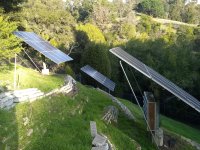
I guess I'm fortunate to be in California where home owners can design and install and the fee from utility is very low?

I have not paid for a kWh since installed and at true up the sell back more than covers the base meter rate and puts money in my pocket...

My panels are circa 1998 with 3 2000 Watt arrays...

Should an Electric Car come my way I might upgrade
 

Attachments

  • IMG_20190103_152900080.jpg
    IMG_20190103_152900080.jpg
    3.7 MB · Views: 132
   / 58 MPG by 2032 #368  
What is "Excess Power" ??????

Are you talking about installing a Solar Grid to generate power and then sell the excess generated during daylight hours to the local electrical provider?
Yes. That is the traditional definition of Grid Tie.

Net Metering traditionally lets one treat the grid as a free battery. They pay full price for what you give, you pay the same to take it out that night. Total rip-off for the utility. Now only available in Progressive Left states.

He said I could give them the excess but they would not pay for it. I have to deal direct with TVA who would install a second meter.
 
   / 58 MPG by 2032 #369  
Yes. That is the traditional definition of Grid Tie.

Net Metering traditionally lets one treat the grid as a free battery. They pay full price for what you give, you pay the same to take it out that night. Total rip-off for the utility. Now only available in Progressive Left states.

He said I could give them the excess but they would not pay for it. I have to deal direct with TVA who would install a second meter.
My knowledge on a Solar System back feeding the grid is very limited. From what I have read and heard people say it is a great deal more complicated that just installing a meter.

Here is one example I found.


We can only have one meter on our dwellings, work shop, business etc supplying electrical current. I gather from what you posted your electrical supplier advised you would have to get TVA to install a meter. Sounds like a rather complicated system. The supplier is advising we will not pay you for electricity you will have to sell your surplus electricity to TVA. So that means TVA would have to install the necessary equipment to capture KWH‘s back feed into the suppliers system. They then would give you money which you could use to pay your supplier for electricity they provided which they had purchased from TVA to provide you.
 
   / 58 MPG by 2032 #370  
Before Smart Meters it was automatic...

Analog meters ran forward and backward.
 
   / 58 MPG by 2032 #371  
My knowledge on a Solar System back feeding the grid is very limited. From what I have read and heard people say it is a great deal more complicated that just installing a meter.

Here is one example I found.

I don't see what is so complicated about that. The "Line or Supply Side" model is used but there is a 2nd meter between the PV disconnect and the utility grid.

If I do not sell power to TVA then the disconnect is as shown in the picture. The meter is configured to only increment when power in incoming. Mechanical meters need a ratchet to keep the wheel from turning backwards if I am sourcing more than I draw. Many electronic meters default to counting power up no matter which way the power flows, meaning I would pay to put power in the grid.
We can only have one meter on our dwellings, work shop, business etc supplying electrical current.
That is what I describe. Only one meter supplying electrical power to me. Another meter supplying electrical power to the utility.
I gather from what you posted your electrical supplier advised you would have to get TVA to install a meter.
Suspect the utility would install it per TVA's instructions.
Sounds like a rather complicated system. The supplier is advising we will not pay you for electricity you will have to sell your surplus electricity to TVA. So that means TVA would have to install the necessary equipment to capture KWH‘s back feed into the suppliers system. They then would give you money which you could use to pay your supplier for electricity they provided which they had purchased from TVA to provide you.
Is just one more meter beside the first.

The local utility will read both meters and everything appears on one bill. Is just that I have to have contracts with both TVA and the local utility.
 
   / 58 MPG by 2032 #373  
Yes, but when PV systems appeared the utility learned to add a ratchet to the wheel preventing it from turning backwards.
Here they just replaced all to Smart…
 
   / 58 MPG by 2032 #374  
What is the unit called and what is the cost of one and what
is the cost of hooking up to the grid?
Thanks for any info

willy
 
   / 58 MPG by 2032 #375  
Around here one must have the system "designed" by a holder of an NABCEP certificate to connect to the power grid. NABCEP is a solar industry lobbying group. The local NABCEP certificate holders have a monopoly and know it. And make the most of it.

Just across the state line I was told by a utility engineer doing a site survey of my future home that I could "do anything I want" on my side only they won't pay for my excess power. Also they will charge one-time $4000 to install a remote disconnect. To get TVA to pay for my excess power it has to be "designed" and approved by an NABCEP certificate holder.

It is roughly the same here. And for that reason I'll be using all that money I save vs going for a professional install and grid tie and buying batteries. 30kwh of lifepo4 is ~8k now and dropping, which would be more than sufficient get me through the night. I am looking into a hybrid system as well.

What is "Excess Power" ??????

Are you talking about installing a Solar Grid to generate power and then sell the excess generated during daylight hours to the local electrical provider?
Historically, power companies would give you a meter that goes in both ways, and you would receive net metering. The meter spins forward at night, and then starts to spin backwards during the day. But power companies decided that was a losing game, at least in areas I've researched. For example, you use 5kwh overnight, and 10kwh during the day. but then produced 15kw with your panels during the day(exporting the unused, causing your meter to spin backwards), your net would be zero, and your meter would read the same today as it did yesterday.

However, they have re-thought this process, and have decided to record forward movements and reverse movements differently. That way they can charge you 20c/kwh, but anything they receive from you, they can buy back at a reduced rate, say 10c/kwh. That way you produced 15kwh, you consumed 15kwh, but they could still charge you for 5kwh.
 
   / 58 MPG by 2032 #376  
However, they have re-thought this process, and have decided to record forward movements and reverse movements differently. That way they can charge you 20c/kwh, but anything they receive from you, they can buy back at a reduced rate, say 10c/kwh. That way you produced 15kwh, you consumed 15kwh, but they could still charge you for 5kwh.
The Federal law governing grid-tie states the utility can charge a connect fee "to pay for the distribution network", and only has to pay the audited incremental cost of generation. For TVA that is $0.015/kWh plus fuel surcharge. A pittance.
 
   / 58 MPG by 2032 #377  
For decades it was all about the high cost of generation… building a hydro project or losing nuclear plant and peaker plants.

It’s amazing how the tables turned and now it’s all about distribution as the cost to generate is only a fraction of the power bill.

If solar, wind and geo turned off PGE could not meet demand…
 
   / 58 MPG by 2032 #378  
The Federal law governing grid-tie states the utility can charge a connect fee "to pay for the distribution network", and only has to pay the audited incremental cost of generation. For TVA that is $0.015/kWh plus fuel surcharge. A pittance.
This is the exact reason I'm not interested in grid tie any more. Utilities are sticking it to people who are just trying to save money. And they're buying your energy at 1.5c/kwh, then what, reselling it to another customer at 15c/kwh? That number varies widely, we were 11c/kwh 3 months ago, now we're 17c/kwh, more than 50% increase out of the blue. I understand them not wanting to pay for transmission, only generation. However around here, generation is the bulk of energy cost, while transmission is considerably lower.
 
   / 58 MPG by 2032 #379  
For decades it was all about the high cost of generation… building a hydro project or losing nuclear plant and peaker plants.

It’s amazing how the tables turned and now it’s all about distribution as the cost to generate is only a fraction of the power bill.

If solar, wind and geo turned off PGE could not meet demand…
I heard that PGE is pushing a new thing where they can borrow your EV's power combined with a new regulation(not yet passed) that would require all EV's have 2 way plugs. That way during times of high demand they could sap your EV's power, then refuel it later. Of course the price they give you for your ev's power would be lower than the price they resell you the power to recharge your ev. Also it would put an additional cycles on your EV battery. The concept of my EV being a backup battery for my personal use, but not for the grid at large.
 
   / 58 MPG by 2032 #380  
Of course the price they give you for your ev's power would be lower than the price they resell you the power to recharge your ev
Ding Ding Ding we have a winner, perpetual money machine.
 

Tractor & Equipment Auctions

2017 FREIGHTLINER CASCADIA TANDEM AXLE SLEEPER (A59904)
2017 FREIGHTLINER...
2007 Capacity TJ6500T Wet Kit T/A Yard Dog Toter Truck (A55973)
2007 Capacity...
2009 Ford F-750 Maxtex 1770C 17 Ton Straight Boom Crane Truck (A59230)
2009 Ford F-750...
2012 Freightliner Cascadia (A61306)
2012 Freightliner...
2005 CHANDLER 500 BBL FRAC TANK (A58214)
2005 CHANDLER 500...
2019 JCB 457 (A60462)
 
Top