Increasing the lift capacity of a FEL

   / Increasing the lift capacity of a FEL #21  
I wouldn't do the cyl swap. Def check pressures like several have noted, as that may get you more lift within the spec range of the loader. Your front axle will be the weak point for sure. And keep front tire pressure up when doing heavy lifts too as tire pressure directly relates to load carrying capacity of the tire. You don't want to pop a bead or something from overload. Check the sidewall for max pressure. This will likely be higher than what the manual says to use. Myself, I don't put them at absolute max but a few psi below that.
 
   / Increasing the lift capacity of a FEL #22  
2,326 lbs lift (full at 500mm)
2,536 lbs lift (full at 500mm)
The items I have been picking up with a lot of difficulty are in the 1500 pound range, so I need to look at the pressures and go from there.
David from jax
With those ratings, I would think the relief Is set below spec. The above suggests that a 1500lb weight should be an Easy lift with the Full height @ 500mm listed.

Trying not to not to knock on Kubota, but it IS a 67 HP tractor, should have no problem with what you are lifting (under a ton.) Check those pressures, seems like that is the fix without resorting to what would terminate a warranty.
 
Last edited:
   / Increasing the lift capacity of a FEL
  • Thread Starter
#23  
How much counterweight are you using?
Filled rear tires, and usually a semi-mount Bush Hog 3008 but this past week it has been with my homemade Dura'grader imitation. I haven't had issues with the rear end being light, EVER! So that is another reason I think my lift capacity is too low (which could be pressure). Messing with the pump or having a pair of cylinders made (or doing nothing at all) hasn't been decided yet. Most of the time I am only loading dirt, or moving stuff around or using the grapple. This past few weeks I have been picking up some heavy stuff, but in reality they were below rated capacity in pounds. The extension past the pin on the loader added tremendously to the load, but still...it was about 1500 pounds, so I felt like it should pick it up. A much smaller Kubota at the other end also had problems with picking them up and that owner felt like his 40hp tractor should do what mine did. I mean, they are both ORANGE aren't they?
David from jax
 
   / Increasing the lift capacity of a FEL
  • Thread Starter
#24  
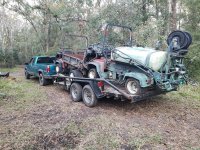
Loading these were the reason for the thoughts on increasing cylinder size. Front one is a complete unit, rear was missing transmission. The dump bed on front one is a lot heavier than the sheet metal framework that holds the tank. Both are now in TN being used as parts. Hydraulics on front unit will be coming back here in April on a cab unit I have in TN. Carb will be used on one here after it is rebuilt. The original came in a cardboard box with pieces missing!
David from jax
 

Attachments

  • 20241228_165304.jpg
    20241228_165304.jpg
    10.4 MB · Views: 810
   / Increasing the lift capacity of a FEL #25  
I have an M7040SUHD with an LA1153 loader. For all practical purposes, this loader does a fine job. Occasionally I need to lift something that is closer to the max limits of the loader, and the lift cylinders just won't pick it up. Most of the time, I figure it is the distance from the pin, since the loader is rated at 24" from pin. Push it either further out, or push it right up against it's RATED limits, and it just won't do it. I can usually compensate by using the curl, but sometimes that isn't enough.
A friend has the same issues, and we talked about putting larger cylinders on the loader. My clinders "may" fit his smaller loader, so we could go together and just buy one set for my tractor. Another option is for me to buy a set and keep my originals in case the new ones have issues. A local hydraulic shop can be tasked into making new cylinders to fit, somewhere in the range of 1/4 to 1/2" larger in diameter. I am considering 1/4" larger, because I know me, and if I need to pick up something, I am probably going to push the limits right up to the max. 1/2" might be just enough to do the FEL frame in, so I am going to be a little more conservative.
Has anyone ever increased the size of their loader cylinders, and what was the outcome? Was it worth the expense, and just how much did it slow the hydraulics down as far as normal useage?
This is pretty much a pipe dream right now, but we are going to look into it, unless someone has already done it and can explain why we shouldn't.
David from jax
A larger cylinder would exert more force but I would bet you would quickly run into clearance issues. I would verify relief pressures first. I recently got around to repacking my tilt cylinders. I had a laugh because through the years I had gotten accustomed to the loss of power. Imagine my shock when it killed my tractor before it went over relief. Check your relief pressures.
 
   / Increasing the lift capacity of a FEL #26  
adjusting the relief vale is not actually playing with the pump and is actually quite simple once you know where the part is. I changed the poppet and seat on mine, chasing the upper limit of the spec but apparently my tractors pump is no longer able to give the max spec for my tractor. it was much cheaper to test if the relief valve was leaking than to dive in and replace the pump. adding shims no longer raises the pressure so I'm living with a slightly reduced lift capacity. Don't play with the shims unless you have a gauge to test the pressure after.

going into relief should not kill the engine. not sure what is going on there but it shouldn't be killing the engine.
 
   / Increasing the lift capacity of a FEL #27  
I had the same machine and I regularly picked up 2 1100# round bales from max height, also had a pretty big grapple for it and lifted 30”+ green fir logs. With cast weights in the rims and a 7’ blade on the back I often drove around with the rear wheels in the air when moving logs and stumps. Never felt the loader under performed and I tend to push my equipment to the limit. The first thing I would do is check your pressure.
 
   / Increasing the lift capacity of a FEL #28  
The heaviest thing I regularly carry on my FEL is a 2K# counterweight. I can lift it with the bucket but I have very little weight left on the rear tires of my 2WD tractor. It's dangerous as hell especially on unlevel terrain. When I have to move it, I use a chain to connect it directly to the quick attach frame. This moves the load rearward about 2 ft and makes a big difference in stability/lift capacity. If you have a quick attach, you can also drop the bucket for more capacity.
 
   / Increasing the lift capacity of a FEL #29  
The heaviest thing I regularly carry on my FEL is a 2K# counterweight. I can lift it with the bucket but I have very little weight left on the rear tires of my 2WD tractor. It's dangerous as hell especially on unlevel terrain. When I have to move it, I use a chain to connect it directly to the quick attach frame. This moves the load rearward about 2 ft and makes a big difference in stability/lift capacity. If you have a quick attach, you can also drop the bucket for more capacity.
Yep, I had to stop over loading my tractor and just switch to my backhoes FEL unloading a 3400lb pallet of quikcrete, was able to get it moved to the back of the trucks bed with the tractor but only had a post hole digger on the 3 point. Had to put it in 4 wheel to move the pallet back because the rear tires were spinning.

Even with chain on Forks added to the bucket it was an easy lift for the TLB's FEL.

(that was dumb), I should have started with the industrial FEL to begin with, but wanted and now know using a "known" weight ~ how much is over the FEL's ability to lift out of the pickup's bed.
 
Last edited:
   / Increasing the lift capacity of a FEL #30  
It has bern several tears ago now (early days of supply issues of covid) so provably early 2020, my son was shopping for a tractor. Part of his needs was to be able to lift a certain amount if weight lifted with forks. Within a few days if receipt of his tractor, he attempted to lift the item for the first time. The new tractor that was purchased in part to lift this item would not lift it. He called his salesperson, not happy, after a bit, the service department head called my son and explained to him how to increase the hydraulic flow to gain the additional lifting capacity.
Perhaps something similar could be done fir your tractor.
 
   / Increasing the lift capacity of a FEL #31  
before making the cyl upgrade, etc, ensure the gpm flow of your tractor will handle the added cyl capacity. & of course, safety is also a primary concern.
may want to inquire w/a hyd shop or your service dealer to determine the new gpm flow requirements
good luck
The flow rate will just affect how fast things move. Unless you're in a high production environment, the loader moving five or even ten percent slower won't be an issue.

Edited to add: The change in volume is proportional to the increase in cylinder diameter. Pi x r-squared. Pi is constant and drops out. So, if you increase the cylinder diameter by 10% the volume of the cylinder increases by 1.1 squared, which is 21% more volume. And at a given flow rate it will move 21% slower.
 
Last edited:
   / Increasing the lift capacity of a FEL #32  
I have an M7040SUHD with an LA1153 loader. For all practical purposes, this loader does a fine job. Occasionally I need to lift something that is closer to the max limits of the loader, and the lift cylinders just won't pick it up. Most of the time, I figure it is the distance from the pin, since the loader is rated at 24" from pin. Push it either further out, or push it right up against it's RATED limits, and it just won't do it. I can usually compensate by using the curl, but sometimes that isn't enough.
A friend has the same issues, and we talked about putting larger cylinders on the loader. My clinders "may" fit his smaller loader, so we could go together and just buy one set for my tractor. Another option is for me to buy a set and keep my originals in case the new ones have issues. A local hydraulic shop can be tasked into making new cylinders to fit, somewhere in the range of 1/4 to 1/2" larger in diameter. I am considering 1/4" larger, because I know me, and if I need to pick up something, I am probably going to push the limits right up to the max. 1/2" might be just enough to do the FEL frame in, so I am going to be a little more conservative.
Has anyone ever increased the size of their loader cylinders, and what was the outcome? Was it worth the expense, and just how much did it slow the hydraulics down as far as normal useage?
This is pretty much a pipe dream right now, but we are going to look into it, unless someone has already done it and can explain why we shouldn't.
David from jax
You can break your tractor in half at the mid section. Don't do it.
 
   / Increasing the lift capacity of a FEL #33  
2,326 lbs lift (full at 500mm)
2,536 lbs lift (full at 500mm)
The items I have been picking up with a lot of difficulty are in the 1500 pound range, so I need to look at the pressures and go from there.
David from jax
It looks like it should have no problem lifting that weight. Check the pump's pressure, and then, if that's Okay, check the relief valve. When lifting weight, do the cylinders creep down? If so, the cylinder seals may be leaking internally.
 
   / Increasing the lift capacity of a FEL #34  
1st check the pressures at the cylinders. Hydraulic control valves can have circuit reliefs, meaning along with a main relief valve that will have control over everything, a circuit relief only controls that circuit. So if either relief valve is out of adjustment, you will have poor performance.
Before you increase your lift capacity you may want to check the front axle rating and see how close you are to exceeding it, they can be very expensive to fix.
Try to imagine when, even with the stock pressures, you lift a load and the back wheels come off the ground. When this happens ALL of the weight of the tractor, wheel weights, 3pt attachment is on the front axle!
 
   / Increasing the lift capacity of a FEL #35  
How are you lifting? Inside the bucket, with forks or with a chain?
 
   / Increasing the lift capacity of a FEL #36  
In addition to increasing the lifting ability of the loader you should determine how much weight the frame of the tractor itself is designed to handle. It would be a shame to lift the larger load only to destroy the tractor frame.
I believe that 'most" machines frames could handle a loader with a larger capacity.
My concern would be overpowering the existing loader itself.
I would think it would be easy to fold up the loader arms if you increased the cylinders and working capacity before damaging the tractor frame.
 
   / Increasing the lift capacity of a FEL
  • Thread Starter
#37  
How are you lifting? Inside the bucket, with forks or with a chain?
To move the heaviest, I use the forks. When it doesn't matter, whatever is on the tractor.
David from jax
 
   / Increasing the lift capacity of a FEL #38  
Make sure your cylinders are correctly oriented....
 
   / Increasing the lift capacity of a FEL #39  
C'mon David, check the pressure, it's been 10 days now.
Like already stated - it has been reported on here years ago that for a while some dealers routinely set the pressure low. My B7610 is on the low side of specs. But I've got to remove my backhoe subframe to fix it, so not worth the effort to me.
 
   / Increasing the lift capacity of a FEL #40  
I'm not sure what you're trying to lift but I did two things to increase the capacity of my MX5800 with LA1065 FEL.

First, I checked the pump pressure and found it to be 10% under spec. Dealer says they do it on purpose for consumer safety reasons. Boosting it to spec gave me a +/- 300# increase in lift.

Second, I took off the bucket and put on a blank SSQA plate with a hook welded to it. This eliminated most of the bucket weight and brought the lift point closer to the pivot pins than it was with bucket mounted hooks. This gave me another 200# of lift.

The second isn't much help if you're moving material with the bucket. In my case. it let me move 2000+# concrete blocks with no trouble. I did find that regularly carrying that much weight caused both front axle seals to start leaking. I switched from UDT2 axle fluid to 90/120W to minimize the leaking.
 

Tractor & Equipment Auctions

2012 Freightliner Cascadia (A56438)
2012 Freightliner...
DEUTZ MARATHON 60KW GENERATOR (A58214)
DEUTZ MARATHON...
2017 GENIE S-45 TELESCOPIC BOOM LIFT (A60429)
2017 GENIE S-45...
7ft Pull-Behind Rake Tractor Attachment (A59228)
7ft Pull-Behind...
2010 Ford Fusion Sedan (A59231)
2010 Ford Fusion...
2018 Toro Groundsmaster 4000D Batwing Commercial Rotary Mower (A59228)
2018 Toro...
 
Top