How big of a slab could I do by myself?

   / How big of a slab could I do by myself?
  • Thread Starter
#61  
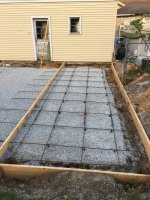
I personally will only use rebar in a concrete pad. It will be set on chairs so it's in the middle of the pad. Wire is impossible to walk on and keep in the middle of the pad. The most common lie told with concrete is that they will pull it up while spreading it.

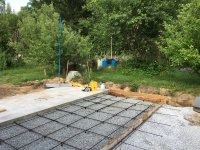
I have my rebar done before I pour my first pad. The form that divides that pads has notches in it so it fits over the rebar. When the concrete is dry, the form comes off, and then goes to the edge of the next pad.

Pouring one pad in a day wears me out, so I do them once a week. During the week, I buy another pallet of concrete, move my forms, clean up the area and stage everything for the next pour on Saturday morning. I'm in no rush to finish, and the more time I take to get everything in place, the easier it goes.

View attachment 1907195

View attachment 1907196
That sounds about my speed, which means all the more reason to buy a mixer rather than renting.

How do you join the pours? Just wet against dry or do you put in an expansion strip.
 
   / How big of a slab could I do by myself? #62  
I personally will only use rebar in a concrete pad. It will be set on chairs so it's in the middle of the pad. Wire is impossible to walk on and keep in the middle of the pad. The most common lie told with concrete is that they will pull it up while spreading it.

I have my rebar done before I pour my first pad. The form that divides that pads has notches in it so it fits over the rebar. When the concrete is dry, the form comes off, and then goes to the edge of the next pad.

Pouring one pad in a day wears me out, so I do them once a week. During the week, I buy another pallet of concrete, move my forms, clean up the area and stage everything for the next pour on Saturday morning. I'm in no rush to finish, and the more time I take to get everything in place, the easier it goes.

View attachment 1907195

View attachment 1907196
That's pretty much how I did mine, only I didn't notch the side form for the rebar, I drilled a hole.

1st pour
(click to enlarge)

IMG_1947.jpeg

2nd pour
(click to enlarge)
IMG_2576.jpeg
 
   / How big of a slab could I do by myself? #63  
I do it the same as Moss did. I remove the form and install it in the next position, then pour the concrete so it's touching the first pour. I use a edging tool to make it all look nice.

For me, it's not important that it looks perfect. I just need it flat and smooth enough to sweep it. When I want it perfect, I hire the pros. I can get it pretty good with a screed board and a trowel, but nobody is going to look at it and say that they would pay for that level of finish!!!

IMG_0349.JPG

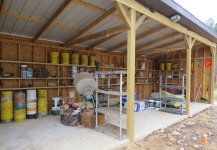
When I'm all caught up on everything else, I'll pour concrete in front of the shed too. But I don't see that happening any time soon.
 
   / How big of a slab could I do by myself? #64  
I do it the same as Moss did. I remove the form and install it in the next position, then pour the concrete so it's touching the first pour. I use a edging tool to make it all look nice.

For me, it's not important that it looks perfect. I just need it flat and smooth enough to sweep it. When I want it perfect, I hire the pros. I can get it pretty good with a screed board and a trowel, but nobody is going to look at it and say that they would pay for that level of finish!!!

View attachment 1907243

When I'm all caught up on everything else, I'll pour concrete in front of the shed too. But I don't see that happening any time soon.
I'd read a lot of your posts well before my garage project, so I was convinced on the rebar on chairs VS wire mesh. The rebar wasn't very expensive at all, I bought a cheap bender, but only used it for really tight 90s. Most of the time I just bent it over my knee..... GRRRRRRR!!!!!! AAAHHHHH!!!!! :ROFLMAO:

But I did use a lot of it. Several down the footing tubes, several in the skirt around the edges, drilled and epoxied into the existing garage slab every couple feet and about a 2'x2' grid in the whole thing.

Since I used 2x6 in center, I had at least 5.5" to work with to keep the rebar in the center of the slab. The outsides were 2x12".

Building inspector seemed happy.

Originally, I thought I could just do a slab with no footings. A contractor told me that since I was adding X square feet to an existing building, even though that original building was just a slab, the total square feet of the entire structure was over the square foot limit and would require a full frost wall on footings. So I was looking at 96' of 4' wall on a 12" footing on all four sides. That was going to double the budget for the entire garage addition.

So I went to the county building department and asked why I had to do full wall below frost line when neighbor did the exact same thing, but a pole barn, and only needed sonotube footings under each post?

He said pole barn is different than stick built. I asked how? He said the footings supported the posts. To which I said, "and nothing is supporting the slab, since it's poured directly on the dirt, not on any footings." And I asked if I could just put in 4' footings every 8' like the pole barn, tie them into the skirt wall of the slabs, pour the slab over the tops of the footings and everything would be supported. I'd even put footing every 8' inside the slab as well.

He agreed and let me do it. So I went from 96' of 4' wall to 16 of 4'x12" sonotubes. That was a huge savings for us. (y)
 
   / How big of a slab could I do by myself? #65  
Here in Texas, there is no Code if you live outside city limits. I try to do "best practices" in what I'm building, and I'm familiar with Code in CA and TX, but since I don't have to pass any inspection, I can get away with whatever I want. Skipping on rebar isn't an option for me. I like it on an 18 inch grid. If I go closer, I trip over it. 24 inches is Code, but for the cost of a few extra sticks of rebar, it's an easy upgrade.
 
   / How big of a slab could I do by myself? #66  
I've never poured nor finished a slab. The wife and I did "make" a 6 foot by 54 foot walk way. Got a heavy duty fibreglass form. It's nine - six sided tiles. All bonded together into a 3 by 3 form. Clear the sod and organics - lay down and compact three inches of gravel.

Lay the form on the gravel and fill with wet concrete. Smack the form and concrete to ensure all nine cubes are filled and smooth on top. Let it set ten minuets. Pull the form and reset. Butting right up tight to the one just poured. The form is four inches deep.

So you end up with a poured square. 3 x3 with nine tiles that are four inches thick.

The beauty of this. If you do a good job on the gravel base - no need for rebar AND you can stop when tired and restart whenever.

We did this walkway in '91 and it's still in excellent shape. Particularly - no frost heaves.

After a month or so - brought in wheelbarrows of sand. Dumped on the walkway - broomed the sand into the cracks between all the tiles with a push broom.
 
Last edited:
   / How big of a slab could I do by myself? #67  
I'd read a lot of your posts well before my garage project, so I was convinced on the rebar on chairs VS wire mesh. The rebar wasn't very expensive at all, I bought a cheap bender, but only used it for really tight 90s. Most of the time I just bent it over my knee..... GRRRRRRR!!!!!! AAAHHHHH!!!!! :ROFLMAO:

But I did use a lot of it. Several down the footing tubes, several in the skirt around the edges, drilled and epoxied into the existing garage slab every couple feet and about a 2'x2' grid in the whole thing.

Since I used 2x6 in center, I had at least 5.5" to work with to keep the rebar in the center of the slab. The outsides were 2x12".

Building inspector seemed happy.

Originally, I thought I could just do a slab with no footings. A contractor told me that since I was adding X square feet to an existing building, even though that original building was just a slab, the total square feet of the entire structure was over the square foot limit and would require a full frost wall on footings. So I was looking at 96' of 4' wall on a 12" footing on all four sides. That was going to double the budget for the entire garage addition.

So I went to the county building department and asked why I had to do full wall below frost line when neighbor did the exact same thing, but a pole barn, and only needed sonotube footings under each post?

He said pole barn is different than stick built. I asked how? He said the footings supported the posts. To which I said, "and nothing is supporting the slab, since it's poured directly on the dirt, not on any footings." And I asked if I could just put in 4' footings every 8' like the pole barn, tie them into the skirt wall of the slabs, pour the slab over the tops of the footings and everything would be supported. I'd even put footing every 8' inside the slab as well.

He agreed and let me do it. So I went from 96' of 4' wall to 16 of 4'x12" sonotubes. That was a huge savings for us. (y)
Looking back at the photos, looks like I didn't put the 4 footings in the middle.... oops! Can't go back now. Inspector never said anything. Not sure if he even came back out after the first inspection before the first pour. :ROFLMAO:
 
   / How big of a slab could I do by myself? #68  
I personally will only use rebar in a concrete pad. It will be set on chairs so it's in the middle of the pad. Wire is impossible to walk on and keep in the middle of the pad. The most common lie told with concrete is that they will pull it up while spreading it.
C'mon Eddie! They double dog pinky swore they would lift it as they went! Where's the trust? ;)
 
   / How big of a slab could I do by myself? #69  
C'mon Eddie! They double dog pinky swore they would lift it as they went! Where's the trust? ;)
I wire tie the wire to a brick to keep it off the ground. Rebar grid mat also does an excellent job, just run some #4 at 24" OC. Really, both are over kill for a non-structural shed floor, but both keep it together if it starts to crack,
 
   / How big of a slab could I do by myself?
  • Thread Starter
#70  
OK, one more question while I have you all.

The walls of the garage are concrete block. Should I pour against them or put in an expansion strip? If so, what? My inclination is to put in a piece of treated 2x4, held by Tapcons, so I have something to screed against. Would something thinner work as well, like 1/2" treated plywood?

If not, how do I screed against the wall?
 
   / How big of a slab could I do by myself? #71  
ok I'll bite
what's BFI?

OK, one more question while I have you all.

The walls of the garage are concrete block. Should I pour against them or put in an expansion strip? If so, what? My inclination is to put in a piece of treated 2x4, held by Tapcons, so I have something to screed against. Would something thinner work as well, like 1/2" treated plywood?

If not, how do I screed against the wall?
I think somebody mentioned this, in the reasons they poured strips along each side and then poured the middle. Gives you something to hold the skeed without bumping the wall. You can do a couple strips and just finish them with a trowel.
David from jax
 
   / How big of a slab could I do by myself? #72  
OK, one more question while I have you all.

The walls of the garage are concrete block. Should I pour against them or put in an expansion strip? If so, what? My inclination is to put in a piece of treated 2x4, held by Tapcons, so I have something to screed against. Would something thinner work as well, like 1/2" treated plywood?

If not, how do I screed against the wall?
I have done what you are saying and just used cut nails to place the fiber expansion joint and screed off that. A 2x4 would work as well, but then you have a 2x4 stuck in your concrete, that looks like crap. You could strip that 2x4 after everything is screeded and work it back by hand. I "think" the 2x4 should offer a flexible enough piece that thermal expansion shouldn't be a problem, but I don't know that for sure. What you describe is exactly what expansion joint material is made for.
 
   / How big of a slab could I do by myself? #73  
Concrete expands when it's hot, contracts with it's cold. The most common way to deal with this is putting a 1x4 board between each slab.

For your slab, and especially since it's going to be done in three pours, I wouldn't worry about it.

For the existing wall, just use a chalk line, or draw a straight edge along the block. Then while you just follow the line as you screed your concrete. If it starts to get wavy, or not very flat, turn your screed board along the wall and work it that way to create a flat, level surface, then screed off of that surface.

Do you have an SDS Rotary Hammer Drill? They have come down on price quite a bit, but they are also cheap to rent. You will want one for drilling into your block wall to slide the rebar into it. I normally use Liquid Nails, or something like that, to anchor the rebar in the holes. Just fill up the hole and then slide the rebar into it.


OK, one more question while I have you all.

The walls of the garage are concrete block. Should I pour against them or put in an expansion strip? If so, what? My inclination is to put in a piece of treated 2x4, held by Tapcons, so I have something to screed against. Would something thinner work as well, like 1/2" treated plywood?

If not, how do I screed against the wall?
 
   / How big of a slab could I do by myself? #74  
If you do the "outside" two pours first, the new slab only has a single rigid point *the CMU walls) and can expand/contract on the free, inside edge. I would place expansion joint between the two outside pours and the inside pour. I dont double Eddie on leaving a 1x4 in place working, but it looks half butt, isn't cheaper than expansion joint, which is made foe the task, and is easy worked with, and readily available. Once all 3 pours are complete, wait 28 days, and caulk over the expansion joint with a polybutylene rubber, and you will have a good looking point.

BTW, I did skip expansion joint in mine, but it's not the "right" way to do things
 
   / How big of a slab could I do by myself? #75  
Also, someone mentioned pouring an entrance at the door. I would definitely want expansion between this e trance "ramp" and the main slab. It also would be a good idea, even if it's just a 3×12, or 3x13-14, extending 6-12" left and right beyond the door way.
 
   / How big of a slab could I do by myself? #76  
Rethink concrete pavers. Installed on a proper base they are much easier to handle than concrete.
On the base sprinkle some lime/cement over the base just prior to laying the bricks. For finishing sprinkle concrete and very fine sand on the floor, brush it smooth and wet it well and keep wet for a half a day or so. Using a rough cut 2x10 plank under the jack eliminates the problems previously mentioned.
 
   / How big of a slab could I do by myself? #77  
I like concrete pavers for a lot of things. Walkways, patios, even driveways. But not for a parking area, or the floor of a building. For me, sweeping is very important, and nothing beats the flat smooth finish of concrete. Even if it's not perfect, like my concrete work, it's still easy to sweep.

The other issue with pavers is the cost. Off the top of my head, I think the last time I did the math, pavers where three times as much money as concrete.
 
   / How big of a slab could I do by myself? #78  
Nothing wring with expansion joints, but for such a small building, I think it's extra work without any measurable benefit. Especially if you pour it in three pads.

I agree that having the seams of the three joints showing at the front of the building isn't ideal. But for me, I wouldn't care about that. If I was hiring it out, and I was expecting it to have a really nice finish, a lot better then I'm capable of, then yes, make the entry perfect to. But for a DIY project, for a utility building, when cost is a factor, I don't see the advantage of making the project any harder.
 
   / How big of a slab could I do by myself?
  • Thread Starter
#79  
Do you have an SDS Rotary Hammer Drill? They have come down on price quite a bit, but they are also cheap to rent. You will want one for drilling into your block wall to slide the rebar into it. I normally use Liquid Nails, or something like that, to anchor the rebar in the holes. Just fill up the hole and then slide the rebar into it.
I have a cheap one and it's one of my favorite tools. It makes Tapcons a cinch.

One technique I've read about is to use a 2x6 ripped in half as a guide along the walls. Align the bottom of it with the level of the concrete and attach it with Tapcons. Use a 2x6 as your screed board, and cut a notch in the screed board so that the bottom is flush with the bottom of the guide board. Once the concrete is placed remove the guide board and finish the surface.
 
   / How big of a slab could I do by myself? #80  
I can see how that would work. But I think it’s an extra step that isn’t needed. With a straight line against the block, it’s pretty easy to get the concrete where you want it.

Just start working the concrete as soon as you have enough in there to spread it out. Then work your way back to the mixer.

When pulling the concrete after dumping it, don’t worry about what goes under the rebar. Just keep pulling what’s above the rebar

Get a tool for pulling concrete. It looks like a super wide hoe. I think mine is about 18 inches wide. I broke the wood handle on it a decade ago and now it has 3/4 copper pipe for a handle because that’s what I had laying around.
 

Tractor & Equipment Auctions

2015 MACK CHU613 DAY CAB ROAD TRACTOR (A58375)
2015 MACK CHU613...
1977 Heil T/A Tanker Trailer (A59230)
1977 Heil T/A...
Case 1020 25ft Draper Head (A56438)
Case 1020 25ft...
2016 Jeep Compass 4X4 SUV (A56859)
2016 Jeep Compass...
Le Roi 80-Gallon Air Compressor, 220 Volts (A59076)
Le Roi 80-Gallon...
2014 International Maxxforce DT (A53317)
2014 International...
 
Top