Setting Fence Posts Issue

   / Setting Fence Posts Issue #1  

Furu

Veteran Member
Joined
Nov 20, 2009
Messages
1,016
Location
.
Tractor
.
I have been setting a LOT of farm/ranch wood fence posts (Round not 4x4) and ran into an issue yesterday that I have not previously had.
Most of my ground is hard clay and I do mean HARD and DRY clay.
In my one corner at the end of a 1600 foot run I dug two holes yesterday by hand as the hydraulic post driver could not get there and found water at 21 inches below grade. "Great" high water table in that location! What are my best options to keep post from rotting out?
Looked on line and found a sleeve that is designed to prevent rotting at grade but I thought I had heard of a sleeve that will protect the post all the way to the bottom of the hole.
This morning found the water had risen to 12 inches below grade so it is even worse than yesterday.

Does anyone have any knowledge of how to protect a post that is set in a high moisture ground condition. Most likely it is seasonal but I never knew this specific corner had such a high water table.
 
   / Setting Fence Posts Issue #2  
I would bet that my posts are damp most of the year at 30" deep. They always seem to rot off near the surface though while being solid down deep.
 
   / Setting Fence Posts Issue #3  
We've had a fair amount of rain lately and if I went and dug a post hole right now there is a good chance that it would have water in it. That doesn't mean your water table is that high though. You just have moisture in the ground that is converging on that hole because you removed soil and it will flow to the point of least resistance.

I would just sink the post, tamp it in good and not worry about it.
 
   / Setting Fence Posts Issue #4  
Every wood post that has broken, was weak within the first 12 inches below the ground. The rest of the post in the ground was solid and a bear to remove. I have been wrapping replacement wood posts with plastic in that 12 inch zone to separate the wood from the earth. I'll let everyone know the results in 20 years.
 
   / Setting Fence Posts Issue #5  
I have been setting a LOT of farm/ranch wood fence posts (Round not 4x4) and ran into an issue yesterday that I have not previously had.
Most of my ground is hard clay and I do mean HARD and DRY clay.
In my one corner at the end of a 1600 foot run I dug two holes yesterday by hand as the hydraulic post driver could not get there and found water at 21 inches below grade. "Great" high water table in that location! What are my best options to keep post from rotting out?
Looked on line and found a sleeve that is designed to prevent rotting at grade but I thought I had heard of a sleeve that will protect the post all the way to the bottom of the hole.
This morning found the water had risen to 12 inches below grade so it is even worse than yesterday.

Does anyone have any knowledge of how to protect a post that is set in a high moisture ground condition. Most likely it is seasonal but I never knew this specific corner had such a high water table.
Where are you? Assuming that you do not have easy access to cypress or locust, I would choose either a marine grade pressure treated post UCB4 (or better), or creosote treated, or switch to a steel post, or pour a concrete pier and bolt a post to it.

There are vinyl sleeved wood posts that are said to protect against insects, but I have no experience with them. IIRC, they are not cheap.

Clay soils will always hold water against the post and that tends to make even normal pressure treated wood decay in a few years, at least around here. Hereabouts, old growth redwood tends to resist rot for 100+ years. Newer redwood, not so much. After losing a bunch of pressure treated "ground contact rated" fence posts, I have gone to treating my UCB4B rated posts with 17% copper naphthenate (2% copper) by brushing it on until it is no longer absorbed.

Good luck,

Peter
 
   / Setting Fence Posts Issue #6  
Furu, don't worry about the wood below the water level rotting, it won't. Wood will rot in the first 4" of ground where there is ready access to oxygen for the rot/fungi to breathe. In 30 years when the fence is replaced you will find the base of the post sound with a "collar" of rotted wood at the ground level point.
I recommend you use naturally ground durable species of timber, treated wood or steel(galvanised, as clay is corosssive).
 
   / Setting Fence Posts Issue #7  
Wood rots because the living organisms in the dirt have the proper condition to eat the wood. Water and air. Wood submerged in water 100% of the time does not rot. Same with wood in the ground that air cannot get to, does not rot.

The problem with wood posts in the ground happens at ground level. The biggest reason is when people fill in around the post with soil, the ground settles over the years because it's loose soil, and you get an area that holds water. Filling with dirt is probably the biggest reason wood posts rot.

If you fill with concrete, the post will be stronger, but even more important, you build up around the post with the concrete to create a crown so the water will flow away from the post. If water cannot sit next to the post, the post will not rot.

Early on, I filled some of my wood posts with dirt and compacted it with the a shovel handle in lifts. I felt that I did a pretty good job. I even built up the dirt so water would flow away from the post. In less then a year, the dirt had settled, or washed away to the point that water was sitting at the base of the post. In my opinion, it is impossible to keep water away from a post with dirt.

Recently I've been building a new fence and removing my old fence. I'm using better wire, more wood posts and trying to make it the best fence possible. I use my front loader with a chain to pull the wood posts out. The ones in dirt come out super easy. The tractor is at idle and it doesn't take any effort at all. I'd say they come out as easy as T posts. The posts set in concrete need more RPM's to pull out, and the front tires compress noticeably before the post breaks free. There is a night and day difference in how much harder it is to pull a post set in concrete.
 
   / Setting Fence Posts Issue #8  
Have used a lot of post setting foam. Works well in wet areas. You would just need to pump out most of the water when setting the post.

 
   / Setting Fence Posts Issue #9  
   / Setting Fence Posts Issue
  • Thread Starter
#10  
Where are you? Assuming that you do not have easy access to cypress or locust, I would choose either a marine grade pressure treated post UCB4 (or better), or creosote treated, or switch to a steel post, or pour a concrete pier and bolt a post to it.

There are vinyl sleeved wood posts that are said to protect against insects, but I have no experience with them. IIRC, they are not cheap.

Clay soils will always hold water against the post and that tends to make even normal pressure treated wood decay in a few years, at least around here. Hereabouts, old growth redwood tends to resist rot for 100+ years. Newer redwood, not so much. After losing a bunch of pressure treated "ground contact rated" fence posts, I have gone to treating my UCB4B rated posts with 17% copper naphthenate (2% copper) by brushing it on until it is no longer absorbed.

Good luck,

Peter
Not sure my clay will hold water most of the time. Not exactly moist here most of the time and this was a dry winter. Very low snow fall. This is the first time I have found any clay that was not hard and dry. This area (corner) obviously is different. What I did not mention is that I found a gravel and sandy clay combination at 20 inches like drillers find where they hit water when drilling. As I said the next morning the water was at 12 inches and the following day I had water at grade. The soil in the area is pretty much dry (slightly moist maybe)at the surface and for the first 12 inches of digging. For the water to rise to grade there must be enough hydraulic pressure to force the water up that much. It is almost like I now have a small spring.
 
   / Setting Fence Posts Issue #11  
In my opinion, it is impossible to keep water away from a post with dirt.
Eddie,

I've seen many posts get set using concrete, but the concrete does not entirely fill the hole. The homeowner adds a final layer of dirt over the concrete so it is more visually pleasing instead of seeing a block of concrete.

Leaving such a layer seems to invite the layer of ground rot you have experienced. When you set posts in concrete now, do you bring the concrete up to grade, and maybe a little beyond with a crown>
 
   / Setting Fence Posts Issue #12  
For my gate and one property corner I use REAL railroad ties. Exceedingly heavy and gooey in warm weather.

They have been there 42+ years and are still solid as a rock.

The remainder of my fence - T-145 steel posts and barbed wire.
 
   / Setting Fence Posts Issue #13  
Keep digging, eventually you'll be through the clay into a aquifer or gravel seam that will drain away the water.... or not 😉
 
   / Setting Fence Posts Issue #14  
For my gate and one property corner I use REAL railroad ties. Exceedingly heavy and gooey in warm weather.

They have been there 42+ years and are still solid as a rock.

The remainder of my fence - T-145 steel posts and barbed wire.

I have a bunch of 25 year old railroad ties that are still plenty solid. My shipping container sits on 8 of them, and the others were made into a bridge over my small stream. They are stamped as coming out of New York City, presumably from the subway?
Even in my younger days I recall them being God awful heavy.
 
   / Setting Fence Posts Issue #15  
Did you know - a healthy, reasonably strong man CAN NOT lift one end of a full RR tie? It's no wonder they leave ties stacked out in the open and unprotected.

It was right at the very limit of our abilities. A friend and I lifted and slid six RR ties into my pickup. I certainly appreciated what the tractor could do when I got these ties home.
 
   / Setting Fence Posts Issue #16  
Eddie,

I've seen many posts get set using concrete, but the concrete does not entirely fill the hole. The homeowner adds a final layer of dirt over the concrete so it is more visually pleasing instead of seeing a block of concrete.

Leaving such a layer seems to invite the layer of ground rot you have experienced. When you set posts in concrete now, do you bring the concrete up to grade, and maybe a little beyond with a crown>
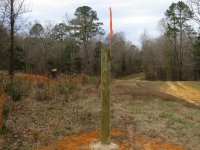
I build up the concrete above grade, into a crown so the water will flow away from the post.

This is a corner post that I put in after the Surveyor marked it. My land is on the left of the post.

IMG_0395.JPG
 
   / Setting Fence Posts Issue #17  
Not sure my clay will hold water most of the time. Not exactly moist here most of the time and this was a dry winter. Very low snow fall. This is the first time I have found any clay that was not hard and dry. This area (corner) obviously is different. What I did not mention is that I found a gravel and sandy clay combination at 20 inches like drillers find where they hit water when drilling. As I said the next morning the water was at 12 inches and the following day I had water at grade. The soil in the area is pretty much dry (slightly moist maybe)at the surface and for the first 12 inches of digging. For the water to rise to grade there must be enough hydraulic pressure to force the water up that much. It is almost like I now have a small spring.
I have spots like that as well; water gets into the gravel and flows for through it going down hill. The funny ones, for me at least, are the ground squirrel burrows that turn into bubblers an inch or two high of bubbling water after heavy rains. The water gets into the burrows up the hill, and then erupts like a garden hose lower down. We also have some historic iron pipes that drain water for the same reasons.

My thoughts are that if the water drains in to your fence post holes now, it will probably keep draining over the years. If it were me, I would be very tempted to use @EddieWalker's concrete method for posts in that area.

All the best,

Peter
 
   / Setting Fence Posts Issue #18  
I build up the concrete above grade, into a crown so the water will flow away from the post.
I really like this-- thanks!

I am about to build a decorative fence at my side yard. Using cedar I milled in CA but that's another story ...

The only thing I don't like about the crown/concrete is the aesthetics. It looks fine in a pasture but along side a green lawn it might conflict. I've never colored any concrete-- maybe doing that would be a good compromise for residential use? To make it blend in a little better?
 
   / Setting Fence Posts Issue #19  
Concrete is easy to paint, you just have to use a primer that is designed to be used on concrete. Once it's primed, you can paint it any color.
 
   / Setting Fence Posts Issue #20  
Even in my younger days I recall them being God awful heavy
My father kept telephone poles and other lumber around so that he had it when he needed it. He also had a stack of RR ties which were great for a lot of things.
One day he put a pulp hook into one of them, heaved... and dislocated his shoulder. The first thing he did after healing from the surgery was put them out at the side of the road (using the tractor) with a "free" sign on them.
 

Tractor & Equipment Auctions

2020 INTERNATIONAL REEFER TRUCK (A58214)
2020 INTERNATIONAL...
2024 CATERPILLAR 255 SKID STEER (A52707)
2024 CATERPILLAR...
2010 International 4300 2,000 Gallon Water Truck (A55973)
2010 International...
FOUR WAY BLADE SKID STEER ATTACHMENT (A58214)
FOUR WAY BLADE...
2017 Toro Sand Pro 5040 Bunker Rake (A59228)
2017 Toro Sand Pro...
2013 Land Rover Range Rover Sport 4X4 SUV (A55853)
2013 Land Rover...
 
Top