Help w compressor selection.

   / Help w compressor selection. #1  

arrow

Super Member
Joined
Dec 15, 2002
Messages
6,248
Location
Wakefield, RI
Tractor
Mahindra 3016
So the new place needs a little bit of air.
I don't paint with it so I'm not thinking I need a 60 gallon.
30 gal would seem plenty.
I like Quincy stuff but over the last few years, their offerings of 30 gal compressors have been eliminated.
The largest garage type they make went from 27 gal to 24 gal. I called them and was told their compressors would outwork a 30 gal because their motors stuff more air in a smaller place(can that be true?)
At any rate, Northern products has a 30 gal and it is rated at 5.3 recovery at 90 and 6.2 @40psi.
The Quincy at 24 gal, is rated at 7.4 @ 100 and 8.3 cfm at 40.
The Northern Products has a 1.6 hp motor while the Quincy claims 2 hp.
They are priced about the same at a bit over $800. I use the compressor for impact, die grinding, scaling and chiseling.
So for the more knowledgeable out there , which one? The 30 gal Northern or the 24 gal Quincy?
 
   / Help w compressor selection. #2  
So the new place needs a little bit of air.
I don't paint with it so I'm not thinking I need a 60 gallon.
30 gal would seem plenty.
I like Quincy stuff but over the last few years, their offerings of 30 gal compressors have been eliminated.
The largest garage type they make went from 27 gal to 24 gal. I called them and was told their compressors would outwork a 30 gal because their motors stuff more air in a smaller place(can that be true?)
At any rate, Northern products has a 30 gal and it is rated at 5.3 recovery at 90 and 6.2 @40psi.
The Quincy at 24 gal, is rated at 7.4 @ 100 and 8.3 cfm at 40.
The Northern Products has a 1.6 hp motor while the Quincy claims 2 hp.
They are priced about the same at a bit over $800. I use the compressor for impact, die grinding, scaling and chiseling.
So for the more knowledgeable out there , which one? The 30 gal Northern or the 24 gal Quincy?

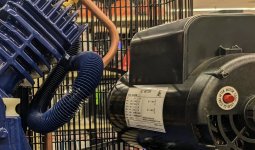
I was going to buy the well regarded QT 54 but they dropped the Baldor motors and now just say made in china. Then they jacked the price up another 200 bucks. That caused me to buy a different compressor.
Some Ads still show the Baldor motors.
Not sure on the smaller Quincy's but I would at least ask which motor you get.

Still a fan of their actual compressors

Have little doubt that the Quincy pump will outlast the Industrial air pump on my 80 gallon 2 stage
Not so confident on the motor.
 

Attachments

  • PXL_20230905_225829299.jpg
    PXL_20230905_225829299.jpg
    1 MB · Views: 113
Last edited:
   / Help w compressor selection. #4  
Like @sd455dan, I'm a fan of the older Quincy compressors, and a fan of the super efficient and reliable Baltor motors. As @ericm979 points, out CFS is CFM, and I would buy a low end Quincy over a NorthernTool any day, even if they had matching performance.

Quincy compressors can come set with higher tank pressures, so yes, more air in the same volume, but since almost all (home) uses need to lower the pressure to use in lines and tools, (OSHA, pipe and airline safety, and all that) so it is really only a win for a large shop with multiple users. For home uses, it just takes more energy. I would turn down the pressure switch to something like 90psi. As long as an impact wrench gets 90psi, or so, it is a happy camper. Grinders are air hogs, so make sure that your grinder isn't too far ahead of the compressor in terms of CFM.

I bought an Ingersoll compressor (SLS-3?) that I have been happy with for periodic heavy use for fifteen years, die grinding, tires, and impact wrenches for the most part. (Try airing up a semi tire with a Sears mini compressor...) I did add an intercooler to get more water out of the air before the air went into the main tank that really helped keep condensate out of my air lines.

Good luck!

All the best,

Peter
 
   / Help w compressor selection.
  • Thread Starter
#5  
7.4 cfm @100 psi beats 5.3 @90 any day. It won't matter for the impact wrenches but might for the die grinder. The tank size is just the buffer before the pump starts.
Ok, thank you Eric and PT
I have to check to see if the motor on the Quincy is a constant run type as opposed to a percentage run time.
 
   / Help w compressor selection. #6  
Don’t worry too much about tank size. Continuous CFM and pressure are the critical factors. See what your tool requirements are and buy accordingly.

Less flow and pressure may work but the wrenches and grinders will not preform properly.
 
   / Help w compressor selection.
  • Thread Starter
#7  
Like @sd455dan, I'm a fan of the older Quincy compressors, and a fan of the super efficient and reliable Baltor motors. As @ericm979 points, out CFS is CFM, and I would buy a low end Quincy over a NorthernTool any day, even if they had matching performance.

Quincy compressors can come set with higher tank pressures, so yes, more air in the same volume, but since almost all (home) uses need to lower the pressure to use in lines and tools, (OSHA, pipe and airline safety, and all that) so it is really only a win for a large shop with multiple users. For home uses, it just takes more energy. I would turn down the pressure switch to something like 90psi. As long as an impact wrench gets 90psi, or so, it is a happy camper. Grinders are air hogs, so make sure that your grinder isn't too far ahead of the compressor in terms of CFM.

I bought an Ingersoll compressor (SLS-3?) that I have been happy with for periodic heavy use for fifteen years, die grinding, tires, and impact wrenches for the most part. (Try airing up a semi tire with a Sears mini compressor...) I did add an intercooler to get more water out of the air before the air went into the main tank that really helped keep condensate out of my air lines.

Good luck!

All the best,

Peter
I checked on this model. Northern no longer carries it but it can be purchased direct from IR for about $150 bucks more than the Quincy ($1019).
I have to see if the new place has a 220 outlet in the garage.
 
   / Help w compressor selection.
  • Thread Starter
#8  
Ok, thank you Eric and PT
I have to check to see if the motor on the Quincy is a constant run type as opposed to a percentage run time.
Nope
The Quincy 24 gal has a 50% duty rating.
The IR is looking better and better.
 
   / Help w compressor selection. #9  
Myself, I have a Saylor Beal vertical 2 stage twin on an 80 gallon receiver with a 7.5 horse cap start, cap run 240 American made motor that has been running for 35 years, no issue. I would never buy anything from Northern tool except a Quincy or an IR all the rest are Chinese. I also have a Sullaire screw compressor because I use a huge amount of compressed air when running my CNC plasma table but the screw compressor only runs when I use the table. All my shop air lines are in steel pipe with drops (and condensate drains on each) place around the shop in convenient spots. However, I keep the screw compressor's receiver pressurized whether it's running or not because the more receiver capacity you have, the less a compressor has to run to maintain air pressure.

I have my entire system set for 135 psi which is all you really need for air powered tools and the lower the static pressure you run, the less condensate is produced plus I have automatic condensate drains on the compressors as well and all my air tools as well as all my air outlets are high volume Milton quick disconnects.

The higher the standing pressure is in any system, the shorter life your compressor will have, simply because at higher pressures, carbon builds up on the valves in the compressor(s) and eventually, they need to be rebuilt. 135 psi will run any air tool and I have a lot of them. From impact's to die grinders to blow guns to air greasers.
 
   / Help w compressor selection.
  • Thread Starter
#10  
Myself, I have a Saylor Beal vertical 2 stage twin on an 80 gallon receiver with a 7.5 horse cap start, cap run 240 American made motor that has been running for 35 years, no issue. I would never buy anything from Northern tool except a Quincy or an IR all the rest are Chinese. I also have a Sullaire screw compressor because I use a huge amount of compressed air when running my CNC plasma table but the screw compressor only runs when I use the table. All my shop air lines are in steel pipe with drops (and condensate drains on each) place around the shop in convenient spots. However, I keep the screw compressor's receiver pressurized whether it's running or not because the more receiver capacity you have, the less a compressor has to run to maintain air pressure.

I have my entire system set for 135 psi which is all you really need for air powered tools and the lower the static pressure you run, the less condensate is produced plus I have automatic condensate drains on the compressors as well and all my air tools as well as all my air outlets are high volume Milton quick disconnects.

The higher the standing pressure is in any system, the shorter life your compressor will have, simply because at higher pressures, carbon builds up on the valves in the compressor(s) and eventually, they need to be rebuilt. 135 psi will run any air tool and I have a lot of them. From impact's to die grinders to blow guns to air greasers.
You have a world class set up there.
Hate to tell ya 5030.
but the small Quincy is also made in China now.
The thing that turns me off on the Quincy is the duty cycle.
50% is not gonna cut it with that small of a tank.
The 60 gal IR has a continuous run motor as well.
And for only $150 more, It's looking better and better.
Now to hunt down to see if the previous owner popped in a 220 outlet in the garage some where.
 
   / Help w compressor selection. #11  
You have a world class set up there.
Hate to tell ya 5030.
but the small Quincy is also made in China now.
The thing that turns me off on the Quincy is the duty cycle.
50% is not gonna cut it with that small of a tank.
The 60 gal IR has a continuous run motor as well.
And for only $150 more, It's looking better and better.
Now to hunt down to see if the previous owner popped in a 220 outlet in the garage some where.


I also have an Ingersoll Rand 60 gallon compressor I bought in 1985 and it is still running well with a Century motor but It has a lot of hours and needs a filter or two because it pumps a little oil
So for painting I need cleaner air. I would have bought another IR but they dropped parts support for the pump and reviews on the newest ones has been a bit spotty.
 
   / Help w compressor selection. #12  
You have a world class set up there.
Hate to tell ya 5030.
but the small Quincy is also made in China now.
The thing that turns me off on the Quincy is the duty cycle.
50% is not gonna cut it with that small of a tank.
The 60 gal IR has a continuous run motor as well.
And for only $150 more, It's looking better and better.
Now to hunt down to see if the previous owner popped in a 220 outlet in the garage some where.

You remind me that the 100% duty rating is why I bought it. When we are die grinding, it runs 80-90%. (Hoof trimming on horses.)

I think that I have had mine 15 or so years. IR used to double the warranty if you used synthetic compressor oil, which I would recommend regardless.

I made the intercooler out of a power steering cooling coil (copper, and suitable for the pressure), together with a 12V power supply (240V to 12V) and an automotive fan, followed by an auto drain 5 micron filter. Plus a few bits of copper tubing to hook things up. It gets a spoonful of water each cycle. Draining the tank now gets almost nothing, and I don't find anything downstream of the output filter.

I plumbed mine with one of those air kits that had plastic tubing rated for air. I wish that I had stepped up to the larger aluminum / plastic system that was perhaps 50%, but much better all around. I have had one elbow fail catastrophically, and was lucky that it was in a relatively enclosed location and the fragments bounced off of wood beams for the most part, so I wasn't in the line of fire. In hindsight, I think it was bad from the start, as I had a persistent slow air leak that I had never found, and after I replaced the elbow, I don't have any leak to speak of. (Well, closing off the lines from the compressor wil leak down over twelve hours or so.

I have a 5 micron filter near the compressor outlet before the air feeds into my piping. It gets a few droplets of water now and again.

For painting, I run the air through a follow up 2 micron and 0.02 micron filter before the sprayer, though I haven't seen anything on either filter. It seems to work, but I am not doing automotive body work, so YMMV.

All the best,

Peter
 
Last edited:
   / Help w compressor selection. #13  
I have Baldor Motors running 24-7 365 days a year in the 3, 5 and up to 20hp and they truly just keep going with only maintenance being a regular shot of bearing grease.

Speed Air 175 psi air compressor turned down to 75 psi approaching 30 years of daily use... It has a dryer for air and auto tank drain that cycles every 4 hours and the State comes out to inspect as it is a pressure tank... also Speed Air
 
Last edited:
   / Help w compressor selection. #15  
   / Help w compressor selection. #16  
I wouldn't get too worked up over the duty cycle. If you match your compressor stats properly to the tools you intend to use on it, it won't be a problem. My Quincy (albeit, larger than what you're looking at) almost never comes on. When it does, it's not on for very long. Using a constant demand tool like an air sander, or air grinder, will be harder on a compressor than and instant demand tool, like a nail gun, or even an impact wrench (proper sized impact to the size bolt/torque you need).

When I'm sanding a large piece, then yes my compressor comes on more often. But I'm not giving the air sander any down time at all, but running it for many minutes straight. When the compressor kicks on, it overcomes the tool demand and still has enough grunt to refill the tank and kick off again.

Cfm trumps all. Psi is almost meaningless, as about any compressor can "make" psi. If your compressor will "make" 100 psi, that's usually plenty. But it's the cfm that does the work. And it needs to be the cfm at tool-needed psi. Most common tools run between 90-100 psi. So a cfm rating on a compressor at 40 psi means nothing. What is it's cfm at 90? At 100? That is what matters. It's easy for a compressor to "make" cfm at low pressure. It's much harder for a compressor to "make" cfm at tool working pressure. Cheap compressors struggle with this.

Tank size helps with constant demand tools (like sanders/grinders). The bigger tanks can go longer between needing to "call" the compressor for more air. But having a compressor rated with enough grunt (cfm) to not only fill the tank, but also run the tool at the same time, is a boon. That means you are not stopping (ever) to let the compressor "catch up" to your usage.

Love my Quincy:

20190222_162901.jpg
 
   / Help w compressor selection. #17  
Buy a junk tank and a Harbor Freight 5 hp 2-stage compressor head. Put a whatever 5 hp motor on it and yo are good to go. Used 5 hp motors are cheap. I paid $25 for the one I used, and $15 for sealed bearings to replace the old oil cup bearings. I was able to use the PRV and switches from the junk compressor.


The problem with big compressors is that they live in the shop and nowhere else. I bought a little pancake compressor for portable air.
 
Last edited:
   / Help w compressor selection. #18  
I wouldn't get too worked up over the duty cycle. If you match your compressor stats properly to the tools you intend to use on it, it won't be a problem. My Quincy (albeit, larger than what you're looking at) almost never comes on. When it does, it's not on for very long. Using a constant demand tool like an air sander, or air grinder, will be harder on a compressor than and instant demand tool, like a nail gun, or even an impact wrench (proper sized impact to the size bolt/torque you need).

When I'm sanding a large piece, then yes my compressor comes on more often. But I'm not giving the air sander any down time at all, but running it for many minutes straight. When the compressor kicks on, it overcomes the tool demand and still has enough grunt to refill the tank and kick off again.

Cfm trumps all. Psi is almost meaningless, as about any compressor can "make" psi. If your compressor will "make" 100 psi, that's usually plenty. But it's the cfm that does the work. And it needs to be the cfm at tool-needed psi. Most common tools run between 90-100 psi. So a cfm rating on a compressor at 40 psi means nothing. What is it's cfm at 90? At 100? That is what matters. It's easy for a compressor to "make" cfm at low pressure. It's much harder for a compressor to "make" cfm at tool working pressure. Cheap compressors struggle with this.

Tank size helps with constant demand tools (like sanders/grinders). The bigger tanks can go longer between needing to "call" the compressor for more air. But having a compressor rated with enough grunt (cfm) to not only fill the tank, but also run the tool at the same time, is a boon. That means you are not stopping (ever) to let the compressor "catch up" to your usage.

Love my Quincy:

View attachment 828118


Were you lucky and got one with the Baldor before they switched?
 
   / Help w compressor selection. #19  
Buy a junk tank and a Harbor Freight 5 hp 2-stage compressor head. Put a whatever 5 hp motor on it and yo are good to go. Used 5 hp motors are cheap. I paid $25 for the one I used, and $15 for sealed bearings to replace the old oil cup bearings. I was able to use the PRV and switches from the junk compressor.


The problem with big compressors is that they live in the shop and nowhere else. I bought a little pancake compressor for portable air.

You know i may do this with the ingersoll

I noticed the local HF has that same pump head in the clearance section and it is now down under a $100 bucks.

If I do- I won't modify the IR to where, with some more searching some new rings can be sourced. Already have a spare motor and So far the new Black diamond 80 gallon 2 stage is running nice smooth and quiet, just about ready to dump the oil and switch to the full synthetic for the 4 year warranty. still think it was a bargain at $1399 during their sale 18 CFM @ 90 17.0 @175 900 RPM Pump speed.
 
   / Help w compressor selection. #20  
I have not shopped for or bought a new compressor in at least 15 years so I really don't know where various ones are made so I'll take your word on that. I'm confident that my Saylor-Beal and the Sullaire will outlast me by a long shot. The other day I was at a fab shop and the owner had a Speedaire sitting in the corner that looked basically new and he asked me if I was interested. I wasn't.
 

Marketplace Items

UNUSED FUTURE REMOTE CONTROLLED TOY (A60430)
UNUSED FUTURE...
2022 CATERPILLAR D4 LGP CRAWLER DOZER (A60429)
2022 CATERPILLAR...
13' ROLL OF CARPET (A60432)
13' ROLL OF CARPET...
2004 CATERPILLAR D5N XL HIGH TRACK CRAWLER DOZER (A60429)
2004 CATERPILLAR...
large capacity skid steer bucket (A56857)
large capacity...
2022 NIFTY TM34TE-MK1B TOW BEHIND BOOM LIFT (A60429)
2022 NIFTY...
 
Top