Pasture into hayfield

   / Pasture into hayfield #21  
According to my jug of 2-4D it kills alfalfa and clover which to me is a hayfield. If talking grasses then yes 2 - 4D is an option along with other pasture sprays.

If small area of thistles a long nosed shovel and pair of good leather gloves also work after nice soaking rain to dig the plants out. Slow process but effective for small areas.
Good observation and I said 24D because I have no idea how much alfalfa there is. I use (expensive) 24D(B) on my hayfields as the B will not kill alfalfa but be apprised there is only one company that makes it and it ain't cheap and unlike 24D which you can buy about anywhere, the B formulation has to come from an ag chemical outfit. I get mine from Wilbur Ellis.
 
   / Pasture into hayfield #22  
candidly, I've never refitted a field when developing one for forage. I'll do a soil sample and apply the proper amendments, usually in the early fall and overseed with vernal alfalfa for the winter and set the alfalfa seed with a large Fuerst drag mat. A couple fields I cut have never been refiited in over 10 years, I just keep up with overseeding and maintaining the correct nutrient levels, leaning on the side of extra boron. The fields continually produce very well. Alfalfa demands good nutrient uptake so I watch my levels all the time. Never plant hybrid (roundup ready alfalfa) either, always vernal because hybrid alfalfa is hard to control and I want them to always be mixed forage.
 
   / Pasture into hayfield
  • Thread Starter
#23  
be sure to take the whole thing down to the same depth then roll.

can you elaborate what you mean by this? I'm very new to this all. I'm guessing you mean grade down to the low spots then plow it over?

I've never refitted a field when developing one for forage.

what do you mean by refitted? Is that when you plow over the hayfield and disc and reseed?
 
   / Pasture into hayfield #24  
If the loose dirt is the same depth as the undisturbed soil you can level it and then run a cultipacker over it to "press" it into the low areas and if necessary level it again and cultipack again.
If you simply fill the holes with loose dirt the loose dirt will settle over time and return to a depression. It will likely be better than having done nothing but time will yield a better field for traveling rapidly over in the future.
 
   / Pasture into hayfield #25  
If the loose dirt is the same depth as the undisturbed soil you can level it and then run a cultipacker over it to "press" it into the low areas and if necessary level it again and cultipack again.
If you simply fill the holes with loose dirt the loose dirt will settle over time and return to a depression. It will likely be better than having done nothing but time will yield a better field for traveling rapidly over in the future.
If we tried to do that in MY area, it would bring lots of unwanted attention from government agencies. We have to get permits just to do farm field ditching. I live in an area once dominated by farming, but has now been taken over by “citidiots”.
I’m not saying what repete says to do is wrong in any way, but be sure to “read the room” before you bring in a dozer with rippers. It might be perfectly fine in your area, or it might require permits and lots of erosion and run-off protection.

We have more of a “leave it be” group overseeing what happens in our area. Probably why we are overrun with invasive species and have 100’ trees blocking everything now. Because of that, I take a more subtle approach and rehab fields one smaller area at a time. Don‘t like attracting attention from the “new environmentalists” in my area. I haven’t owned a sprayer for over 10 years and quite honestly, don’t agree with spraying chemicals at nauseam like some farmers.

Just one man’s opinion here, but for the price of hay, I would never spend that kind of money to get rid of bumps and low spots and I mean no disrespect to repetes ideas. Maybe would consider for a higher profit/acre crop.

I have invested in tractor with suspensions and attachments with tandem walking beam suspensions in some cases. That is how I make a bumpy field feel smoother.
 
Last edited:
   / Pasture into hayfield #26  
I just rehabbed 40 acres for a customer last summer. They had been farmed by a previous farmer who never did much anything but spray herbicides. Hemp dogbane was the worst invasive.
When I took over, yields were basically nothing-maybe (1)1,000lb round bale per acre (1/2 ton per acre). Essentially it had become what we call a “desert”.
Without using herbicides or chemical fertilizers, I was able to fix their issues for at least the foreseeable future. This is what we did:

1. Baled what little growth was left and got rid of it.
2. scalped ground down low with 15’ rotary mower before any weeds significantly went to seed.
3. applied 2 tons lime per acre (soil tests asked for 5 tons per acre).
4. aerated the soil vigorously. It looked very opened up when it was done. Aerated to a depth of about 15”.
5. waited a few months and applied another 2 tons/acre of wet lime.
6. in mid august we drilled in Rebel endophyte free fescue. Seedlings were 12” tall by October.
7. in mid fall, after seedlings emerged, we applied 1-2” of mushroom compost. We waited until seedlings were strong enough to handle tractor with minimal loss.
8. by late June of the following year, we were baling new grass hay at about 2 tons per acre.

We expect 2nd cutting to be almost as heavy since bunch clumps of grasses are just starting to get bigger. Next year we expect yields to be even higher with continued organic fertilizing, lime and other key nutrients.

We didn’t use any herbicides or pesticides and we won’t in the future. We will apply another round of lime this august at 2 tons/acre.
 
   / Pasture into hayfield #27  
If we tried to do that in MY area, it would bring lots of unwanted attention from government agencies. We have to get permits just to do farm field ditching. I live in an area once dominated by farming, but has now been taken over by “citidiots”.
I’m not saying what repete says to do is wrong in any way, but be sure to “read the room” before you bring in a dozer with rippers. It might be perfectly fine in your area, or it might require permits and lots of erosion and run-off protection.

We have more of a “leave it be” group overseeing what happens in our area. Probably why we are overrun with invasive species and have 100’ trees blocking everything now. Because of that, I take a more subtle approach and rehab fields one smaller area at a time. Don‘t like attracting attention from the “new environmentalists” in my area. I haven’t owned a sprayer for over 10 years and quite honestly, don’t agree with spraying chemicals at nauseam like some farmers.

Just one man’s opinion here, but for the price of hay, I would never spend that kind of money to get rid of bumps and low spots and I mean no disrespect to repetes ideas. Maybe would consider for a higher profit/acre crop.

I have invested in tractor with suspensions and attachments with tandem walking beam suspensions in some cases. That is how I make a bumpy field feel smoother.
I am in total agreement Hay Dude. There is a limit to how much to do and how much roughness one can tolerate, just up to the individual to know each limit for themselves. I was thinking large discs that can work the ground down as opposed to rippers, that would be a bit extreme.

I think most everybody is dealing with the "leave it alone and let it grow back naturally" people. Those same people do nothing to restore their cities to what they looked like 100 years ago but rather focus on the rural areas. Think salmon spawning beds in downtown Seattle that once had fish runs in neighborhood creeks as compared to how rural folks need to stay 150' from any fish bearing stream.

Don't get me wrong, I do not believe in trashing the environment but I do tire of the double standard...
 
   / Pasture into hayfield #28  
There is 2,4-D amine which will kill broadleafs like wild mustard, may knock back legumes depending on how heavy, but won't kill thistles. I use that on my underseeded small grain to kill mostly wild mustard and dragonhead mint. There is also 2,4-D ester which is more volatile making it easier to enter the plant and as a rule, can kill tougher to kill plants. 2,4-D amine is a commonly used brush killer here in MN. I have a hay field that for some reason has a lot of thistle in it this year. I am going to try 2,4-D ester because the amine hasn't touched it. A problem is how long the weed seed can survived in the soil. We need to knock back wild mustard every year. I read that mustard seed can survive 90 years in the soil. I'm 76 now so never going to get rid of it. Your area of MN - I bought used equipment from there. I got a very good price on a heavy disk due to blade damage from rocks. Do you have only a few large rocks with which to contend or do you have small rocks scattered? I would go more with chisel, cultivate, seed with a Brillion grass seeder. Grass seeds should only be 1/4 to 1/2 inch deep. The grass seeder attachment on my grain drill places grass on top of the soil in front of the row units I tried to seed my small grain 1.5 inches deep. It gets the grass spread but this year I borrowed a Brillion and seeded grass following drilling small grain and have much better grasses - alfalfa, birdsfoot trefoil, and timothy. I had to mix brome and orchard grass in with the grain because of its large, fluffy seed. So planting once you get the soil ready will depend a lot on what you are going to raise.
 
   / Pasture into hayfield #29  
I don't know about your area, but here the county extension office has certain equipment like no till seeders that they loan out to farmers. It is a great program to work with small farmers who can't afford the expense of a big piece of equipment they would use once every few years. And the rental companies are much more into construction equipment than ag machinery.
 
   / Pasture into hayfield #30  
what do you mean by refitted? Is that when you plow over the hayfield and disc and reseed?
I've never plowed any hayfield. I'll chisel plow it and disc it if necessary but most times, when I overseed, I mix the seed with the granulated fertilizer I'm applying and the just drag mat it to set the seed. You don't want it deep ever so I don't use a planter to seed.
 
   / Pasture into hayfield #31  
The issue with 'pasture to hayfield' will always be the manure issue and the entrained seeds in the manure which always germinate and grow invasive plants you don't want.
 
   / Pasture into hayfield #32  
The last field I did was plowed with a 4 bottom moldboard plow, disked with a heavy Rome plow with a 12 foot spreader bar( a spreader bar from a crane) chained to the rear of the Rome plow.

The moldboard plow turned the soil and buried the seeds deep enough that there was not a problem. The disk chopped the soil enough that the bar smoothed the soil. In Florida you sprig (transplant) coastal hay to start a new field.

This turned a one time horse farm with all the small turnout areas with many ridges and holes into a very nice hay field.

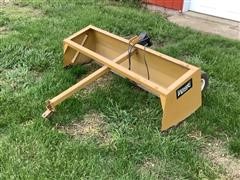
Plowing a field and disking it should be enough to smooth out a field. If that is not enough rent a leveling box as large as your tractor can pull.Wemhoff P-5 Box Scraper
 
   / Pasture into hayfield #33  
I have been reading whatever info google presents me on converting rough pasture into hayfield but I wanted to see if anyone here has any tips that will make my life a bit easier.

I have gotten a few different opinions on what the proper procedure is but I should preface that my pasture is rather boulder-y. I was late getting cows out there to keep the grass down so they are working on it now but I'm in this kind of catch 23 situation where I need to mow to see the rocks better to pick them out but the rocks would make mowing almost impossible. Is there some sort of method that people do where they just light it all on fire and start from zero using an excavator to pick the bigger boulders out and then plow it over?

My current plan is to be patient let the cows do there thing, a local landscape company will come pick boulders and pay you for them, but the thistles are taking over a bit as well. Not to mention the buckthorn which I should be able to finish shredding once I get my new cutter.

after that I was thinking:
1) plow it over
2) disc a few times
3) likely pay neighbor to drill seed it
4) mow weeds while grass takes


My neighbor suggested planting corn for 2 years to help break up the sod, saying using a disc wouldn't be super effective or something. Anyhow if anyone has surefire way of converting rough pasture into hayable field im all ears.
I did this on 40 acres, but no rock problem Moldboard plowed, harrowgated 2 different directions, cultimulched at angle then seed with easy flow spreader with small seed attachment with oats as cover crop for alfalfa. Seeded and cultimulched in long direction of field. Made for a very smooth field. Cultimulcher had 2 sets of rollers with 2 sets of soil stirring tines between. Ran tines just low enough to barely stir soil. Got a very good stand of alfalfa.
 
   / Pasture into hayfield
  • Thread Starter
#34  
Alright well I appreciate everyone's contribution. It sounds like the thing I was missing from my own plan was the roller/cultipacker

I wish I could do fewer steps but I think the field is in such poor condition that I just need to invest in the dozer work to get it in a much better starting place. I literally can't drive more than 2 mph without getting bounced out of the seat currently. I have a meeting planned with the local NRCS and they can also advise, but this is probably going to be a 2 summer project at minimum. I figure the rest of this season will be boulder / shrub removal and maybe dozer work, next spring discing/packing and planting and then let it grow unmolested depending on when I get it planted.
 
   / Pasture into hayfield #35  
Alright well I appreciate everyone's contribution. It sounds like the thing I was missing from my own plan was the roller/cultipacker

I wish I could do fewer steps but I think the field is in such poor condition that I just need to invest in the dozer work to get it in a much better starting place. I literally can't drive more than 2 mph without getting bounced out of the seat currently. I have a meeting planned with the local NRCS and they can also advise, but this is probably going to be a 2 summer project at minimum. I figure the rest of this season will be boulder / shrub removal and maybe dozer work, next spring discing/packing and planting and then let it grow unmolested depending on when I get it planted.

Sometimes thats the way it is and what is required. That sounds like some rough terrain.
I am usually rehabbing fields which were once hayfields that were let go, so there’s still an adequate base to work with. Luckily most big boulders and rock outcroppings were dynamited before I was born.

Good luck and keep us updated. Could be a cool “progress” thread.
 
   / Pasture into hayfield
  • Thread Starter
#36  
Yeah I don't think this could have ever been hayfield, if it was then maybe like 80 years ago.

The previous owner had a few horses, but 2-3 horses for 20 acres means a lot of overgrowth happened. I should do a little more digging to find out how the land was used in the last 50 years if I can.

Ill try and get some photos, but I feel like unless I get a drone it's just going to be random photos of shrubs lol, maybe the photos of the work being done will be more exciting.
 
   / Pasture into hayfield #37  
Yeah I don't think this could have ever been hayfield, if it was then maybe like 80 years ago.

The previous owner had a few horses, but 2-3 horses for 20 acres means a lot of overgrowth happened. I should do a little more digging to find out how the land was used in the last 50 years if I can.

Ill try and get some photos, but I feel like unless I get a drone it's just going to be random photos of shrubs lol, maybe the photos of the work being done will be more exciting.

There’s probably a reason it wasn’t. Probably the same reason you are describing.
Think it over. Hay doesn’t pay squat, so do it for the combination of income & enjoyment.
 
   / Pasture into hayfield
  • Thread Starter
#38  
Truthfully the real reason I want to just get to to workable state is so that it doesn't get worse and I lose the little bit of value the land has now. When I purchased this place I had no idea pasture should be "mowed" a few times a season, I just figure if I'm going to bother to clean it up I might as well do it properly so I can hay it 2 years and have cows out there on the 3rd year. From what I understand if you can rotate hayfield / pasture it will help keep the soil better than if you just hayed 1 field endlessly.

edit: I should add that I have a suburban upbringing but I never really enjoyed the city, I bought this land with the intention of renting out the fields and to give myself space to spread out. It's funny how things change once you insert yourself in various situations.
 
   / Pasture into hayfield #39  
Do have any neighbors that have farmed in your area for years? They could be your best resource on how that land was used in the past. Also could provide additional insight on how bad the rock problem is.

Not exactly sure where in central MN you are but I know by Grey Eagle most of the fence rows where stone fences just from rocks in the field. They are one crop that grows every year without planting any seeds.
 
   / Pasture into hayfield #40  
Alright well I appreciate everyone's contribution. It sounds like the thing I was missing from my own plan was the roller/cultipacker

I wish I could do fewer steps but I think the field is in such poor condition that I just need to invest in the dozer work to get it in a much better starting place. I literally can't drive more than 2 mph without getting bounced out of the seat currently. I have a meeting planned with the local NRCS and they can also advise, but this is probably going to be a 2 summer project at minimum. I figure the rest of this season will be boulder / shrub removal and maybe dozer work, next spring discing/packing and planting and then let it grow unmolested depending on when I get it planted.
In the last two day I mowed a small section of my pasture that was not "smoothed" prior to being turned into a pasture. When I mow it I turn a 6' rotary cutter in high PTO range and about 1300 engine RPM on my L2250. I exclusively use this cutter on fields so I keep it very sharp and only really "top" the vegetation so no significant load.

I can only mow in second gear high range due to the unlevel nature of the field. I tried in third gear and the cutter did the job but the bouncing was killing me. I would much rather have not spend five hours mowing. I can run my pasture harrow over the whole thing in about 45 minutes with my IH584 due to the size. I waste so many hours putting around....

Do it once, do it right Morg.
 

Tractor & Equipment Auctions

32in. Tilt Grading Bucket Mini Excavator Attachment (A59228)
32in. Tilt Grading...
500 BBL FRAC TANK (A58214)
500 BBL FRAC TANK...
2021 Ford F-150 Ext Cab 4X4 Pickup Truck (A55852)
2021 Ford F-150...
2012 AMERITRAIL (A55745)
2012 AMERITRAIL...
Westfield Conveyor (A56438)
Westfield Conveyor...
Carry-On 5'x8' Trailer (A53316)
Carry-On 5'x8'...
 
Top