Watch out for bicycles too.

/ Watch out for bicycles too. #61  
Takes a lot of tax money to upgrade the roads for cyclists.. and the cyclists do not pay any road tax for that !!

See ArlyA's post #46. I put many more street miles on my 2 registered, insured, and taxed motor vehicles than the 3000 miles I ride my bicycle each year.

I have had occasion to ride on the interstates in South Dakota and New Mexico. It is legal as the interstate is the only practicable way to get from A to B. One can argue that the interstates are "upgraded" roads. Great sight-lines; relatively good pavement, although the high speed traffic sweeps a lot of debris into the breakdown lane; fair separation, although a semi passing at 60 mph greater speed 10 to 12 feet away can buffet one around. I found it "safe" but generally unpleasant and boring. I much prefer riding on curvey roads where two wheels allow banking and one has much more intimate connection with the surroundings.
 
/ Watch out for bicycles too. #62  
See ArlyA's post #46. I put many more street miles on my 2 registered, insured, and taxed motor vehicles than the 3000 miles I ride my bicycle each year.

I have had occasion to ride on the interstates in South Dakota and New Mexico. It is legal as the interstate is the only practicable way to get from A to B. One can argue that the interstates are "upgraded" roads. Great sight-lines; relatively good pavement, although the high speed traffic sweeps a lot of debris into the breakdown lane; fair separation, although a semi passing at 60 mph greater speed 10 to 12 feet away can buffet one around. I found it "safe" but generally unpleasant and boring. I much prefer riding on curvey roads where two wheels allow banking and one has much more intimate connection with the surroundings.
My home state is SD and I'd be damned if I'd ride with the 80mph interstate traffic! 😖
 
/ Watch out for bicycles too. #63  
My home state is SD and I'd be damned if I'd ride with the 80mph interstate traffic! 😖
But when the interstate is the only road going between two points, you have no choice. My wife and I have ridden on interstates in NM and WA state where it was legal and no other way around. Not the nicest way, very noisy, and not fun. Not sure of the speeds, WA was in 1982, and semis were aloud in the breakdown lane going up hills. It wasn't fun being there when a truck came upon us going up hill, with another in the right lane with cars passing him in the left lane. We had nowhere to go except against the guard rail and hope for the best. Luckily the the semi passed the one in our lane and he was able to move out of the breakdown lane just before getting to us. Jon
 
/ Watch out for bicycles too. #64  
But when the interstate is the only road going between two points, you have no choice. My wife and I have ridden on interstates in NM and WA state where it was legal and no other way around. Not the nicest way, very noisy, and not fun. Not sure of the speeds, WA was in 1982, and semis were aloud in the breakdown lane going up hills. It wasn't fun being there when a truck came upon us going up hill, with another in the right lane with cars passing him in the left lane. We had nowhere to go except against the guard rail and hope for the best. Luckily the the semi passed the one in our lane and he was able to move out of the breakdown lane just before getting to us. Jon
I'm assuming you are referring to riding bicycles on the shoulder of the interstates?

I would strongly suggest getting a bike carrier for your vehicle and transporting your bikes by car to your nearest mountain bike trail. That is what my wife and I do.
 
/ Watch out for bicycles too. #65  
I'm assuming you are referring to riding bicycles on the shoulder of the interstates?

I would strongly suggest getting a bike carrier for your vehicle and transporting your bikes by car to your nearest mountain bike trail. That is what my wife and I do.
We could not use a car to transport the bikes. The Washington tandem bike trip started in Seattle airport, out to the coast, down into Oregon then up to Crater Lake and down to Medford OR to fly home, 2 weeks. NM mountain bike trip started in Roosville, MT at the border down the Continental Divide through ID, Wyoming, Colorado, then NM and ended up at the border of Mexico, 10 weeks.

Missed one other time. Cross country road bikes from OR to VA, through Sinclair WY when we had to ride the shoulder of an interstate. Wife, daughter 15, son 12 and myself, 3 months. Because we were traveling by bicycles and no sag support, we rode the interstate because there were no other roads/trails, etc to ride. Jon
 
/ Watch out for bicycles too. #67  
There are not bike trails to everywhere.
I don't understand this statement.

I am suggesting, for concerns of safety, to transport your bikes by car to your nearest mountain bike trail. There is an app you can download on your phone that will list trails in your area.

We found a really nice 6.2 mile mountain bike trail just 25 miles from us.
 
/ Watch out for bicycles too. #68  
We could not use a car to transport the bikes. The Washington tandem bike trip started in Seattle airport, out to the coast, down into Oregon then up to Crater Lake and down to Medford OR to fly home, 2 weeks. NM mountain bike trip started in Roosville, MT at the border down the Continental Divide through ID, Wyoming, Colorado, then NM and ended up at the border of Mexico, 10 weeks.

Missed one other time. Cross country road bikes from OR to VA, through Sinclair WY when we had to ride the shoulder of an interstate. Wife, daughter 15, son 12 and myself, 3 months. Because we were traveling by bicycles and no sag support, we rode the interstate because there were no other roads/trails, etc to ride. Jon

Cross country road bike trips are different than what I am talking about. I wouldn't chance those either. And I certainly wouldn't be having my kids riding near traffic.
 
/ Watch out for bicycles too. #69  
I believe what he is saying is not all of us have trails nearby. Think of it this way - you have a 50 mile round trip to ride, now let's say you only rode 5 days a week, that is 250 miles of driving to trails each week, or 1000 a month, that's a lot driving/time/expense. Also, a lot more bikers are injured mountain biking than road riding (lots of broken bones, dislocations, etc) so it is not exactly the safe option for some. I know my wife isn't too interested in mountain biking with me but enjoys a ride in the evening after dinner down our back county roads.
 

Attachments

  • Biking - 1.jpeg
    Biking - 1.jpeg
    5.3 MB · Views: 143
/ Watch out for bicycles too. #70  
I believe what he is saying is not all of us have trails nearby. Think of it this way - you have a 50 mile round trip to ride, now let's say you only rode 5 days a week, that is 250 miles of driving to trails each week, or 1000 a month, that's a lot driving/time/expense. Also, a lot more bikers are injured mountain biking than road riding (lots of broken bones, dislocations, etc) so it is not exactly the safe option for some. I know my wife isn't too interested in mountain biking with me but enjoys a ride in the evening after dinner down our back county roads.
If you are wanting to ride every day I can see the conundrum. And I suspect those bikers injured on bike trails are the more adventurous types that take trails at high speeds. The point of this thread I suppose is to talk about the dangers of riding bicycles on or near the roads. I think it's playing Russian Roulette.
 
/ Watch out for bicycles too.
  • Thread Starter
#71  
I don’t want to ride mountain bike trails. My bike just isn’t setup for it. I ride nearly every day, it just isn’t practical for me to load the bike every day and drive to the nearest paved dedicated bike trail, which is an hour or two drive away.
 
/ Watch out for bicycles too. #72  
I have had so many close calls involving bicycles that I've become anti bike.
They share the road network but (mostly) disregard any of the rules/laws.
They blow stops, make unlawful turns, dodge in/out of traffic in/out of sidewalks.
I once had one bounce off of my van to expedite his turn.
In my area a law was enacted to prevent dooring and another to provide a minimum passing clearance, both subject to fines and demerit points.
When it comes to speeding I've often been passed on my right by a bike that is greatly exceeding the posted limits. (That on a main street in a busy city hill)
One area has a dedicate bike trail that crosses a main artery and has posted stop signs for the bikes but the very rarely obey them, and if I exercise my basic right of way rights they give me the finger. Worst yet, the LEO's ignore those basic violations.
To add insult to injury the pay nothing towards the maintenance of the networks they demand to share.
 
/ Watch out for bicycles too. #73  
A few basic's.

99% of cyclist do pay for road infrastructure, just like everyone else.

Cyclist should not disregard traffic laws. When they do, they tend to get hurt. I personally will not ride in door opening widths.

I personally love bike paths, but statically they are more likely to put you in ER, than road rides are.
 
/ Watch out for bicycles too. #74  
America has an auto-centric culture. In the century since the first popularization of the motor car, the industry, its fellow-travelers, and "safety experts" have used the convenient political fact that the vast majority of Americans own and drive automobiles to inculcate the idea that the roads belong to automobiles and all others are interlopers. In his book Effective Cycling, John Forester relates how this has given rise to the "cyclist inferiority phobia". Forester also holds that cycling is learned activity, and that those with better training have fewer accidents. He cites statistics that children average 1500 miles per accident (severe enough to require bicycle repair or medical treatment), college associated adults 2000 miles, and club cyclists 10,000 miles. This training can be acquired guided by the principle that "Bicyclists fare best when they behave like other users of the roadway."

Trained cyclists respect and obey traffic law; they also have a pretty good grasp of the laws of physics. Those who say the "Right of Weigh" theory makes it unsafe for a 200 lb. bicycle and rider to share a roadway with 3-5,000 lb. automobiles violate the principle when they drive their 3-5,000 lb. car on a roadway with 44,000+ lb. behemoths hauling gravel or steel. Cars, trucks, (and tractors) can coexist on our roads; automobiles and bicycles can coexist too.
 
Last edited:
/ Watch out for bicycles too. #75  
America has an auto-centric culture. In the century since the first popularization of the motor car, the industry, its fellow-travelers, and "safety experts" have used the convenient political fact that the vast majority of Americans own and drive automobiles to inculcate the idea that the roads belong to automobiles and all others are interlopers. In his book Effective Cycling, John Forester relates how this has given rise to the "cyclist inferiority phobia". Forester also holds that cycling is learned activity, and that those with better training have fewer accidents. He cites statistics that children average 1500 miles per accident (severe enough to require bicycle repair or medical treatment), college associated adults 2000 miles, and club cyclists 10,000 miles. This training can be acquired guided by the principle that "Bicyclist fare best when they behave like other users of the roadway."

Trained cyclists respect and obey traffic law; they also have a pretty good grasp of the laws of physics. Those who say the "Right of Weigh" theory makes it unsafe for a 200 lb. bicycle and rider to share a roadway with 3-5,000 lb. automobiles violate the principle when they drive their 3-5,000 lb. car on a roadway with a 44,000+ lb. behemoths hauling gravel or steel. Cars, trucks, (and tractors) can coexist on our roads; automobiles and bicyclists can coexist too.
We've attended the effective cyclist course and own the book. Its gold. (y)
 
/ Watch out for bicycles too. #76  
I find a lot of cyclists ignore the rules of the road - particularly stop signs - when nobody is coming. Ive got great respect for those ones who will ride the lane with the vehicles and stop at the lights and use hand signals, but I see far more of the other type around here.
Here on the other side of the Pond, cycling is much more common, but sport cyclists are among the most antisocial road users there are: they are using the road as a circuit, cycle in rows of three, as oncoming traffic on the curvy road i live on, in a dense forest with no room to pass a truck without driving onto the slopes on each side of the road.

Their herd mentality is what puts them in greatest danger, when one crosses a railroad the rest will follow in sight of the train. They dont stop at intersections but take crossroads at speeds motorised traffic wouldnt even think of.

When a local news source posts news about an accident with sport cyclists on social media, you can count on it that you will see people reacting like "they had it coming" "these people are an accident waiting to happen" etcetera.
 
/ Watch out for bicycles too. #78  
Around us there is not a ton of on road cycling - few small clubs and a very occasional rider here and there. I can easily drive all week without meeting a bicycle on the road and normally when I do they are staying to the side of the road or on a sidewalk.

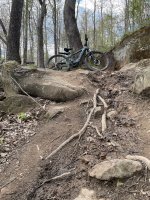
Mountain biking is pretty big around us - some of the trails are pretty much bumpy dirt trails but often they are rooted, rocky and fairly difficult. Generally you need a higher end bike and at least front suspension, but often full suspension is preferred by many. They are fun trails but anyone riding them are not casual riders as the chance of injury is alway looming.

I really wish we had a nice bike path/trail close by as I really do enjoy the rails to trails paths because you can relax a bit more and have less concern with cars. Athen Ohio has a GREAT trail and you can do a nice 40 mile ride in the afternoon and not do anything but cross some roads. Heck they even have a good BBQ place along the trail for lunch. Now a riding there beats the road any day, the negative for us is it takes about 1hr 45 minutes to get there.
 
/ Watch out for bicycles too. #79  
Once an ardent cyclist wanted the city to install water fountains every few kilometers as cyclists became rapidly dehydrated.
He actually made that demand at a council meeting.

In Montreal they spent close to 1 million$ to keep a scenic waterfront bike path snow cleared.
Wonder how many cycled at -20 degrees to view a frozen river.
Then there is a question of snow removal on bike paths that are on the long bridges that span the St Lawrence river. Hey, folks need to get to work.
 
Last edited:
/ Watch out for bicycles too. #80  
Once an ardent cyclist wanted the city to install water fountains every few kilometers as cyclists became rapidly dehydrated.
He actually made that proposal at a council meeting.
I could support that... my dog gets thirsty and I could teach him to drink from the fountain. ;)
 

Marketplace Items

2025 Swict 66in Tooth Bucket Skid Steer Attachment (A61567)
2025 Swict 66in...
2017 Freightliner M2 106 AWD Terex Hi-Ranger 5TC-55 55ft Insulated Material Handling Bucket Truck (A60460)
2017 Freightliner...
2018 Chevrolet Equinox AWD SUV (A61569)
2018 Chevrolet...
2005 FRAC TANK 500BBL WHEELED (A60736)
2005 FRAC TANK...
2013 Peterbilt 365 IMT 40/275K6 9.5 Ton Knuckleboom Crane Truck (A60352)
2013 Peterbilt 365...
CATERPILLAR 108" WHEEL LOADER RAKE (A52707)
CATERPILLAR 108"...
 
Top