Water line question

   / Water line question #61  
I've designed a few commercial water systems (more pressure sewer systems, but the principle is the same.) Usually the design is controlled by the local regs and what the guy doing the install wants to put in. Any of it will work for a long time if bedded and installed properly and below the freeze line. My preference is SDR11 HDPE, because it is self restraining and doesn't require any blocking at the elbows. If you run PVC you may want to put some blocking at the bends to spread the load out over the soil and keep the soil from being pushed away.

I wouldn't run anything smaller than inch and a quarter. I doubt that you need 2", but I would consider inch and a half.
 
   / Water line question #62  
Eddie, good info as usual!

You and others advised against blue glue for pressure applications. Christy's rates both blue and clear for pressure in up to 4" PVC pipes. Q- what's wrong with blue?

BTW I use primer/blue glue for all water connections, medium clear for electrical PVC with no primer. Not sure why, but that's what I have always done and I can't ever remember a joint failure?
The blue glue is a glue. It does not soak into the PVC, or melt it together. AC guys use it all the time for their drain lines, and it's fine for that, but I wouldn't use it for a larger drain or vent pipe. But that's just me. I'm only comfortable with purple primer and heavy duty clear cement for all PVC, Vent and SDR pipes. The pipes really do melt together!!!!

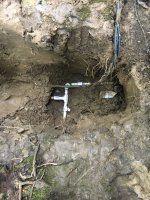
About 7 years ago the Natural Gas company installed a yellow gas line to my house and when trenching the line, they cut the top of one of my 1 inch PVC water lines by my barn. They ran their trencher pretty much exactly where I dug for the water line, just a little above the line except for that one spot. They put it together with a coupling and Blue Glue. It held fine until this past winter when we got really cold. I found the leak a month ago. The ground stayed wet even after everything around it dried out. It took me a couple of days of seeing it before I realized it was a leak. I kept thinking it was odd that the ground was holding so much more moisture then any of the ground around that are. The leak was a minor drip, but a constant drip that had been going on for months. The pipe slid out of the coupling about 1/8th of an inch. I wonder if the pipe would have broke if they had used purple primer and heavy duty clear cement, or if it would have remained intact? Might be that having a weak link saved me from more serious damage? I don't know, but it does make me wonder when so many people around here had much worse damage from pipes breaking. That line is 2 feet in the ground, and usually well below our normal freeze depth.
 
   / Water line question #63  
If you go to big you'll ruin your volume/pressure. Unlike a lot people think, you can not create pressure by down sizing your line
Believing you can increase PSI by reducing pipe size is commonly misunderstood.

So why do you say increasing pipe size will reduce pressure?
 
Last edited:
   / Water line question #64  
Forgot to mention .. its recommended to pressure test the new pipe (using water) before covering it with sand. (maybe others already did ...)
 
   / Water line question #65  
In these parts (southern BC) we use a lot of black poly for the combination of continuous (any joint underground WILL fail), potable, forgiving of rock contact, and relatively inexpensive, given all the pluses. I see folks recommending PVC. I'm on a rural water system (25 properties, mountain creek fed...) and we use a combination of steel, PVC and poly. All the system's failures in the past 10 years have been PVC joints or pipe itself.

My own property uses PVC and poly. I've worked on both and where you need the minute workability of fittings - PVC - long runs: poly.
 
   / Water line question #66  
All anyone here in n idaho use is the thick black poly rolls. Never heard of any failures. Our water is installed 5 feet down. Its not the Home Depot crap, I believe it’s rated 200 psi. A roll can kick your butt installing, as it can be 500 feet long and nearly impossible to unroll. Ive had it re-roll itself while I was in the trench...thought this is it.
 
   / Water line question #67  
My new home install from a well, I ran 1" black 'Well' hose in 1.5" sch40. We are very Rocky with sharp shale..i did it all at once as I didn't want to get screwed if I couldn't pull the black.
 
   / Water line question #68  
Two years ago I had to reroute waterline to my house. The house is about 300 ft from the meter and 45 ft vertically over a 1-1/2 -1 slope. I didn’t want to have to dig on the slope again so I put a 1” sdr9 cts dr9 hdpe waterline (blue looks like pex but slightly different) through 2” electrical conduit with long sweep elbows. If I ever have an issue I just unhook both ends and pull new line in as old line comes out. I have never had a lack of water even at my barn which is another 300ft from house with similarly ran line from house. The local water company does run with higher pressures thought. Whatever pipe you chose make sure you get appropriate fittings. There are 4-5 versions of PE pipe in that size range.
 
   / Water line question #69  
I have to run a water line to a home I'm building and would like to get some of your opinions on what you guys would do. Now remember its hard to find most materials. I'm needing to get the water line in so they can pour the concrete pad for shop. The shop pad is about 350 feet from the meter and I'm running 1" line. My two options are 1" pex and schedule 40. This is somewhat rocky ground with a lot of clay, sand and small stone in the mix. I'm reading that it wouldn't be a bad idea if I go with Pex to sleeve it which is going to raise the cost.

Pex line 1" x 400' is going run around 400.00 and I will roughly have two fitting in the total run. If I sleeve the pex with 4'x100' black corrugated sewer and drain pipe its going add another 240.00 for a total of 640.00. The pex isn't a full one inch inside diameter and more like .830. I can get a 300' roll and 100' roll so really one connection to get to shop.

Schedule 40 will be in 20' sticks at around 300.00 and I wouldn't think I would need to sleeve this. With the schedule 40 I will have about 20 glue joints and of course would use the blue glue in a quart. The PVC is a full one inch ID which means more water up to home and shop.

I am somewhat familiar with both setups. Meaning I have experience gluing PVC and I also have a pex tool and have ran pex before. My pocket book is telling me to go with PVC. Probably no clear cut answers but what would you guys do in this situation?
I vote for PVC. It's tough stuff. Unless your pump rate is way in excess of 5 gpm, 3/4" is big enough. I've about 1100 feet of 3/4" just running down the hill and along a maintenance road to a little stream below. I run over it with the tractor a number of times in 2 or 3 places. Has ovalled it out a bit but only ever had a leak where I caught it with the bush hog. Much more careful. Haven't done that in a long time.
 
   / Water line question #71  
In my area pf Quebec I know of 3 municipalities that approve the use of blue poly B for municipal hookups.
Now all 3 have well informed engineers on staff and they do research.
Generally no municipality won't OK something if they can't CYA.
It is all about liabilities, don't U know.
Now with copper prices being in orbit there is more and more poly B being used.
Fortunately I have a supplies that can provide Blue Poly B in spools up to 300 ft.

My 2 cents, FYI.
 
   / Water line question #72  
Good grief indeed, workinonit! At the risk of adding further to the confusion, I would just like to add some observations (several of these have already been posted by others) from my own experiences working on rural plumbing for over 50 years:
- Avoid buried fittings if at all possible
- Poly pipe rated for 160 or 200 psi is hard to beat. The only problems I have seen with poly is where 100 psi rated was used, or where the installer used a torch to make it easier to insert fittings.
- Protect with at least 6 inches of sand, under and over the pipe
- I'm a big fan of sleeving where practical (I don't understand the comment that sleeves can sometimes cause problems, and would be interested in learning how)
- I perform hydraulic calculations for fire sprinkler systems and can flat out state, bigger pipe WILL NOT negatively affect volume or pressure.
 
   / Water line question #73  
Pex or municipex is the way to go. Take car when backfilling to sort your material. A load of sand could also help majorly. PVC is rigid and more inclined to cracking if hit by a rock. Also you have to take great care to clean prime and seat each joint, the potential failures are massive.

the best peice of advise you will ever get is this. Compare the cost of having to dig up even one leak to repair. I’m my mind an extra 250$ isn’t even worth mentioning. Total no brainer.
 
   / Water line question #74  
I would run stainless steel tubing
Stainless is only recommended for homeowners awash in excess cash.

The OP can satisfy everyone-- doing the job in segments-- part copper, poly, pvc, cpvc, and pex. And stainless where it comes up out of the ground-- looks nice plus no UV problems!

Totally overlooked is the "old school" trenching idea. Instead, I'd suggest modern-day underground directional pipe bore .... after all, why skimp on your project? :D

 
Last edited:
   / Water line question #75  
Believing you can increase PSI by reducing pipe size is commonly misunderstood.

So why do you say increasing pipe size will reduce pressure?

That’s some more terrible advice which this thread is chocked full of. Most people don’t seem to understand volume and pressure. You could run 4” pipe if you wanted to. It’s obviously not going to flow very much because you’re only feeding it with a 3/4 pump or meter but at the other side you’ll still have very close to the same pressure and volume you started with. And pressure really doesn’t mean much taken as a static reading. You could run 1/4 inch line a mile and it wouldn’t loose any pressure without flow.
 
   / Water line question #76  
I have a cabin about 3500 feet from the road where there is a meter pit and city water supply. Original homeowner installed 20 foot lengths of 1 inch sch 40 pvc. Pressure is fine. I’ve had to dig it up and repair it 3 times in the 5 years I’ve owned it. Even more fun when they bury electrical lines with the water! All breaks at fittings. Maybe it was poor install but if it were me I’d be running pex or some sort of poly with no fittings. Our soil is silty loam.

The inside of the cabin is all cvpc. Granted it’s 30 years old but that stuff is so brittle now as someone mentioned it cracks and is an accident waiting to happen. I’ve had to fix 10 or so leaks. Plan to rip it all out but it’s rather involved and the log cabin design presents some other challenges.
 

Attachments

  • 13F12DE4-7F8F-496C-8B24-59BBF26AFAB7.jpeg
    13F12DE4-7F8F-496C-8B24-59BBF26AFAB7.jpeg
    2.7 MB · Views: 154
   / Water line question #77  
I have a cabin about 3500 feet from the road where there is a meter pit and city water supply. Original homeowner installed 20 foot lengths of 1 inch sch 40 pvc. Pressure is fine. I’ve had to dig it up and repair it 3 times in the 5 years I’ve owned it. Even more fun when they bury electrical lines with the water! All breaks at fittings. Maybe it was poor install but if it were me I’d be running pex or some sort of poly with no fittings. Our soil is silty loam.

The inside of the cabin is all cvpc. Granted it’s 30 years old but that stuff is so brittle now as someone mentioned it cracks and is an accident waiting to happen. I’ve had to fix 10 or so leaks. Plan to rip it all out but it’s rather involved and the log cabin design presents some other challenges.

Those are all couplers vs belled ends. Have you had any belled ends leaking?
 
   / Water line question #78  
Believing you can increase PSI by reducing pipe size is commonly misunderstood.

So why do you say increasing pipe size will reduce pressure?

If the inside is similar in smoothness, then increasing pipe size reduces pressure loss. With a larger pipe you retain more of the psi at the far end. It's as simple as that. It's a matter of math & science - not a matter of debate.
It has to do with the thickness and shape of fluid in the friction layer that touches the inside of the pipe compared with the total volume and velocity of fluid carried.

But why even go there? Just accept that with larger pipe and fewer couplings less psi is lost to fluid friction. So you get more pressure available at the far end. The relationship is not linear, but again the idea to take home is simple: all we need to remember that for pipes, a little bit larger and a few less couplings turns out to be a whole lot better.
rScotty
 
   / Water line question #79  
All anyone here in n idaho use is the thick black poly rolls. Never heard of any failures. Our water is installed 5 feet down. Its not the Home Depot crap, I believe it’s rated 200 psi. A roll can kick your butt installing, as it can be 500 feet long and nearly impossible to unroll. Ive had it re-roll itself while I was in the trench...thought this is it.

Yep, that's the good stuff. It's important to note that HEAVY WALL Commercial well duty black poly has no comparison at all to the Home Depot black poly. Just like schedule 40 PVC from the box store doesn't compare to the commercial 20 foot belled lenghts of 80 PSI & higher UV resistant grey PVC.

I've seen some good work done with 20 foot bell end sections of sched. 80 large diameter PVC. Use sweep bends, & proper glue. Avoid short radius bends. Any pipe benefits from being sleeved.

As others say, I've seen CPVC becoming brittle too. Some of my own installations, too. Not a good product. I used it and now wish I hadn't.
For hot water inside (and gas outside) I've now gone back to copper and am using soldered and flared connections. Damn the expense; it's a good product.

For a long well line or water line you won't have any problem with that heavy high PSI thick wall black poly stuff lasting a long time. Of course you will bed it in sand. That heavy poly is fairly expensive, but is what most well installers use. However, unrolling a 500 foot roll of 1.5" 200 psi black poly so that it doesn't have an kinks & relaxes in the sun so that it can be installed as a single straight run is a real hassle, but worth the effort.
For unrolling heavy poly rolls, it helps to tie one end to a tree and have a few friends and a small tractor to help you unroll it. Give it a day in the hot sun and it will relax.

So for long runs that heavy wall my favorite today is
1 1/4 or 1 1/2inch diam heavy wall black poly. I have used a heat gun and long barbed fittings, but don't really like that because once assembled there is no constant compression. For Poly pipe I am considering changing over to compression fittings. Only thing stopping me is lack of experience with those fittings.

For constant compression of the tubing onto the fitting it is hard to beat PEX connectors with their O ring fittings compressed by the copper ring with the special PEX squeezer. That in itself is a good reason to keep PEX as an option. That and the fact that it unrolls nicely without a fight.
Have fun out there,
rScotty
 
   / Water line question #80  
.. For Poly pipe I am considering changing over to compression fittings. Only thing stopping me is lack of experience with those fittings.

For constant compression of the tubing onto the fitting it is hard to beat PEX connectors with their O ring fittings compressed by the copper ring with the special PEX squeezer. That in itself is a good reason to keep PEX as an option. That and the fact that it unrolls nicely without a fight.

'Plumber' and decades of DIY reminded me that compression fittings are easy. Match the ferrule to the line mat'l. Poly ferrule with poly lines, brass/SS with metal lines. btw, poly ferrules are 'directional' but the fit-up isn't confusing at all.
 

Tractor & Equipment Auctions

2014 Chevrolet Impala Limited Sedan (A59231)
2014 Chevrolet...
2013 Ford F-450 4x4 Crew Cab Little Beaver LS300 Drill Rig Truck (A59230)
2013 Ford F-450...
2016 LEEBOY 8510D ASPHALT PAVER (A60429)
2016 LEEBOY 8510D...
Bobcat T590 (A53317)
Alamo SHD96 Flail Mower
Alamo SHD96 Flail...
2022 Schulte SMR-800 Multi Rake Landscape Windrower (A56438)
2022 Schulte...
 
Top