How do you prep for future power outages?

/ How do you prep for future power outages? #101  
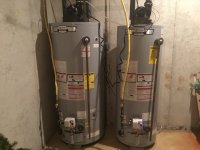
I have 2 Hot water heaters side by side in my basement. After 35 years in construction, I learned they tend to go belly up at the worst times. At one time I was going to split them and do one side of my home (master bedroom and guest suite) with one and kitchen and kids side of the house on the other. I scrapped the plan and simply use one to preheat and the other to finish heating hot water. Works fantastic and never run out of HW.
I have used this system in my last 2 homes and have shown customers I built homes for this method. They all agree its worth the $1000-$1500 extra on a big project and go for it.
I also always install a sub panel upstairs to reduce # of home runs back to basement panel and put one HVAC in attic for second floor and first floor HVAC in basement.
Lastly, I try to get all customers to install whole house backup while we are under construction. Once i show them it is cheaper to do while under construction, its usually a "go".
Overkill, maybe but I really like it. My customers often are going for more sophisticated mechanicals and saving money on less square feet.

The high end, large family homes here have 2 water heaters.
 
/ How do you prep for future power outages? #102  
I have 2 Hot water heaters side by side in my basement. After 35 years in construction, I learned they tend to go belly up at the worst times. At one time I was going to split them and do one side of my home (master bedroom and guest suite) with one and kitchen and kids side of the house on the other. I scrapped the plan and simply use one to preheat and the other to finish heating hot water. Works fantastic and never run out of HW.
I have used this system in my last 2 homes and have shown customers I built homes for this method. They all agree its worth the $1000-$1500 extra on a big project and go for it.
I also always install a sub panel upstairs to reduce # of home runs back to basement panel and put one HVAC in attic for second floor and first floor HVAC in basement.
Lastly, I try to get all customers to install whole house backup while we are under construction. Once i show them it is cheaper to do while under construction, its usually a "go".
Overkill, maybe but I really like it. My customers often are going for more sophisticated mechanicals and saving money on less square feet.
We have a similar set up only ours ar NG
 
/ How do you prep for future power outages? #103  
We have a similar set up only ours ar NG
Mine are NG, too. In fact, so are our Dacor ranges, the clothes dryers, 2 fireplaces, 2 heaters, whole house standby generator, grill on the deck and fire pit.
Im finishing an apartment in my daylight basement with a gas heat, cooktop and gas dryer in the basement laundry room. Trying to run a gas fireplace down there, too. I have a close relative with cancer and want to build a nice place for him to live with the months he has left.
 
Last edited:
/ How do you prep for future power outages? #104  
Last noteworthy power outage was a few years ago. Temps were in the teens and we were down for a few days. I'm lazy and didn't find a need for juice, dressed to be outside, read by candle light and listened to NPR on a battery-powered radio. (just another day with a good book wearing longies, a sweater, Winter coat, and stocking cap. It only lasted two days.

Nat gas was not affected so I turned two stove burners on to medium and lit a few candle stubs in a metal pan downstairs. Most of my food reserves are canned vs perishable, could be heated on the stove, andin retirement I don't need to shower for or after work.

I have a Generac ~7hp 3500w or so gen that powers more than I ever need. I loan it more than use it. What it doesn't do for sour hen crap is start a 1/2 hp sump pump. ("Master plumber pal & I did our best, failed")

Don't have or need that here, but I wouldn't try again with <7kw and preferably 'externally' regulated (Honda if few others) vs more economical 'externally' regulated that stalls more easily and IMO doesn't benefit from auto idle control in many instances. (reefer, AC, or well pump kicks on).
I live in Texas and we had no power for 4 or 5 days had solar panels kept frig's running and freezer and lights and had some induction cooking units so no problem kooking. Plan on a diesel yanmar generator eg100i 7.5 kw to run whole house and sh;op and diesel will keep for over a year not like gas. Yanmar diesel engines are very reliable ask John Deere they have Yanmar diesel engines in there tractors

willy
 
/ How do you prep for future power outages? #105  
Have 2 back to back gas direct vent water heaters myself....love it.
 
/ How do you prep for future power outages? #106  
For the cost, its really not that bad. I swear by the AO Smith water heaters. We have been getting 15 years and more out of them even with junk well water.
 

Attachments

  • D48DF79E-CC2C-4486-87A9-27DBEC35CBED.jpeg
    D48DF79E-CC2C-4486-87A9-27DBEC35CBED.jpeg
    3.3 MB · Views: 158
Last edited:
/ How do you prep for future power outages? #107  
I have 2 Hot water heaters side by side in my basement. After 35 years in construction, I learned they tend to go belly up at the worst time.

I’m not sure there is anytime when a hot water heater breaking is not the worst time. We all need hot water when we want hot water.

MoKelly
 
/ How do you prep for future power outages? #108  
I’m not sure there is anytime when a hot water heater breaking is not the worst time. We all need hot water when we want hot water.

MoKelly
All the more reason to have 2
 
/ How do you prep for future power outages? #110  
Yep. We have 2 but - I like my shower better than the upstairs showers!

I know - I’m spoiled.

MoKelly
Are yours split into zones? Or does one feed into the other?
Im tempted to split them into zones to speed up hot water.
 
Last edited:
/ How do you prep for future power outages? #112  
Are yours split into zones? Or does one feed into the other?
Im tempted to split them into zones to speed up hot water.

They are split into zones. Both are in the utility room in the basement. It takes approx. 45 seconds to get really hot water to first floor showers but about 1-1/2 minutes to get really hot water to the second floor showers.

Not sure why the builder didn’t put the second floor water heater upstairs. There is a furnace area located upstairs. The water does have to travel some distance to get to the upstairs bathrooms. Perhaps the original owners were not comfortable with a 50 gallon heater located upstairs? I can sort of understand that concept.

MoKelly
 
/ How do you prep for future power outages? #113  
They are split into zones. Both are in the utility room in the basement. It takes approx. 45 seconds to get really hot water to first floor showers but about 1-1/2 minutes to get really hot water to the second floor showers.

Not sure why the builder didn’t put the second floor water heater upstairs. There is a furnace area located upstairs. The water does have to travel some distance to get to the upstairs bathrooms. Perhaps the original owners were not comfortable with a 50 gallon heater located upstairs? I can sort of understand that concept.

MoKelly
Probably worried about a leak, but I am in complete agreement about the upstairs HWH. A pan underneath with a gravity drain to the outside and a water sensor alarm , similar to a washing machine.
If I could have done it again, I'd put the upstairs heater in a utility room near exterior wall with short drain tube to outside and floor water alarm.
 
Last edited:
/ How do you prep for future power outages? #114  
Mine are hooked together, so if one fails the other still provides hot water. I have my system piped with circulation pump, so no more than a few seconds to have hot water anywheres in house.
 
/ How do you prep for future power outages? #115  
Mine are hooked together, so if one fails the other still provides hot water. I have my system piped with circulation pump, so no more than a few seconds to have hot water anywheres in house.

So, I am not the smartest person. I thought my problem was the hot water in the pipes cooled just sitting in the pipe with no use. Then, you turn on the hot water and all the cooled water had to flow thru the pipes until the hot water in the tank gets to the spigot.

The water flow is limited by the faucet.

How does a pump help? Does the pump continuously re-circulate the water so it’s always hot in the pipes?

Sorry if this is a dumb question.

MoKelly
 
/ How do you prep for future power outages? #116  
........................zip......................diesel will keep for over a year not like gas.................zip.......................

willy

Yes it will

I don't know how long Diesel fuel will keep, but I store few hundred gallons of off-road Diesel fuel stored in a safe place, out of the weather and buy it when the price is low by plan.

For sure I have used 10 years old fuel without any problems whatsoever, but in a different climate who knows?

I always add biocide and lubricant (Biobor JF & Opti-Lube Summer)when buying the fuel.

Cheers
 
Last edited:
/ How do you prep for future power outages? #117  
So, I am not the smartest person. I thought my problem was the hot water in the pipes cooled just sitting in the pipe with no use. Then, you turn on the hot water and all the cooled water had to flow thru the pipes until the hot water in the tank gets to the spigot.

The water flow is limited by the faucet.

How does a pump help? Does the pump continuously re-circulate the water so it’s always hot in the pipes?

Sorry if this is a dumb question.

MoKelly
yes
 
/ How do you prep for future power outages? #119  
If the water heater has two elements in parallel, simply open the element's service door and disconnect one? You would drop from 4600W to 2400W, only when there is an outage if that works.

Edit: How about if you use a Single Pole Double Throw switch to 'switch' between the return from the other live line or a return line (white wire)? Would this effectively drop the usable power from 4600W to 2400W?
All of the electric water heaters I've worked on use 2000W elements on a flip-flop. Never seen anything else in a residential heater.
 
/ How do you prep for future power outages? #120  
So, I am not the smartest person. I thought my problem was the hot water in the pipes cooled just sitting in the pipe with no use. Then, you turn on the hot water and all the cooled water had to flow thru the pipes until the hot water in the tank gets to the spigot.

The water flow is limited by the faucet.

How does a pump help? Does the pump continuously re-circulate the water so it’s always hot in the pipes?

Sorry if this is a dumb question.

MoKelly
Yes; they are a couple of ways to do it. One is to plumb in a return line from near the far end of your hot water run back to the cold water inlet on the water tank and then the pump (we use a little Grundfos) pushes water around the line continuously. We have our on a timer. The other way is to get a thermal bypass valve or sensor valve(s) in addition to your pump, but not plumb in a return line. The sensor valve is a heat swelling plug between the hot and cold lines. When it is cold, it lets the cold "hot" water bleed through to your cold water line. When warm water gets there, it swells shut. You can put in several throughout your house to have instant warm water at distant faucets. They do wear out, but we have had ours for over a decade.

We love it.

We also replaced the anode rod with an electronic version that doesn't wear out and doesn't need annual cleaning. I highly recommend them if your water isn't super soft and you aren't in the habit of frequently cleaning your water heater anode rods. We bought ours from Powered Anodes - Water Heater Rescue Our water heater lifetime has more than tripled, and still counting...

All the best,

Peter
 
 
Top