Advice needed on tire configuration for my applications.

   / Advice needed on tire configuration for my applications. #1  

Bullwinkle123

Platinum Member
Joined
Mar 30, 2019
Messages
658
Location
Southern VT
Tractor
Kubota MX5400HST, Z724XKW-3-54
Keywords: ballast, tire type, lawn preservation.

I have these applications for a new tractor I plan to buy, which are somewhat at odds with each other in terms of weight and tire requirements. However I only get one tractor, so need to figure out the best compromise. My tentative plan is to have unfilled R4's, curious to hear what you recommend.

Here are my _primary_ applications:

  1. Once a year, maybe more, I need to brush hog a very rough and sloped field. I'm planning on a 6 foot rotary cutter. The saplings aggressively take root each year, otherwise we leave the undergrowth for the animals (scrub blueberries, blackberries, wild strawberries). There are occasional pits pits (1.5-3 feet in diameter, depth proportional to width) and stone outcroppings in the field if you aren't careful. The field is 5 acres.
  2. Once every couple of years I need to do gravel driveway repair, though maybe having the tractor will change the frequency. This is relatively level (but beware ditch to the side), and will involve a lot of FEL and rear blade work with dense gravel. Driveway at a guess is 500'.
  3. Tractor will be used to haul mulch to flower beds _ACROSS THE LAWN_ and haul away flower bed debris. It's very important not to hurt the grass, but the traffic will hopefully happen only twice a year. Other lawn driving (different locations) for spring/fall/storm cleanups as needed (lawn is surrounded by forest, trees fall). Lawn is a little over 1 acre.
  4. TBD: I may buy something like a wallenstein chipper/shredder, though whether I'd haul the shredder to the trees/brush or the trees/brush to the shredder I don't yet know.

So on the one hand, we have the driveway repair with gravel in the bucket and rear weight is important. Is the blade enough? Or do I need wheel weights too? I'd kind of like to avoid loaded tires, but realize that's another option.

On the other hand, I'll occasionally be on the lawn with mulch in a bucket, brush in a grapple, or perhaps a cart in tow, and it's imperative I don't kill the grass. I.e the tractor is my occasional lawn cart. So R1 ag tires are probably out.

On the third hand (the gripping hand...) I need traction for the brush hogging field work. Ag tires would be preferred, but I'm hoping that R4's are good enough and might not kill the grass for the lawn crossings. The field has muddy parts, but mostly I'll try to time it when it's dry in the fall. Nobody has ever had issues getting stuck. They _do_ observe a pretty strict uphill/downhill travel pattern though due to the incline. I don't know what angle the incline is.

So one tractor, many needs. What's the best approach?

Miscellaneous notes.
  • The tractor will never be used to mow the lawn. I will do my best to keep it off the lawn, but the layout of my environment is such that I will have to drive across it more than I'd like. Not every use, but as noted above for cleanups and things.
  • I may use the tractor for some minimum skidding. Decisions there are still pending, but I'm not planning to scale up my tractor purchase for serious skidding purposes. That's just a whole other can of worms.
  • I'm looking at tractors with minimum 30 PTO HP, but haven't quite figured out what I need yet beyond that. Generally eyeing the 37-47 general HP categories of Kubota and Deere (as those are the dealers nearest me). So we're probably looking at a minimum 3000 lb machine.
 
   / Advice needed on tire configuration for my applications. #2  
Well for as often as traction is needed on lower traction surfaces I'd be tempted to go with turf tires.
They will be gentle on your lawn, they should provide adequate traction on your driveway.
When you want to skid wood or mow a steep field throw on a set of good tire chains.
 
   / Advice needed on tire configuration for my applications. #3  
Information on permeability and composition of soil under your lawn is important.

I have highly permeable sandy-loam in North Florida growing a mixture of failing St. Augustine and robust Argentine Bahia grass which I over seed with Argentine Bahia annually.

My tractor has air inflated R4/industrial tires which traverse the lawn several times per week without damage.

As you can see in the sidebar, my Kubota L3560 has a bare tractor weight of 3,700 pounds and an operating weight of 5,400 pounds.

As tractor weight increases, so does wheel/tires size, so ground loading increases less quickly than you may think.

As you only foresee traversing you lawn twice per year you should be able to wait for DRY conditions. When your grass and soil is DRY R4/industrial tires will not mark you lawn with only 2-WD engaged, unless your soil/drainage is extremely unusual.


  1. Once a year, maybe more, I need to brush hog a very rough and sloped field. I'm planning on a 6 foot rotary cutter. The saplings aggressively take root each year, otherwise we leave the undergrowth for the animals (scrub blueberries, blackberries, wild strawberries). There are occasional pits pits (1.5-3 feet in diameter, depth proportional to width) and stone outcroppings in the field if you aren't careful. The field is 5 acres.
  2. I'm looking at tractors with minimum 30 PTO HP, but haven't quite figured out what I need yet beyond that. Generally eyeing the 37-47 general HP categories of Kubota and Deere (as those are the dealers nearest me). So we're probably looking at a minimum 3000 lb machine.


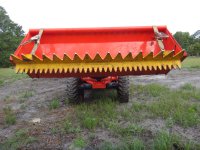
  1. A medium duty Rotary Cutter weighing around 700 pounds requires 45-horsepower net to spin through tall, dry grass cutting a full swathe width of 66". Fifty horsepower if grass is wet with dew or exceptionally long.

    For operating over rough and sloped ground tractor width pretty much determines tractor stability. I recommend a tractor of >60" width.
    Bigger wheels and tires bridge pits better than small wheels and tires. I recommend a Kubota 'Grand L' 66" wide or a Kubota MX, also 66" wide.
    Unusually, Grand Ls come with two-part wheel rims when ordered with R4/industrial tires, so rear R4 wheels/tires can be configured with a very wide stance during dealer assembly to further improve stability. If you can afford a 'Grand L' as your first tractor you are fortunate indeed.

    A rear/angle blade, preferably hydraulically adjustable in use via tractor rear hydraulic ports, will take care of your driveway and filling pits in your field. Implement weight is your friend. Rear blade weighing 700 - 800 pounds (with protrusion to rear providing leverage) will be just sufficient counterbalance for FEL loads with air inflated tires.
    VIDEO: RBT35 blade - YouTube

    Turf tires and R1/ag tires are four (4) ply standard. R4/industrial tires are six (6) ply standard. Tire sidewalls are the vulnerable area. Stone outcroppings call for R4/industrial six ply tires.

    When you want to skid wood or mow a steep field throw on a set of good tire chains.


    VIDEOS (2): Kubota Grand L Series VS. Kubota MX Series - YouTube

    Kubota HST Plus Transmission Features - YouTube


    BUY ENOUGH TRACTOR
 
Last edited:
   / Advice needed on tire configuration for my applications. #4  

Attachments

  • DSC00451.JPG
    DSC00451.JPG
    3.4 MB · Views: 133
   / Advice needed on tire configuration for my applications.
  • Thread Starter
#5  
Information on permeability and composition of soil under your lawn is important.
...
A medium duty Rotary Cutter weighing around 700 pounds requires 45-horsepower net to spin through tall, dry grass cutting a full swathe width of 66". Fifty horsepower if grass is wet with dew or exceptionally long.
...

I can't say how deep the soil is, it varies. Much of the house had to blast out bedrock schist for a basement/foundation. THe driveway definitely has parts that are close to the schist.
I'm not sure how deep the soil in the field goes. and havent' dug any deep holes on the property except in a well developed garden that predates my residence. Certainly the yard has a a couple of feet of soil underneath as I've been 12+ inches down for gardening purposes.

Anyway, this is pretty classic new england stuff, and not in a beachy Nantucket sand fun kind of way :)

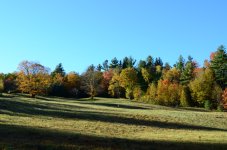
Here's a pic of part of the field to get an idea of the slope, this is after a recent brush-hog.
DSC_9195m1024.JPG

Doesn't look too horrible in the photo, though after any given year's brush hog there's lots of stubs of the things that were cut. Pines that never stop trying to grow, little stalks of cut saplings.
The grade is deceptive, and some of the steeper parts aren't shown. But between the grade and the stubble, you _never_ want to run through this field or you will plant your face on a stick. My wife broke her ankle just walking through it a couple of years ago, but not on stubble, instead that was wet slippery bedrock peaking through in one corner.

This year my field looks awful though. We missed the cut in fall of 2018 (bozos since fired), and the guy who cut it in 2019 had difficulty since all the saplings had an extra year to grow, so now there's all kinds of stubble and a bunch of 4 foot saplings whose cuts weren't complete, so maybe they're only an inch or less in diameter, but it's one stubbly looking field.

What usually grows there is tons of golden rod, lupine, iris, ferns, and all other manner of brush, and a high volume of birch and black cherry shoots.

I'm not sure about the horsepower of the tractor that used to do it. Last year's guy had a 45HP (not PTO) thing and a 5 foot cutter. Most of the rocks and pits are known and mostly avoidable except unless I just can't see them in the tall weeds and forget where they are.

Reading other things they recommend 5+ PTO HP per foot of cutter, so I figured if I manage 30+ HP I'd manage with a 6 foot cutter, but maybe I need to do 5. I'm not sure how this relates to your comments which talk about more power for dry and wet grass, but while there are plenty of grasses, "grass" isn't the first word that comes to mind describing my field.

Re: width, I was hoping I wouldn't need special measures, but how do you feel about wheel spacers/inserts? I was mostly considering that only if I wanted to go deeper into the forest.
 
Last edited:
   / Advice needed on tire configuration for my applications.
  • Thread Starter
#6  
Almost an aside: Consider a Ratchet Rake bucket attachment for infrequent driveway grading.

My long-ish driveway is in all states One end has long neglected pea-size gravel which is disappearing and being overgrown. May top that up.
The middle has only dirt and gets muddy ruts, so I'm thinking of repairing that.

A long segment has been repaired multiple times and exists in a place where there is high water flow both in storms and spring thaw (the hillside next to it just oozes water).
It needs some repair as it's starting to form water pathways that we don't want. The trick there is keeping that whole bed properly graded so that the water stays to either side of the driveway and not _in_ the driveway.

So one of my goals for the tractor is to order a truckload of gravel, and dress this all up, and just to be prepared after that for the routine grading and gravel top-up.
There's also a vital ditch to keep clear on one side which unfortunately is not much of a ditch since it runs right into schist bedrock very quickly, but we're making do.

Anyway, I'm figuring a blade because grading is everything on this driveway, the water flow has to be managed.
 
   / Advice needed on tire configuration for my applications. #7  
I have a 45 hp tractor with a 6 foot cutter. Most of the time it's enough power. When the growth is too much, either overlap the cut or slow the forward speed. 30 hp on a 6 foot cutter is marginal in my book, but the major issue is: will the tractor lift it ? A loader does a fair job of front counter weight.

Second, with a loader, do everything for stability. First IMHO is rear tire width. Even with loaded tires a mere 8 inches (4 inches per side) of increased track made a world of difference to the seat of my pants.
 
   / Advice needed on tire configuration for my applications. #8  
Re: width. I was hoping I wouldn't need special measures, but how do you feel about wheel spacers/inserts? I was mostly considering that only if I wanted to go deeper into the forest.

Spacers are not as strong, nor as adaptable increasing rear wheel spread as a wider axle and two part wheel rims. R1/ag tires come with two part rims on all tractors over 1,700 pounds bare tractor weight. You could special order six ply or eight ply R1/ag tires but as tire strength/plies increase, flexibility decreases and with stiffness traction decreases slightly on relatively narrows R1/ag tires vs R4/industrial tires.

I have not read of it being done, but it is possible you could order two-part R4 wheel rims standard on Grand Ls as OEM equipment on an MX series tractor. Dealer can change tractor two part rim rear tire stance by lifting/jacking rear of tractor and swapping around the bits. (Rear tires are quite heavy, even inflated with air.)

Know distinctions: tractor width, rear tread width, outside-to-outside rear tire width.

R4 tread width can be set as follows on Grand Ls, less my lighter L3560: 52.8", 56.1", 58.7"
These measurements are from center of one rear tire to center of second rear tire, not outside-to-outside measure.

When you want to skid wood or mow a steep field throw on a set of good tire chains.


Buy a 10' stick of 1-1/4" PVC pipe, which will not sag. Cut it width of proposed outside-to-outside rear tire width. Walk around forest and test gate and door widths to see how well tractor passes. Using this test I decided 60" L3560 was better for my application than 66" L4060 etc.

If you are inexperienced operating a tractor you may not realize how unstable a tractor is. BUY ENOUGH TRACTOR.
 
Last edited:
   / Advice needed on tire configuration for my applications. #9  
I would go with unfilled R4's and a 7' rear blade as Jeff mentioned for counterweight for FEL work and since you only cut this infrequently you can get a used brush hog 6' and take a 5' cut. Then keep the bucket low for the first time cutting to "find" that ledge or outcropping of stone.

Those remaining sticks/stumps can be sharp and R4's are tougher and at the same time don't hurt the lawn. I have a ratchet rake too, but rarely use it anymore - mostly because of our new England soil/rocks it skips over the embedded rocks trying to back drag etc.

You didn't mention snow removal, so assume you have other tools for that, but the back blade would help there, and I use chains on the front with R4's and it works well.
 
   / Advice needed on tire configuration for my applications. #10  
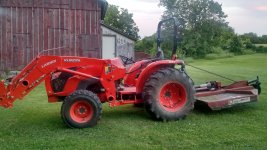
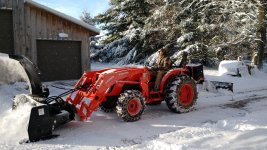
I have a MX4800. I use a 6' Bush hog 2x a year on a 3 acre pasture. I use the grapple in the timber to get logs. A 6' Land pride 3 point finish mower. I use a 8' rear blade and a 6' skid steer blower on the front. And of course the FEL with a 72" bucket for everything else. I have R-4s. They are tough and a good compromise. We have hills, snow and ice.. so I have chains too... My R-4 have fluid in them as well.

IMG_20160607_204547545_HDR.jpgIMG_20180609_113505299_HDR.jpgIMG_20151121_085649865.jpg
 
   / Advice needed on tire configuration for my applications.
  • Thread Starter
#11  
You didn't mention snow removal, so assume you have other tools for that, but the back blade would help there, and I use chains on the front with R4's and it works well.

Yeah, I've definitely looked at the snow potential. It's complicated, I know I will hire a guy for at least the next two years, and to do my driveway myself I have to negotiate a complicated bit with the neighbors with whom I must split the cost of privately plowing a town road because it's a class 4 road and the town won't plow it. It's also a awful thing I I wouldn't want to try to do with a tractor. But the driveway piece I'd like to do someday. It just isn't a "primary" chore for the tractor.

If you have advice there w.r.t. horsepower I'm interested, but I don't even know what I'd use. I like snowblowers, but that's a **** of a lot of moving parts (and expense) on a tractor, and I don't even know if I'd go front or rear. Definitely on the back burner for the most part. Plus, these days I never know what I'll get for snow. Heck, I've barely even had to shovel this year much less anything else. Wind and water damage is playing a much bigger role lately.
 
   / Advice needed on tire configuration for my applications. #12  
As we have replied to your other posts - 35-45 HP, get one with a cab, FEL, and rear blade. If in the future you need to buy a snowblower you can get a front mounted unit - just get a tractor now with a front PTO.

If you need to fit a specific budget #, then downsize to a 32-35 HP Cab version, with same features/implements. All the major brands will fit and meet your needs. There are many out there, but in New England, Kubota is probably #1 brand, then Kioti/John Deere #2 due to dealers and time in the region.
 
   / Advice needed on tire configuration for my applications. #13  
I'm not sure about the horsepower of the tractor that used to do it. Last year's guy had a 45HP (not PTO) thing and a 5 foot cutter. Most of the rocks and pits are known and mostly avoidable except unless I just can't see them in the tall weeds and forget where they are.

Reading other things they recommend 5+ PTO HP per foot of cutter, so I figured if I manage 30+ HP I'd manage with a 6 foot cutter, but maybe I need to do 5. I'm not sure how this relates to your comments which talk about more power for dry and wet grass, but while there are plenty of grasses, "grass" isn't the first word that comes to mind describing my field.

Five horsepower per foot of Rotary Cutter width is a minimum power recommendation for a hay field cut regularly.

A medium duty Rotary Cutter weighing around 700 pounds requires 45-horsepower net to spin through tall, dry grass cutting a full swathe width of 66" or when tough saplings are part of the field mix.

Once a year, maybe more, I need to brush hog a very rough and sloped field. I'm planning on a 6 foot rotary cutter. The saplings aggressively take root each year, otherwise we leave the undergrowth for the animals (scrub blueberries, blackberries, wild strawberries). There are occasional pits pits (1.5-3 feet in diameter, depth proportional to width) and stone outcroppings in the field if you aren't careful. The field is 5 acres.

MOWING TIME CALCULATOR: Mowing Calcuator | How many acres can I mow in an hour
 
Last edited:
   / Advice needed on tire configuration for my applications. #14  
I also suggest the R4 tires for reasons given. I have a 7,000 pound plus farm tractor with R-1 and will use in my yard for fel work or such and for the seldom trip there leaves little damage and it disappears after a week or two but still would go with R-4.

With your comments on the rough cut mower, dropping a tire into a hole that size with the size tractor I think you are considering believe you will end up with tractor not having enough lift to pick mower clear so weight is off of it unless you fill those holes some. An offset mower can allow you to cut to the side as you drive where has already been mowed allowing clear view for holes for the tractor and might help with seeing the out crops as you will not be looking over the tractor's hood to see them rather to the side. However those mowers cost more and you then are driving over just cut stubble, rough on tires. If your tractor has fel on it have seen it suggested you lower the bucket to prevent hitting such as large stumps or out cropping and also would prevent the front end dropping into a hole.
 
   / Advice needed on tire configuration for my applications. #15  
Yeah, I've definitely looked at the snow potential.

If you have advice there w.r.t. horsepower (?) I'm interested, but I don't even know what I'd use. I like snowblowers, but that's a **** of a lot of moving parts (and expense) on a tractor, and I don't even know if I'd go front or rear. Definitely on the back burner for the most part. Plus, these days I never know what I'll get for snow. Heck, I've barely even had to shovel this year much less anything else.

Your FEL bucket, perhaps with Edge Tamers and your rear/angle blade should be sufficient except for blizzards.

VIDEO: YouTube
 
   / Advice needed on tire configuration for my applications.
  • Thread Starter
#16  
Your FEL bucket, perhaps with Edge Tamers and your rear/angle blade should be sufficient except for blizzards.

Edge tamers, that's interesting, I hadn't seen those before.
 

Marketplace Items

Booster Cables (A59230)
Booster Cables...
2009 CHEVROLET C8500 DUMP TRUCK (A59823)
2009 CHEVROLET...
Cushman Hauler 1200X Golf Cart (A57148)
Cushman Hauler...
2025 GIYI SE61 61in Sweeper Skid Steer Attachment (A59228)
2025 GIYI SE61...
2012 TROXELL 130 BBL STEEL (A58214)
2012 TROXELL 130...
2016 John Deere 35G Mini Excavator (A55973)
2016 John Deere...
 
Top