What is this electrical breaker

/ What is this electrical breaker #1  

BeezFun

Elite Member
Joined
Jul 1, 2009
Messages
2,521
Location
IL
Tractor
Kubota B2710
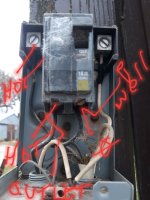
My friend's well stopped working, he traced the problem to the 20A breaker in the attached photo. The 120v line power/neutral comes in to the top left and right screws. There are 2 screws at the bottom of the breaker, one feeding the well pump, the other feeding the sump pump in the well pit. One of those two screws no longer is hot, the other one is hot.
I've never seen a breaker like this, what is it called? I'm kind of surprised that a single 20A breaker can feed a well pump and a sump pump.
image (2).jpg
 
/ What is this electrical breaker #2  
It's only 120V running the well pump?
 
/ What is this electrical breaker #3  
My friend's well stopped working, he traced the problem to the 20A breaker in the attached photo. The 120v line power/neutral comes in to the top left and right screws. There are 2 screws at the bottom of the breaker, one feeding the well pump, the other feeding the sump pump in the well pit. One of those two screws no longer is hot, the other one is hot.
I've never seen a breaker like this, what is it called? I'm kind of surprised that a single 20A breaker can feed a well pump and a sump pump.
View attachment 629616
Appears the White wire upper right is HOT also by the Black Tape?????
 
/ What is this electrical breaker #5  
I don't think that is 120 volts and that definitely looks like someone didn't know what they were doing. I think they are running 120 v on the black and 120 v on the white with no neutral. You see the neutrals tied down with the grounds? Scary, but I have seen worse. Go look at the breaker feeding that and I bet it's a 220v breaker
 
/ What is this electrical breaker
  • Thread Starter
#6  
OK thanks, I didn't see that black tape. You're right, this breaker is being fed by 220v and he lost a leg somewhere. I noticed the neutral wires bonded to the box too, this is a farm, so anything is possible. I'm going to head out there and help him. I was trying to diagnose this on the phone with a photo.
 
/ What is this electrical breaker #7  
Thats normaly a fused disconnect. The fact that its powered by 240v is fine and that is a 240v breaker. It should not have two 120v circuits coming out of it.

In its place you can put a small sub pannel and run the circuits off that but i would only do this if the circuits cant be ran to the main breaker.
 
/ What is this electrical breaker #8  
Thats normaly a fused disconnect. The fact that its powered by 240v is fine and that is a 240v breaker. It should not have two 120v circuits coming out of it.

In its place you can put a small sub pannel and run the circuits off that but i would only do this if the circuits cant be ran to the main breaker.


really? how do you think a MWBC is configured?, other then the neutral and ground being bonded, I'm not seeing a huge issue here.

Op thats a standard common trip breaker 240v.
 
/ What is this electrical breaker #9  
Square D, 2 pole, 20 amp, 10,000 amp interrupting rating, probably Square D Type QO, if it plugs into stabs that are part of the back plate of the enclosure that the supply wires terminate on; or type QOB if it's bolt on (doesn't look bolt on), or maybe QOH if unit mounted.

The question is: Is the white wire (taped black) that lands on the lug at top right hot? As other suspect, seems it is suppose to be (i.e. 240V brought to enclosure). If it isn't, your problem is upstream of this breaker.
 
/ What is this electrical breaker #10  
OK thanks, I didn't see that black tape. You're right, this breaker is being fed by 220v and he lost a leg somewhere. I noticed the neutral wires bonded to the box too, this is a farm, so anything is possible. I'm going to head out there and help him. I was trying to diagnose this on the phone with a photo.

That's an understatement. I once worked on a grain bin fan, 120 volt that had one hot wire to it and a bare copper wire stuck in the dirt, it worked.
The farmer liked to have had a heart attacked when he got the bill from when I replaced the single THHN 14 gauge wire laying freely with 50' of new 10 gauge wire in conduit to it to make it all work and replaced the burnt penny under the burnt 5 amp fuse with a new 20 amp fuse. "well why did you replace all that wire, it worked before."
 
/ What is this electrical breaker
  • Thread Starter
#11  
There was only a single 120v line running into the well pit, so I called the well installer who installed the pump. He installed a 120v pump. So my guess is at some point in history there was a 220v pump running off this 220v breaker, and for whatever reason the pump got changed over to 120v and they used one leg of the 220v breaker to power the well pump and the other leg to power the sump pump (which is 120v). At some point I'll help him clean all this up, but for now at least we know how to fix the problem.
thanks
 
/ What is this electrical breaker #12  
Thats normaly a fused disconnect. The fact that its powered by 240v is fine and that is a 240v breaker. It should not have two 120v circuits coming out of it.

In its place you can put a small sub pannel and run the circuits off that but i would only do this if the circuits cant be ran to the main breaker.

Multiwire Branch Circuit. Allowed by code, BUT be really really careful how the neutral is treated so you don't overload the neutral wire. This requires the breakers for the 120v to be tied together. The 2 hots HAVE TO BE out of phase or the neutral will carry twice the current the circuit is fused for without tripping the breaker.
 
/ What is this electrical breaker #13  
That's an understatement. I once worked on a grain bin fan, 120 volt that had one hot wire to it and a bare copper wire stuck in the dirt, it worked.
QUOTE]

Genius! ...fan automatically stops running when it's too dry for ground to conduct current. Automatically turns after a rain & humid conditions. I know nothing about grain bin fans, but isn't that what you want it to do? :D
 
Last edited:
/ What is this electrical breaker #14  
There was only a single 120v line running into the well pit, so I called the well installer who installed the pump. He installed a 120v pump. So my guess is at some point in history there was a 220v pump running off this 220v breaker, and for whatever reason the pump got changed over to 120v and they used one leg of the 220v breaker to power the well pump and the other leg to power the sump pump (which is 120v). At some point I'll help him clean all this up, but for now at least we know how to fix the problem.
thanks


other then the bonding, your not really making anything safer, you apparently have a break upstream of this breaker if you lost one leg.
 
/ What is this electrical breaker #15  
Multiwire Branch Circuit. Allowed by code, BUT be really really careful how the neutral is treated so you don't overload the neutral wire. This requires the breakers for the 120v to be tied together. The 2 hots HAVE TO BE out of phase or the neutral will carry twice the current the circuit is fused for without tripping the breaker.

Yep, if its a 240V MWBC, the "neutral", in this case "ground", will only carry the unbalanced current. (i.e if well takes 12 amps and sump uses 6 amps, the ground only carries 6 amps.)

When only (say) 12 amp well pump is running, the ground is carrying 12 amps. Lets say this black & white wires are #12 Awg w/ #14 ground, 200' long back to main panel. 200 feet of 14Awg (at 3.14 ohms/1000 ft) = .628 Ohms. 12 amps across .628 ohms is 7.5 volts.
...which will be the voltage of the enclosure if you touch it when just the well is running because you have current running on the ground wire instead of a proper neutral conductor.

Now if the ground wire somehow gets cut, disconnected or lifted on the way back to main panel, the enclosure will be at 120 volts waiting for someone to come along and touch it when they're trying to figure out why the pump isn't running.
 
/ What is this electrical breaker
  • Thread Starter
#16  
Forgot to mention the well pit is right next to this breaker, and this breaker is fed from a disconnect that's about 2 feet away, and the disconnect is fed from a panel that's right next to it. The whole thing could be reduced to a breaker in the panel and 6 feet of wire, so I have no idea how this all evolved. I'll figure out the best way to fix this some day when it stops raining, but for today at least he can take a shower.
 
/ What is this electrical breaker #17  
The 2 hots HAVE TO BE out of phase or the neutral will carry twice the current the circuit is fused for without tripping the breaker.

?? How would you have in, or out of phase choices to worry about on a single phase 240v system?

I am ready to learn something new today.
 
/ What is this electrical breaker #18  
?? How would you have in, or out of phase choices to worry about on a single phase 240v system?

I am ready to learn something new today.

Short answer: You wouldn't if all you had was 240V, but this is a 120/240V split phase system.

Long answer:
Consider a single phase transformer that produces 240V across the wires that come off the end of secondary winding. Call those wires L1 & L2.
Consider if you then tap that winding at it's half-way mark (center tap). You will then have 120V from the center tap across 1/2 the winding to each of the end wires. (Note typically the center tap is referenced to (earth) ground, and we establish this as neutral 0V.)
So voltages are
L1-L2: 240V (with respect to each other)
L1-N (or ground): 120V
L2-N: 120V
From above we know we have 120V (to center tap) +120V (from center tap) = 240V across total winding.
But L1 and L2 are from opposite ends of the winding, so the (2) 120VAC waveforms are 180 degrees out of phase with each other.

There's better ways to explain or illustrate this...but consider if they were in phase with each other then L1-L2 would be zero volts (as they cancel each other) volts instead of adding to each other to be 240V.

...so in a 120V/240V panel board where the breakers are one side are alternately connected to L1 & L2 (Example: Left side breakers (poles) are odd numbered 1,3,5,7,9,11 etc....; then poles (breakers) 1, 5, 9,13, etc..are L1. Poles 3, 7, 11, 15, etc..are L2.
You can only get 240V from a double pole breaker that spans across two poles where one is L1 and the other is L2.

Now to answer your question: If someone tried to bring 240V to a external location but wired from two poles in the panel that were both "L1", both wires would be in phase with each other and there would be zero volts between the two wires instead of 240V. (although each wire would still be 120V compared to ground (and the center tap).
 
/ What is this electrical breaker #19  
Now to answer your question: If someone tried to bring 240V to a external location but wired from two poles in the panel that were both "L1", both wires would be in phase with each other and there would be zero volts between the two wires instead of 240V. (although each wire would still be 120V compared to ground (and the center tap).

Sorry but I guess I posted somewhat of a trick question. If both wires brought out came from L1, you have just wired a 120v circuit not a 240v one. That逞エ the crux of my post on not worrying about picking 2 out of phase hots for a single phase 240v run.

In other words, you can稚 get your 240v any other way.....
 
/ What is this electrical breaker #20  
Sorry but I guess I posted somewhat of a trick question. If both wires brought out came from L1, you have just wired a 120v circuit not a 240v one. That逞エ the crux of my post on not worrying about picking 2 out of phase hots for a single phase 240v run.

In other words, you can稚 get your 240v any other way.....

Yes........but....
This is a rigged/modified "farm installation". We don't know that enclosure was supplied with 240V from a 2 pole breaker in the main panel versus 2 single pole breakers on the same (split) phase, especially given that the circuit was modified to power (2) 120V loads.
 
 
Top